


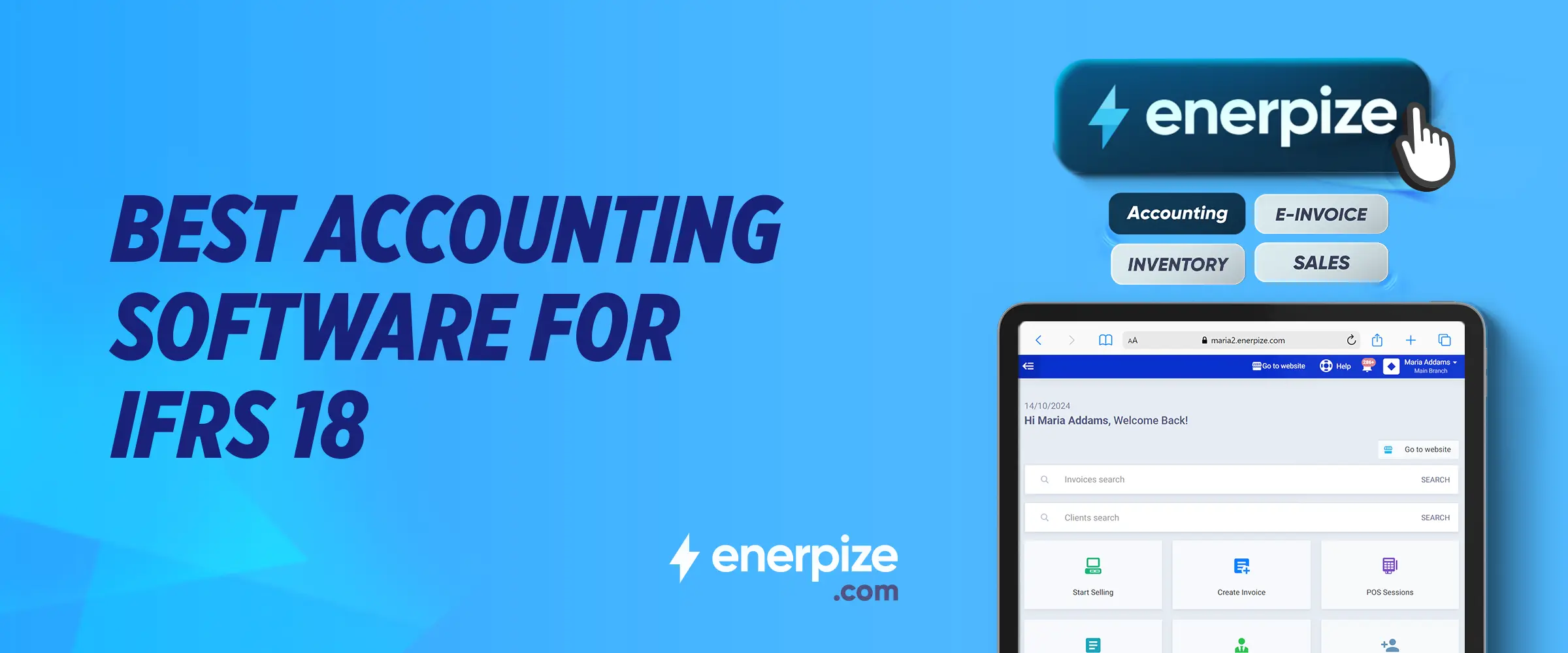
Best Accounting Software for IFRS 18: Stay Compliant Before the 2027 Deadline


Key Takeaways
- IFRS 18 replaces IAS 1 and is mandatory from January 1, 2027— with 2026 comparative data already affected.
- It introduces five income/expense categories and two new mandatory subtotals in the profit & loss statement.
- Companies must formally disclose MPMs (Management-Defined Performance Measures) like adjusted EBITDA inside audited financial statements.
- The impact goes beyond finance— affecting IT systems, chart of accounts, processes, governance, and external communications.
- Enerpize helps SMEs structure their accounting data today so the 2027 transition doesn't become a crisis.
There's a scene every finance director quietly dreads: the one where the auditor slides a document across the table and says, "Your income statement doesn't meet the new standard."
For companies reporting under IFRS, that scene is closer than most realize. IFRS 18 — the most significant change to financial reporting standards in over two decades — replaces IAS 1 and mandates a complete restructuring of how businesses present their financial performance. The deadline is January 1, 2027. But here's the catch: your 2026 comparative data needs to comply too.
That means the clock isn't ticking toward 2027. It already ran out.
In this guide, we break down exactly what IFRS 18 requires, why it matters for SMEs, and how the best accounting software for IFRS 18 — like Enerpize — helps you restructure your accounts now rather than scramble later.
1. What Is IFRS 18?
IFRS 18, officially titled "Presentation and Disclosure in Financial Statements," is a new accounting standard issued by the International Accounting Standards Board (IASB) in April 2024. It replaces IAS 1 — the standard that has governed financial statement presentation for nearly thirty years — and fundamentally redesigns how companies communicate financial performance to investors, regulators, and stakeholders.
At its core, IFRS 18 does three things: it standardizes income statement structure, formalizes the disclosure of management-defined performance measures (MPMs), and tightens the rules around how financial information is grouped and presented.
It also triggers consequential amendments to IAS 7 (Cash Flow Statements), IAS 8, IAS 33 (Earnings Per Share), and IAS 34 (Interim Financial Reporting) — meaning the change ripples across your entire reporting ecosystem, not just the income statement.
2. Why IFRS 18 Is the Biggest Accounting Shake-Up in 20 Years
IAS 1 was broad and flexible — intentionally so. Companies chose their own subtotals, defined "operating profit" however they liked, and reported alternative performance measures (APMs) like adjusted EBITDA outside the audited financial statements, where they were essentially unpoliced.
The result? A landscape where over 60 companies out of a sample of 100, studied by the IASB, each calculated operating profit using at least nine different methods. Comparing two companies in the same industry was like comparing two recipes for the same dish written in different languages.
IFRS 18 closes that gap. It imposes a standardized income statement structure, makes two new subtotals mandatory, and — critically — requires that company-specific performance metrics be disclosed inside audited financial statements and reconciled to IFRS-defined measures.
For investors, this is a long-overdue upgrade. For businesses, it's the most significant structural change to financial reporting since IFRS standards were first introduced. According to Deloitte and EY the impact extends well beyond the finance team — touching strategic communications, data infrastructure, IT systems, and internal governance.
3. IFRS 18 vs IAS 1: What Actually Changes?
Here is a side-by-side breakdown of the most significant changes:
| Aspect | IAS 1 (Old) | IFRS 18 (New) |
The New Income Statement Structure
Under IAS 1, your income statement structure was largely up to you. Under IFRS 18, every entity must present two new mandatory subtotals above the bottom-line profit or loss figure:
- Operating profit — the total of all income and expenses in the operating category
- Profit before financing and income taxes — a new intermediate subtotal that separates operating and investing results from financing costs and tax
- These aren't optional enhancements. They are required line items, and every company reporting under IFRS must present them consistently, regardless of industry.
The Five Categories of Income and Expenses
IFRS 18 divides all income and expense items into five defined categories. Every transaction your business records must be classified into one of these:
| # | Category | What It Covers |
| 1 | Operating | Core business income and expenses — revenue, COGS, operating costs |
| 2 | Investing | Returns from assets that generate income largely independently |
| 3 | Financing | Income/expenses from financing liabilities (borrowings, bonds) |
| 4 | Income taxes | Tax-related income and expenses |
| 5 | Discontinued operations | Results from operations being wound down or sold |
Management-Defined Performance Measures (MPMs)
This is the most consequential change for many businesses. MPMs are subtotals of income and expenses that management uses in public communications — outside the financial statements — to describe the company's financial performance. Think: adjusted EBITDA, underlying profit, operating profit before exceptional items.
Under IAS 1, these lived in investor presentations and press releases, outside the reach of auditors. Under IFRS 18, if you use them externally, you must disclose them inside your audited financial statements — with a full reconciliation back to the nearest IFRS-defined measure.
If your business regularly communicates an 'adjusted profit' or 'underlying EBITDA' figure to investors or in your annual report narrative, IFRS 18 will require that figure to appear in your audited accounts — reconciled, labelled, and subject to audit.
Enhanced Grouping and Disclosure Requirements
IFRS 18 also introduces enhanced guidance on how to aggregate and disaggregate financial information across the primary statements and the notes. The days of burying line items in aggregated totals are limited — the standard is designed to give investors more granular, traceable information about operating expenses and performance drivers.
4. IFRS 18 Effective Date and Transition Timeline
IFRS 18 is mandatory for annual reporting periods beginning on or after January 1, 2027. Early adoption is permitted and encouraged.
Why 2026 Already Matters
Here is the detail most businesses are underestimating: IFRS 18 requires retrospective application. That means when you file your 2027 financial statements, you must also restate your 2026 comparative figures under the new standard. In plain language: the way you categorize income and expenses throughout 2026 must already align with IFRS 18's five categories — even though the standard doesn't technically take effect until 2027.
Timeline at a Glance Now–End 2025: Impact assessment, CoA restructure planning, system review2026: Apply IFRS 18 categories to live transactions (comparative period) January 1, 2027: IFRS 18 mandatory. First-year financial statements filed under the new standard.
According to Grant Thornton and BDO, entities that delay preparation until 2027 will face a painful, expensive retrospective restatement exercise. The time to act is now — not next year.
5. How IFRS 18 Affects Your Business Beyond the Finance Team
Deloitte's impact framework identifies five organizational dimensions that IFRS 18 touches. If you're planning your compliance response, each one needs its own workstream:
Strategic Communications
How do you talk to investors, lenders, and stakeholders about your performance? If your external communications reference any non-IFRS measure — any adjusted figure, any alternative metric — IFRS 18 now governs how you present and reconcile that number. This is a strategic communications challenge, not just an accounting one.
People and Roles
IFRS 18 compliance requires cross-functional involvement. Finance, IT, legal, investor relations, and operations teams all have a role in identifying affected processes, training staff, and implementing changes. This isn't a task for the accounting team alone.
Processes and Governance
Your internal controls, policies, and governance frameworks will need to reflect the new classification rules. Any performance management process tied to operating profit — bonuses, KPIs, management reporting — may need to be reviewed and potentially renegotiated.
Data and Chart of Accounts
This is where the rubber meets the road. IFRS 18 requires your chart of accounts to support the classification of every transaction into one of the five categories. If your current CoA doesn't distinguish between operating, investing, and financing income and expenses at a granular enough level, you will need to restructure it before 2026 comparative data starts accumulating.
Systems and IT Architecture
Can your current accounting system tag and categorize income and expenses into the IFRS 18 categories? Can it generate the new required subtotals? Can it produce the MPM disclosures and reconciliations the standard demands? These are questions your software needs to answer — not your finance team manually in a spreadsheet.
6. How to Prepare for IFRS 18: A Practical Checklist
Based on guidance from Deloitte, Grant Thornton, EY, and BDO, here is a practical preparation roadmap for SMEs:
- Run an impact assessment. Identify how IFRS 18 changes your income statement presentation — particularly whether you currently report an operating profit subtotal, and how it would be defined under the new standard.
- Audit your MPMs. List every non-IFRS performance measure you use in public communications (board reports, investor decks, press releases). Each one will need to be evaluated against the MPM definition in IFRS 18.
- Restructure your Chart of Accounts. Map each account code to one of IFRS 18's five categories. This is the most operationally intensive step — and the one where your accounting software either helps or hinders.
- Review your IT systems. Assess whether your accounting platform can support IFRS 18 categorization, subtotal generation, and audit trail requirements. If not, now is the time to switch.
- Train your finance team. IFRS 18 introduces new terminology and classification logic. The finance team needs to understand the five categories and the MPM disclosure requirements before 2026 comparative data starts being captured.
- Engage your auditors early. IFRS 18 MPM disclosures are subject to audit. Bring your auditors into the conversation now — not when the first IFRS 18 financial statements are due.
- Apply IFRS 18 categories from January 1, 2026. Even though the standard is technically effective January 1, 2027, your 2026 transactions need to be captured in IFRS 18 format for the comparative period restatement.
7. How Enerpize Supports IFRS 18 Compliance
Following the introduction of IFRS 18 — and the increased demand for structured, auditable financial reporting — businesses are turning to cloud-based accounting platforms that organize accounts and present data in alignment with IASB requirements.
Enerpize is designed with the structural building blocks that IFRS 18 preparation depends on. As a cloud ERP serving businesses across its ecosystem, Enerpize's accounting module gives SMEs the foundation to begin organizing their financial data in a way that supports the transition — without rebuilding their infrastructure from scratch.
| Enerpize Feature | IFRS 18 Role |
| Chart of Accounts (CoA) | Provides the account structure needed to begin mapping income and expenses toward IFRS 18's five categories |
| Journal Entries | Records transactions with the classification detail that auditable MPM disclosures will require |
| Cost Centers | Enables expense tagging by department or function — relevant to operating profit subtotal tracking |
| Accounting Reports | Generates P&L, balance sheet, and cash flow reports in structured formats |
| Branches | Supports multi-entity or multi-branch reporting under a consolidated structure |
The Enerpize accounting module gives businesses a structured Chart of Accounts they can begin aligning to IFRS 18's five income/expense categories. The cost centers feature supports the granular expense tagging that operating profit subtotals require. And the accounting reports module produces the structured financial statements that form the basis of IASB-compliant disclosure.
IFRS 18 compliance starts with clean, structured data. Enerpize gives you the architecture to start capturing that data correctly — before 2026 comparative reporting begins.
Ready to prepare your accounts for IFRS 18? Start your free trial of Enerpize today and restructure your Chart of Accounts with guidance from our accounting module.
8. FAQs: IFRS 18 Questions Answered
What is IFRS 18 and what does it replace?
IFRS 18, titled "Presentation and Disclosure in Financial Statements," is a new standard issued by the IASB in April 2024. It replaces IAS 1 and fundamentally redesigns how companies structure and present their financial statements — with a particular focus on the income statement, mandatory subtotals, and the disclosure of management-defined performance measures.
When does IFRS 18 come into effect?
IFRS 18 is mandatory for annual reporting periods beginning on or after January 1, 2027. However, because the standard requires retrospective application, 2026 comparative data must also comply. Early adoption is permitted and encouraged by the IASB.
What is the difference between IFRS 18 and IAS 1?
IAS 1 gave companies significant flexibility in how they structured their income statement. IFRS 18 removes much of that flexibility by mandating five income/expense categories, two new required subtotals (operating profit and profit before financing and income taxes), and formal disclosure of any management-defined performance measures inside audited financial statements.
What are Management-Defined Performance Measures (MPMs) under IFRS 18?
MPMs are subtotals of income and expenses that management uses in external public communications — press releases, investor presentations, annual reports — to describe the company's financial performance. Common examples include adjusted EBITDA, underlying profit, or operating profit before exceptional items. Under IFRS 18, these must be disclosed inside the audited financial statements with a reconciliation to the nearest IFRS-defined measure.
Does IFRS 18 apply to small and medium businesses?
IFRS 18 applies to all entities that prepare financial statements using IFRS Accounting Standards. If your SME reports under IFRS — as many businesses in IFRS-adopting markets do — then yes, IFRS 18 applies to you. The standard was designed with all entity sizes in mind, though implementation complexity varies.
What changes do I need to make to my Chart of Accounts for IFRS 18?
Your Chart of Accounts needs to be restructured so that every income and expense account maps to one of IFRS 18's five categories: operating, investing, financing, income taxes, and discontinued operations. This is a foundational step — without it, your accounting system cannot generate the required subtotals or support the MPM reconciliation disclosures the standard demands.
Which accounting software supports IFRS 18 compliance?
The best accounting software for IFRS 18 compliance is one that allows you to structure your Chart of Accounts around the standard's five categories, supports granular cost-center tagging for operating profit subtotals, generates structured financial statements aligned to IASB presentation requirements, and maintains an auditable trail of journal entries. Enerpize's cloud accounting module is designed to support exactly this — giving SMEs the infrastructure to comply with IFRS 18 from 2026 onward.
Summary
Remember that finance director dreading the auditor's slide across the table? The good news is that scene is entirely avoidable — but only if the preparation starts now. IFRS 18 isn't a distant regulatory event. It's a structural change that begins with how you categorize a journal entry in January 2026. The businesses that treat it that way — restructuring their Chart of Accounts, reviewing their MPMs, and choosing accounting software that speaks IFRS 18 natively — will file their 2027 financial statements with confidence. The ones that don't will spend 2027 reconstructing a year's worth of transactions from scratch.
Enerpize is built to be in the first group. Start your IFRS 18 preparation today.
About the Author
Omar El Bahr is a Senior Digital Growth Specialist at Enerpize, where he leads SEO, content strategy, and organic growth across international markets. He is a Forbes Communications Council contributor and has written for Entrepreneur on business communication and digital strategy.

Related Articles
 Accounting
Comparative Income Statement: Importance & Preparation
Read more Accounting
What Does POS Debit Mean? All You Need To Know
Read more Accounting
Main Differences Between Cash Flow Statement and Income Statement
Read more Accounting
Transposition Error: Definition, Example, And How To Correct
Read more Accounting
Amortization of Intangible Assets: Methods and How To Calculate
Read more Accounting