

Author : Omar El Bahr
Reviewed By : Enerpize Team
The Best ERP for Small Business in Australia (2026)
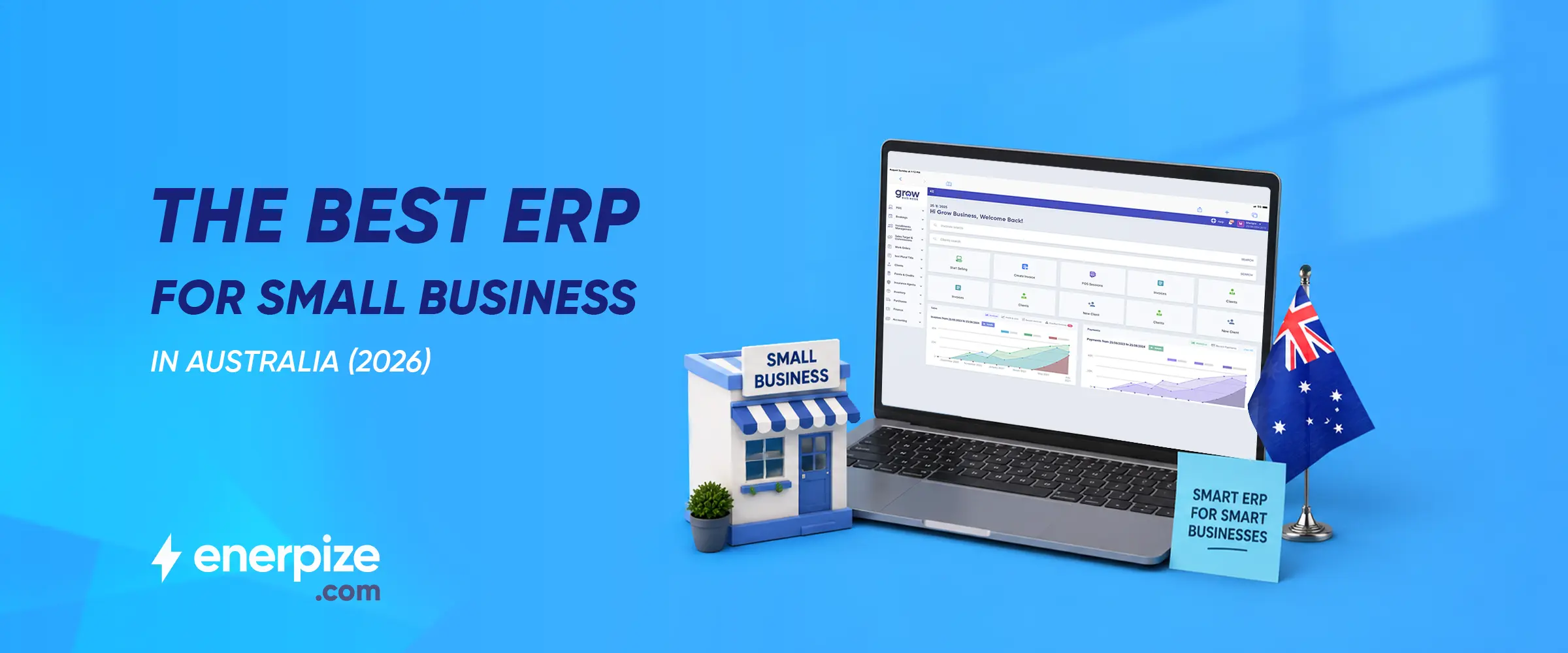
Table of contents:
- Key Takeaways
- What Is ERP Software — and Why Does It Matter for Australian Small Businesses?
- The Australian Small Business Landscape — and Why the Right ERP Matters More Here
- What to Look for in ERP Software in Australia
- Understanding Australia's Key Tax and Compliance Obligations
- Why Enerpize Is the Best ERP for Small Business in Australia
- Which Australian Industries Does Enerpize Serve?
- How Much Does ERP Software Cost in Australia?
- How to Get Started with Enerpize in Australia
- FAQs
- Summary
Key Takeaways
- Australia has 2.7 million actively trading businesses — 98% of them are small businesses generating $500B in GDP. Most are running on tools that were never designed to scale with them.
- The Australian ERP software market is worth $930M and growing to $1.19B by 2030. The shift from spreadsheets to integrated ERP is no longer a trend — it's the baseline.
- Australian compliance isn't optional. GST, BAS, Single Touch Payroll, and superannuation obligations carry penalties from $4,500 per violation. Your ERP system must handle all of it natively — not as a bolt-on.
- ERP software and accounting software are not the same thing. Accounting manages your money. ERP connects your entire business — sales, inventory, payroll, purchasing, CRM, and operations — in one live platform.
- The best ERP for small business in Australia needs to be cloud-based, GST-compliant, industry-customised, and affordable from day one — not after a six-month implementation project.
- Enerpize is up and running in less than a day, with no implementation fees, no consultants required, and plans starting from $9.99/month — trusted by hundreds of Australian businesses and 40,000+ globally.
Somewhere between your fourth spreadsheet tab and the third time you’ve manually re-entered the same supplier invoice this week, a thought crosses your mind.
There has to be a better way.
There is. It’s called ERP software — and if you’re running a small business in Australia, it might be the most impactful software decision you make this year.
The problem is that most ERP software in Australia was built for large enterprises. Expensive to implement. Complex to run. Designed for teams of 500, not five. Australian small and medium businesses are left squeezing into systems that are either too big, too rigid, or too far out of their budget.
Enerpize is the exception.
It’s cloud-based ERP software purpose-built for small businesses — with GST-ready accounting, end-to-end inventory, payroll, sales, CRM, and operations all under one roof. Hundreds of Australian businesses run on it today, backed by a platform trusted by more than 40,000 businesses globally.
This guide will show you exactly what ERP software does, what separates a great system from a mediocre one, and why Enerpize is the best ERP for small business in Australia in 2026.
Ready to stop duct-taping your business together? Enerpize connects your accounting, inventory, payroll, and sales in one place — and you're up and running in less than a day. Start for free.
What Is ERP Software — and Why Does It Matter for Australian Small Businesses?
ERP stands for Enterprise Resource Planning. But strip away the corporate jargon and it means one thing: a single platform where every part of your business lives, talks to each other, and updates in real time.
Instead of running five separate tools that don’t integrate — accounting software here, inventory tracker there, a payroll app somewhere else — an ERP system connects everything. A sale made in your POS updates your inventory automatically. A purchase order flows directly into your accounts payable. Your payroll runs from the same system that manages employee leave requests.
That’s not a luxury. According to the Australian Bureau of Statistics, there are 2,729,648 actively trading businesses in Australia — and the overwhelming majority are small operators who can’t afford to get their systems wrong. For an Australian small business owner managing GST, BAS lodgements, Fair Work compliance, and real-time stock levels all at once, a connected ERP system isn’t a nice-to-have. It’s a survival tool.
ERP vs. Accounting Software: Not the Same Thing
Accounting software manages your money. ERP software manages your entire business. If you want the full breakdown, read our guide on ERP vs. Accounting software— but the short version is this: accounting software is one chapter. ERP is the whole book.
Most Australian small businesses start with accounting software and outgrow it faster than they expect. The moment you’re tracking stock in one place, invoicing in another, and managing staff in a third, you’re already paying the hidden cost of disconnected systems — in time, in errors, and in decisions made on data that’s a day behind.
The Australian Small Business Landscape — and Why the Right ERP Matters More Here
Australia’s small business sector is larger than most people realise. According to the Australian Small Business and Family Enterprise Ombudsman, almost 98% of all businesses in Australia are small businesses — around 2.5 million of them — generating $500 billion in economic activity and accounting for one-third of the nation’s GDP.
That’s an enormous weight carried by businesses that are, in most cases, resource-constrained, time-poor, and running on tools that were never designed to scale with them.
This is precisely why Enerpize was built the way it was. Not for the enterprise tier. Not for the mid-market with dedicated IT departments. For the business owner who needs a fully operational ERP system up and running in less than a day — no implementation project, no consultant fees, no six-month onboarding timeline. Sign up, select your industry from 50+ pre-configured templates, and you’re live. Plans start at $9.99 per month. The contrast with legacy ERP giants, which routinely charge tens of thousands of dollars before a single employee logs in, could not be sharper.
Built for Australian SMBs. Not enterprise giants.
98% of Australian businesses are small businesses. Enerpize is the ERP that was actually designed for them — GST-ready, affordable from $9.99/mo, and live today. Try Enerpize free.
What to Look for in ERP Software in Australia
Not all ERP software is created equal — and what works for a multinational won’t necessarily work for an Australian SMB with ten employees and a warehouse in Dandenong. Here’s what actually matters when evaluating cloud ERP software in Australia.
GST Compliance and BAS-Ready Reporting
This is non-negotiable. Australian compliance requirements are legally mandatory and operationally complex. As compliance specialists have noted, Australian businesses face obligations that many global ERP platforms simply don’t handle well: GST calculations, Business Activity Statement preparation, Single Touch Payroll reporting to the ATO, superannuation compliance, and multi-state payroll tax variations. Getting any of these wrong carries penalties starting at $4,500 per violation. Your ERP system must handle all of it natively — not as a bolt-on, and not through a third-party integration that creates another point of failure.
Generic international platforms often treat Australian tax requirements as an afterthought. You need them built in from the ground up.
Cloud-Based Accessibility
The best ERP software in Australia runs entirely in the cloud. That means your team can access it from any device, in any location — whether you’re on the floor of your warehouse, working from home, or visiting a client site. No server maintenance, no IT overhead, no version updates to manage.
Affordability Without Feature Compromise
Enterprise ERP systems can cost tens of thousands of dollars per year before implementation fees. Australian small businesses need a system that starts affordable and scales with them — not one that prices them out the moment they grow. Look for transparent, predictable monthly pricing with no hidden per-module costs.
Industry Customisation
A café doesn’t run like a construction company. A retail store doesn’t operate like a professional services firm. The best ERP software for small businesses in Australia is pre-configured for your industry, so you’re not building the system from scratch or paying for modules you’ll never use.
Local Support
When something goes wrong at 9am on a Tuesday before a BAS deadline, you need support that picks up the phone — not a ticketing system in a different time zone. Enerpize has a local Australian support team that understands the Australian business context: GST rules, STP obligations, Fair Work nuances. That kind of proximity isn't a soft benefit. It's the difference between a resolved issue and a missed lodgement deadline. Call Enerpize Australia at +61 7 5606 8183.
Understanding Australia's Key Tax and Compliance Obligations
For Australian small businesses, compliance isn't a background task — it's a legal obligation that runs through every payroll cycle, every sale, and every quarter. Here's what you're required to manage, and why your ERP system needs to handle all of it natively.
GST and the Business Activity Statement (BAS)
Every Australian business with annual turnover of $75,000 or more must register for GST and lodge a Business Activity Statement with the ATO — quarterly for most SMBs, monthly for businesses turning over $20M or more. Your BAS consolidates GST collected on sales (10% on taxable transactions), input tax credits on purchases, and PAYG withholding from employee wages into a single lodgement. Late or incorrect lodgements carry penalties of up to $1,565. The maths itself isn't complex — GST collected minus GST paid equals your net position — but doing it manually across hundreds of transactions every quarter is where errors creep in.
Single Touch Payroll (STP) Phase 2
STP Phase 1 was officially decommissioned on 27 February 2025. Only Phase 2 is now accepted by the ATO. Every time you run payroll, your software must transmit a structured data payload directly to the ATO — wages, PAYG withholding, and superannuation data broken down by income type per employee. Ordinary time earnings, overtime, bonuses, allowances, and paid leave must all be reported separately. Any payroll software that cannot generate a compliant STP Phase 2 submission cannot legally be used by Australian employers.
Superannuation Guarantee
From 1 July 2025, the Superannuation Guarantee rate is 12% — the final legislated rate. Employers must contribute 12% of each eligible employee's Ordinary Time Earnings into a compliant superannuation fund, capped at $7,500 per employee per quarter (based on the $62,500 Maximum Contribution Base). From 1 July 2026, Payday Super legislation requires super to be paid within 7 days of each wage payment — not quarterly. Building on a platform that is already architected for this change matters.
Enerpize is built to support all of Australia's compliance requirements — GST, BAS, STP Phase 2, and superannuation — within a single system, so nothing falls through the gaps between disconnected tools.
Why Enerpize Is the Best ERP for Small Business in Australia
Enerpize is built to support Australia's compliance requirements — GST, BAS preparation, STP Phase 2 payroll reporting, and superannuation — within the same platform you use to run sales, manage inventory, and pay your team. There are no third-party integrations required to stay compliant. No separate tax tool. No manual exports. Everything the ATO expects from your business flows through one system.
Here’s what’s inside.
Full-Scale Accounting — GST-Ready and Built for Australia
Enerpize’s accounting module handles everything from chart of accounts and general ledger to income statements, cash flow reports, and profit and loss. GST rules are built directly into the platform, so your tax codes apply automatically, your reporting stays clean, and your tax liabilities are always visible in real time.
Auto-generated journals, cost centre tracking, asset management with multiple depreciation methods, expense mirroring — all of it runs without needing a dedicated finance team to operate it.
No need to be an accountant. No need to hire one.
Sales, Invoicing, and POS — All Connected
From the moment a customer walks in or places an order, Enerpize tracks it. Create invoices and estimates instantly with custom GST rules applied. Manage your point-of-sale via mobile or desktop with barcode scanner support. Set up instalment plans, track payment dues, and get notified automatically when collections are due.
Sales targets, team performance, and commissions are all managed from the same dashboard. Your sales data feeds directly into your accounting. One entry, complete picture.
Inventory Management That Actually Works
For product-based businesses, inventory is where the margins live or die. Enerpize tracks stock levels in real time, manages multiple warehouses, handles purchase orders and supplier accounts, and flags low stock before it becomes a problem.
Barcode scanning, stocktaking tools, requisition management, price lists by customer or product category — it’s the kind of inventory control that used to require a dedicated system running alongside your accounting software. With Enerpize, it’s all one.
Payroll and HR — Fair Work Ready
Australian payroll compliance is complex. Award rates, superannuation, leave entitlements, multi-shift rostering — getting it wrong costs more than just money. Enerpize’s payroll and HR management automates payslip processing, manages contracts with smart salary components, tracks attendance on-site or remotely, and handles leave and holiday requests with custom approval workflows.
Your organisation structure, policies, and HR core functions all live in the same system as your accounts. When someone takes leave, it flows through to payroll automatically. When you hire someone new, their contract is generated from the same platform.
CRM — So Your Best Clients Stay That Way
Customer relationships are harder to manage than most small business owners admit. Enerpize’s CRM module tracks every client by purchase history and activity, flags upcoming renewals and expiring subscriptions, and manages memberships, loyalty points, and appointments.
You’ll know which customers are worth nurturing, which contracts are at risk, and which segments are most valuable — without building a separate CRM tool that doesn’t talk to your sales data.
Operations: Work Orders, Manufacturing, Bookings, and More
Beyond the core modules, Enerpize handles the operational layer most ERP software ignores. Create and invoice work orders. Manage manufacturing orders and integrate them with your inventory. Set up online booking systems with shift and availability management. Run rental or unit-based businesses. Track project hours and expenses against billable work.
These aren’t add-ons. They’re built in.
AI-Powered Automation — Built for the Modern SMB
Enerpize’s AI features are live and available today. Upload a supplier invoice and the AI extracts line items, quantities, and prices automatically, then matches them against your product catalogue and supplier database. Upload a batch of up to 100 expense receipts and the AI fills in the fields, categorises the expenses, and auto-generates the journal entries.
Less manual data entry. More time running your business.
See everything Enerpize can do for your business. Sales, accounting, inventory, payroll, CRM, AI automation — all in one platform, all included. Try Enerpize free.
Which Australian Industries Does Enerpize Serve?
Australia's economy is powered by a diverse mix of industries — and the compliance obligations, operational workflows, and reporting requirements vary significantly between them. Enerpize is industry-customised for more than 50 verticals, pre-configured to match how each type of business actually operates from day one.
The top industries driving Australian small business activity — and the specific ways Enerpize serves each one:
- Retail — multi-location POS, real-time inventory tracking, barcode scanning, loyalty programmes, and GST-inclusive pricing across product catalogues
- Hospitality — booking and reservation management, shift rostering, supplier purchasing, and cost-per-cover reporting
- Construction — work orders, job costing, subcontractor management, and PEPPOL e-invoicing for government contracts
- Professional Services — time tracking, project billing, client management, and expense reporting against billable work
- Manufacturing — production orders, bill of materials management, and inventory integration across the full production cycle
- Healthcare — appointment management, membership and subscription billing, and attendance tracking for clinical staff
- Wholesale and Distribution — multi-warehouse management, purchase order cycles, price lists by customer tier, and supplier account tracking
- Trades and Field Services — mobile-accessible work orders, on-site attendance, and job-based invoicing from any device
Select your industry during setup and Enerpize pre-configures the modules, workflows, and reporting structure to match. You're not building the system from scratch. You're starting from a template that already understands your business.
How Much Does ERP Software Cost in Australia?
The Australian ERP software market is growing fast. Market research puts its value at USD $930 million in 2024, projected to reach USD $1.19 billion by 2030. The demand is there. The question every Australian small business owner asks next is the same one: how much will it cost me?
For most ERP vendors, the answer is deliberately vague. “Contact us for a quote.” Which usually means: more than you want to spend, plus an implementation engagement you didn’t budget for, and a six-month rollout before your team sees a single live screen.
Enerpize is built differently. Pricing is public, predictable, and designed so a small business can get started today — not after a procurement process.
- Basic Plan — from $9.99/month. Core accounting, sales, and invoicing for early-stage businesses.
- Advanced Plan — from $29.95/month. Adds inventory, purchasing, HR, and payroll for growing teams.
Premium Plan — from $41.63/month. Full access to all modules including CRM, manufacturing, bookings, and operations.
All plans are all-app inclusive — you’re not paying extra to unlock accounting or payroll. Add-ons are available for additional users, employees, branches, or warehouses as you scale.
There are no implementation fees. No consultants required to get started. No six-month rollout. Enerpize is live in less than a day. Compare that to the cost of running separate tools — accounting software, inventory management, payroll platform, and CRM — and the savings aren’t marginal. See the full plans breakdown.
No implementation project. No consultant. No waiting.
Most ERP systems take months to go live. Enerpize takes a day. Plans from $9.99/month. Try Enerpize free.
How to Get Started with Enerpize in Australia
Getting started takes less time than your next payroll run.
Enerpize offers a free 14-day trial — no credit card required, no setup fees, no onboarding contract. Sign up, select your industry, and your ERP system is ready to use on day one.
Hundreds of Australian businesses made the switch and haven’t looked back. Whether you’re replacing a patchwork of disconnected tools or setting up your first real business management system, Enerpize meets you where you are.
Start your free 14-day trial — no credit card, no setup, no catch.
FAQs
What is the best ERP for small business in Australia?
Enerpize is the best ERP for small business in Australia in 2026. It is a cloud-based, all-in-one ERP system with GST-ready accounting, inventory, payroll, sales, CRM, and operations modules — all starting from $9.99 per month. It is industry-customised for 50+ verticals, up and running in less than a day, and trusted by hundreds of Australian businesses.
Which ERP is most used in Australia?
The most widely used ERP platforms in Australia include NetSuite, MYOB Acumatica, and SAP Business One for larger enterprises. For small and medium businesses, cloud-based ERP systems like Enerpize are increasingly preferred for their affordability, ease of use, and all-inclusive module access without enterprise-level pricing or implementation costs.
How much does ERP software cost in Australia?
ERP software costs in Australia vary significantly. Enterprise platforms can cost $50,000+ per year before implementation. Enerpize, built for Australian SMBs, starts from $9.99/month on the Basic Plan, with Advanced plans from $29.95/month and Premium from $41.63/month — all-inclusive, no per-module fees, and no implementation project required.
What is the difference between ERP and accounting software?
Accounting software manages financial transactions: invoicing, expenses, bank reconciliation, and reporting. ERP software does all of that and connects it to every other part of your business — inventory, sales, payroll, purchasing, CRM, and operations — in a single live platform. As your business grows, accounting software alone creates data silos that cost time and increase errors.
Is Enerpize suitable for Australian small businesses?
Yes. Enerpize was built specifically for small and medium businesses, with pricing, features, and industry templates designed for SMBs rather than large enterprises. It is live in less than a day with no implementation fees, and plans start from $9.99/month. Hundreds of Australian businesses across retail, hospitality, manufacturing, professional services, and more use Enerpize to run their day-to-day operations.
Does Enerpize support GST and BAS reporting in Australia?
Yes. Enerpize has GST built natively into its accounting module. Tax codes apply automatically to transactions, GST-inclusive pricing is supported, and financial reports are structured to support BAS preparation. There is no need to apply GST settings manually or use a separate tool for tax compliance.
Summary
Somewhere between spreadsheet number 47 and that supplier invoice you re-entered for the third time, you decided enough was enough.
The best ERP for small business in Australia doesn’t make you compromise. It connects your accounting, sales, inventory, payroll, CRM, and operations into one live system — GST-ready from day one, up and running in less than a day, and priced so that a business with ten employees can afford it just as easily as a business with a hundred.
That’s Enerpize.
Start your free 14-day trial — no credit card, no setup, no catch.
About the Author
Omar El Bahr is a Senior Digital Growth Specialist at Enerpize, where he leads SEO, content strategy, and organic growth across international markets. He is a Forbes Communications Council contributor and has written for Entrepreneur on business communication and digital strategy.
Enerpize was built for the 98% Australian small businesses that need GST-ready ERP without implementation costs, consultants, or complexity.
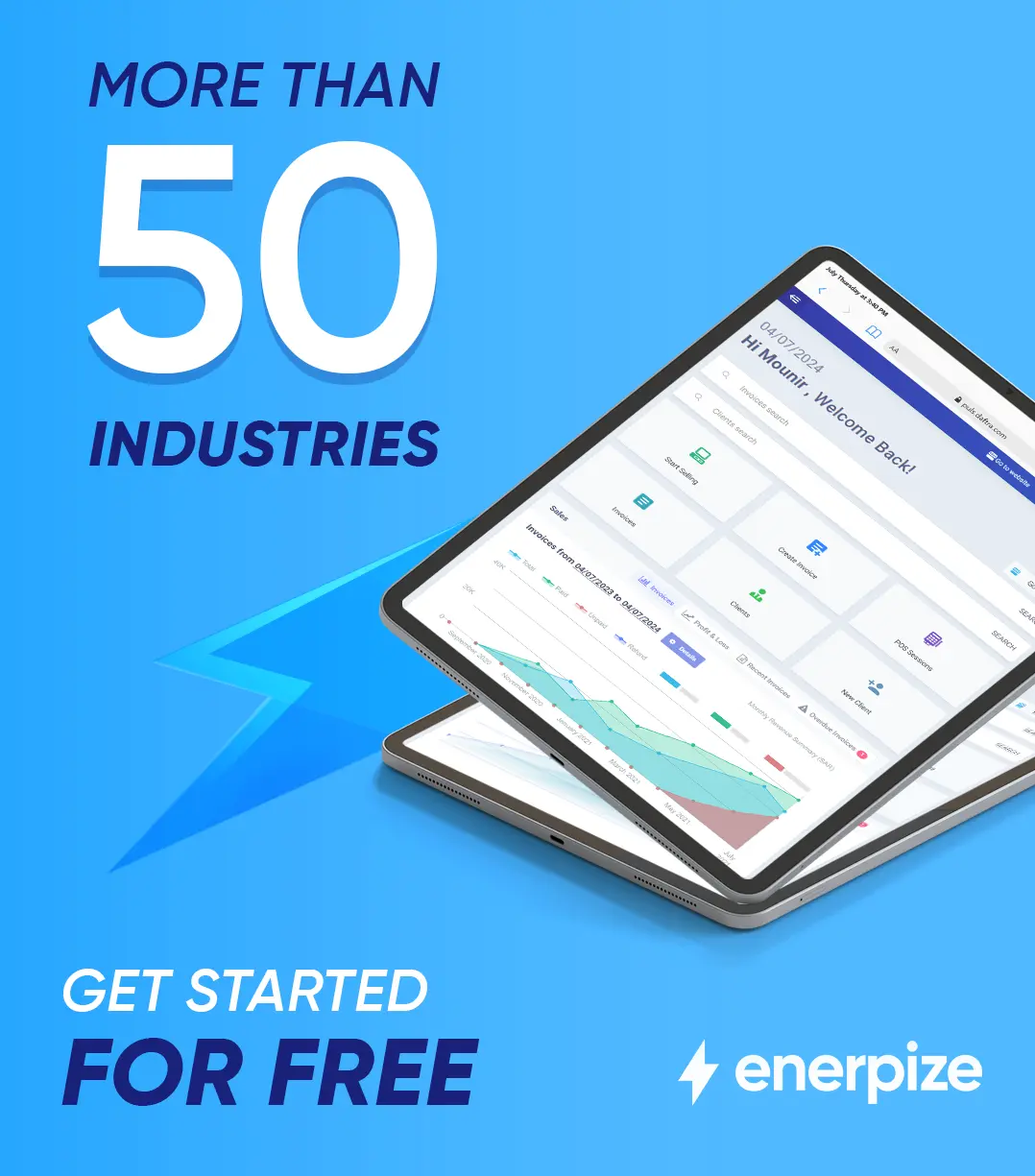
Enerpize was built for the 98% Australian small businesses that need GST-ready ERP without implementation costs, consultants, or complexity.