


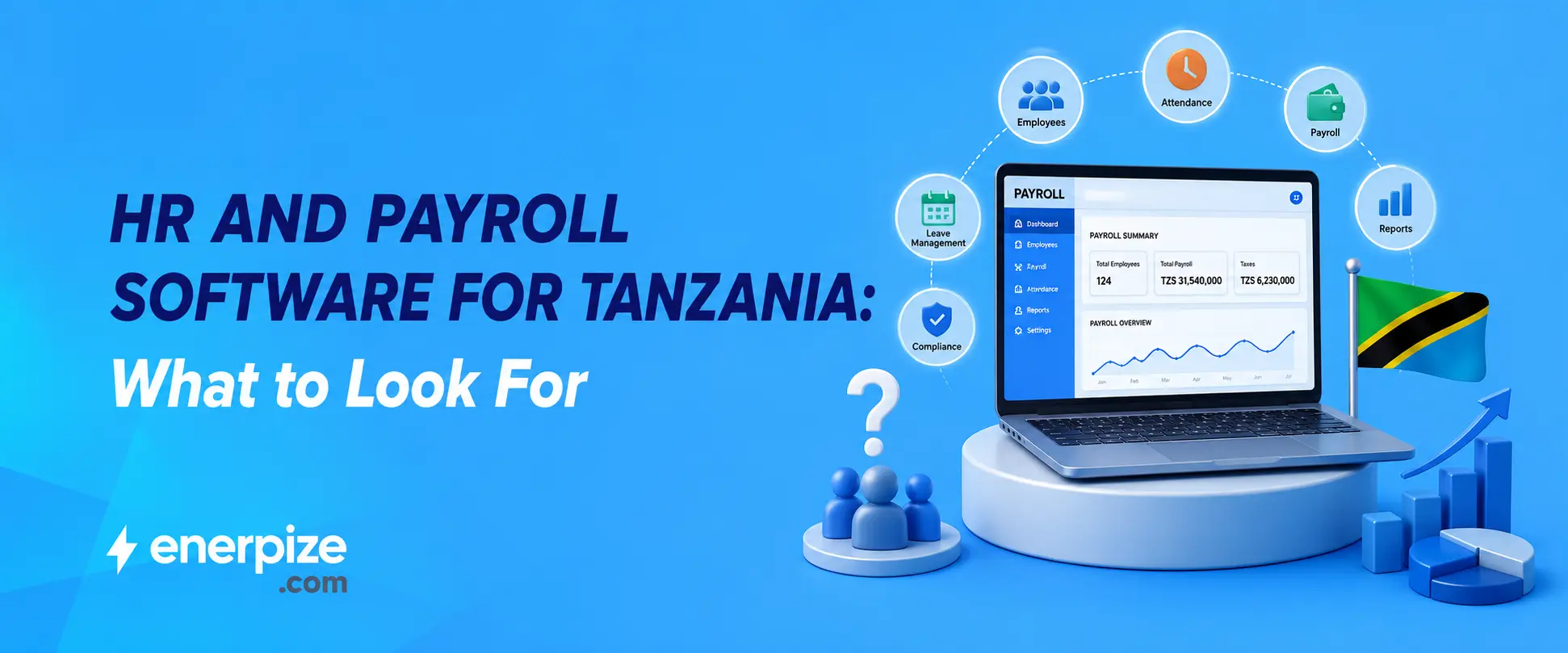
HR and Payroll Software for Tanzania: What to Look For and What the Law Requires


Key Takeaways
- Tanzania's PAYE system uses five monthly bands, from 0 percent up to 30 percent, with a tax-free threshold of TZS 270,000 per month.
- NSSF takes 20 percent of gross salary total, split evenly between employer and employee, with no upper cap.
- Female employees are entitled to 84 days of fully paid maternity leave, 100 days for multiple births, a fact most HR software vendors in Tanzania never mention.
- SDL and WCF are employer-only levies, and the exact current rate should always be confirmed directly with TRA since sources vary slightly year to year.
- Enerpize supports the payroll setup, employee records, and attendance tracking a growing Tanzanian business needs, in one connected system.
Ask any HR manager in Dar es Salaam how they run payroll and you will hear some version of the same story. A spreadsheet for salaries. A separate notebook for leave. A biometric device nobody fully trusts. And every month, someone stays late reconciling numbers that should have matched from the start.
That is not a Tanzania problem specifically. It is what happens anywhere HR tools grow one at a time instead of being built together. But Tanzania adds its own layer on top, PAYE bands, NSSF contributions, SDL, WCF, and leave entitlements that most HR software Tanzania vendors either get slightly wrong or skip over entirely.
This guide walks through what Tanzania's employment law actually requires, what payroll software Tanzania businesses can rely on needs to calculate correctly, and how to think about buying the right system instead of the one every reseller happens to be pushing this quarter.
Stop running payroll from three different tools. See how Enerpize handles PAYE, NSSF, and leave tracking in one place. Start for Free
What HR and Payroll Software Needs to Handle in Tanzania
Getting the software right starts with getting the underlying rules right, and a surprising number of vendor pages in this space do not.
PAYE, NSSF, SDL, and WCF, Correctly Calculated
Tanzania's PAYE system runs on five monthly income bands. The first TZS 270,000 of monthly income is tax free. Above that, the bands step up from 8 percent through 20 percent and 25 percent, reaching a top rate of 30 percent on income above TZS 1,000,000 per month. Each band only taxes the portion of income that falls inside it, not the whole salary.
On top of PAYE sits NSSF, the National Social Security Fund. The total contribution is 20 percent of gross salary, split evenly, 10 percent from the employer and 10 percent from the employee, with no cap on how much salary it applies to. Public sector employees contribute to PSSSF instead, which runs on a similar structure but is administered separately.
Then there are two employer-only levies. The Skills Development Levy, SDL, applies to employers with a certain minimum headcount and has stepped down over the years from a much higher starting rate. The Workers Compensation Fund, WCF, is a smaller employer contribution that funds workplace injury cover. Here is where I want to be straight with you rather than pretend certainty that is not there. Sources currently disagree slightly on the exact current SDL and WCF percentages, some cite SDL at 3.5 percent, others at 4 percent, and WCF shows up as either 0.5 or 0.6 percent depending on the source and the year it was published. NSSF payroll software Tanzania businesses use needs to let you adjust these rates as TRA updates them, rather than hardcoding a number that was correct two years ago and quietly wrong today.
Leave Entitlements Under the Employment and Labour Relations Act
Here is a fact almost none of the HR software vendors selling into Tanzania actually mention, and it genuinely surprised me how consistently it gets left out. Under Section 33 of the Employment and Labour Relations Act, female employees are entitled to 84 days of fully paid maternity leave, or 100 days for multiple births. That is a real, legally mandated entitlement, not a company policy perk, and it is paid in full by the employer.
Male employees get 3 days of paid paternity leave, and every employee is entitled to 28 consecutive days of paid annual leave once they have completed 12 months of service. A 2025 amendment to the Act also introduced up to 30 days of unpaid leave for personal reasons, giving employers and employees a formal way to agree on time off that previously had no legal structure at all.
Swahili and English Payslips
Tanzania is bilingual in practice, and payslips that only run in English miss a meaningful part of the workforce. A payslip with NSSF, PAYE, bonus, leave pay, and overtime clearly labeled in both languages is not a nice-to-have feature, it is what actually gets read and understood by the person receiving it.
Tanzania Statutory Payroll Rates at a Glance
| Deduction | Rate | Who Pays |
|---|---|---|
| PAYE | 0% to 30% across five monthly bands | Employee |
| NSSF | 20% total | 10% employer, 10% employee |
| SDL | Approximately 3.5% to 4% (confirm current rate with TRA) | Employer only |
| WCF | Approximately 0.5% to 0.6% (confirm current rate with TRA or WCF directly) | Employer only |
| Maternity leave | 84 days paid, 100 for multiple births | Employer pays in full |
| Paternity leave | 3 days paid | Employer pays in full |
| Annual leave | 28 consecutive days after 12 months | Employer pays in full |
Rates and thresholds change. This table reflects the most consistently corroborated figures at the time of writing, cross-checked against PwC's Tanzania tax summary and the Section 33 of the Employment and Labour Relations Act, but SDL and WCF specifically are worth verifying directly before you rely on them for a live payroll run.
HRMS vs Payroll-Only vs Full HR Suite: What Tanzanian Businesses Actually Need
Not every business in Tanzania needs the same tool, and a lot of buying decisions here go wrong because the pitch focuses on features instead of fit.
A payroll-only tool is fine if your only problem is calculating salaries correctly. It will not help you track leave balances against the Employment and Labour Relations Act, manage employee contracts, or give a manager visibility into who is actually at work today. HRMS Tanzania businesses turn to when they outgrow a payroll-only tool needs to bring salary, attendance, and employee records into one place, not three logins that never quite agree with each other.
For a business managing multiple branches or a mixed office and field workforce, HR and payroll software Tanzania companies rely on also needs to handle attendance from more than one location reliably, since a system that only works from a fixed biometric device at head office is useless for a field team in Mwanza or Arusha.
See how Enerpize brings payroll, employee records, and attendance into one platform built for how Tanzanian businesses actually operate. Start for Free
Payroll Software Built for Tanzania's Statutory Deductions
This is where the right setup actually earns its keep. Enerpize's payroll and contracts module lets you build salary structures with your own earnings and deduction components, rather than being locked into a fixed template built for a different country's tax system. For a Tanzanian business, that means PAYE, NSSF, SDL, and WCF can each be configured as their own distinct component, calculated on the correct base, and shown clearly on every payslip.
Enerpize supports the underlying structure, correctly configured PAYE, NSSF, SDL, and WCF components that reflect Tanzania's actual deduction categories, which is the foundation any HR management software Tanzania businesses adopt needs before payroll can be trusted at all. Payslips generate automatically against attendance and leave records, so a payroll run reflects what actually happened that month, not a static number someone typed in three weeks ago.
Employee Records and Organizational Structure for Growing Tanzanian Businesses
Once a business grows past a handful of employees, keeping records straight in a spreadsheet stops working. Enerpize's employee management tools let you set up departments, branches, job roles, and designations, then keep every employee's contract, personal details, and employment history in one centralized record.
The Employment and Labour Relations Act requires written contracts specifying the terms of employment, and Enerpize's automated contract generation ties salary components directly to the contract itself, so a change in role or pay does not mean rewriting a document from scratch. For a business expanding across Dar es Salaam, Arusha, or Zanzibar, having one organizational structure that reflects every branch accurately matters more than most owners realize until the day it does not.
Attendance and Leave Tracking Against Tanzania's Leave Entitlements
Given everything covered above about maternity, paternity, and annual leave, this is where compliance either happens automatically or gets missed entirely. Enerpize's attendance and leave management module supports fully configurable leave types, so the 84 day maternity leave entitlement, the 3 day paternity leave, and the 28 day annual leave allowance can each be set up with the correct day count from the start, rather than tracked manually and hoped to be right.
For businesses with remote or field teams, attendance can be captured through geofencing, IP validation, or photo verification via the mobile app, and logs sync automatically even after periods offline. That matters in parts of Tanzania where connectivity is not always reliable, since a system that loses attendance data when the signal drops creates exactly the kind of payroll dispute nobody wants to deal with at month end.
One Platform Instead of Separate HR, Payroll, and Attendance Tools
Here is the actual cost of running HR, payroll, and attendance as three separate tools. A leave request gets approved in one system. Someone has to remember to reflect it in payroll manually. A new hire gets added to the employee database but not to the attendance system until someone notices the gap. None of this is anyone's fault specifically, it is just what happens when systems do not talk to each other.
Enerpize's human resources platform keeps employee records, payroll, attendance, and contracts on one shared foundation, so an approved leave request automatically reflects in the next pay run without anyone re-entering it. For an HR software for small business Tanzania owner running lean, that is not a convenience feature, it is the difference between HR being a monthly fire drill and HR actually working the way it is supposed to.
Run payroll, attendance, and employee records from one connected platform built for how growing businesses actually operate. Start for Free
FAQs
What is the best HR software for small businesses in Tanzania?
The best HR software Tanzania small businesses can rely on is one that connects payroll, attendance, and employee records instead of treating each as a separate purchase. A payroll-only tool works fine for very simple needs, but a growing business benefits from a system where a leave approval, an attendance log, and a payroll run all update from the same record automatically.
What is the NSSF contribution rate in Tanzania?
NSSF takes 20 percent of gross salary in total, split evenly between employer and employee at 10 percent each, with no upper cap on the salary it applies to. Public sector employees contribute to PSSSF instead, under a broadly similar structure.
How many days of maternity leave are employees entitled to in Tanzania?
Female employees are entitled to 84 days of fully paid maternity leave under the Employment and Labour Relations Act, 2004, or 100 days for multiple births. This is a legal entitlement paid in full by the employer, not a discretionary company benefit.
Does HR software need to calculate SDL and WCF automatically?
It should be able to, but the exact current rates for both SDL and WCF should be verified directly against current TRA and WCF guidance, since published sources vary slightly. NSSF payroll software Tanzania businesses choose should let you adjust these rates when they change rather than locking them in permanently.
How much does HR and payroll software cost in Tanzania?
Enerpize's plans start from $9.99 a month, with HR, payroll, attendance, accounting, and CRM included rather than sold separately. A 14 day free trial with no credit card required gives an HR software for small business Tanzania owner enough time to see how the payroll setup actually performs before committing.
About the Author
Omar El Bahr is a Senior Digital Growth Specialist at Enerpize, where he leads SEO, content strategy, and organic growth across international markets. He is a Forbes Communications Council contributor and has written for Entrepreneur on business communication and digital strategy.
Disclaimer: This article reflects Tanzania's PAYE, NSSF, SDL, WCF, and leave entitlement facts accurate at the time of writing, drawn from TRA, PwC Tanzania, and the Employment and Labour Relations Act, 2004. Tax and labor law rates change. Confirm current figures directly with TRA, NSSF, or a registered Tanzanian labor law practitioner before making payroll or compliance decisions.
Related Articles
 HR Management
What Payroll Software Are Small Businesses Actually Using in 2026 and Is It Worth It?
Read more HR Management
The Ultimate Payroll Cheat Sheet
Read more HR Management
What Is HR Management: A Comprehensive Guide
Read more HR Management
Payroll Software for Kenya: PAYE, SHIF, and NSSF Compliance Compared
Read more HR Management
Recruitment Strategies: The Comprehensive Guide
Read more HR Management