


6 Best NetSuite Alternatives in 2026: ERP Software Compared for Small Business


Last updated: November 11, 2026
What this page covers
Six NetSuite alternatives for businesses that need ERP but not NetSuite’s scale, compared on pricing model, fit, and real cost at 10 users.
NetSuite’s cost
Oracle does not publish NetSuite prices. Third-party estimates put the base platform near $999 a month, plus $99 to $199 per user, plus implementation.
The alternatives
Enerpize, Sage Intacct, Acumatica, Microsoft Dynamics 365 Business Central, SAP Business One, and Odoo.
When to stay on NetSuite
Real multi-entity, multi-currency operations, ecommerce at the core, and enough users to spread the base fee.
Where Enerpize fits
Teams of roughly 5 to 15 people that need accounting, inventory, sales, and HR together, from $14.95 a month, or $9.99 billed yearly.
What Is NetSuite, and Why Are So Many Smaller Businesses Looking for NetSuite Alternatives?
Picture the moment someone tells a small business owner they have graduated. Not from a business milestone. From QuickBooks. On a board call or in an adviser meeting, someone says it out loud: you have outgrown QuickBooks, it is time for a real ERP. The name that comes up next is almost always NetSuite, and that sentence is where a lot of NetSuite alternatives searches actually start.
NetSuite is a genuinely capable cloud ERP. Oracle bought it in 2016 for roughly $9.3 billion, which tells you how seriously it treats the platform. It covers financials, inventory, CRM, and ecommerce in one system, and its OneWorld module handles multi-entity, multi-currency consolidation better than almost anything else at its price. For a company with subsidiaries in three countries and a CFO who wants consolidated numbers by the tenth of every month, that is a real strength.
Here is the part almost nobody says before you sign. NetSuite is typically sold to established mid-market companies, often described as roughly $5 million to $500 million in revenue with dozens to thousands of employees, and its pricing is built around that size. Oracle does not publish prices, but third-party estimates put the base platform at about $999 a month before a single user is added, with user licences at roughly $99 to $199 a month each on top.
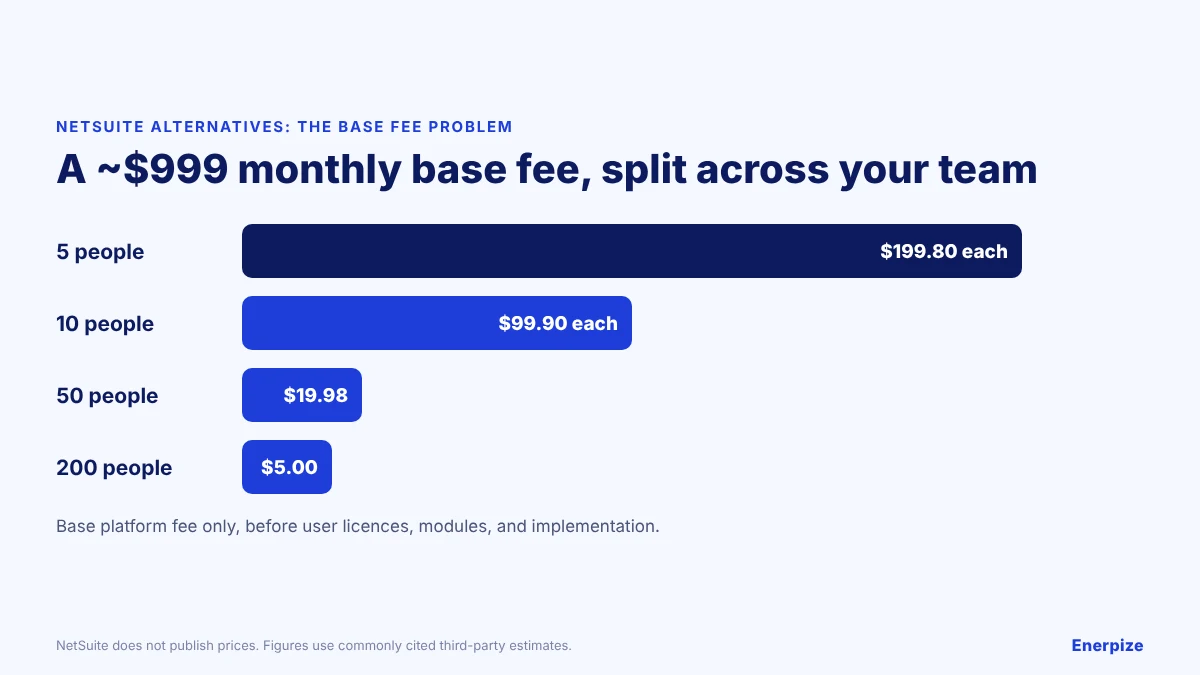
That maths is why so many smaller teams end up comparing NetSuite alternatives instead of signing where the adviser pointed. This guide covers what NetSuite does well, where the small-team maths breaks down, what the real alternatives cost, and what switching involves. If you are still deciding whether you need an ERP at all, read how ERP software differs from accounting software first.
What NetSuite Doesn’t Do Well for Small Teams
Every ERP has a ceiling, and NetSuite’s shows up fastest for smaller teams.
The Base Fee Does Not Scale Down
An estimated $999 a month platform fee costs the same whether you have 200 employees or 8. For a large company it disappears into the budget. For a small team it can be the biggest line in the subscription, before user licences, modules, or implementation.
Customisation Runs Through Partners
Meaningful changes are built in SuiteScript, usually by a NetSuite Solution Provider. Partner rates are commonly quoted at $150 to $300 an hour, so a small workflow change becomes a scoping call, a statement of work, and a change order.
Implementation Takes Months
Mid-market rollouts commonly run three to six months, and longer with several entities or custom integrations. Meanwhile your team runs two systems at once.
Reporting Can Need Extra Tools
Saved searches and SuiteAnalytics cover the basics, but some teams add Power BI or Tableau for cross-department dashboards, which means another vendor and another line item.
None of this makes NetSuite a bad product. It makes it a product built for a company with the headcount to absorb a large base fee and the budget to keep a partner on call.
Where NetSuite Still Gets It Right
It would not be honest to pick at NetSuite without naming where it earns its reputation.
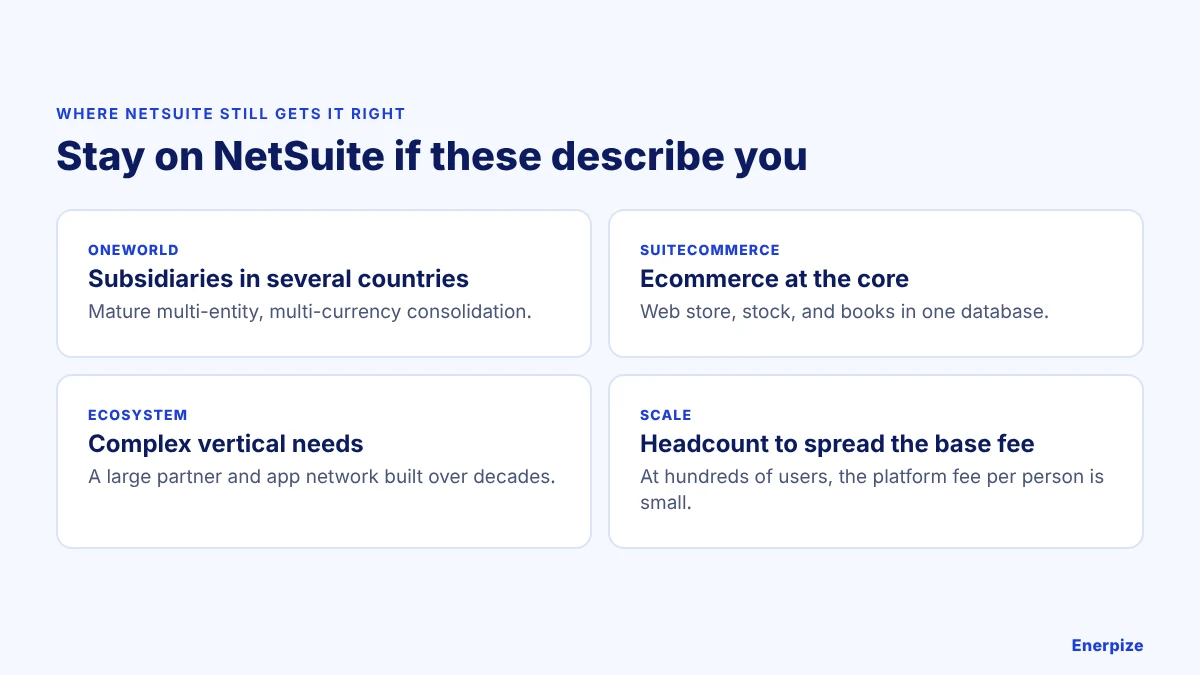
- Multi-entity consolidation. OneWorld is mature, and companies with subsidiaries across borders get value that smaller platforms, Enerpize included, do not match.
- Native ecommerce. SuiteCommerce keeps sales, stock, and financials in one database rather than three systems syncing overnight.
- A large ecosystem. Decades in the market have produced a big partner and app network for complex vertical needs.
- Scale. With hundreds of users, the base fee per person becomes small.
If your business sits inside NetSuite’s real target range, with genuine multi-entity operations and the headcount to spread the base fee, NetSuite remains a reasonable choice. The rest of this guide is for the business that was told it needed that scale before it had it.
The Best NetSuite Alternatives at a Glance
If you are looking for NetSuite alternatives in 2026, here is the shortlist. Each one solves a different problem, and the pricing model matters as much as the price.
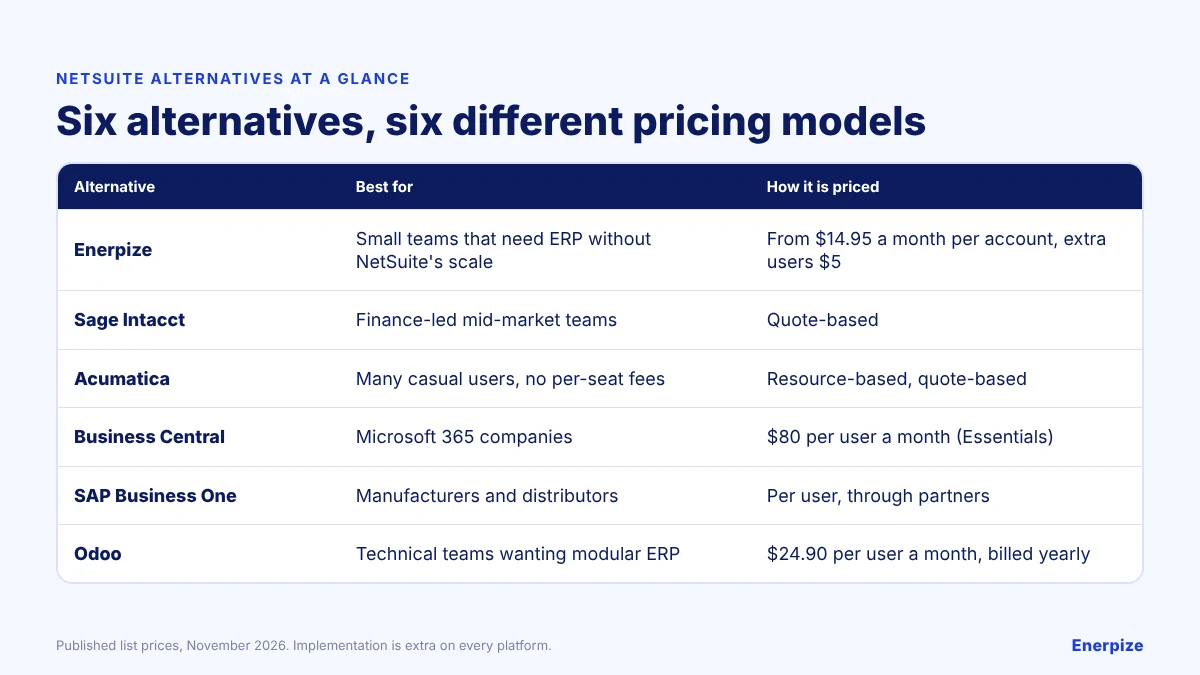
| Alternative | Best for | How it is priced | Type |
|---|---|---|---|
| Enerpize | Small teams that need ERP without NetSuite’s scale | $14.95 a month, or $9.99 billed yearly, per account; extra users $5 | All-in-one cloud ERP |
| Sage Intacct | Finance-led mid-market teams | Quote-based | Financial management |
| Acumatica | Teams with many casual users | Resource-based, quote-based | Cloud ERP |
| Microsoft Dynamics 365 Business Central | Microsoft 365 companies | $80 per user a month (Essentials), $110 (Premium) | Cloud ERP |
| SAP Business One | Manufacturing and distribution SMBs | Per user, quoted through partners | SME ERP |
| Odoo | Technical teams wanting modular ERP | $24.90 per user a month billed yearly, or $31.10 monthly (Standard) | Modular ERP |
Enerpize vs NetSuite: What a 10-Person Team Pays
A $999 base fee looks small on a slide. It looks very different divided by your actual headcount.
| Platform | 10 users, per month | How it adds up |
|---|---|---|
| NetSuite (estimate) | $1,989 to $2,989 | ~$999 base plus 10 users at $99 to $199 |
| Business Central Essentials | $800 | 10 users at $80 |
| Odoo Standard | $249 | 10 users at $24.90, billed yearly |
| Enerpize Premium | $86.63 | $41.63 a month billed yearly, plus 9 extra users at $5 |
These are licence costs only. Implementation is extra on every platform, and for NetSuite it is commonly estimated at tens of thousands to a few hundred thousand dollars. On Enerpize, payroll adds $2.28 a month for each employee you pay through it.
⚑ Practical note: NetSuite does not publish prices. Its figures here are third-party estimates; get a written quote for your own user count before you compare.
Feature by Feature
Both platforms cover accounting, inventory, and CRM on paper. The difference is what each one charges extra for, and what sits on which plan.
| Area | Enerpize | NetSuite |
|---|---|---|
| Accounting | Ledger, bank reconciliation, and asset management on every plan; cost centres from the Advanced plan | Core financials; advanced financials sold as add-on modules |
| Multi-entity | Extra branches from the Advanced plan, $19 a month each; no multi-entity consolidation | OneWorld consolidation across subsidiaries and currencies |
| Inventory | Barcode tracking and stocktaking on every plan; 2, 3 or 5 warehouses by plan | Inventory and warehouse modules, priced by edition |
| Sales and POS | Quotes, invoices, order tracking, and POS on every plan | Order management; POS and ecommerce through SuiteCommerce |
| HR and payroll | HR, attendance, leave, and payroll on every plan, at $2.28 per employee | Through SuitePeople and payroll add-ons where available |
| Customisation | Configured from settings | SuiteScript, usually through a partner |
Accounting
Enerpize’s accounting module includes asset management and bank reconciliation on every plan, with cost centres from the Advanced plan. If you need cost centres or fixed assets, that need does not start a new sales conversation.
Inventory
Enerpize’s inventory module includes barcode tracking and stocktaking on every plan, across 2 warehouses on Basic, 3 on Advanced, and 5 on Premium, with $10 a month for each one beyond that.
Sales
Enerpize’s sales module handles quotes, invoicing, and order tracking in every plan, so your team is not waiting on a separate purchase approval to issue a proper quote.
HR
Enerpize’s HR module covers payroll, attendance, and leave in the same system as the books, billed at $2.28 per employee on payroll. Many platforms in this comparison treat HR as a separate product.
Other NetSuite Alternatives Worth a Look
Enerpize is not the only serious option, and pretending otherwise would not help you. Here is an honest look at five other NetSuite alternatives, and who each one fits.
Sage Intacct
Sage Intacct is a finance-first cloud platform rather than a full operational ERP, built around dimensional reporting, multi-entity consolidation, and revenue recognition.
- Strength: strong financial reporting and consolidation for companies where finance, not operations, is the pain point.
- Limit: no native manufacturing or warehouse management, so many customers pair it with an operations system. Subscriptions are quote-based and commonly estimated in the tens of thousands of dollars a year.
- Best for: finance-led mid-market companies that bought NetSuite for the general ledger and rarely used the rest.
Acumatica
Acumatica prices by resources consumed rather than per user, so everyone in the company can log in without raising the licence fee.
- Strength: unlimited users plus real depth in distribution and manufacturing.
- Limit: resource-based pricing is harder to forecast, and annual costs are commonly estimated from about $15,000 to well over $100,000 depending on volume.
- Best for: operations-heavy teams with many warehouse and field users.
Microsoft Dynamics 365 Business Central
Business Central is the natural pick for teams already in Outlook, Excel, and Teams. Microsoft lists Essentials at $80 per user a month and Premium at $110, after raising prices on 1 November 2025, with Team Member licences at $8.
- Strength: native Microsoft 365 integration most office teams already use daily.
- Limit: per-user pricing grows with every new login, and deeper needs usually mean partner apps and implementation.
- Best for: Microsoft-heavy teams that want ERP inside the tools they already use.
SAP Business One
SAP Business One targets small and mid-sized manufacturers and distributors that need production planning and multi-warehouse control. It is sold and priced through certified partners.
- Strength: manufacturing depth and a long track record in distribution.
- Limit: partner-led implementation cost, and an interface reviewers often describe as dated next to newer cloud platforms.
- Best for: manufacturers and distributors that need shop-floor depth more than polish.
Odoo
Odoo is a modular ERP with a free, self-hosted Community edition and paid cloud plans. Standard, which includes all apps, costs $24.90 per user a month billed yearly, or $31.10 billed monthly.
- Strength: modular flexibility, a large app ecosystem, and a genuinely free entry point for technical teams.
- Limit: several features sit in the paid editions, and multi-company setups need the higher Custom plan.
- Best for: technically capable teams that want open-source control and are comfortable managing more of the setup.
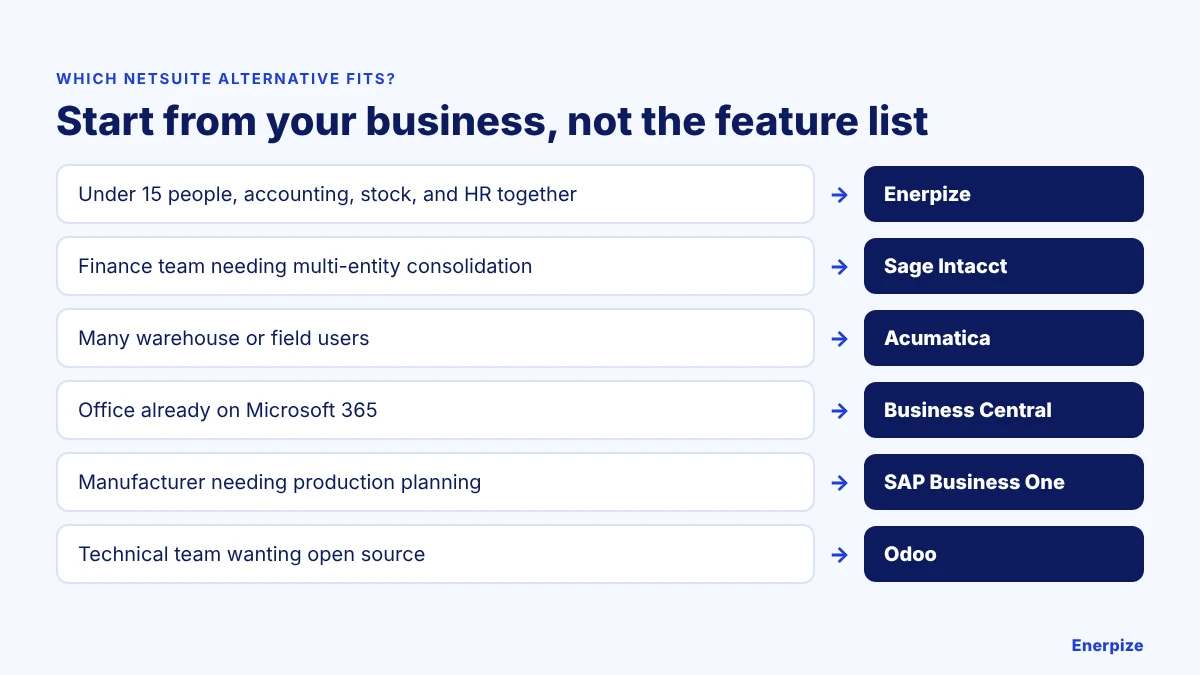
Which NetSuite Alternative Fits Your Business?
Features on a comparison page only tell you so much. What matters is whether your business has outgrown a simple system, or whether someone just told you it had.
| Your business | Better fit | Why |
|---|---|---|
| Under 15 people needing accounting, inventory, and HR together | Enerpize | No platform base fee, core modules on every plan |
| Finance team needing multi-entity consolidation | Sage Intacct | Strong financial reporting without a full ERP overhaul |
| Distribution or manufacturing with many warehouse users | Acumatica | Resource-based pricing instead of per-seat licences |
| Office already running on Microsoft 365 | Business Central | Native Outlook, Excel, and Teams integration |
| Manufacturer needing deep production planning | SAP Business One | Shop-floor and multi-warehouse depth |
| Technical team wanting open-source control | Odoo | Free self-hosted core and modular apps |
| Subsidiaries across several countries | NetSuite | OneWorld consolidation is its real strength |
Switching From NetSuite: What Migration Actually Involves
Moving off NetSuite is not a weekend project, but it is not the year-long ordeal some consultants imply either.
1- Export Your Financial Data
NetSuite lets you export the chart of accounts, general ledger history, open AP and AR, and saved searches to CSV or through the API. Expect a few days of cleaning and reformatting, because every platform maps fields differently.
2- Move the General Ledger First
Account structure, historical balances, and custom segments go first. Nothing else works correctly until the GL is in place, and this is where most of the mapping work lives.
⚡ Tip: Decide how much history to bring across; many teams move opening balances plus one or two years of detail.
3- Reconnect Every Integration
List every system that talks to NetSuite: bank feeds, payroll, ecommerce, reporting tools. Confirm which ones the new platform supports and test each with real data before you cut over.
4- Run Both Systems in Parallel
Post the same transactions in both systems for at least a few weeks. Compare the trial balance, AR ageing, and stock on hand line by line, then cut over.
⚡ Tip: Cut over at the start of a month or quarter so no period sits in two systems.
Common Mistakes When Leaving NetSuite
✕ Comparing list prices only
Why it matters: Implementation and partner fees can outweigh years of licences.
Fix: Compare total year-one cost, including setup.
✕ Moving without a multi-entity plan
Why it matters: Smaller platforms rarely consolidate subsidiaries the way OneWorld does.
Fix: If you run several entities, check consolidation first.
✕ Skipping the parallel run
Why it matters: Mapping errors surface at the first month-end close.
Fix: Run both systems for at least one full period.
✕ Forgetting the integrations
Why it matters: A bank feed or ecommerce link that breaks stops daily work.
Fix: List and test every integration before cut-over.
How to Choose the Right NetSuite Alternative
Run through these five questions honestly before you sign anything.
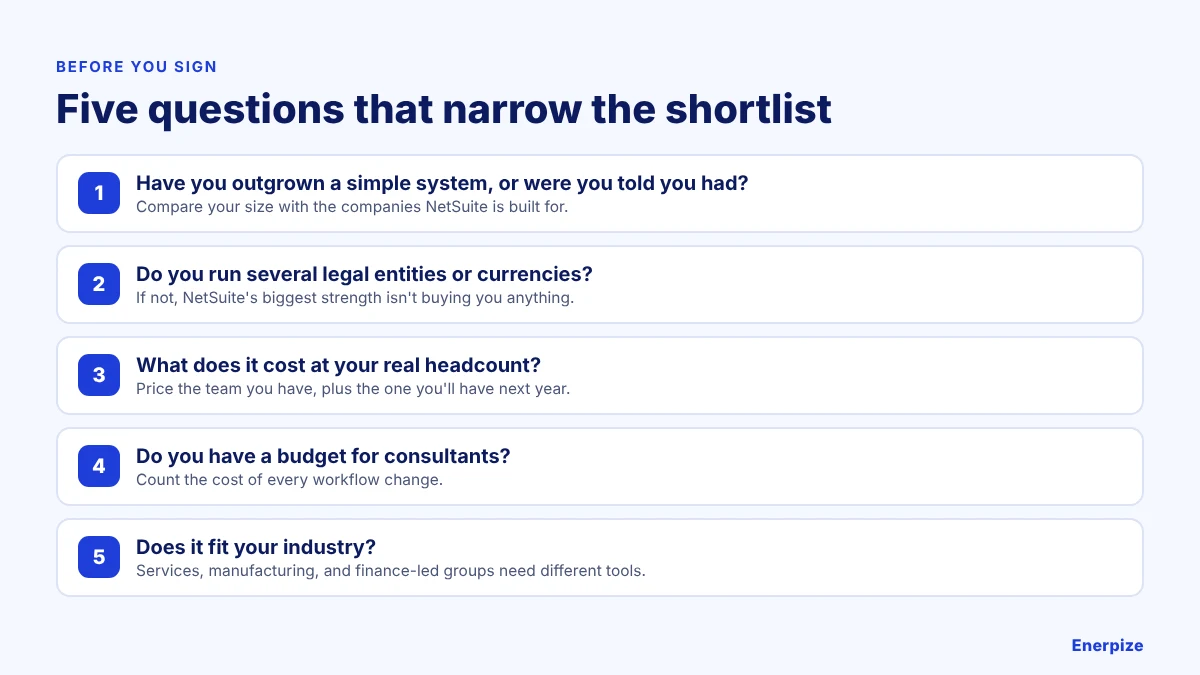
Have You Outgrown a Simple System, or Were You Told You Had?
Be honest about your headcount and revenue compared with the companies NetSuite is built for. Many teams realise the advice was generic.
Do You Have Several Legal Entities or Real Multi-Currency Needs?
If yes, NetSuite’s OneWorld strength starts to matter. If not, that strength is not buying you anything.
What Will It Cost at Your Real Headcount?
Run the ten-person maths above with your own numbers. A base fee that disappears at 200 people can dominate the bill at 10.
Do You Have a Budget for Ongoing Consultant Changes?
If every workflow change needs a paid partner, count that recurring cost now, not after a three-year contract.
Does It Fit Your Industry?
A service business, a small manufacturer, and a multi-entity finance team do not need the same platform.
Answer those five honestly and the shortlist usually narrows to one or two real options.
Frequently Asked Questions
What are the best alternatives to NetSuite?
It depends on why you are leaving. Enerpize suits small businesses that have not reached NetSuite’s target size, Sage Intacct suits finance-led mid-market teams, Acumatica suits operations-heavy companies avoiding per-seat pricing, Business Central suits Microsoft 365 companies, SAP Business One suits manufacturers, and Odoo suits technical teams.
Who is NetSuite’s biggest competitor?
In the mid-market, Microsoft Dynamics 365 and Sage Intacct are the most commonly cited NetSuite competitors, while SAP and Acumatica compete more at the operations-heavy end.
Is there a free or cheaper alternative to NetSuite?
Yes. Odoo’s Community edition and ERPNext are free to self-host, though you pay for hosting and setup. Enerpize starts at $14.95 a month, or $9.99 billed yearly, with a 14-day free trial and no credit card.
What is the best NetSuite alternative for a small business?
For a business well below NetSuite’s typical customer size that needs accounting, inventory, sales, and HR together, Enerpize is worth comparing, with no platform base fee and core modules on every plan. If you run several legal entities across countries, check consolidation needs first.
Is Odoo better than NetSuite?
Neither is better for everyone. Odoo wins on cost for technical teams willing to configure it, at $24.90 per user a month billed yearly. NetSuite wins on multi-entity consolidation and ecosystem maturity for companies operating at that scale.
Is SAP or NetSuite better?
It depends on the operation. SAP Business One goes deeper on manufacturing and multi-warehouse control. NetSuite goes deeper on multi-entity consolidation and native ecommerce. Neither is usually the right first ERP for a small team.
How much does NetSuite cost compared to alternatives?
Oracle does not publish NetSuite pricing. Third-party estimates put a 10-user setup at roughly $1,989 to $2,989 a month before implementation. The same 10 users cost $800 on Business Central Essentials, $249 on Odoo Standard billed yearly, and $86.63 on Enerpize Premium billed yearly, plus $2.28 per employee if you run payroll.
That adviser telling you it is time for a real ERP does not have to end with a contract sized for a company five times yours. If the real problem is that accounting, inventory, and HR live in three places, the fix is usually a system that brings them together at your size.
About the Author
Omar El Bahr is a Senior Digital Growth Specialist at Enerpize, where he leads SEO, content strategy, and organic growth across international markets. He is a Forbes Communications Council contributor and has written for Entrepreneur on business communication and digital strategy.
Disclaimer: NetSuite, Sage Intacct, Acumatica, and SAP Business One prices are quote-based; figures here are third-party estimates. Business Central, Odoo, and Enerpize figures are published list prices as of November 2026. All prices can change, so confirm with each vendor before deciding.
Related Articles
 Software Reviews
6 Best Microsoft Dynamics 365 Business Central Alternatives in 2026: ERP Software Compared
Read more Software Reviews
11 Best Video Editing Software for Free for Small Businesses
Read more Software Reviews
Accounting Software for Cleaning Business: How The Wash Runs Nearly 180 Services From One System
Read more Software Reviews
Best Odoo Alternatives in 2026: ERP Software Compared
Read more Software Reviews
5 Best Logo Design Software for Startups and Entrepreneurs
Read more Software Reviews


