

Posted on 11 August 2026
Employee Handbook Template: Free Download Word, PDF & Docs
- Available in Word, PDF, and Google Docs, free to download with no sign up required.
- Covers equal employment opportunity, code of conduct, remote and hybrid work, leave and PTO, data protection, social media policy, and employee acknowledgment in one document.
- Built with country specific compliance notes for the United States, United Kingdom, India, and Canada.
- Includes a version controlled acknowledgment page so you always know which policy version an employee actually signed.
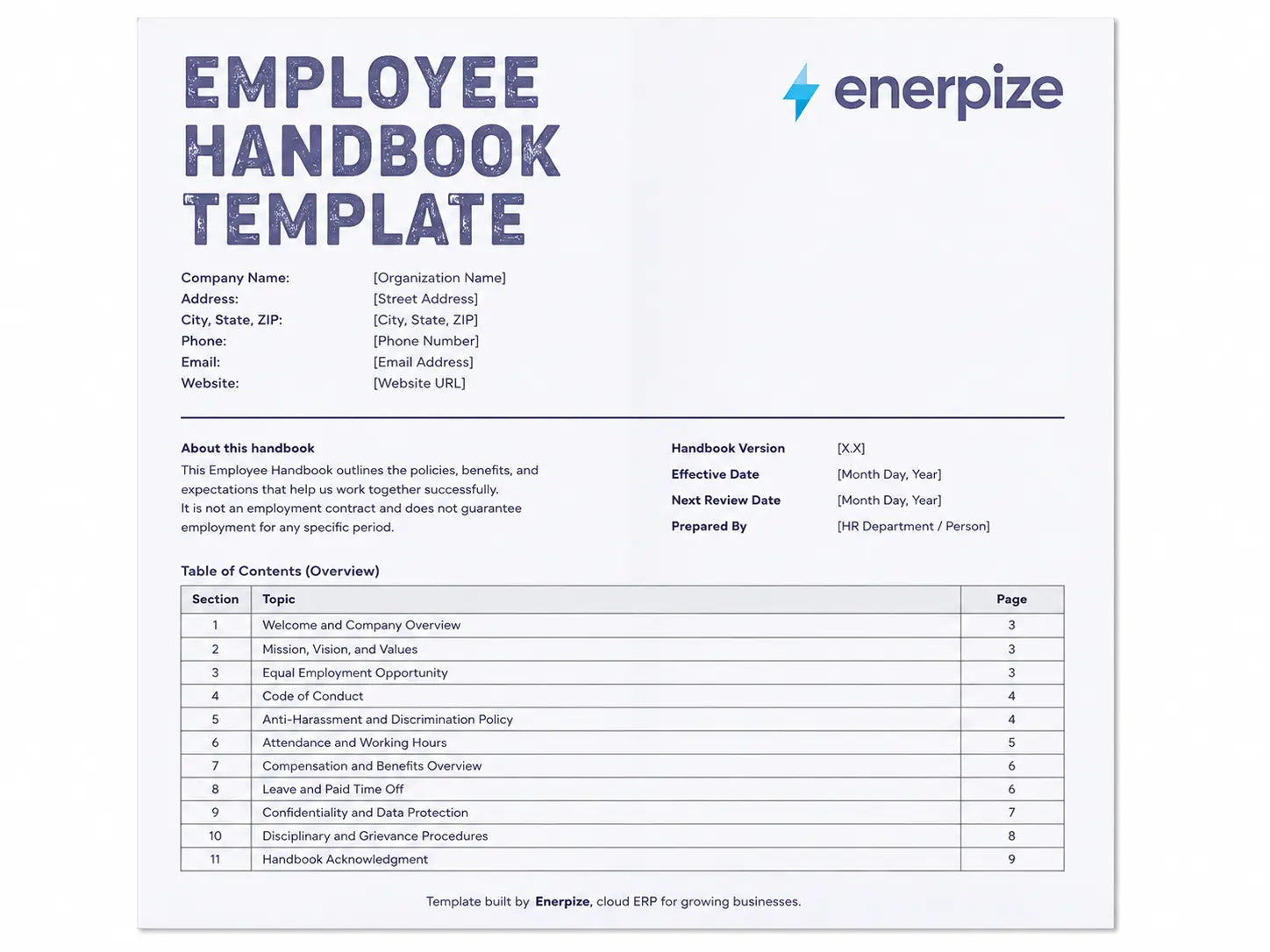
An employee handbook template is a pre-formatted policy document that lays out a company's rules, benefits, and expectations for its workforce, giving both employer and employee one shared reference for how the workplace actually runs.


What Is an Employee Handbook Template?
Think of it as the owner's manual nobody reads until something breaks. Every car comes with one. Most companies do not have an equivalent for their own workplace, and that gap shows up at the worst possible moment, during a dispute, an audit, or a termination that ends up in front of a labor board.
A template like this gives you the structure of that manual already built. Equal employment opportunity language, code of conduct, leave policy, disciplinary steps, all of it organized into sections you fill in rather than write from scratch. You are not drafting employment law from a blank page. You are adapting language that already accounts for what regulators and courts actually look for.
Here is the distinction worth remembering. A handbook is not an employment contract. It does not promise a job for any set period, and in most jurisdictions it should say so explicitly. What it does is document workplace policies consistently, which matters more than people expect. If a manager fires someone for repeated lateness but the handbook never mentioned an attendance policy, that termination just got a lot harder to defend. Consistency is the entire value proposition here.
Small businesses skip this step more than any other HR document, usually because nobody has the two or three hours it takes to build one from nothing. A small business employee handbook does not need to be fifty pages of legal language to work. It needs to cover the handful of policies that actually get tested in real disputes, written clearly enough that an employee reads it once and remembers where to look when a question comes up. A free employee handbook template removes the excuse of starting from nothing.
It also helps to know what a finished one actually looks like before you start filling in the blanks. Pull up a few employee handbook examples from companies your size, not just the giant tech company versions that get shared online, and you will notice the good ones read like a conversation rather than a legal filing. That is the tone worth aiming for here too.
Enerpize gives you this handbook template plus the rest of the onboarding paperwork. Build your first policy document in minutes. Start free with Enerpize
What to Include in an Employee Handbook Template
Every competent employee handbook covers the same core ground, even if the language shifts by industry or country. Skip a row in this table and you have not simplified your handbook, you have just moved the risk from a written policy to an unwritten one, which is a worse place for it to live. Here is what belongs in yours, and why leaving it out creates a problem later.
| Section | Why It Matters |
|---|---|
| Equal Employment Opportunity | Documents your non-discrimination commitment and the process for reporting a violation. |
| Employment Classifications | Defines full-time, part-time, and temporary status, plus at-will or notice period language. |
| Code of Conduct | Sets expectations for behavior, conflicts of interest, and confidentiality. |
| Anti-Harassment Policy | Names what is prohibited and exactly who to contact to report it. |
| Remote and Hybrid Work Policy | Defines availability, equipment rules, and eligibility for flexible arrangements. |
| Leave and PTO | Covers vacation, sick leave, parental leave, and how to request time off. |
| Compensation and Benefits | Summarizes payroll schedule, insurance, and retirement contributions. |
| Data Protection | Explains what employee data is collected and how it is secured. |
| Social Media Policy | Sets the line between personal expression and confidential company information. |
| Disciplinary Procedure | Lays out the actual steps, not just the outcome, so enforcement stays consistent. |
| Employee Acknowledgment | Confirms receipt and understanding, tied to a specific handbook version. |
Miss the acknowledgment section and you lose the one piece of paper that proves an employee actually saw the workplace policies you are trying to enforce. That single missing signature has decided more than one wrongful termination case.
It helps to see how other companies handle the same eleven sections before you commit to your own wording. Pulling up a handful of real employee handbook examples from businesses roughly your size, rather than only the giant, heavily lawyered versions that show up first in a search, usually saves more time than starting from a totally blank template. You are not copying their policy, you are learning what plain, readable policy language actually sounds like once someone else has already worked out the kinks.
A few of these deserve a closer look before you start filling anything in. Confidentiality and the non-disclosure agreement clause inside your code of conduct section are two different things doing two different jobs. The code of conduct sets the general expectation that employees keep company information private. A standalone non-disclosure agreement, signed separately for roles that touch sensitive client data or product plans, is the enforceable version of that same promise. Most small businesses only need the handbook language. Growing teams handling client contracts or proprietary technology usually need both.
The same layering applies to leave. The handbook should state your paid time off policy in plain numbers, how many days, how they accrue, how far in advance to request them, but the actual balance tracking belongs in a system, not a paragraph. A handbook that says "20 days of paid time off per year" and a payroll system that shows something different is exactly the kind of mismatch that turns a routine leave request into a dispute.
What the Enerpize Employee Handbook Template Includes
I built this one differently, mostly because the same three gaps kept showing up in every handbook sample I pulled while researching this page, including the well known nonprofit and government reference templates that most other free versions still copy from.
The Three Gaps Missing From Standard Templates
None of them cover remote or hybrid work. None of them mention a social media policy, which is strange given how routine that policy has become everywhere else. And none of them solve the version problem, meaning if you revise the handbook eighteen months from now, there is no clean record of which version a specific employee actually acknowledged.
Where the Enerpize Template Closes Them
The Enerpize employee handbook template fixes all three. It includes a full remote and hybrid work policy section covering availability windows and equipment rules, a social media policy that draws a clear line between personal expression and confidential information, and a version controlled employee acknowledgment page that records the exact handbook version an employee signed off on, not just the fact that they signed something at some point.
Whistleblower Protection and Wellbeing, Added as Their Own Sections
It also adds a whistleblower protection policy as its own standalone section instead of folding it into general harassment reporting, which most templates do and which quietly weakens both policies. Harassment reporting and whistleblowing are different situations with different power dynamics and different protections, and treating them as one paragraph tends to under-serve whoever is reporting the more serious issue. And it includes a wellbeing and mental health support section, something almost no free employee handbook template addresses directly even though it has become one of the more searched HR topics of the last few years.
Why These Sections Made the Cut
I did not add these sections because they look good on a comparison chart. I added them because every one of them showed up as a real gap when I actually sat down and read through the standard reference handbooks people have been copying from for years, including a well known nonprofit template that is still one of the top ranking results for this exact search today. It covers benefits and leave in real depth. It says nothing about remote work, social media, or version tracking, because it was written before any of those were routine problems for a growing business.
Every section is written to be filled in fast, with bracketed placeholders in place of guesswork, and with our full human resources module behind it once you are ready to move past the document itself and into a system that actually tracks who agreed to what.
How Enerpize Handles Your Employee Handbook
A handbook that lives as a static PDF in a shared drive is already halfway to useless. Nobody remembers to check it, nobody can prove who read the latest version, and the manager who fired someone last year for missing three consecutive shifts has no easy way to show the attendance policy that decision was based on.
Enerpize connects the handbook to what actually happens after someone signs it, across four parts of the system.
Employee Records and Organizational Structure
The classifications you write into the handbook, full-time, part-time, temporary, which department, which branch, are not just a paragraph inside Enerpize. They are the actual org chart. Set up departments, job roles, levels, and designations once, and every employee record ties back to that structure automatically, with role-based permissions controlling who can see what. That is what keeps a handbook promise like "personnel data is only shared with your manager and HR" true in practice rather than in theory, since access is enforced by the system, not by good intentions. Enerpize employee management software centralizes personal information, employment history, and performance reviews in one protected place instead of scattered spreadsheets.
Contracts Built From the Policy You Just Wrote
Once your handbook defines employment classifications and at-will or notice period language, that same language should not need to be retyped for every new hire's contract. Enerpize automates employment contracts with the personal, employment, and salary details already on file, tracks contract status, and goes paperless end to end, so the terms in the contract and the terms in the handbook stay in sync instead of quietly drifting apart after the third or fourth hire. This is where human resources in Enerpize stops being a document repository and starts being the system that generates the paperwork the handbook only describes.
Attendance and Leave Tracked Against the Policy You Wrote
The paid time off numbers in Step 4 of this template are not meant to live only on paper. Enerpize lets you configure leave types, public holidays, and attendance rules directly, aligned with the actual labor regulations in the country you are hiring in, and every request runs through single or multi-level approval so nothing gets signed off informally over chat. Remote and hybrid employees get tracked through geofencing, IP validation, or photo verification through the ESS app, which matters directly for the remote work section in Step 3, since a policy about availability windows only means something if attendance is actually being recorded. Over 27,000 businesses run their leave balances through Enerpize attendance and leave management, logging more than 20 million attendance entries a month between them.
Payroll That Matches What the Handbook Promises
Compensation and benefits is one of the sections employees actually read closely, which means it is also the section where a mismatch gets noticed fastest. Enerpize payroll runs directly against attendance and leave data, so overtime, deductions, and absences calculate automatically instead of getting reconciled by hand at the end of the month. Salary rules can even be described in plain language and built into a formula automatically, tested against a real employee before anything gets saved. That closes the loop the handbook opens, the policy states the rule, payroll and contracts enforces it every pay cycle without anyone needing to remember it manually.
Put together, that is the difference between a document and a working policy. One sits in a folder. The other runs your organizational structure, your contracts, your attendance, and your payroll, quietly enough that nobody has to remember to check it.
How to Fill In This Employee Handbook
Step 1: Set your company details
Start here, not because it is the most important step, but because everything after it reads better once the reader knows who is talking to them. Add your organization's name, your mission, a line or two on how the company got started. This is also where you decide what tone the handbook takes, formal or conversational, and that decision carries through every section that follows it, whether you plan for it to or not.
Step 2: Confirm your employment classifications
Define full-time, part-time, and temporary status the way your business actually uses those terms, not the way a textbook would. Then add the at-will employment or notice period language that matches wherever your people actually work. This is not a paragraph to copy once and paste across every location. A US at-will statement and a UK written particulars statement are answering two completely different legal questions, and treating them as interchangeable is exactly how a handbook stops protecting the company it was written for.
Step 3: Fill in your workplace policies
Code of conduct. Anti-harassment policy. Health and safety. Remote work policy. If your team handles sensitive client data or proprietary work, this is also where a non-disclosure agreement clause belongs, either summarized in the handbook or referenced as a separate document employees sign alongside it. Write it the way you would explain it to someone out loud on their first day, not the way a lawyer would write it for a courtroom. A policy nobody understands does not protect anyone. It just gives everyone the false sense that something is being handled when nothing is.
Step 4: Add compensation, benefits, and leave details
Payroll schedule. Insurance. Paid time off accrual. Parental leave. Put real numbers here. "Generous leave" is not a policy, it is a sentence someone will eventually argue with you about. Pull every figure straight from your existing HR system rather than from memory, because the gap between what the handbook promises and what actually gets paid out is exactly where a routine leave request turns into a dispute.
Step 5: Complete the acknowledgment section
Set a version number and an effective date on the cover page before this goes anywhere. Every employee who receives this copy signs against that exact number. It sounds like a small detail right up until the day you need to prove which version of the policy was in effect when a decision got made, and then it is the only detail that matters.
Step 6: Distribute and collect signatures
Hand the handbook over during onboarding, in the first few days, not two weeks in once someone has already formed their own idea of how things work here. Pair it with an offer letter template so the terms someone agreed to on day one still match what they are signing now. Then actually collect the signature. A handbook nobody signed is just a document you hoped everyone read.
Ready to move past paperwork? Put these policies to work instead of leaving them in a folder. Start free with Enerpize
Employee Handbook vs. Policy Manual vs. Employment Contract
People use these terms interchangeably, and that habit causes real problems. Here is the difference, laid out plainly.
| Document | Purpose | Legally Binding? | Covers |
|---|---|---|---|
| Employee Handbook | Communicates policy, culture, and expectations | Generally no, unless stated otherwise | Company wide policies and conduct standards |
| Policy Manual | Detailed procedural reference, often internal only | No | Step by step process documentation |
| Employment Contract | Defines the specific terms of one person's employment | Yes | Salary, title, term, and individually negotiated terms |
The handbook is the constitution. The employment contract is the individual agreement. Our employee contract template covers exactly those individually negotiated terms that a handbook is never meant to hold. Confuse the two and you either promise something you did not mean to, or fail to enforce something you actually needed.
This distinction matters most at the exact moment someone tries to hold you to something. If an employee points to a line in the handbook and argues it functions as a contract, the explicit non-contract language you wrote back in the introduction is what protects you. If an employee points to their signed employment contract and it says something different from the general handbook policy, the contract wins, because it was negotiated specifically for that one person. Keeping the two documents in their own lanes, rather than letting handbook language drift into contract territory, is a small habit that avoids a genuinely expensive mistake.
Employee Handbook Requirements in the United States
No federal law requires a handbook, but that has never stopped one from deciding a wrongful termination case. Courts and the EEOC look closely at whether a company followed its own written policy, so a handbook that promises progressive discipline and then skips straight to termination usually works against the employer, not for it.
Most US employment is at-will employment, and that status needs an explicit statement in the handbook along with a line confirming the handbook itself is not a contract. Montana is the one real exception worth knowing. Once an employee there completes probation, they are protected by a good cause standard for termination, so a Montana specific handbook needs different at-will language than the other 49 states.
Federal requirements that belong in the document include equal employment opportunity language covering Title VII, the ADA, and the ADEA, Form I-9 verification for every new hire, and a basic safety policy referencing OSHA expectations. Several states now mandate specific workplace policies inside the handbook itself, California's workplace violence prevention plan requirement being the clearest recent example. Personnel records tied to an employment claim should generally be kept for at least three years, sometimes longer depending on the claim.
Paid time off in the US handbook is worth its own careful line, mostly because there is no federal mandate for it at all. Whatever your company offers, sick leave, vacation, parental leave, is a company policy rather than a legal floor in most states, which means the handbook is doing more work here than in almost any other country on this list. Write the actual numbers, not a general promise, and keep them next to the accrual rules employees will actually use.
Employee Handbook Requirements in the United Kingdom
UK law does not require a document called a handbook, but it does require something close to one. Every employee has a Day 1 right to a written statement of employment particulars under the Employment Rights Act 1996, covering pay, hours, and holiday entitlement, and a handbook is the natural place to deliver that alongside the rest of company policy.
Disciplinary and grievance procedures carry more weight here than almost anywhere else, because the ACAS Code of Practice sets the standard employment tribunals measure against. Skip a fair process and a tribunal can increase any award against you by up to 25%, regardless of who was actually right on the underlying facts. That single detail deserves its own paragraph in a UK handbook, not a passing mention.
Data protection needs a dedicated section too. Personnel files fall under UK GDPR, so the handbook should state what data is collected, how long it is retained, and who can access it. The Equality Act 2010 sets out the protected characteristics your anti-harassment policy and anti-discrimination language have to name specifically, and right to work checks now run through the Home Office's digital verification system.
Statutory paid time off in the UK sits at a floor of 28 days including public holidays for a full-time employee, and the handbook should state clearly whether your company matches that minimum or offers more. Undercutting it, even by accident through vague wording, is a compliance problem, not just a communication one.
Employee Handbook Requirements in India
India's biggest requirement is the Prevention of Sexual Harassment of Women at Workplace Act, 2013, known as POSH. Any establishment with 10 or more employees must form an Internal Complaints Committee, and the handbook is where that committee, its members, and the complaint process get formally disclosed to staff. This is not optional language. It is a statutory obligation, and it is the section every Indian handbook needs to get right before anything else.
Employment terms below that run through state level Shops and Establishments Acts, so a handbook written for a Mumbai office and one written for a Bangalore office may need slightly different working hour language depending on the applicable state. Larger factory or industrial employers fall under the Industrial Employment Standing Orders Act, 1946, which requires formal standing orders covering attendance and termination. The Maternity Benefit Act, 1961 sets a 26 week paid leave floor that your leave policy section cannot undercut. The Ministry of Labour and Employment publishes the current version of each of these acts if you need the source text.
Beyond maternity leave, general paid time off in India is set at the state level too, through each state's Shops and Establishments Act, typically landing somewhere between 12 and 21 earned leave days a year depending on the state and the length of service. Confirm the applicable number for the state your office sits in before you finalize the leave section, rather than assuming one figure works nationwide.
Employee Handbook Requirements in Canada
Canada runs on provincial employment law rather than one national standard. Each province has its own Employment Standards Act, so a handbook built for an Ontario workforce and one built for an Alberta workforce will differ on overtime thresholds and termination notice periods. Human rights protections follow the same pattern, with a federal Human Rights Act sitting alongside provincial codes that largely mirror it.
Occupational health and safety law in most provinces, Ontario's Bill 168 and Bill 132 being the clearest examples, requires a written workplace violence and harassment policy that gets reviewed annually. State that review cadence directly in the handbook rather than leaving it implied.
Quebec adds a requirement that catches a lot of companies off guard. Under the Charter of the French Language, strengthened further by Bill 96, employees in Quebec have the right to receive workplace documents, the handbook included, in French. If you operate there, a French language version needs to exist from day one, not get built after someone finally asks for it. Employment and Social Development Canada is the federal reference point, with each province's labour ministry covering the provincial layer.
Paid time off follows the same provincial pattern as everything else here. Ontario's floor sits at two weeks after one year of service, rising to three after five years, while other provinces set their own minimums. Match your handbook's leave section to the province you are actually hiring in rather than defaulting to whichever number sounds most generous.
Download the employee handbook template above, then start free with Enerpize to keep every policy, acknowledgment, and leave record in one connected system.
Key Takeaways
- An employee handbook template gives you the structure of a compliant policy document without starting from a blank page, covering equal employment opportunity, code of conduct, leave, and disciplinary process in one place.
- A handbook is not an employment contract, and most jurisdictions expect that distinction stated explicitly inside the document itself.
- The Enerpize employee handbook template adds a remote work policy, a social media policy, and a version controlled acknowledgment page, three sections missing from most free templates available today.
- At-will employment status in the United States, the written statement of particulars in the United Kingdom, the POSH Act requirement in India, and provincial employment standards in Canada each demand different handbook language, not one paragraph reused everywhere.
- The employee acknowledgment section is the single most important page in the entire document, since it is the proof that a specific employee received a specific version of the policy.
- A handbook connected to your actual HR system, rather than sitting as a static file, keeps leave balances, disciplinary records, and acknowledgment tracking accurate without manual follow up.
Frequently Asked Questions
Is an employee handbook legally required?
In most countries, no single law requires a document called a handbook. What is required, in the US, UK, India, and Canada alike, are the individual workplace policies a handbook typically contains, equal employment opportunity language, safety policy, and in some cases specific statutory disclosures like India's POSH committee details.
What is the difference between an employee handbook and a company policy manual?
A handbook communicates policy and culture in language every employee can read. A policy manual is usually the more detailed, procedural backup that HR and management reference internally. Most companies need both, but only the handbook goes to every new hire on day one.
How long should an employee handbook template be?
Most complete handbooks run between 15 and 30 pages once filled in. Shorter than that and you are probably missing a required policy. Longer than that and employees stop reading it, which defeats the purpose entirely.
How often should you update an employee handbook?
At least once a year, and immediately whenever employment law changes in a jurisdiction where you employ people. Each update should carry a new version number, tied to a fresh employee acknowledgment from every employee who receives it.
Do small businesses need an employee handbook?
Yes, arguably more than large ones. A small business has fewer HR resources to fall back on when a dispute happens, which makes a documented, consistently applied set of workplace policies even more valuable as protection.
Can I use the same employee handbook in every country I operate in?
No. At-will employment language, notice periods, harassment policy reporting requirements, and data protection obligations all change by country. Build one base handbook and add a country specific addendum for each location rather than writing one document and hoping it covers everywhere.
What is the difference between an employee handbook and an employment contract?
The handbook sets company wide policy and is generally not a binding contract on its own. The employment contract is the individually negotiated agreement between one employee and the company, covering salary, title, and specific terms that override general handbook language where the two conflict.
Should the employee handbook be part of onboarding?
Yes, and ideally on day one rather than day ten. The handbook works best read alongside the offer letter and employment contract, while the terms are still fresh, rather than handed over separately once the new hire has already settled into the role and stopped reading anything new about how the company works.
About the Author
Omar El Bahr is a Senior Digital Growth Specialist at Enerpize, where he leads SEO, content strategy, and organic growth across international markets. He is a Forbes Communications Council contributor and has written for Entrepreneur on business communication and digital strategy.
Disclaimer: This page and its template are provided for general informational purposes only and do not constitute legal advice. Employment law varies by country and changes over time, so have your finished handbook reviewed by a qualified employment lawyer in each jurisdiction where you operate before you distribute it.