Posted on 23 November 2026
Free Japanese Receipt Template Download: Excel, Google Sheets, Word and PDF
- Bilingual 領収書 RECEIPT with tax split by 10% and 8%
- Checks whether each paper receipt needs a revenue stamp
- Three modes: registered, simplified or tax-exempt
- Available to download for free in Excel, Google Sheets, Word and PDF formats
A Japanese receipt template is a ready-made 領収書 (ryoshusho) form that proves you received payment in Japan. It holds the date, the payer's name, the amount, a purpose line and the issuer, plus the registration number and tax by rate when the receipt must count as a qualified invoice.


Last updated: November 23, 2026
What it is
A bilingual Japanese receipt template (領収書, ryoshusho) with English instructions, tax split by 10% and 8%, and a revenue stamp check on every receipt.
When you need it
When a client in Japan pays you and asks for a 領収書, or when you run a shop, café or service business in Japan and work in English.
What's inside
Settings, an Issue Log, a printable bilingual receipt, a receipt with your copy, and three handwritten receipts per page.
Formats
Excel, Google Sheets, Word and PDF. Free to download, with no sign-up.
Want to see it filled in first?
Make your own copy of the filled sample in Google Sheets.
What Is a Japanese Receipt Template?
A client in Tokyo pays your invoice. The next email says: 領収書をお願いします.
They want a ryoshusho. Not a thank-you note, not your invoice marked paid. A Japanese receipt in a format their accounting team recognizes.
A Japanese receipt template is a ready-made 領収書 (ryoshusho) form that proves you received payment in Japan. It holds the date, the payer's name, the amount, a purpose line and the issuer, plus the registration number and tax by rate when the receipt must count as a qualified invoice.
You'll see it called a ryoshusho, a ryōshūsho, a 領収証 or simply a Japanese receipt. The word 領収証 means the same thing. A レシート (reshiito) is the itemized slip a register prints. Both prove payment.
cash, transfer or card
領収書 with tax by rate
expense claim
if it counts as a qualified invoice
What it is not: an invoice. An invoice (請求書) asks for money. A Japanese receipt says the money arrived. Mark an invoice 領収済 and hand it over, though, and Japan treats it as a receipt, stamp duty included.
Ryoshusho vs Reshiito vs Invoice vs Qualified Invoice
Four documents, one transaction. Here's what each one does.
| Document | What it proves | Client name | Typical use |
|---|---|---|---|
| 領収書 ryoshusho | You received payment | Usually written | Business expenses, B2B payments |
| レシート reshiito | You received payment, item by item | Not printed | Shops, cafés, convenience stores |
| 請求書 invoice | Payment is due | Required | Before payment |
| 適格請求書 qualified invoice | The buyer can claim consumption tax back | Required (simplified version can skip it) | Any of the above with the six required items |
A qualified invoice is not a separate form. It is any receipt or invoice that carries the six required items.
So why do you sometimes get two receipts in Japan? Because a café hands you the register reshiito first, then writes a ryoshusho when you ask for one with your company name. They prove the same payment. Keep one per expense claim.
Which Version of the Japanese Receipt Template Fits You?
Start with how you get paid and who reads the receipt.
| If your situation is... | Use this | Where to find it |
|---|---|---|
| A company client paid by bank transfer | Bilingual receipt in registered mode | Issue Log, then the Receipt sheet |
| You keep a copy of every receipt you hand over | Receipt with your copy (控え) on one A4 page | Receipt with Copy sheet |
| You take cash on site and have no laptop | Three handwritten receipts per page | Handwritten sheet or the PDF |
| You run a shop or café and customers want 上様 | Simplified invoice mode | Settings |
| You're not registered for the invoice system | Tax-exempt mode, no registration number | Settings |
| Your client reads Japanese only | The Japanese-language receipt page | A separate page |
| You need a receipt outside Japan | A general receipt template | A separate download |
What Goes on a Japanese Receipt?
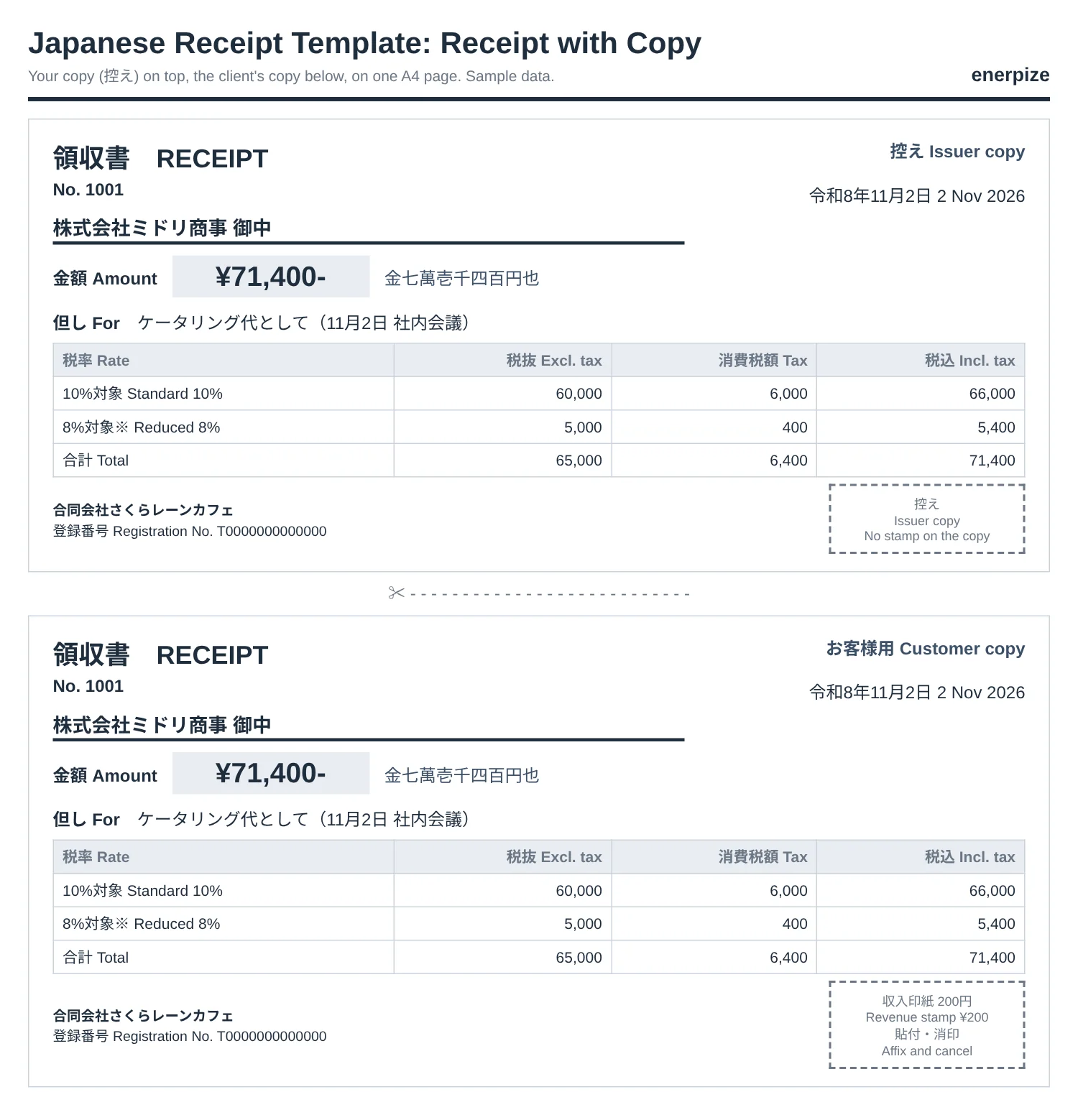
Japan has no legal layout for a Japan receipt. The Japanese receipt format is set by what the reader needs.
| Field | Japanese | Why it matters |
|---|---|---|
| Date received | 日付 | Puts the payment in the right period. Write the full year. |
| Addressee | 宛名 + 御中 or 様 | Required on a qualified invoice. 御中 after a company, 様 after a person. |
| Amount | 金額 | Written ¥71,400- so nobody can add a digit. |
| Purpose line | 但し書き | Says what the money was for. 飲食代として beats お品代として. |
| Breakdown by rate | 内訳 | 10% and 8% shown apart, with tax for each. |
| Issuer and registration number | 発行者 / 登録番号 | T + 13 digits. Only registered issuers may show one. |
| Revenue stamp | 収入印紙 | Paper receipts of ¥50,000 or more before tax, paid in cash or by transfer. |
The field that matters most is the breakdown. Write ¥54,780 as one tax-inclusive figure and the paper receipt needs a ¥200 revenue stamp. Split it into ¥49,800 plus ¥4,980 tax, and the stamp is judged on ¥49,800. No stamp at all. One line, ¥200 saved, and the receipt is ready to count as a qualified invoice.
What the Enerpize Japanese Receipt Template Includes
We built it from the rules first. Every calculation was checked against the National Tax Agency's stamp tax and invoice guidance, then tested against a separate calculation on hundreds of rows. You type in the yellow cells. Formulas do the rest, with no macros, so it opens the same way in Excel and Google Sheets.
A Stamp Decision Before You Print
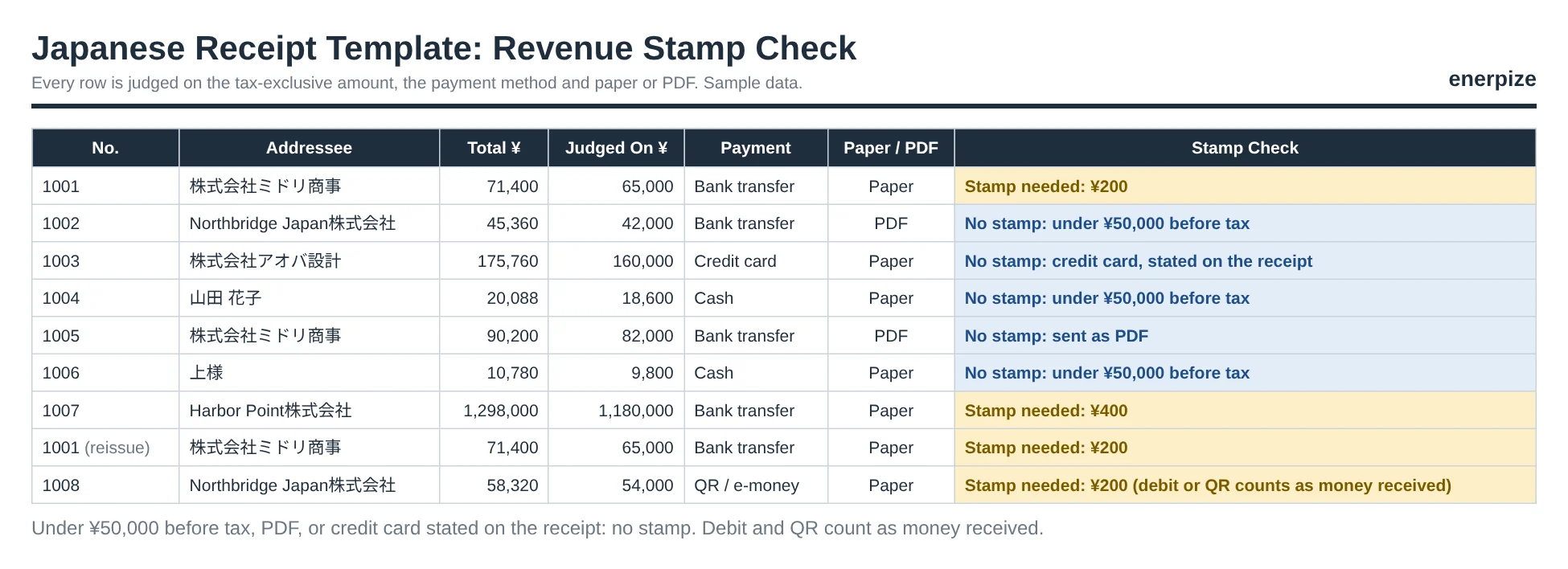
Every row in the Issue Log answers one question: does this paper need a stamp? The check reads the tax-exclusive amount, the payment method and whether you're handing over paper or a PDF, then gives the stamp and the reason. In our sample, 4 of 9 receipts need one, for ¥1,000 in stamps.
One Workbook, Three Identities
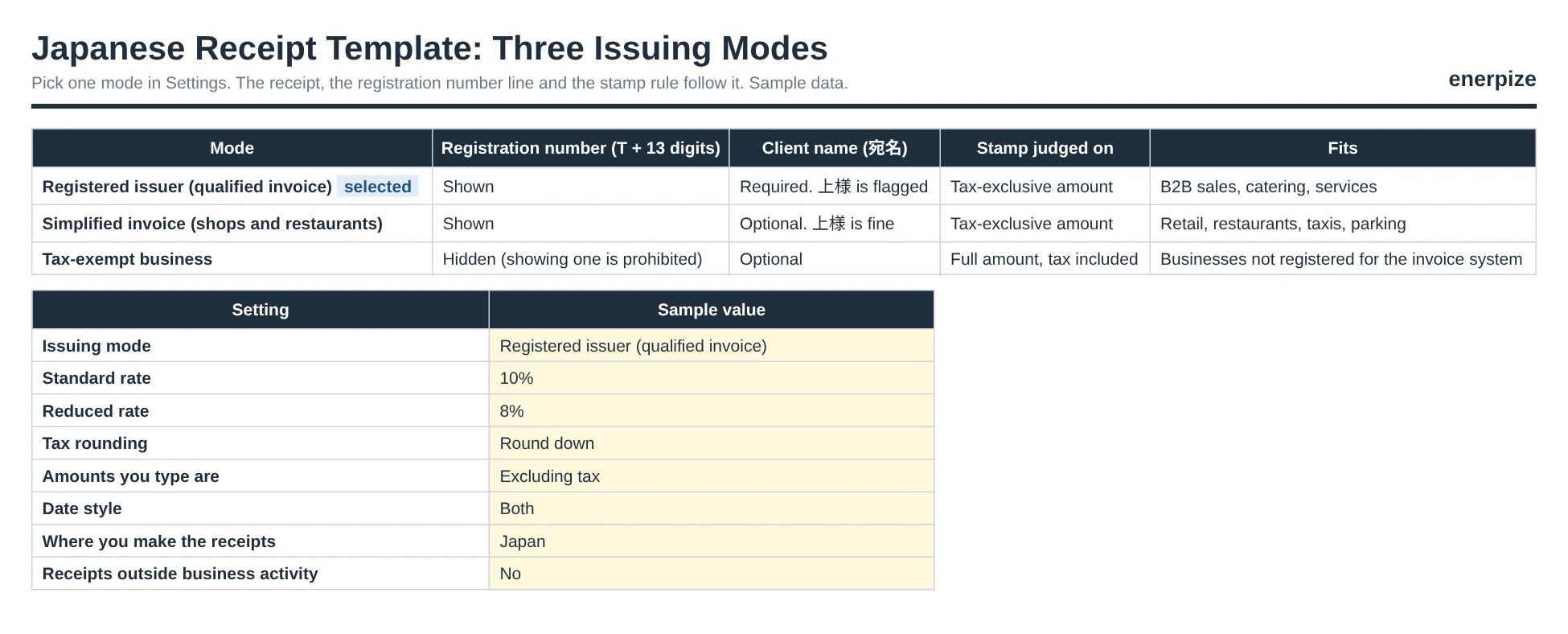
Pick a mode in Settings: registered issuer, simplified invoice or tax-exempt business. The receipt follows. Tax-exempt mode removes the registration number line and judges the stamp on the full amount, because an exempt business has no consumption tax to separate.
English on Your Screen, Japanese on the Paper
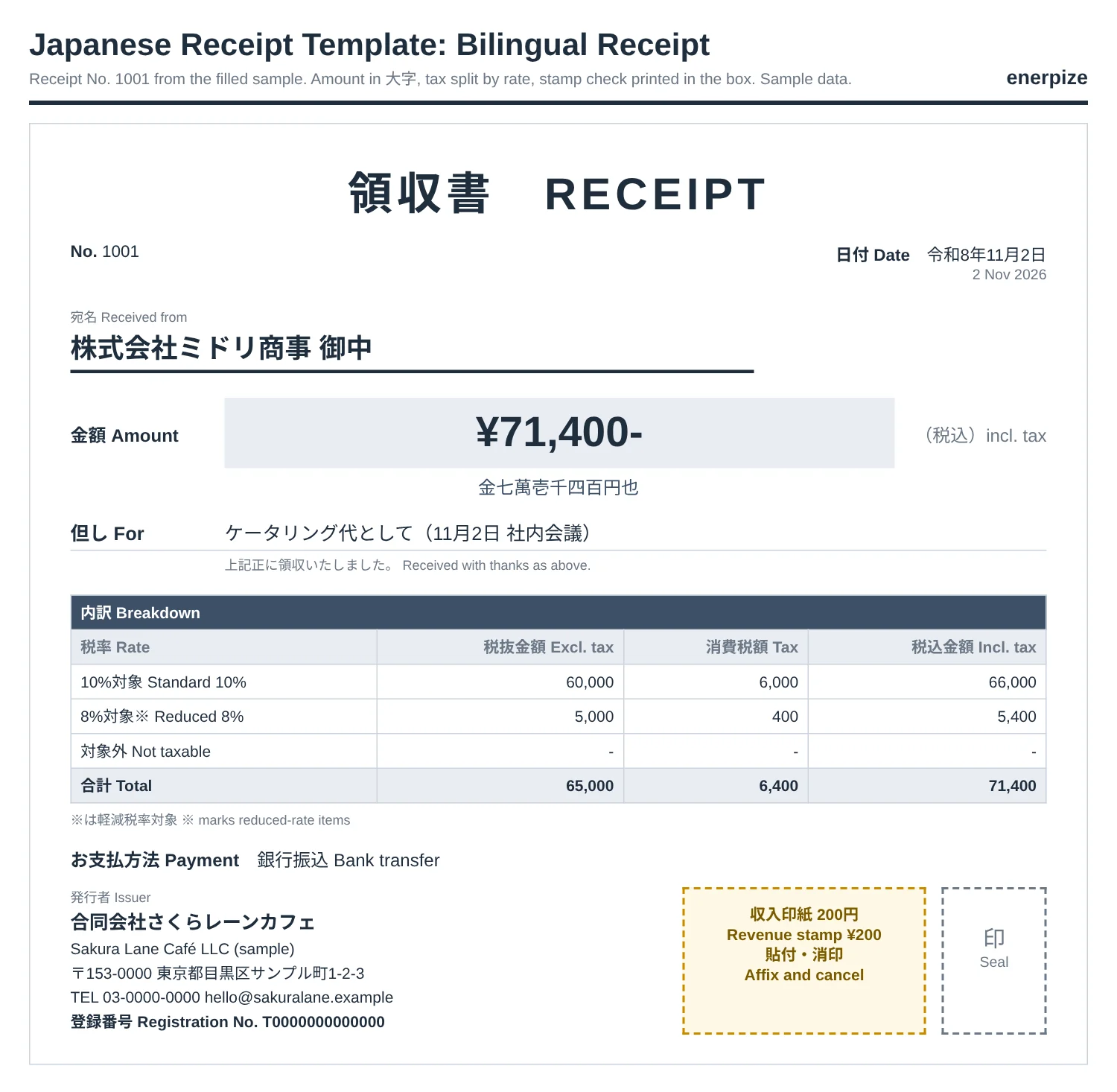
You fill it in with English labels. The printed receipt reads 領収書 RECEIPT, with every field in both languages, so your client's accountant and your own bookkeeper can both read it. The amount also prints in 大字 (daiji), the formal numerals: 金七萬壱千四百円也 for ¥71,400.
A Log That Keeps Your Copies
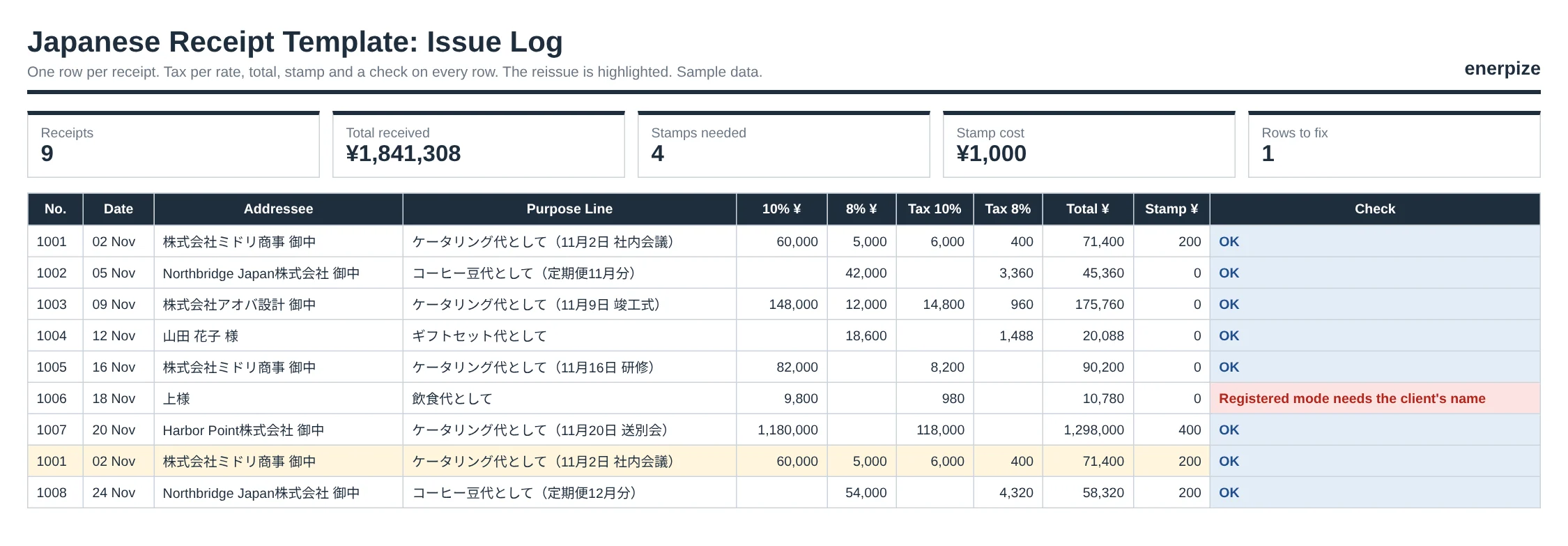
Registered issuers keep copies of the qualified invoices they issue for 7 years. The Issue Log is that record: one row per receipt, tax by rate, total, stamp and a Check column that flags a missing name, purpose line or payment method. A reissued receipt keeps its number and stands out in amber.
Rates in One Cell Each
10% and 8% each live in one cell in Settings, with rounding down, to the nearest yen or up. Tax is rounded once per rate on each receipt, never line by line. If the 8% food rate changes, you change one cell.
Example: A Filled Japanese Receipt Template
Want to see it working before you type anything? Make your own copy of the filled sample in Google Sheets. The sample follows a fictional Tokyo business, Sakura Lane Café, through 9 receipts in November 2026: catering for companies, coffee bean subscriptions and counter sales. It totals ¥1,841,308 received.
How to Read the Sample
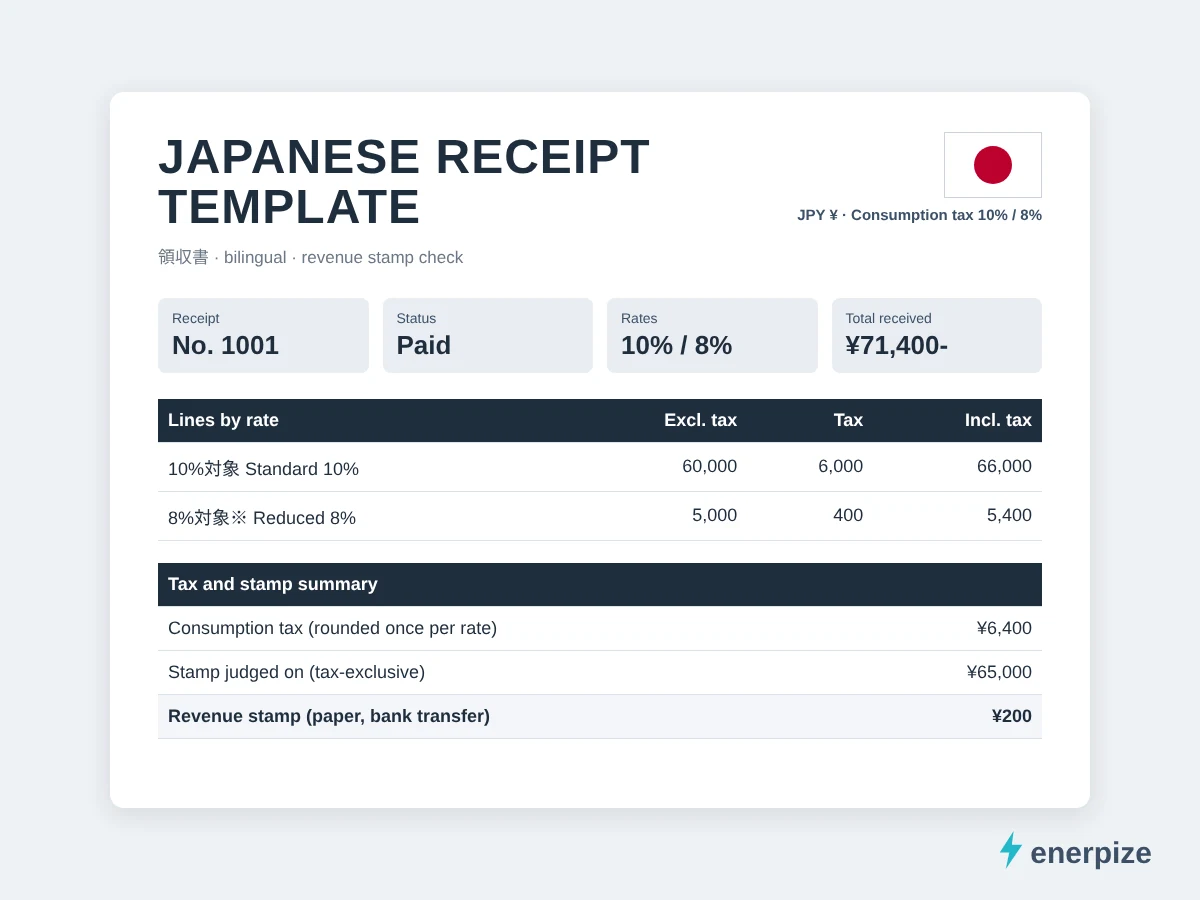
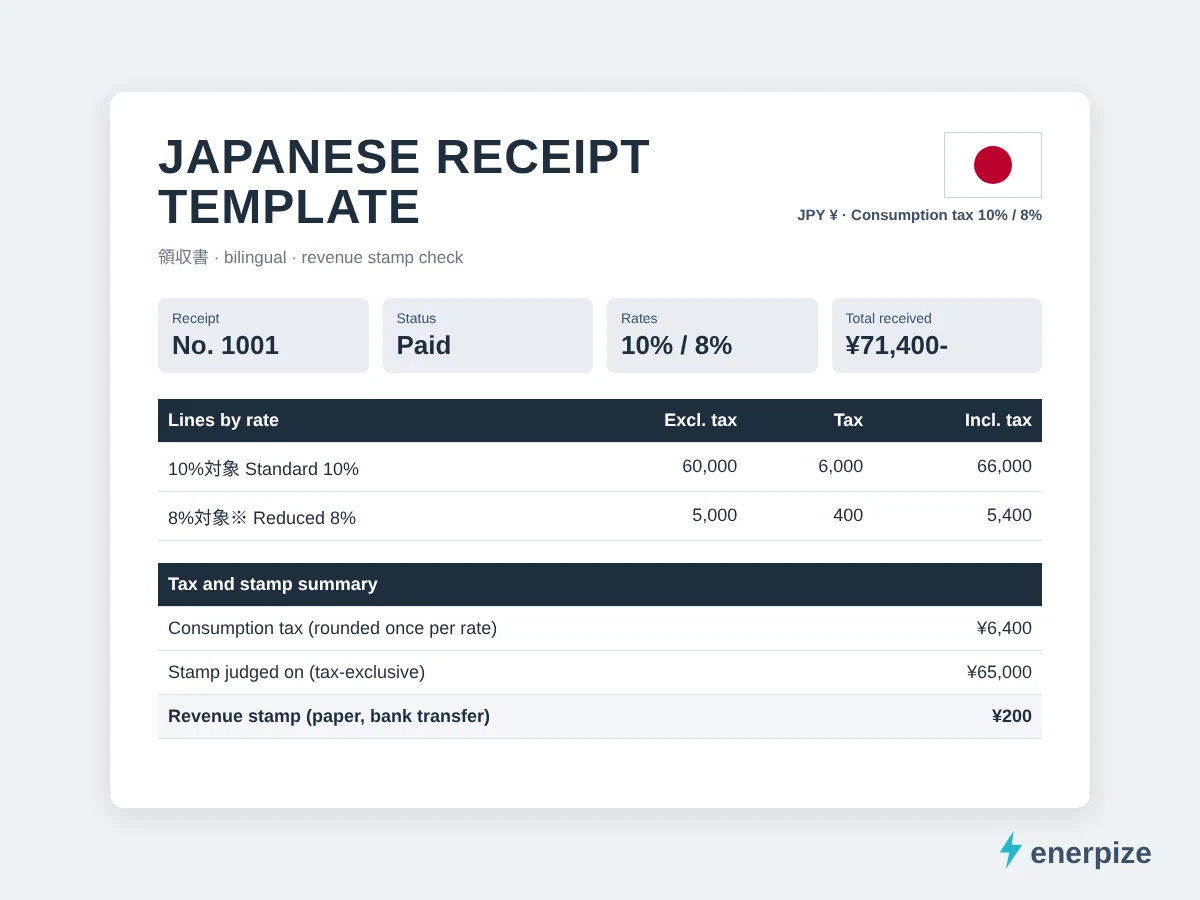
Start with receipt No. 1001. Catering for ¥60,000 at 10% plus boxed sweets for ¥5,000 at 8%.
¥65,000
¥6,000 + ¥400
¥71,400
¥65,000
¥200
Now compare the others. No. 1003 is ¥175,760, but paid by credit card and marked so on the receipt: no stamp. No. 1005 is ¥90,200 sent as a PDF: no stamp. No. 1007 is ¥1,298,000 by transfer, judged on ¥1,180,000: a ¥400 stamp. No. 1008 is ¥58,320 by QR code, which counts as money received: ¥200.
Then find No. 1006. It's addressed to 上様, and the Check column says "Registered mode needs the client's name". A café can use 上様 on a simplified invoice. This sample runs in registered mode, so the row is flagged.
Japanese Receipt Formulas
Every formula is built in. Here is what each one does, with a number from the sample.
Tax per Rate
Tax = ROUNDDOWN(Amount at the rate × Rate)
¥60,000 × 10% = ¥6,000. If you type tax-inclusive amounts instead, the tax is pulled out: ¥11,000 × 10 / 110 = ¥1,000.
Amount the Stamp Is Judged On
Registered or simplified: Excl. tax 10% + Excl. tax 8% + Not taxable | Tax-exempt: Total received
¥60,000 + ¥5,000 = ¥65,000 for No. 1001. Under ¥50,000 means no stamp.
Stamp Amount
=INDEX(Stamp column, MATCH(Amount judged on, Band start column, 1))
The workbook holds all 14 bands. ¥1,180,000 falls in the band from ¥1,000,001 to ¥2,000,000, so the stamp is ¥400.
Amount in 大字
金 + 億 group + 萬 group + units + 円也
¥71,400 splits into 7 萬 and 1,400, which prints as 金七萬壱千四百円也. 壱, 弐 and 参 are used because they are hard to alter.
How to Write a Japanese Receipt with the Template
Ten minutes to set up, one minute per receipt after that.
1- Set Up Your Business Once
Enter your business name in Japanese, the English name if you want it, address, phone and registration number in Settings. The number check tells you if it isn't T plus 13 digits.
⚡ Tip: No registration number? Choose tax-exempt mode, and leave the number blank.
2- Write the Date You Received the Money
Not the invoice date. For a bank transfer, use the day it reached your account, so the receipt matches your bank statement.
⚡ Tip: Pick Reiwa, Western or both in Settings. 令和8年 is 2026.
3- Write the Client's Full Name
Use the full legal name with 株式会社, never the short (株). Pick 御中 for a company or 様 for a person.
⚡ Tip: On a simplified invoice, 上様 is allowed. On a full qualified invoice, it isn't.
4- Write a Real Purpose Line
Finish it with として: ケータリング代として (for catering). The dropdown suggests common lines, and you can type your own.
⚡ Tip: Add the period or event in brackets, such as (11月分), so the date reads clearly.
5- Enter Amounts by Rate
Put food and drinks to take away under 8%, everything else under 10%. The log adds the tax once per rate.
⚡ Tip: Mixed receipt? The ※ note for reduced-rate items prints by itself.
6- Pick the Payment Method and Paper or PDF
These two choices decide the stamp. Credit card prints クレジットカード利用 on the receipt, which is the line that removes the stamp.
⚡ Tip: Sending a PDF? Don't hand over paper too, or the paper copy can need a stamp.
7- Print, Stamp and Keep the Copy
Pick the number on the Receipt sheet and print or save as a PDF. If the box says a stamp is needed, affix it and cancel it with your seal or signature across the edge.
⚡ Tip: Email PDFs, never the Excel file, so the numbers can't be edited.
Common Japanese Receipt Mistakes
A receipt can look perfect and still cost you money.
✕ Writing only the tax-inclusive total
Why it matters: The stamp is judged on the higher figure, sometimes one band up.
Fix: Show the amount before tax and the tax separately.
✕ Stamping a credit card receipt
Why it matters: The stamp was never owed, and you paid it anyway.
Fix: Write クレジットカード利用 on the receipt and skip the stamp.
✕ Forgetting to cancel the stamp
Why it matters: An uncancelled stamp counts as unpaid.
Fix: Run your seal or signature across the stamp and the paper.
✕ お品代 as the purpose line
Why it matters: Nobody can tell what was bought, and the expense gets questioned.
Fix: Name the item or service and end with として.
✕ A number that looks like a registration number
Why it matters: A tax-exempt business must not show one.
Fix: Use tax-exempt mode, which removes the line.
✕ Sending a PDF and paper together
Why it matters: The paper copy is a stamped document, so the PDF saving is lost.
Fix: Send one or the other.
Why the Japanese Receipt Matters
How often will that stamp question come up? More each year. Japan's Ministry of Economy, Trade and Industry put the 2025 cashless payment ratio at 58.0%, with credit cards making up 82.7% of cashless spending. So what? A card payment marked on the receipt needs no stamp, while a QR code payment usually does. The payment method is now a tax question.
It Protects Your Client's Tax Credit
Without a registration number, your client's credit on what they paid you drops. From October 1, 2026, the transitional rate is 70% until September 30, 2028, then 50% and 30%. Your T number on the receipt keeps them at 100%.
It Stops a Small Tax Turning Into a Big One
A missing ¥200 stamp found in an audit costs three times the stamp. Report it yourself first and it is 1.1 times, according to the National Tax Agency's rules on unpaid stamp tax.
It Ends the Back and Forth
A clear name, date and purpose line means the receipt clears your client's expense check the first time.
Spreadsheet vs Software for Japanese Receipts
A template is the right tool for a handful of receipts a month. Past that, the copying starts.
| What you need | Japanese receipt template | Enerpize |
|---|---|---|
| Cost | Free | Free trial, then a paid plan |
| Bilingual 領収書 with stamp check | Built in | Keep using the template for this |
| 10% and 8% on one document | Two cells per receipt | Multiple taxes on invoices |
| Registration number on documents | A Settings cell | A custom field on your printable templates |
| Link to the invoice and payment | Typed again | Payment recorded against the invoice |
| Receipt for each payment | Printed from the log | Payment receipt to print, save as PDF or email |
How Enerpize Handles Invoices, Payments and Receipts in Yen
Where does the number on the receipt come from? In most small businesses, from an invoice someone typed twice. Enerpize keeps the invoice, the payment and the receipt on one record. The screens below use sample data.
Yen as Your Base Currency
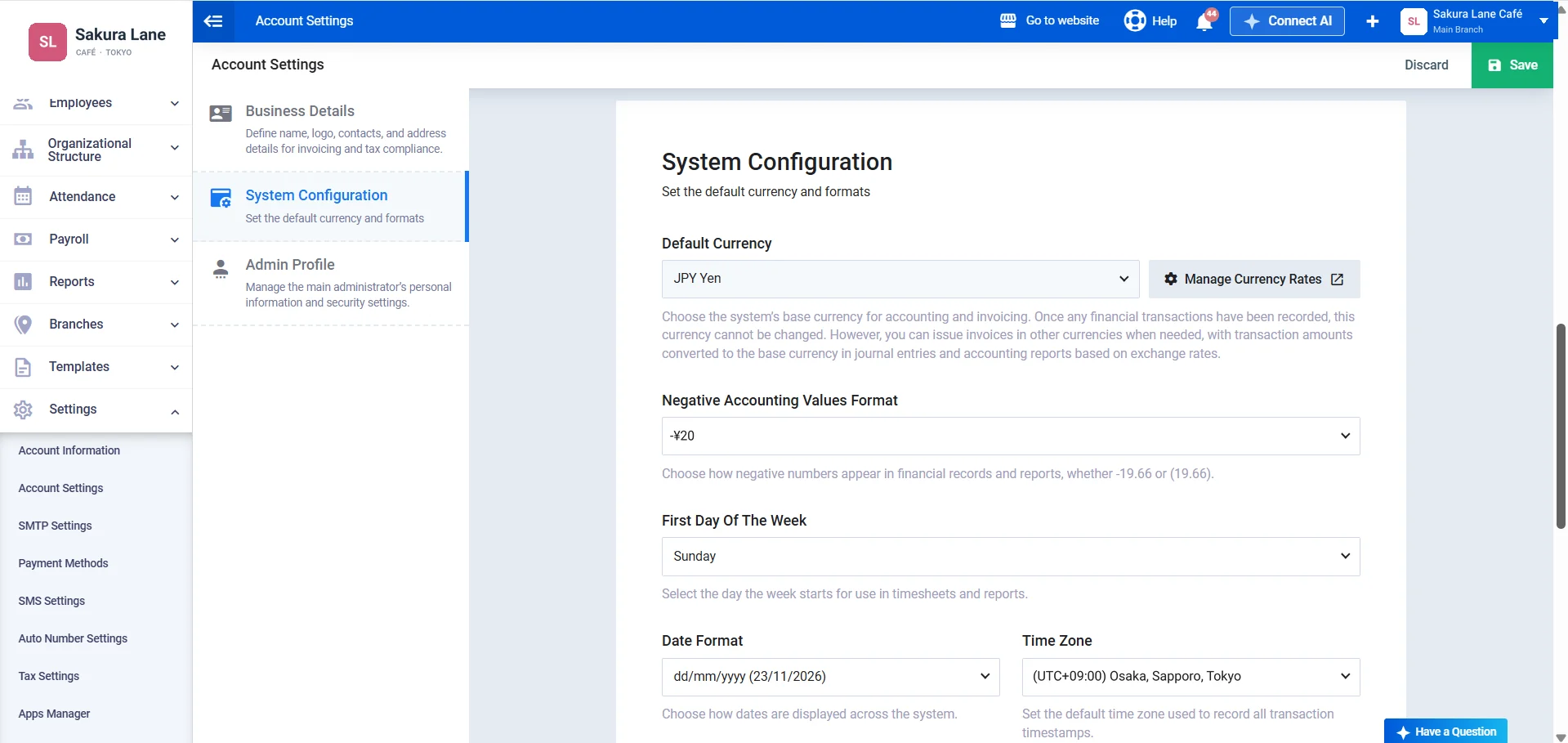
Set JPY as the default currency in System Configuration, with your date format and time zone. You can still issue invoices in other currencies when needed, and amounts convert to yen in your journal entries.
Consumption Tax at 10% and 8%
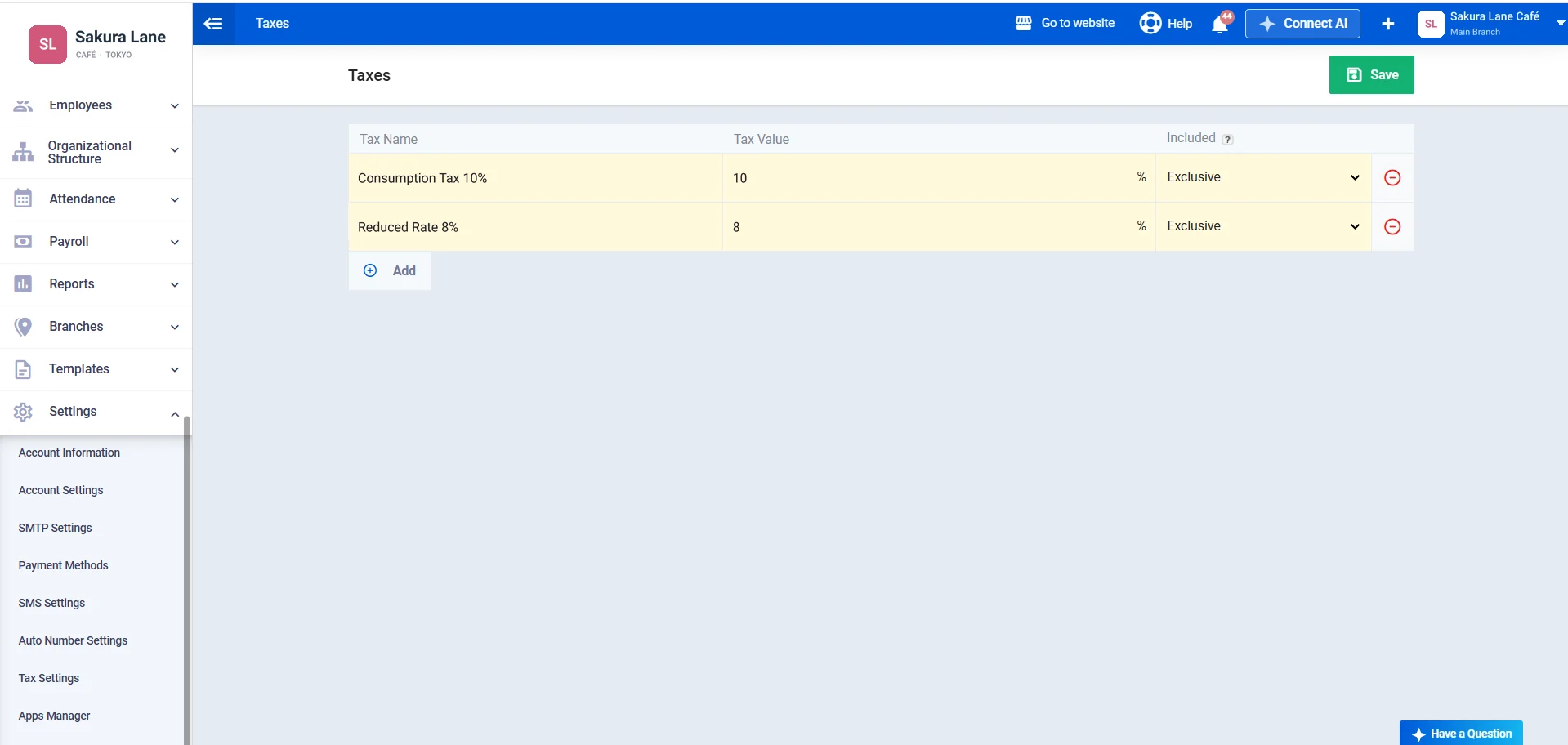
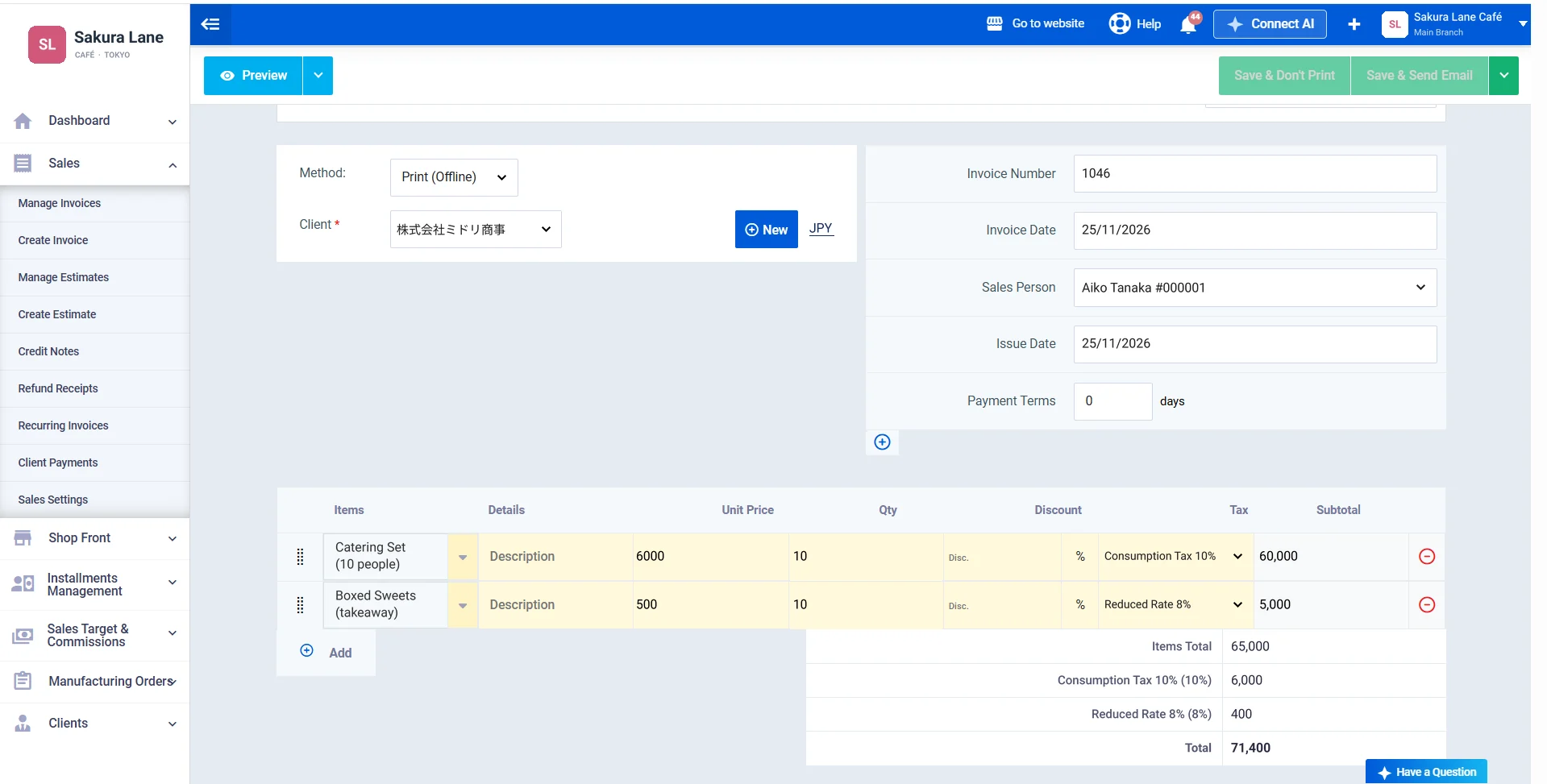
Add each rate once in Tax Settings, then pick it per line. The invoicing software supports multiple taxes, so catering at 10% and sweets at 8% sit on the same invoice with a total for each.
Your Registration Number on Every Document
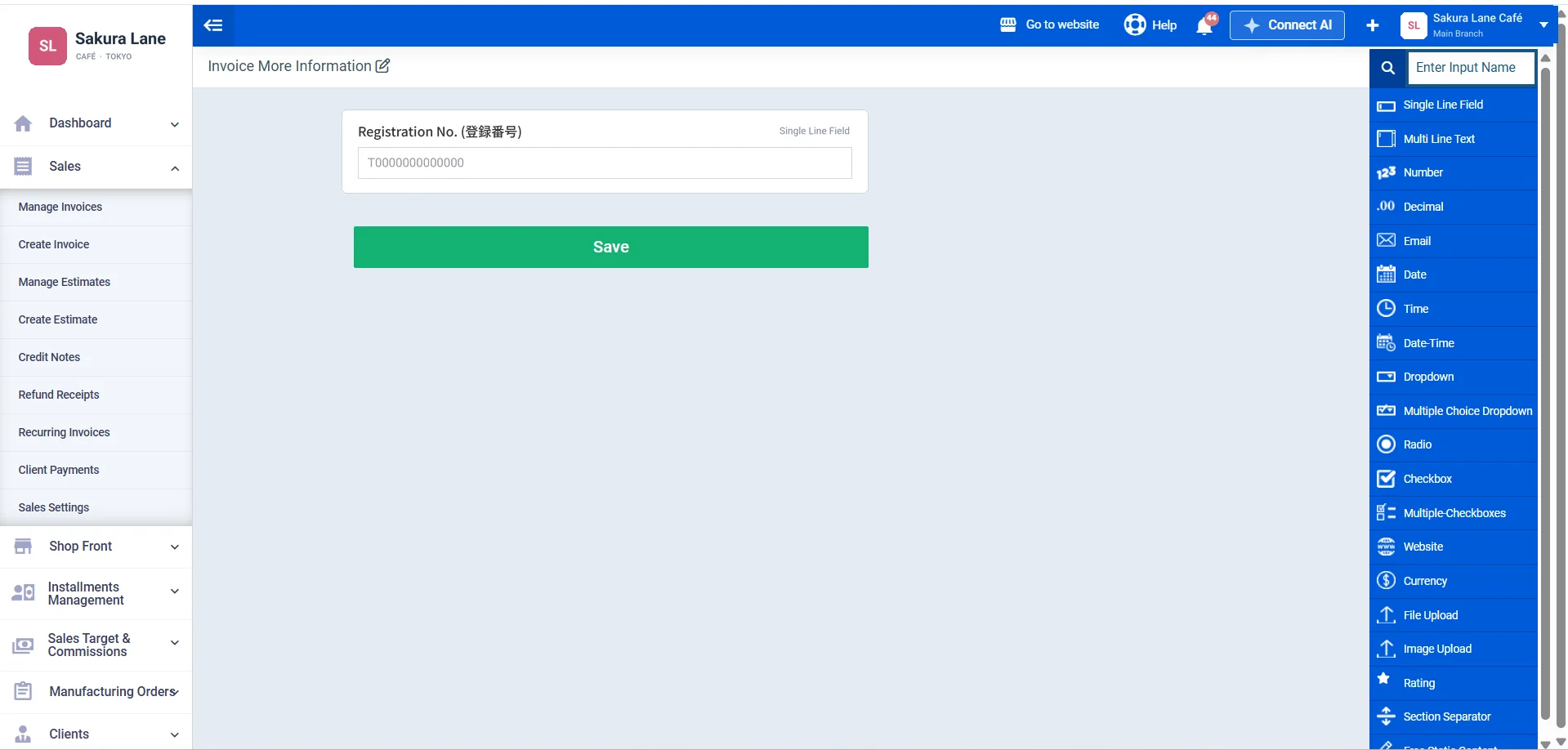
Add a field with custom fields, then show it on your printable templates. The invoicing page lists custom fields and customizable printable templates for exactly this kind of addition.
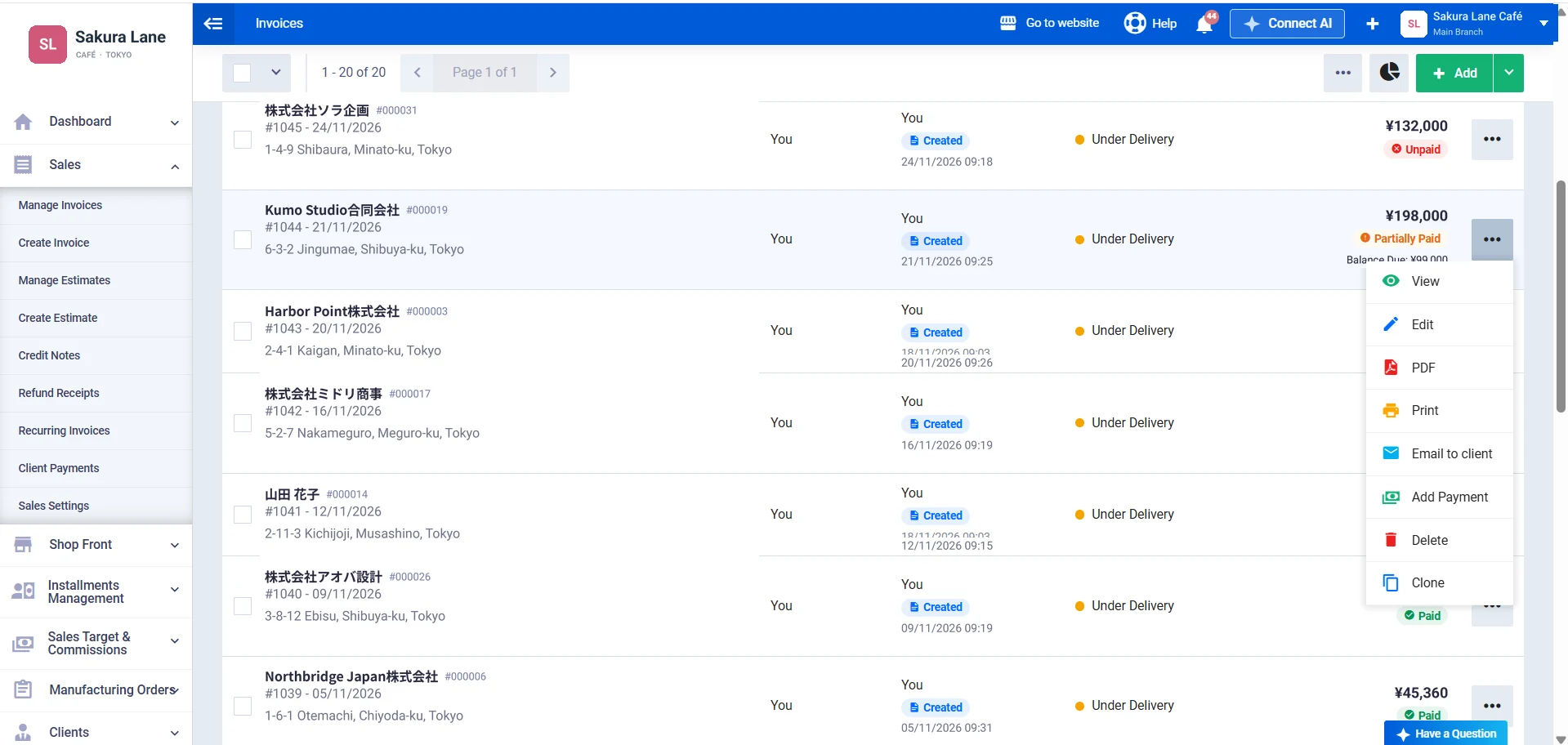
Paid, Partly Paid, Unpaid
Every invoice shows its status. Add Payment from the invoice menu, including partial payments, and the balance due updates.
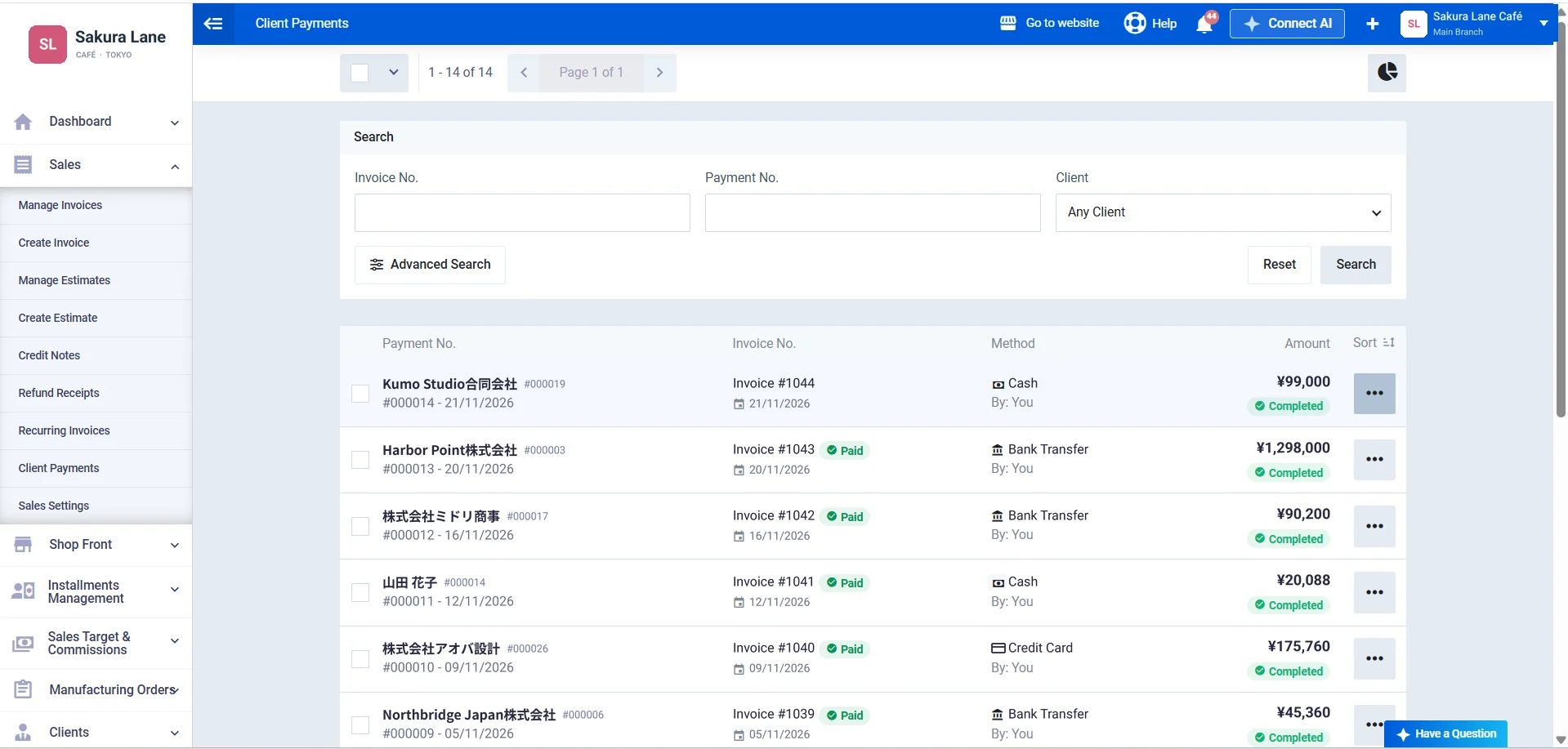
A Receipt for Every Payment
Open any payment in Client Payments and print it, save it as a PDF or email it as a payment receipt. You can use your own receipt template, and the amount prints in words too, according to the knowledge base article on payment receipts.
Receipts at the Counter
At a shop or café, the POS system takes several payment methods in one sale, keeps selling offline and syncs when you reconnect. Its settings choose the receipt layout and can print the receipt automatically after payment.
The Receipts You Receive
Receipts flow the other way too. The expense management software lets you scan or upload receipts and pull out the amount, date, vendor and tax.
Revenue Stamps on Japanese Receipts (収入印紙)
The most common question about a Japanese receipt is about a ¥200 sticker.
A revenue stamp (収入印紙, shunyu inshi) pays stamp tax on paper documents. A receipt for sales is a Category 17-1 document, and the National Tax Agency's guidance on receipts treats a stated amount under ¥50,000 as tax-free. When a consumption taxpayer shows the tax separately, the tax is left out of the stated amount. A tax-exempt business must count the full figure.
| Amount on the receipt | Stamp |
|---|---|
| Under ¥50,000 | None |
| ¥50,000 to ¥1,000,000 | ¥200 |
| Over ¥1,000,000 to ¥2,000,000 | ¥400 |
| Over ¥2,000,000 to ¥3,000,000 | ¥600 |
| Over ¥3,000,000 to ¥5,000,000 | ¥1,000 |
| Over ¥5,000,000 to ¥10,000,000 | ¥2,000 |
| Over ¥10,000,000 | ¥4,000, rising to ¥200,000 over ¥1 billion |
What to add:
- The amount before tax and the tax as two separate figures
- クレジットカード利用 on card receipts, since a card receipt without that note is still taxable
- A stamp, cancelled with your seal or signature, on paper receipts of ¥50,000 or more
⚑ Practical note: QR code payments are different. The National Tax Agency says receipts marked as code payments fall under Category 17-1, so treat them like cash.
Japan's Invoice System and Your Receipts (適格請求書)
Since October 1, 2023, the content on your receipt decides whether your client can claim tax back.
The National Tax Agency's invoice Q&A lists six items a qualified invoice must carry: issuer name and registration number, transaction date, what was supplied with any reduced-rate items marked, the total per tax rate with the rate, the consumption tax per rate, and the buyer's name. A receipt with all six is a qualified invoice.
What to add:
- Your T number on every receipt, once you're registered
- Tax rounded once per rate on each receipt
- A ※ or similar mark on reduced-rate items
⚑ Practical note: Handwritten receipts count too, as long as the six items are there. A rubber stamp with your T number is fine.
Simplified Invoices and 上様
Can a café write 上様 instead of a name? Yes, if it issues a simplified invoice.
Businesses that sell to many unspecified customers, such as retail, restaurants and taxis, may issue a simplified qualified invoice. The National Tax Agency's Q&A on simplified invoices says it can leave out the buyer's name and needs either the tax per rate or the rate, not both.
What to add:
- Simplified invoice mode in Settings if you sell over a counter
- The client's full name whenever a company asks for one anyway
- Your T number, which a simplified invoice still needs
⚑ Practical note: Catering for a company is a named B2B sale. Use registered mode and the client's name, even if your café runs simplified mode at the counter.
Electronic Receipts and Stamp Tax
Sending a Japan receipt as a PDF is the simplest way to skip the stamp.
Stamp tax applies when a paper document is handed over. A Fukuoka Regional Taxation Bureau response confirmed that a document sent as a PDF by email is not a taxable document being made. The amount doesn't matter.
What to add:
- PDF in the Paper or PDF column, so the log shows no stamp
- A file name with the date, client and amount, such as 20261102_Client_71400.pdf
- Your PDFs kept as files, searchable by date, amount and client
⚑ Practical note: Food rate watch: a bill to cut the 8% rate on food and drink to 1% from April 1, 2027 is in the Diet. The National Tax Agency's leaflet on the proposal says it applies only if the bill passes. If it does, change one cell in Settings.
Who Can Use the Japanese Receipt Template?
Foreign Companies Selling in Japan
Your finance team works in English. Your clients file in Japanese. The bilingual receipt serves both.
Freelancers With Japanese Clients
A designer or developer paid by a Tokyo company gets asked for a ryoshusho once and then every month. The log keeps the numbering straight.
Cafés, Restaurants and Shops
8% for takeaway, 10% for eating in, often on one receipt. A retail business can run simplified mode at the counter and print a named receipt when a company asks.
Service Businesses Taking Cash on Site
Cleaning, repairs, lessons. Print the handwritten sheet with your details on it and carry it.
Japanese Receipt Glossary
| Term | Romaji | Meaning |
|---|---|---|
| 領収書 | ryoshusho | Receipt proving payment |
| レシート | reshiito | Register slip |
| 但し書き | tadashigaki | Purpose line |
| 御中 / 様 | onchu / sama | Honorific for a company / a person |
| 上様 | uesama | "Valued customer" in place of a name |
| 収入印紙 | shunyu inshi | Revenue stamp |
| 消印 | keshiin | Cancelling the stamp |
| 登録番号 | toroku bango | Registration number, T + 13 digits |
| 適格請求書 | tekikaku seikyusho | Qualified invoice |
| 大字 | daiji | Formal numerals for amounts |
Key Takeaways
- A Japanese receipt (ryoshusho) proves payment. An invoice asks for it.
- Paper receipts of ¥50,000 or more for sales need a revenue stamp, starting at ¥200.
- Show tax separately and the stamp is judged before tax: ¥54,780 becomes ¥49,800, so no stamp.
- Card receipts marked クレジットカード利用 and PDF receipts need no stamp. QR code receipts usually do.
- A qualified invoice needs six items, including a T number with 13 digits and tax per rate.
- Without a registration number, your client's tax credit is 70% from October 1, 2026.
- A missing stamp costs three times the stamp in an audit, or 1.1 times if you report it first.
- The sample's 9 receipts total ¥1,841,308, with 4 stamps costing ¥1,000.
Frequently Asked Questions
What is a ryoshusho?
A ryoshusho (領収書) is a Japanese receipt that proves you received payment. It shows the date, the payer's name, the amount, a purpose line and the issuer. Businesses ask for one to support expense claims, and with a registration number and tax by rate it also counts as a qualified invoice.
Why do you get two receipts in Japan?
Shops often print a register slip (reshiito) first, then write a formal ryoshusho when you ask for one with your company name. Both prove the same payment. Use one of them for your expense claim, not both, so the expense isn't counted twice.
Can a Japanese receipt be in English?
Yes. Japan has no set receipt layout, so English is allowed, but Japanese clients and accountants expect the Japanese terms. A bilingual receipt with 領収書 RECEIPT on top and both languages on each field works for both sides.
When does a Japanese receipt need a revenue stamp?
When it is a paper receipt for sales of ¥50,000 or more, paid in cash or by transfer. If the tax is shown separately, the stamp is judged on the amount before tax. The stamp is ¥200 up to ¥1,000,000 and rises with the amount.
Where can I buy a revenue stamp in Japan?
Post offices sell most amounts, and many convenience stores sell the ¥200 stamp used on most receipts. Pay in cash. After you affix the stamp, cancel it with your seal or signature across the stamp and the paper.
Does a PDF or credit card receipt need a stamp?
No. Stamp tax applies to paper documents, so a receipt sent as a PDF needs none. A credit card receipt needs none either, as long as it states クレジットカード利用. Without that note, it is taxed like a cash receipt.
Can I write 上様 on a Japanese receipt?
Only on a simplified qualified invoice, which shops, restaurants and taxis may issue. A full qualified invoice needs the buyer's name. For company clients, write the full legal name with 御中.
Do I need a hanko or company seal on a receipt?
No law requires one, but many Japanese businesses expect a seal next to the issuer's name. You do need a seal or signature to cancel a revenue stamp. A rubber stamp with your registration number also works on handwritten receipts.
About the Author
Omar El Bahr is a Senior Digital Growth Specialist at Enerpize, where he leads SEO, content strategy, and organic growth across international markets. He is a Forbes Communications Council contributor and has written for Entrepreneur on business communication and digital strategy.
Disclaimer
The Enerpize Japanese receipt template and this page are general information based on rules and official materials as of November 2026, not tax or legal advice. A receipt template is not a legal form. Confirm your own transactions with a licensed tax accountant (税理士) or the National Tax Agency.