

Posted on 3 June 2026
Free Receipt Template Download: PDF, Excel, Word & Google Sheets
- Covers cash, sales, payment, rent, and donation receipts across every transaction your business handles.
- Auto-calculates subtotals, tax, and balance due in every format.
- Fully editable fields for your logo, business details, tax rate, and payment terms.
- Available in PDF, Excel, Word, Google Docs, and Google Sheets.
A receipt template is a pre-formatted document that records a completed payment between a business and a customer, covering the transaction date, items or services provided, the amount paid, the payment method, and any applicable taxes.


What Is a Receipt Template?
You know that slip of paper the cashier hands you before you walk out the door? The one you stuff into your wallet and find three weeks later when you are looking for your loyalty card?
That piece of paper is doing more work than it looks like.
A receipt is the legal record that a transaction happened. It says money changed hands, what it was for, how much it was, and when it occurred. For your business, it is the raw material of your accounts receivable records, your tax filings, and your audit trail.
A receipt template gives you a consistent, professional way to produce that record every time, without rebuilding the layout from scratch for each customer.
The difference between a receipt and an invoice is simple. An invoice is a request for payment. A receipt confirms that the payment was made. You issue the invoice first. The receipt comes after the money arrives.
Stop creating receipts from scratch every time. Issue them directly in Enerpize, free, no credit card required. Start for free.
What to Include on a Receipt Template
Most receipt templates online give you the basics and stop there. Here is the complete picture.
Required Fields
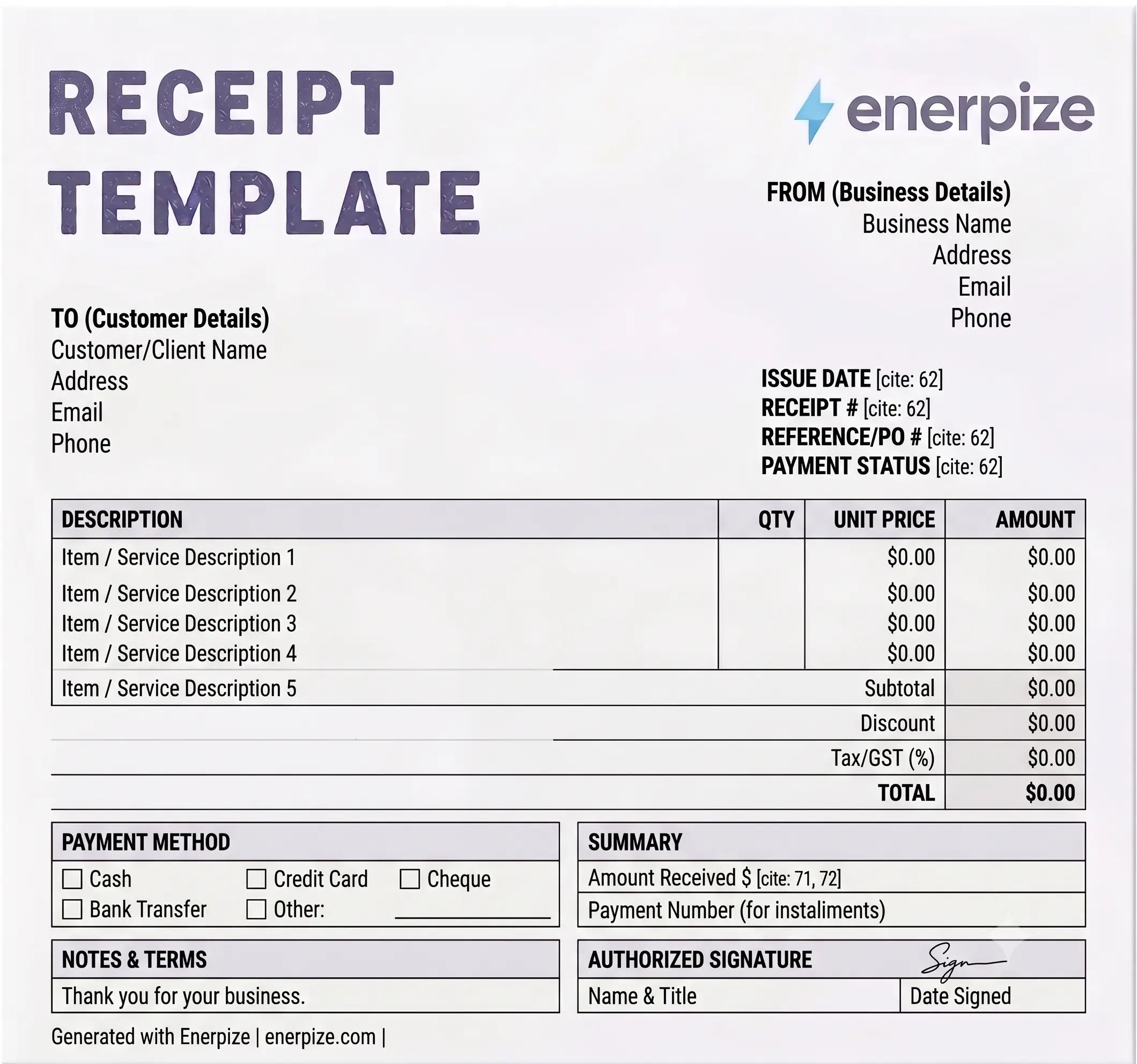
Every receipt you issue should include these fields, regardless of industry or transaction type.
| Field | What It Does |
|---|---|
| Business name and contact details | Identifies who issued the receipt |
| Receipt number | Sequential numbering creates an audit trail |
| Transaction date | Establishes when the payment was received |
| Description of goods or services | Documents what the payment was for |
| Quantity and unit price | Allows itemized verification |
| Subtotal | The pre-tax total |
| Tax rate and tax amount | Shows what was collected on behalf of the government |
| Total amount | The final figure the customer paid |
| Payment method | Cash, card, bank transfer, cheque, or other |
| Received by | The name or signature of the person who accepted payment |
Optional Fields That Strengthen Your Records
These fields are not legally required in most jurisdictions, but they will save you from headaches later.
Adding a customer name and contact details makes the receipt searchable in your records. Including a reference or purchase order number links the receipt back to a specific invoice or job. A balance due field matters the moment a customer pays in installments, because without it you have no paper record of how much they still owe. A payment number field (Payment 1 of 3, for example) turns a plain receipt into a proper installment log.
Fields Required for Australian GST Receipts
If your business is registered for GST in Australia and the sale is over $82.50 including GST, the receipt needs to meet the requirements of a tax invoice. That means it must display your ABN, the words "Tax Invoice," a clear statement of the GST amount included, and a description of the taxable supply.
A plain receipt without these fields is not sufficient for a GST-registered customer to claim an input tax credit. The Australian Tax Office is explicit on this. If you are issuing receipts to other GST-registered businesses in Australia, treat every sale over that threshold as a tax invoice, not just a receipt.
Fields Required for US Cash Transactions
For cash transactions in the United States, the receipt is often the only proof of purchase, since cash leaves no digital trail. The IRS recommends that businesses keep records of all cash income, and a sequentially numbered receipt book is one of the cleaner ways to demonstrate that your reported income matches your actual transactions. Some states, including California, require businesses to include their seller's permit number on receipts for certain sales.
Receipt vs. Invoice: The Difference That Trips Everyone Up
Here is the version of this question that actually shows up in real life.
You finish a job, send the client an invoice, and they pay two weeks later. When they ask you for a receipt, what do you send them? The invoice with "PAID" stamped on it, or a separate document?
Technically, a paid invoice and a receipt are different documents. The invoice was a request for payment. The receipt is the acknowledgment that the payment was received. In practice, many small businesses use a paid invoice as a receipt, and that works fine for most purposes.
Where it matters is in cash transactions, installment payments, and donation acknowledgments. In those cases, a standalone receipt is the cleaner and more legally defensible document.
| Invoice | Receipt | |
|---|---|---|
| Issued | Before payment | After payment |
| Purpose | Requests payment | Confirms payment received |
| Required for GST input tax credit (AU) | Yes, as a tax invoice | Not on its own |
| Used for cash transactions | Rarely | Always |
| Contains payment method | No | Yes |
| IRS / ATO record keeping | Request side | Receipt side |
If you want to understand the full invoicing side of this, the invoice template page covers that in detail.
Types of Receipt Templates
Cash Receipt Template
Cash is the one payment type that disappears without a trace the moment it changes hands. No bank statement. No card transaction record. Just a physical handshake and a number in someone's head.
That is why a cash receipt is the most legally important receipt you will ever issue. It is the only documentation that the transaction happened at all.
A cash receipt should always include the amount tendered by the customer, any change returned, a description of what was paid for, and a signature from the person who received it. Without that, you are relying on memory if the transaction is ever questioned. The IRS recommends keeping all business receipts for a minimum of three years. Keep records for seven years if you file a claim for a loss from worthless securities or a bad debt deduction, and for six years if you underreported income by more than 25% of your gross income.
One more thing worth knowing: cash-heavy businesses get audited at higher rates because cash income is harder to verify independently. A clean, sequential receipt log is the simplest way to demonstrate that your reported cash revenue is accurate.
Sales Receipt Template
A sales receipt covers the sale of physical goods. It is the most common type of receipt and the one most people picture when they think of a receipt template.
The key difference from a general receipt is the emphasis on item descriptions, quantities, and unit prices. In a product-based business, the line items on the receipt are also your inventory movement record. What went out the door, how many units, at what price. If you are running a point-of-sale system, this data should be feeding directly into your inventory management.
Payment Receipt Template
A payment receipt is used when a client is paying a specific invoice, often as part of an installment arrangement. It records how much was paid on that date, which invoice it applies to, and what balance remains.
This is the receipt type that most businesses handle badly. They either issue a standard receipt with no reference to the outstanding invoice, or they email a "your payment has been received" message that has no legal standing as a document.
The right approach is to issue a payment receipt that references the original invoice number, shows the amount received in this payment, shows the running total paid to date, and shows the balance still outstanding. That way both sides have a clean paper trail for every installment, not just the final one.
Rent Receipt Template
In most Australian states and territories, landlords are required to provide rent receipts under their respective Residential Tenancies Acts, though the exact rules vary by state. In NSW, a receipt is required for any payment not made by electronic funds transfer. In South Australia, one must be issued within 48 hours of receiving payment.
Most other jurisdictions strongly recommend rent receipts even where they are not explicitly mandated, because a receipt log is the cleanest way to resolve payment disputes between landlords and tenants.
A rent receipt should always include the tenant name, the rental property address, the rental period the payment covers, the amount paid, the date it was received, and the payment method. If a partial payment is made, note the amount paid and the outstanding balance.
Donation Receipt Template
If you run a nonprofit or charity, the donation receipt is not just a courtesy. In the United States, donors cannot claim a tax deduction for a contribution of $250 or more without a written acknowledgment from the organization that received it. That acknowledgment is the donation receipt.
The IRS guidance on written acknowledgments covers exactly what a written acknowledgment must include: the organization's name, the date and amount of the contribution, and a statement of whether any goods or services were provided in exchange. If you received something in return for the donation, its fair market value must be stated.
A donation receipt template that skips any of these fields is not protecting your donors.
Delivery Receipt Template
A delivery receipt serves a different purpose than a payment receipt. It confirms that goods were physically received by the customer, not that payment was made. It is the document the person at the warehouse signs when a shipment arrives, or the confirmation that a courier collects.
For businesses that ship products, a delivery receipt protects you against "I never received it" disputes. It is also the document that links your inventory records to your outbound logistics: what left the warehouse, when, and who signed for it.
How to Make a Receipt
Most people overthink this. Here is how it actually works.
Step 1: Choose your format
If you are issuing a one-off receipt right now, download the PDF version of this template and fill it in. If you are issuing receipts regularly, use Excel or Google Sheets so your totals calculate automatically. If you are issuing receipts at scale, use accounting software that generates them directly from paid invoices.
Step 2: Add your business details
Business name, address, phone number, email. If you are GST-registered in Australia or VAT-registered in the UK, include your tax registration number.
Step 3: Assign a receipt number
Start at 001 and go sequentially from there. Never skip a number. A gap in your receipt sequence is an immediate red flag in any tax audit, because it suggests a transaction that was not recorded.
Step 4: Enter the transaction date and payment method
Be specific on the payment method. "Cash" is different from "bank transfer" is different from "credit card" from an audit perspective, and it matters when you are reconciling your accounts at month end.
Step 5: Itemize the goods or services
Description, quantity, unit price, line total. Resist the urge to write "services" as the entire description. Be specific. It protects you and it is more professional for the customer.
Step 6: Apply your tax rate and calculate totals
Subtotal first. Tax on top. Total last. If you are offering a discount, show it as a separate line between the subtotal and the tax, so the calculation is transparent.
Step 7: Get a signature and send it
If the payment was in cash, a "received by" signature on the receipt is important. For digital payments, email the receipt as a PDF immediately after the transaction is confirmed. The Stripe data shows that 84% of UK retailers were offering digital receipts as of 2023. Your customer expects one and they will remember the businesses that do not send one.
How Long Should You Keep Receipts?
The answer depends on where you are.
In the United States, the IRS general rule is three years from the date you filed the return. If you underreported income by more than 25%, the window extends to six years. If you filed a fraudulent return, there is no limit. For businesses that claimed a loss in a given year, the IRS says keep records for seven years.
In Australia, the ATO requires businesses to keep records for five years from when you prepared or obtained them, or from when the transactions were completed, whichever is later. For GST records specifically, that five-year clock runs from when you lodged the relevant BAS.
The practical advice: keep everything for five years as a baseline. If you use accounting software that archives your receipts automatically, you do not need to think about this at all.
Digital vs. Printed Receipt Templates
Why Digital Receipts Have Quietly Taken Over
Think about the last time you kept a printed receipt for more than a week. You probably cannot remember.
Digital receipts changed the relationship between businesses and customers because they arrive in an inbox instead of a wallet. They do not fade, they do not get lost, and they are searchable. For a customer who needs to submit an expense claim six months after a transaction, a PDF receipt in their email is worth ten times a paper receipt they cannot find.
There is a business angle here too. Digital receipts consistently achieve open rates between 60 and 80%, according to industry data on transactional emails, compared to around 20% for standard marketing emails. Your customer opens them. That means the footer of a digital receipt is valuable real estate. A link to a referral program, a discount code for their next order, a request for a Google review. These are not spammy add-ons. They are genuinely useful to a customer who just completed a transaction and is in a positive frame of mind about your business.
What Printed Receipts Still Do Well
Paper receipts are not going anywhere for cash-heavy environments, market stalls, mobile tradespeople, and situations where a customer needs immediate physical proof of purchase. The printed receipt also matters in formal contexts like construction contracts, where the AIA G702/G703 payment application process requires a documented audit trail that physical signatures support.
Keep your printed receipts legible, well spaced, and signed when cash is involved. If you are using a thermal printer, know that thermal printing fades over time, which matters for records you need to hold for five years. For long-term records, scan and archive a digital copy.
When a Receipt Template Is Not Enough
A receipt template works well when your transaction volume is low, your product mix is simple, and you are not yet dealing with multi-currency sales, tax across multiple jurisdictions, or customers who need receipts tied back to specific invoices in an accounts receivable system.
The moment any of those conditions apply, manual templates start creating more work than they save. You are copying numbers from one document to another. Your receipt records and your accounting records are separate documents that may not always agree. And when someone asks you to reconcile the two, you are doing it by hand.
Enerpize connects your invoicing, payment, and receipt records in one place. When a customer pays an invoice, the receipt generates automatically. Your accounts receivable template updates in real time. Your bank reconciliation has the transaction waiting for you. Nothing falls through the gap between a receipt folder and an accounting spreadsheet.
Enerpize generates receipts automatically when an invoice is marked paid, so your records are always in sync. Start for free.
Key Takeaways
- A receipt template records a completed payment. It comes after the invoice, not instead of it.
- Cash transactions need a signed receipt more than any other payment type because they leave no independent paper trail.
- Australian businesses registered for GST must issue a tax invoice, not just a receipt, for sales over $82.50 including GST.
- Sequential receipt numbering is not a formality. A gap in your sequence is a red flag in a tax audit.
- Keep receipts for at least five years. In the US, certain loss years require seven.
- When your transaction volume grows past what a template handles comfortably, accounting software that auto-generates receipts from paid invoices is the cleaner solution.
Frequently Asked Questions
What is the difference between a receipt and an invoice?
An invoice is a request for payment that you send before the money arrives. A receipt is a confirmation that the payment was received. You can issue both for the same transaction: the invoice first, the receipt once the customer pays.
What fields must a receipt include to be legally valid?
At minimum: your business name and contact details, the transaction date, a description of what was sold, the total amount, and the payment method. For cash transactions, adding a "received by" signature strengthens the record. For GST-registered businesses in Australia, the receipt must also function as a tax invoice for sales over $82.50.
How long should I keep receipts for tax purposes?
Three years in the US under the general IRS rule, extending to seven years for any year where you reported a loss. Five years in Australia under the ATO standard. When in doubt, keep everything for five years.
Can I use a receipt template for cash payments?
Yes, and for cash payments specifically, a signed receipt is the most important document you will issue. It is the only independent proof that the transaction happened.
Do I need to include GST on a receipt in Australia?
If your business is registered for GST and the sale is over $82.50 including GST, yes. The receipt must meet the requirements of a tax invoice, including your ABN, the words "Tax Invoice," and the GST amount. A plain receipt without these fields does not allow the other party to claim an input tax credit.
What is a cash receipt template used for?
It documents cash transactions where no digital payment trail exists. It records who paid, how much, what for, and when, and it is signed by the person who received the payment.
How do I create a receipt for a partial payment?
Use a payment receipt that references the original invoice number, states the amount received in this payment, shows the cumulative total paid to date, and shows the balance still outstanding. Issue a new receipt for every installment, not just the final one.
What is the difference between a sales receipt and a payment receipt?
A sales receipt records the sale of goods or services at the point of transaction. A payment receipt records a specific payment against an existing invoice, often as part of an installment arrangement. In practice, many businesses use the same template for both, but for installment customers, a payment receipt with running totals is the cleaner document.
Ready to stop issuing receipts manually? Enerpize's invoicing module handles receipts, tax calculations, and your full accounts receivable from the first invoice to the final payment. Start for free.
About the Author
Omar El Bahr is a Senior Digital Growth Specialist at Enerpize, where he leads SEO, content strategy, and organic growth across international markets. He is a Forbes Communications Council contributor and has written for Entrepreneur on mobile apps, business communication, and digital strategy.
This content is provided for informational purposes only and does not constitute legal, tax, or accounting advice. Requirements vary by jurisdiction. Consult a qualified professional for advice specific to your business.