

Posted on 9 December 2024
Free Statement of Account Template – Excel, Word & Google Sheets
- Free to download in Excel, Word, Google Sheets, Google Docs, and PDF — no signup required.
- Includes a filled-in sample showing invoices, payments, credits, and running balance.
- Fully editable format: add your business name, logo, client details, and transaction history in minutes.
A statement of account shows every transaction with a client over a specific period — invoices, payments, credits, and the outstanding balance. Download and customize this free template in Excel, Word, Google Sheets, Google Docs, or PDF.


What is a Statement of Account Template?
A statement of account template is a document sent by a seller to a buyer that provides a summary of all transactions within a specific period. It serves as a reminder of the amount due while also detailing sales, payments, and credits. Businesses typically use this document to manage credit sales and help customers stay informed about their outstanding balances. This guide will explain the components of a statement of account and how it simplifies transaction tracking for both businesses and clients. Across Enerpize's user base, businesses that send statements on a fixed monthly schedule collect roughly 20% faster than those who send them irregularly.
Want statements that generate themselves? Enerpize pulls your invoice and payment records automatically and produces a client-ready statement of account in seconds — free to start. Try Enerpize Free.
Statement of Account Sample
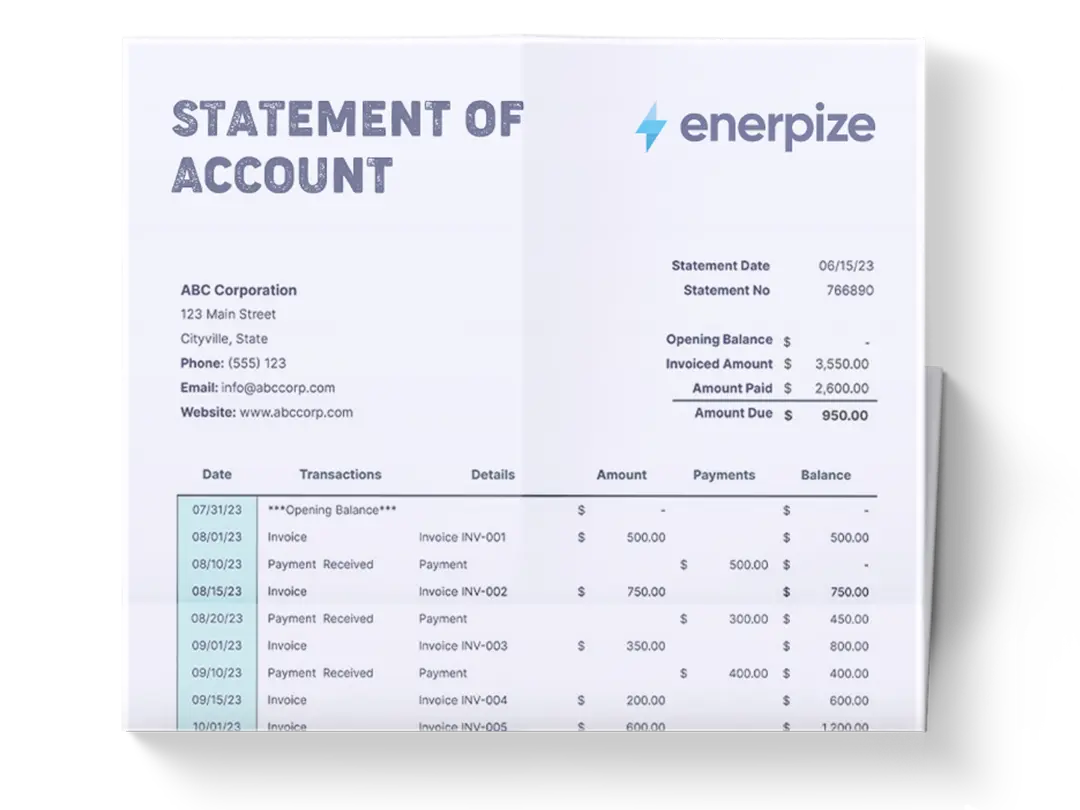
Below is a filled-in statement of account example showing how a business would summarize one month of transactions with a client.
| Date | Reference | Description | Invoice Amount | Payment Received | Balance |
|---|---|---|---|---|---|
| Mar 1, 2025 | Opening Balance | $800.00 | |||
| Mar 4, 2025 | INV-0055 | Product Supply — Batch #44 | $2,400.00 | $3,200.00 | |
| Mar 11, 2025 | PMT-0101 | Payment Received | $800.00 | $2,400.00 | |
| Mar 19, 2025 | INV-0061 | Monthly Service Fee | $1,200.00 | $3,600.00 | |
| Mar 25, 2025 | CN-0008 | Credit Note — Damaged Goods | $200.00 | $3,400.00 | |
| Mar 31, 2025 | Closing Balance | $3,400.00 |
Total Invoiced: $3,600.00 | Total Payments: $1,000.00 | Amount Due: $3,400.00
Importance of Statement of Account Template
Using an account statement template serves as a vital communication tool between businesses and their customers. It consolidates all transactions in one place, providing clarity and reducing misunderstandings. Here's why it matters:
Clear Financial Records
By summarizing all invoices, payments, and credits, a statement ensures both the business and the customer have an accurate account of financial interactions. This transparency helps in identifying and correcting errors such as missed payments or duplicate charges.
Payment Management
For businesses dealing with recurring customers, statements streamline payment tracking. They allow both parties to confirm which invoices have been settled and which remain outstanding. This functionality is particularly useful for monthly, quarterly, or annual billing cycles.
Cash Flow Improvement
Sending statements can encourage timely payments, improving cash flow. Vendors can use the document as a gentle reminder, helping clients avoid late fees and ensuring the business has the resources it needs to operate effectively.
Error Detection
Statements act as a fact-checking tool for inconsistent records. For example, if a payment is missing from the general ledger, the statement helps verify whether it was overlooked or misallocated. Similarly, duplicate entries can be spotted and corrected.
Client Relationship Management
Providing a clear, organized statement reflects professionalism and care for client relationships. It helps customers monitor their expenses, ensuring they stay on top of their accounts while building trust with the vendor.
Account Summary
Every statement needs a section a client can read in five seconds and understand exactly where they stand. This usually sits near the top, right under the client's name, and pulls together the previous balance, new charges added during the period, payments and credits received, and the new balance due. Enerpize's template builds this automatically from the transaction table below it, so nobody is manually adding up a column of numbers before hitting send.
Who Uses a Statement of Account Template?
A statement of account isn't industry-specific — any business that extends credit, manages recurring billing, or deals with multiple outstanding invoices at once has a use for it. Here's who relies on it most.
Small Business Owners and Freelancers
When you're managing client relationships without a dedicated finance team, a statement of account is your paper trail. It consolidates everything — invoices raised, payments received, credits applied, balance remaining — into one document you can send at the end of every month without reconstructing the history from scratch.
Accountants and Bookkeepers
Finance professionals routinely send statements on behalf of their clients' businesses as part of month-end procedures. A clean, consistently formatted template speeds up the process and ensures every client communication reflects the same level of professionalism across accounts.
Wholesale and B2B Suppliers
Businesses supplying goods on credit terms to multiple buyers need a reliable way to communicate outstanding balances without triggering disputes. A statement of account gives buyers a complete view of what's been invoiced, what's been paid, and what remains — reducing back-and-forth and accelerating collections.
Service-Based Businesses
Retainer arrangements, milestone-based projects, and recurring service agreements all generate complex billing histories. A monthly statement gives clients a running summary of the engagement, makes it easy to match payments to specific deliverables, and reduces the likelihood of payment delays caused by billing confusion.
Finance and Accounts Receivable Teams
In larger organizations, AR teams use statements to reconcile outstanding client balances against internal ledgers. Pair this with an accounts receivable template to cross-reference outstanding balances against your AR ledger and ensure both records are aligned before closing the period.
What Does Template for Statement of Account Contain?
A statement of account template is designed to provide a clear summary of transactions between a business and its client. The template typically includes the following components:
Business and Client Information
- Business Name: The issuing company’s name.
- Client Information: The recipient’s business name or personal details.
- Date of Statement: The date the statement is issued.
- Reference Information: A unique identifier for the statement, such as an account number or invoice reference.
Transaction Details
- Date: When the transaction occurred.
- Reference: An identifier for the specific transaction (e.g., invoice or payment number).
- Description: A brief note about the transaction (e.g., "Invoice Payment").
- Amount: The value of the transaction.
- Payment: The amount paid for each transaction.
- Remaining: The outstanding balance after the transaction.
Payment Instructions
- Payment Due Date: The deadline for payment submission.
- Bank Details: Instructions for bank transfers or other forms of payment.
Remittance Section
A detachable section to streamline payment processing, including:
- Customer Name or ID: For identification purposes.
- Invoice Numbers and Amounts Paid: To specify which invoices are being paid.
- Total Paid: The total remittance amount.
Plantilla de Estado de Cuenta (This Template Works for Spanish-Speaking Clients Too)
Searching for a plantilla de estado de cuenta or a formato de estado de cuenta en Excel? This is the same document. Every field, business name, client name, the transaction table, opening and closing balance, is fully editable, so relabeling the column headers in Spanish takes a few minutes and the formulas and layout stay exactly as they are. Download the Excel or Word version, swap the header text, and it's ready to send to a Spanish-speaking client without rebuilding anything from scratch.
How to Use the Statement of Account Template
1- Enter Business and Client Information
Fill in your business name and the client’s name at the top of the statement of account template. Add the issue date and a reference number to distinguish this statement from others.
2- Provide Opening Balance
Include the balance carried forward from the previous statement. If there is no prior balance, input “0” in the Opening Balance field.
3- Log Transactions
Record each transaction in the table provided, specifying:
- The date of the transaction.
- A reference number (e.g., invoice or receipt number).
- A brief description of the transaction.
- The amount of the transaction and any corresponding payments.
- The remaining balance after each transaction.
4- Calculate Subtotal
Sum up all transactions to determine the subtotal. Input this amount in the designated section of the template.
5- Specify Payment Due Date and Instructions
Indicate the deadline for payment and provide necessary banking details or other payment options to ensure prompt payment processing.
6- Complete the Remittance Section
- Enter the customer name and invoice numbers.
- Record the amounts paid for each invoice.
- Calculate and input the total payment amount.
7- Review and Finalize
Double-check all details for accuracy. Ensure the statement is professional and clear before sending it to the client.
Sending statements manually every month? Enerpize generates client statements automatically from your invoice and payment records — no copy-paste required. Start for free.
Statement of Account vs. Invoice — What's the Difference?
They're related documents — but they serve completely different purposes and get sent at different points in the payment cycle.
An invoice is issued per transaction. Every time you sell a product or complete a service, you send an invoice requesting payment for that specific interaction. It has one transaction, one amount, one due date. It's the original payment request.
A statement of account is issued periodically — typically monthly. It summarizes all the invoices, payments, and credits that have passed between you and a client over a defined period, and shows the net outstanding balance. It's not a new payment request for a new sale — it's a consolidated reminder of everything already billed and what remains unpaid.
The practical rule: you send the invoice first. If the invoice goes unpaid, or if the client has multiple outstanding invoices across the month, you follow up with a statement. The statement says: "here's everything we've agreed on so far — here's what's settled, and here's what still needs to be resolved."
One important distinction: a statement of account is not a legal demand for payment in most jurisdictions — it's a communication and reconciliation tool. However, it can serve as supporting documentation in a payment dispute, since it provides a timestamped, itemized record of the business relationship. If you're sending both documents regularly at volume, invoicing software automates both from a single client record — no duplication, no manual cross-referencing.
Statement of Account vs. Billing Statement
The two terms get used interchangeably, and most of the time that's fine. But there's a real distinction worth knowing. A billing statement usually covers one recurring charge cycle, the kind a subscription service or utility company sends every month for the same type of charge. A statement of account is broader. It covers everything that happened between you and a specific client during the period: invoices for different jobs, payments against different invoices, credit notes, adjustments, whatever occurred. If your business bills the same amount every month for the same service, a billing statement and a statement of account will often look identical. If a client relationship involves multiple invoices, projects, or products in a single month, the statement of account is the document built to hold all of it together.
Best Practices for Sending Statements of Account
The template handles the formatting. These practices make sure the statements you send actually get paid.
Send on a consistent, predictable schedule
Monthly is the standard for most businesses — typically on the last day of the month or the first business day of the following month. Clients who know when to expect statements are more likely to have payments ready. Inconsistent timing creates confusion about whether a statement is current or overdue.
Always carry the opening balance forward from the previous period
A statement that starts at zero every month is missing the point. The opening balance — whatever was outstanding at the close of the previous statement — needs to appear as the first line. Without it, clients can't see whether prior balances have been resolved, and you lose the cumulative audit trail that makes statements useful.
Match every line item to a specific invoice or reference number
Vague descriptions like "services rendered" or "outstanding amount" create disputes. Every transaction row should reference an invoice number, a payment receipt number, or a credit note number that the client can look up in their own records. Specificity eliminates the most common reason clients delay payment: they can't match your statement to their own records.
Include clear payment instructions and a due date on every statement
Don't assume the client remembers how to pay you. Bank details, payment methods accepted, and the specific due date should appear on every statement — even for long-standing clients. Making payment frictionless is the single most effective way to accelerate settlement.
Follow up within 3–5 business days if there's no acknowledgement
A statement sent is not a statement received. If you haven't heard back within a few days — no payment, no query, no confirmation — follow up directly. Most delayed payments are not disputes; they're overlooked emails. A brief, professional follow-up is often all it takes.
Keep a dated copy of every statement you send
After closing each statement period, use a cash reconciliation template to verify your bank records match what clients have confirmed as paid. File both documents together. If a payment dispute arises later, the combination of the sent statement and the reconciled bank record is your strongest evidence.
Statement of Account Rules and Record-Keeping by Country
Malaysia
Sending statements of account to Malaysian clients works the same way as anywhere else, but the record-keeping expectations behind them are stricter than most businesses realize. Under Section 82 of Malaysia's Income Tax Act 1967, businesses are required to retain accounting records, including the invoices and payments a statement summarizes, for seven years from the year the transaction relates to, according to Malaysia's Inland Revenue Board. That's longer than most Western jurisdictions, so a monthly statement of account isn't just a courtesy to the client, it's part of the paper trail your own business needs to hold onto for years after the balance is settled. With MyInvois, Malaysia's e-invoicing rollout, gradually becoming the primary record for underlying transactions, keeping a clean statement alongside those e-invoices makes reconciliation far easier if LHDN ever asks to see the full history.
Philippines
In the Philippines, it helps to be clear about what a statement of account is and isn't. The BIR treats invoices and official receipts, not statements of account, as the primary tax documents for a sale, and those records need to be preserved for ten years under Revenue Regulations No. 17-2013, as confirmed by the Supreme Court E-Library's record of the regulation. A statement of account still plays an important role for Filipino businesses managing multiple clients on credit terms, it's the document that consolidates everything owed across several invoices into one clear summary, but it sits alongside the official receipt, not in place of it. If you're extending credit to Philippine clients, send the statement as your reconciliation and follow-up tool, while keeping the underlying receipts as your actual tax records.
South Africa
South African businesses sending statements of account should keep one number in mind: five years. That's how long SARS requires supporting documents, including the invoices and payment records a statement summarizes, to be retained after a tax return is submitted, according to SARS's own guidance. A statement of account doesn't replace a VAT invoice for tax purposes, but it's a genuinely useful reconciliation layer on top of one, especially for businesses managing recurring B2B credit accounts across the retail, wholesale, and service sectors that make up a large share of South Africa's SME economy. Keeping a dated copy of every statement sent, alongside the underlying invoices, gives you a much easier audit trail if SARS ever comes calling.
United States
In the US, a statement of account isn't a tax document on its own, the underlying invoices and receipts are what the IRS actually cares about, and the general guidance is to keep those records for at least three years after filing, per the IRS's recordkeeping guidance for small businesses. Where the statement of account earns its keep in the US market is on the collections side, not the tax side. American B2B clients are used to net-30 and net-60 terms, and a clear monthly statement that shows exactly what's outstanding, and for how long, is often what turns a vague "we'll get to it" into an actual payment date. Pair it with the aging breakdown and follow-up sequence above, and it becomes less of a formality and more of a working collections tool.
What to Do After You Send a Statement
Sending the statement is not the last step, it's the first one. A statement that goes unanswered needs a plan, not a shrug.
If a week passes with no payment and no reply, send a short, polite follow-up that references the statement directly. Most late payments aren't disputes, they're emails that got buried.
If two weeks pass with still no response, pick up the phone. Confirm the client actually received the statement, ask whether there's a dispute on any line item, and try to agree on a payment date while you have them on the line.
If a balance is still unpaid after 30 days, put it in writing. A short, formal letter that restates the amount owed, the invoices involved, and a firm deadline moves the account into a different category in the client's mind.
Past that point, most businesses either pause future credit terms for that client or hand the account to collections. Neither is a fun conversation, but a documented trail, the original statement, the follow-up emails, the call notes, is what makes that next step defensible if it comes to it.
Grouping Outstanding Balances by Age
Once you're managing more than a handful of clients with open balances, a single running total stops being useful. You need to know which balances are fresh and which ones are becoming a problem. The standard way to do this is by grouping invoices according to how many days they've been outstanding.
0 to 30 days: recently due. A gentle reminder is usually enough here.
31 to 60 days: starting to age. This is where a phone call, not just an email, starts to make sense.
61 to 90 days: significantly overdue. Worth a more direct conversation and a firm deadline.
90 plus days: at this stage, most businesses are weighing whether to escalate to a formal demand or collections.
Sorting outstanding statements into these buckets, even in a simple spreadsheet column, turns a wall of numbers into a prioritized to-do list.
Statement of Account Email Templates
Sending the document is only half the job, the email around it matters too. Here are two you can adapt directly.
For a routine monthly statement:
Subject: Your statement of account for [Month], [Your Company Name]
Dear [Client Name], attached is your statement of account for the period ending [date]. Your current balance is [amount]. If payment is already on its way, you can disregard this note. Questions about any of the transactions listed, just reply here.
For an overdue balance:
Subject: Outstanding balance, statement of account for [Client Name]
Dear [Client Name], attached is your updated statement of account, showing an outstanding balance of [amount] against invoice(s) [invoice numbers]. We'd appreciate payment at your earliest convenience. If there's a question or a dispute about any of the invoices listed, reach out and we'll sort it out before taking any further steps.
FAQs
What is a statement of account used for?
A statement of account is used to communicate a consolidated summary of financial transactions between a business and a client over a defined period — typically one month. It shows all invoices raised, payments received, credits applied, and the resulting outstanding balance. Businesses use it to manage credit sales, prompt overdue payments, and give clients a clear picture of their account status without sending individual follow-ups for each unpaid invoice.
What is the difference between a statement of account and an invoice?
An invoice is issued per transaction — it requests payment for a specific sale or service and has its own due date. A statement of account is issued periodically and summarizes multiple invoices, payments, and credits over a set period. You send an invoice first; you send a statement when one or more invoices remain outstanding or when you want to give the client a full picture of the account. If you mail statements rather than email them, our client statement template is built around a tear-off remittance slip designed for print and manual check payments.
How often should a statement of account be sent?
Monthly is the standard for most businesses, typically aligned with the end of the calendar month or billing cycle. High-volume suppliers or businesses with shorter payment terms may send statements bi-weekly. Service businesses with retainer arrangements often send quarterly. The key principle is consistency — clients should be able to predict when your statement will arrive, which makes payment planning easier on their end.
What should be included in a statement of account?
A complete statement of account should include: your business name and contact details; the client's name and account reference; the statement period (start and end dates); an opening balance carried from the previous period; a transaction log showing each invoice, payment, and credit with its date, reference number, description, and amount; a closing balance; a payment due date; and clear payment instructions. A remittance section at the bottom — which the client can detach and return with their payment — makes reconciliation faster for both parties.
Can I use a statement of account as proof of debt?
A statement of account can serve as supporting evidence in a payment dispute or legal proceeding, but it is not a formal legal instrument on its own. It demonstrates that invoices were raised, that the client was notified of the outstanding balance, and that the business maintained organized records. Courts and arbitrators typically treat a well-maintained statement of account — especially one that was sent to and acknowledged by the client — as credible documentation. For formal debt recovery, consult a legal professional in your jurisdiction. The statement is part of your evidence, not the entirety of it. Keeping records of accounting errors and discrepancies is critical — catching these early prevents accounting errors from compounding across reporting periods and strengthening your documentation trail.
How do I create a statement of account in Excel?
Start by setting up a header section with your business name, client name, statement date, and reference number. Below that, create a transaction table with columns for date, reference number, description, invoice amount, payment amount, and running balance. Use a simple formula (previous balance + invoice amount − payment amount) to auto-calculate the running balance after each row. Add a reconciliation section at the bottom to show the closing balance and payment due date. Alternatively, download Enerpize's free statement of account template — the structure, formulas, and remittance section are already built in, available in Excel, Google Sheets, Word, and PDF.
What does a statement of account look like?
It typically looks like a simple table: a header with your business and client details, an opening balance carried from the previous period, a row for each invoice and payment, a running balance column, and a closing balance at the bottom. See the sample above for exactly how this comes together in practice.
Join 40,000+ businesses that track client balances, outstanding invoices, and payment history in real time — without a single spreadsheet. Start for free.
About the Author
Omar El Bahr is a Senior Digital Growth Specialist at Enerpize, where he leads SEO, content strategy, and organic growth across international markets. He is a Forbes Communications Council contributor and has written for Entrepreneur on mobile apps, business communication, and digital strategy.