

Posted on 29 April 2026
Event Budget Template Excel & Sheets
- The event budget template is available in Excel and Google Sheets.
- Gain complete visibility into every event cost before and during execution.
- Prevent budget overruns by structuring expenses into clear categories with real-time subtotals and a projected total.
- Make smarter financial decisions by identifying cost drivers, optimizing allocations, and aligning spending with event goals.


What is the Event Budget Template?
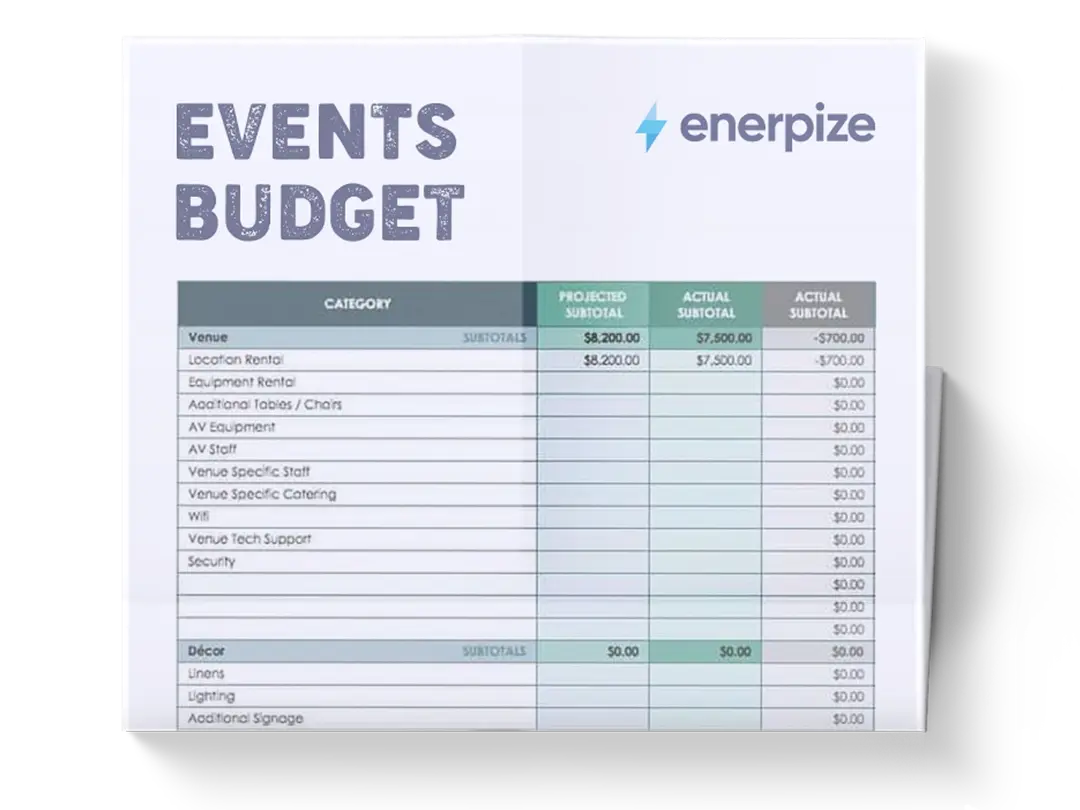
An Event Budget Template helps event planners estimate, allocate, and monitor all costs associated with organizing an event. It organizes expenses into clearly defined categories allowing users to break down costs into granular line items while maintaining a consolidated financial overview.
What Does The Event Budget Template Contain?
Projected Total:
Displays the overall estimated cost of the event based on the combined category subtotals.
Venue (Subtotal):
Includes all costs directly related to the event location.
Décor (Subtotal):
Covers all aesthetic and design-related elements.
Food / Beverage (Subtotal):
Captures all catering and hospitality expenses.
Event Programming (Subtotal):
Accounts for content and experience delivery.
Additional Entertainment (Subtotal):
Includes optional engagement elements.
Event Documentation (Subtotal):
Tracks content capture services.
Travel (Subtotal):
Covers transportation and accommodation for organizers or participants.
Attendee / Guest Services (Subtotal):
Focuses on guest experience and convenience.
Registration (Subtotal):
Handles attendee onboarding and access management.
Communications (Subtotal):
Includes all printed and digital communication materials.
Public Relations (Subtotal):
Covers media and announcement efforts.
Marketing (Subtotal):
Tracks promotional campaign costs.
Social Media (Subtotal):
Allocates budget across platforms.
Advertising (Subtotal):
Captures paid promotional efforts.
Sponsors (Subtotal):
Tracks sponsor-related costs.
Logistics (Subtotal):
Covers operational and legal essentials.
Other (Subtotal):
Allows for miscellaneous or unforeseen expenses not categorized above.
How to Use The Event Budget Template
1- Start with the Projected Total Mindset
Before entering any numbers, define your maximum allowable event budget. This figure acts as your financial boundary and guides all allocations. The “Projected Total” will automatically reflect your inputs across categories, helping you stay aligned with this limit.
2- Populate Venue Costs First
Begin with the Venue section, as it typically represents the largest and most fixed expense. Enter costs for rental, equipment, staffing, and technical support. This establishes a foundational cost baseline that influences all remaining decisions.
3- Layer in Experience-Driven Costs (Décor, Food, Programming)
Move to Décor, Food / Beverage, and Event Programming. These directly shape the attendee experience. Input realistic estimates for each line item, ensuring that quality expectations align with your remaining budget capacity.
4- Add Engagement and Content Elements
Complete sections like Additional Entertainment and Event Documentation. These enhance engagement and extend the event’s lifecycle through captured content, but should be balanced against core priorities.
5- Account for Operational and Guest Logistics
Fill in Travel and Attendee / Guest Services. These ensure smooth operations and a positive attendee journey. Include all transportation, accommodation, and convenience-related expenses.
6- Configure Registration and Communications
Input costs for Registration and Communications. These are critical for managing attendees and delivering information effectively before and during the event.
7- Allocate Budget for Promotion (PR, Marketing, Social Media, Advertising)
Work through Public Relations, Marketing, Social Media, and Advertising. Distribute your promotional budget strategically across channels to maximize reach and attendance.
8- Include Sponsor and Logistics Costs
Enter expenses related to Sponsors and Logistics. These often include overlooked but essential costs such as permits, insurance, and sponsor engagement efforts.
9- Capture Miscellaneous Expenses
Use the “Other” category for any additional costs not previously listed. This ensures nothing is left unaccounted for.
10- Review Subtotals and Adjust Strategically
Analyze each category subtotal in relation to the projected total. If you exceed your budget, identify high-cost areas and optimize, either by reducing scope, renegotiating vendors, or reallocating funds.
Importance of Event Budget Template
Prevents Cost Overruns and Financial Surprises
A budget template for events provides a structured framework that forces you to account for every expense before it occurs, significantly reducing the risk of unexpected costs. Without a centralized budgeting system, planners often overlook smaller line items that accumulate quickly and push budgets beyond limits. By organizing all expenses into clearly defined categories with subtotals, the template gives you early visibility into potential overruns. This allows you to make proactive adjustments, such as scaling back non-essential elements or renegotiating vendor contracts. In high-stakes events where margins are tight, this level of financial control is critical to maintaining profitability and avoiding last-minute compromises.
Improves Decision-Making with Real-Time Cost Visibility
When every expense is categorized and tracked, decision-making becomes data-driven rather than reactive. The template enables you to compare how much you’re spending on key areas like venue, catering, and marketing, helping you prioritize investments that deliver the highest impact. For example, if your food and beverage costs are consuming a disproportionate share of the budget, you can rebalance by adjusting menu options or reallocating funds toward audience engagement. This visibility also supports scenario planning, allowing you to test different budget allocations before committing. As a result, you gain greater confidence in your financial decisions and ensure that spending aligns with your event’s strategic objectives.
Enhances Accountability Across Teams and Vendors
Event planning often involves multiple stakeholders, internal teams, external vendors, sponsors, and partners, each responsible for different aspects of execution. A well-structured budget template acts as a single source of truth, clearly defining who is responsible for each cost component. This reduces ambiguity and ensures that all parties are aligned on financial expectations. It also simplifies communication, as stakeholders can easily reference the same document to track progress and updates. In practice, this minimizes disputes, prevents duplicated expenses, and ensures that every dollar is accounted for, improving overall operational efficiency.
Supports Post-Event Analysis and Future Planning
Beyond the event itself, the template becomes a valuable analytical tool. By comparing projected costs with actual spending, you can identify areas of inefficiency, cost overruns, or savings opportunities. This insight is essential for improving future event planning processes and building more accurate budgets over time. For organizations that run recurring events, this historical data becomes a strategic asset, enabling better forecasting, stronger vendor negotiations, and more consistent financial performance. Ultimately, the template transforms budgeting from a one-time task into a continuous improvement process.
Who Can Use an Event Budget Template?
Event Planners and Event Management Agencies
Professional event planners rely on precise budgeting to deliver high-quality experiences while maintaining profitability. This template provides them with a detailed framework to manage multiple events simultaneously, ensuring that each project stays within financial constraints. By breaking down costs into granular categories, planners can track vendor expenses, allocate resources efficiently, and present transparent budgets to clients. It also helps them justify pricing, manage expectations, and maintain control over complex event logistics.
Corporate Teams and Marketing Managers
Corporate events, such as product launches, conferences, and internal gatherings, often involve significant budgets and high expectations. Marketing managers and corporate teams can use this template to align event spending with business objectives, ensuring that every dollar contributes to brand visibility, lead generation, or employee engagement. The structured format makes it easier to secure approvals from leadership, track ROI, and ensure compliance with internal financial policies. It also supports cross-department collaboration by providing a clear financial overview accessible to all stakeholders.
Wedding Planners and Private Event Organizers
For weddings and private events, budgeting is often both emotional and financial. This template helps planners and individuals maintain control over spending while still delivering a memorable experience. Clearly outlining costs for venue, décor, catering, and guest services allows users to prioritize what matters most and make informed trade-offs. This reduces stress, prevents overspending, and ensures that the event stays aligned with the original vision and budget.
Freelancers and Small Business Owners Managing Events
Freelancers, consultants, and small business owners who organize workshops, seminars, or promotional events can use this template to manage costs effectively without needing advanced financial tools. It simplifies budgeting into a clear, actionable format, allowing them to focus on delivering value to attendees while maintaining profitability. For smaller-scale events with limited resources, this level of financial clarity is essential to avoid losses and ensure sustainable growth.
Looking for Beyond Just Budget Tracking?
While this event budget template helps you plan and control event expenses, businesses often need more advanced capabilities. That’s where Enerpize, our all-in-one ERP platform, comes in.
With Enerpize catering management software, you can:
- Create and manage event bookings, assign coordinators, and organize logistics and venues in one centralized system
- Track expenses, invoices, and cash flow in real time with integrated accounting and billing tools
- Manage client relationships, follow-ups, and event schedules seamlessly with built-in CRM and operations features
If you’re ready to move beyond spreadsheets, Enerpize brings enterprise-grade control to growing teams.