

Posted on 12 July 2026
Free Rent Receipt Template Download: PDF, Excel, Word & Google Sheets
- Available in Word, Excel, PDF, Google Docs, and Google Sheets, free to download with no sign up required
- Covers full payments, partial payments, cash transactions, and multi property tenants in one structured document
- Built with country specific fields for GST (Australia), VAT (UK), HST (Canada), and standard rent receipts (US)
- Calculates subtotal, tax, and balance remaining automatically in Excel and Google Sheets
A rent receipt template is a pre formatted document that confirms a landlord received a rent payment from a tenant, covering the payment date, the rental period it applies to, the amount paid, and the payment method.


What Is a Rent Receipt Template?
Picture the last time you handed someone cash and just trusted they would remember it later. Doesn't happen much anymore, does it? That is exactly the gap a rent receipt closes.
A rent receipt is proof that a landlord received a specific rent payment from a specific tenant, for a specific period. It sounds simple because it is simple. But that piece of paper, or that PDF sitting in an inbox, is often the only thing standing between a tenant and a wrongful late fee, or between a landlord and a dispute over whether June's rent ever showed up.
A rent receipt template gives you the structure to produce that record the same way every time, instead of scribbling it on whatever is nearby when a tenant hands you cash.
It is worth being precise about what a rent receipt is not. A lease agreement sets the terms of the tenancy. An invoice, where one is used, requests the payment before it happens. The rent receipt template comes after the money has already changed hands. It confirms, it does not request.
Stop writing rent receipts by hand. Issue them directly from a payment record in Enerpize, free, no credit card required. Start for free.
Rent Receipt vs Rent Invoice vs Lease Agreement
People mix these up constantly, so let's separate them properly.
A lease agreement is the contract. It says what the rent is, when it is due, and what happens if it is not paid. You sign it once, maybe you renew it, but it does not change month to month.
A rental invoice, when a landlord issues one, is a request. It goes out before the due date and says "this is what you owe." Not every landlord uses one. Plenty just expect the tenant to pay on the date written into the lease.
A rent receipt is the confirmation. It goes out after the tenant pays, and it says "this is what I received." For cash payments especially, it is the only paper trail that exists.
If you are looking for the invoicing side of a rental relationship rather than the receipt side, our rental invoice template covers that separately.
What to Include on a Rent Receipt Template
Most templates online give you the bare minimum. Here is the full picture, including the pieces that get left out until someone actually needs them.
Required Fields
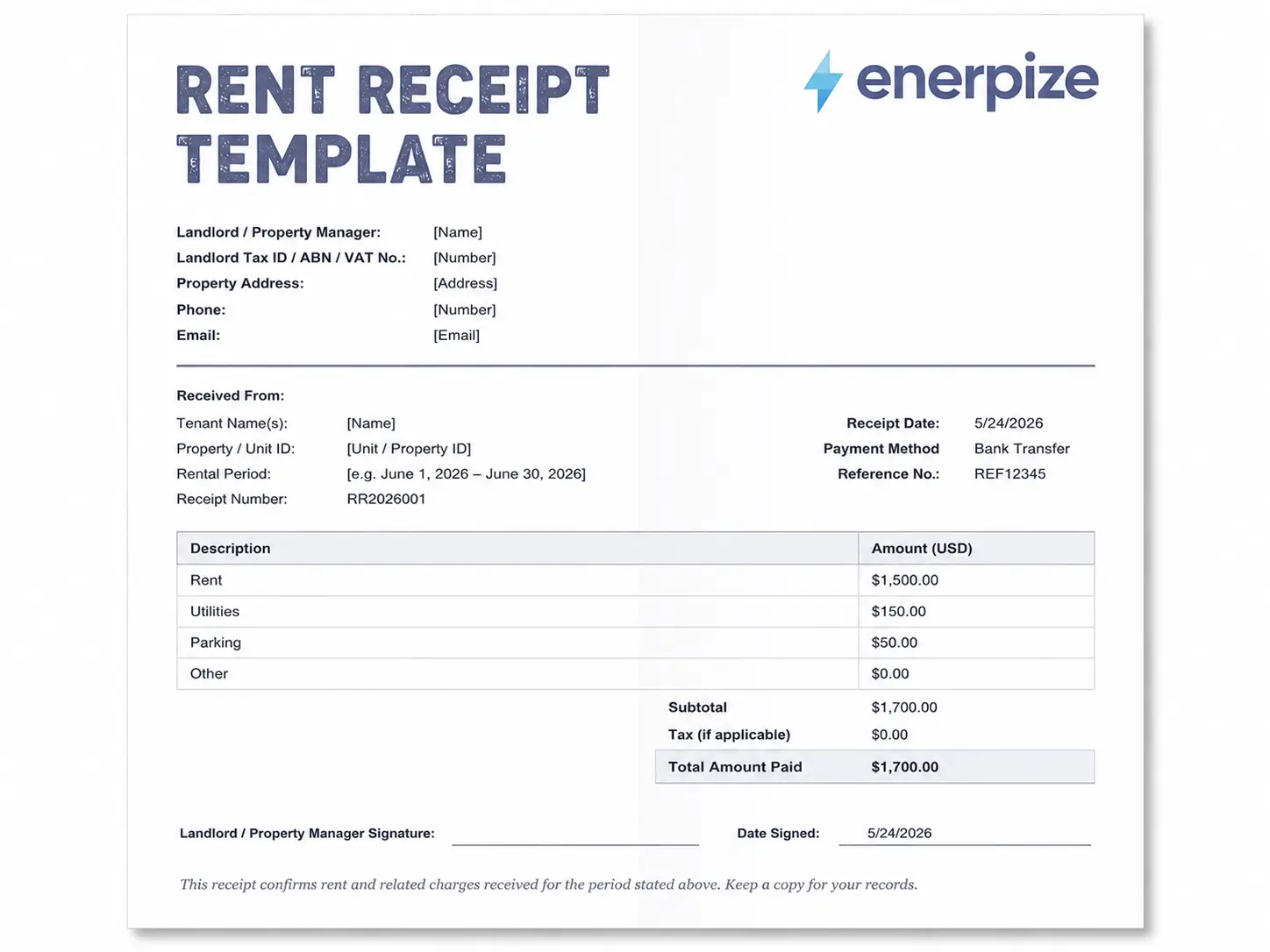
| Field | What It Does |
|---|---|
| Landlord or property manager name | Identifies who issued the receipt |
| Property address | Confirms which rental unit the payment applies to |
| Tenant name | Confirms who made the payment |
| Rental period covered | States which month or weeks the payment is for |
| Date payment received | Establishes exactly when the money arrived |
| Amount paid | The actual figure handed over or transferred |
| Payment method | Cash, cheque, bank transfer, or other |
| Landlord signature | Confirms the payment was actually received |
Optional Fields That Prevent Disputes Later
A unit or property identifier matters the moment you own more than one rental. Without it, a landlord managing several units has no way to tell, six months later, which receipt belongs to which address.
A late fee line matters just as much. If a payment came in after the due date and included a penalty, that penalty should be broken out separately from the base rent, not folded silently into one number.
A balance remaining field is the one most templates skip entirely, and it is the one that causes the most arguments. If a tenant pays part of what is owed, the receipt needs to show the amount paid today, the cumulative amount paid so far, and what is still outstanding. Otherwise you are relying on memory the next time there is a disagreement.
Fields Required for GST Registered Landlords in Australia
If a landlord in Australia is registered for GST, which is uncommon for standard residential rent but does apply to some commercial leases, the receipt needs to function as a tax invoice once the amount crosses the threshold. That means displaying the ABN, the words "Tax Invoice," and the GST amount as its own line. Most residential rent in Australia is GST free, so this mainly applies to commercial tenancies. Check your own GST registration status before assuming this section applies to you.
Fields Required for VAT Registered Landlords in the UK
Residential rent in the UK is generally exempt from VAT. Where VAT does apply, typically for certain commercial lettings where the landlord has opted to tax the property, the receipt should show the VAT registration number and the VAT amount separately from the base rent.
Rent Receipt Requirements by Country
This is the part most rent receipt template pages skip, and it is the part that actually matters if you are a landlord operating anywhere outside your home country.
United States
Rent receipt rules vary by state. Some states require a receipt whenever a tenant requests one. Others only require it for cash payments. Landlords in California must provide one on request under California Civil Code Section 1499. Colorado requires a receipt for cash or money order payments specifically, under Colorado Revised Statutes Section 38-12-802. Always check your own state's landlord tenant statute, since these requirements change and vary widely.
Canada
Provincial tenancy legislation governs rent receipts in Canada, and tenants often need them to claim provincial tax credits, such as the Ontario Trillium Benefit. Landlords should keep this in mind even where a receipt is not strictly mandatory, since tenants may come back asking for one months later at tax time.
United Kingdom
The UK does not have a single blanket legal requirement forcing every landlord to issue a rent receipt for every payment, but landlords should still issue one whenever rent is paid in cash, since bank transfer payments already leave a digital trail through the tenant's own bank statement. Landlords who are also filing a self assessment return with HMRC will want clean receipt records regardless.
Australia
Most Australian states and territories require landlords to provide rent receipts under their respective Residential Tenancies Acts, though the specific triggers vary. In New South Wales, a receipt is required for any rent paid in person other than electronically, under Section 36 of the Residential Tenancies Act 2010. In South Australia, one must be issued within 48 hours of receiving a payment made by a method other than direct bank deposit, under Section 58 of the Residential Tenancies Act 1995. Check your specific state's tenancy authority for the exact rule that applies to you.
Managing tenants across more than one property or country? Enerpize keeps your leasing records, payments, and receipts in one place. Start for free.
Types of Rent Receipts
Full Payment Rent Receipt
This is the standard case. A tenant pays the full rent owed for the period, and the receipt confirms the full amount against the full period. Straightforward, and the version most landlords will use most months.
Partial Payment Rent Receipt
This is where a proper template earns its keep. A tenant pays part of what is owed, whether due to a payment plan, a temporary hardship, or a dispute over the total. The receipt needs to show three numbers, not one: what was paid today, what has been paid cumulatively, and what remains outstanding. A single "amount paid" field with nothing else is not enough here, and it is exactly the gap that causes landlords and tenants to disagree about balances months later.
Cash Rent Receipt
Cash is the payment type most likely to get disputed later, purely because it leaves no independent trail. A cash rent receipt needs the landlord's signature more than any other version, since that signature is often the only evidence the transaction happened at all.
What the Enerpize Rent Receipt Template Includes
We built this template around the gaps we kept seeing in the ones already out there. Most rent receipt templates assume one landlord, one property, and one payment in full. That covers a lot of people, but it stops working the moment reality gets slightly more complicated, and reality gets complicated fast for anyone managing more than a single unit.
A Unit or Property Identifier
The Enerpize rent receipt template includes a dedicated unit or property identifier, so a landlord with several rentals can tell at a glance which receipt belongs to which address without opening every file.
A Full Payment Breakdown
It includes a full payment breakdown table covering rent, utilities, parking, and late fees as separate line items instead of one lump figure, because a tenant disputing a charge needs to see exactly what that charge was for.
A Running Balance Section
It includes a proper running balance section, amount paid this payment, cumulative amount paid to date, and balance remaining, built specifically for partial payment situations that most templates ignore entirely.
An Optional Tax Line
It includes an optional tax line for the landlords who do need to account for GST or VAT on commercial tenancies.
A Delivery Method Field
It includes a delivery method field, since more receipts now get emailed than handed over in person, and that detail is worth having on record too.
None of this is decoration. Every field above exists because leaving it out is the specific reason landlords and tenants end up arguing about a payment that already happened.
If you manage several units and this kind of receipt is only one piece of a bigger workflow, our leasing and reservation management software handles unit tracking, lease periods, and payment history in the same place, so receipts stop being a separate task you do after the fact.
How to Fill Out a Rent Receipt Template
Step 1: Add the Landlord and Property Details
Name, property address, and unit identifier if you manage more than one rental. This is the part people rush through and then can't find six months later.
Step 2: Add the Tenant Name and Rental Period
Be specific about the period. "June rent" is fine for a single tenant with one lease. "June 1 to June 30, 2026" is better, and it removes any ambiguity if a dispute ever comes up.
Step 3: Record the Payment Date and Method
The date the money actually arrived, not the date it was due. Note whether it was cash, cheque, bank transfer, or another method. This single field matters more than people expect when reconciling accounts later.
Step 4: Break Down the Charges
Rent as its own line. Utilities, parking, or late fees as separate lines if they apply. Resist the urge to lump everything into one number just because it is faster in the moment.
Step 5: Calculate the Totals
Subtotal, tax if applicable, and total due. If this is a partial payment, show the amount paid today, the cumulative total paid, and what remains.
Step 6: Sign and Deliver
A signature matters most for cash payments, since it is the clearest proof the transaction happened. Decide how you are delivering the receipt, whether printed and handed over, emailed as a PDF, or through a tenant portal, and note that method on the receipt itself.
You can print and download the free receipt template directly if you would rather start from our general version and adapt it. Both follow the same structure, so switching between them is straightforward.
Managing Rent Receipts for Multiple Properties
A single landlord with one rental unit can get away with a folder of paper receipts. A landlord with five units cannot, not without something breaking down eventually.
The problem is not the receipts themselves. It is the fact that a manual template has no memory. Nothing connects this month's receipt to last month's, nothing flags a missed payment, and nothing tells you at a glance which of your properties has an outstanding balance right now.
In Enerpize, a landlord or property manager can generate a receipt directly from a recorded payment rather than typing one out from scratch. You open the client payment, select the one you need a receipt for, and generate it as a print or PDF straight from that record. That means the receipt and the underlying payment are the same record, not two documents that might quietly drift apart from each other over time.
For landlords running several units, our leasing and reservation management software tracks each unit's lease period, availability, and payment history in one dashboard, so a receipt for unit 4B does not require digging through a spreadsheet to confirm what unit 4B's tenant actually owes.
Ready to stop tracking rent payments in a spreadsheet? Enerpize connects your leasing, payments, and receipts in one system. Start for free.
Digital vs Paper Rent Receipts
A paper receipt still has its place. Cash heavy situations, market stalls, mobile tradespeople collecting rent on commercial units in person, these are all cases where a physical signed copy makes sense on the spot.
But digital has quietly become the default for most landlords, and for good reason. A PDF receipt does not fade, does not get lost in a drawer, and is searchable the moment a tenant needs it for a tax credit claim or a dispute months later. Digital receipts also tend to get opened. Transactional emails like receipts see notably higher open rates than standard marketing emails, since the recipient is actively expecting them.
If you are printing receipts, keep them legible and store a digital backup regardless. Thermal printer paper fades over time, and a faded receipt is not much better than no receipt at all if you need it five years from now.
How Long to Keep Rent Receipts
United States landlords should generally follow the IRS general rule of three years from the date a return was filed, extending to seven years for any year where a loss was claimed on the property.
Australian landlords should keep records for five years under standard ATO guidance, since rental income and related receipts fall under the same record keeping rules as other business income.
Canadian and UK landlords should check their own tax authority's current guidance, since retention periods can differ by province in Canada and are subject to change under HMRC rules in the UK.
Key Takeaways
- A rent receipt confirms a payment already made. It is not the same as a lease agreement or a rental invoice, both of which come before the money changes hands.
- Partial payments need three numbers on the receipt, not one: amount paid today, cumulative amount paid, and balance remaining.
- Cash payments are the ones most likely to be disputed later, so the landlord's signature matters most for those specific transactions.
- Rent receipt requirements vary by country and, in the US and Australia, by state as well. Check your own jurisdiction rather than assuming a blanket rule applies.
- Landlords managing more than one property need a unit identifier on every receipt, or records become impossible to sort through later.
- Digital receipts do not fade, are searchable, and tend to get opened. Keep a digital copy even if you also hand over a printed one.
Frequently Asked Questions
What is the difference between a rent receipt and a rental invoice?
A rental invoice requests payment before it happens. A rent receipt confirms payment after it has already been received. Not every landlord issues an invoice, but a rent receipt is useful, and in many places required, regardless.
Do I need a rent receipt template for every payment?
If your tenant pays by bank transfer, the bank statement itself already provides some proof of payment. For cash payments especially, a signed rent receipt is the clearest and often only evidence the transaction happened.
How do I fill out a rent receipt for a partial payment?
Show three figures: the amount paid in this specific payment, the cumulative amount paid so far for the period, and the balance still outstanding. Issue a new receipt for each partial payment, not just the final one.
Is a rent receipt legally required?
It depends on your country and, in some cases, your state or province. Several US states and most Australian states and territories require one under certain conditions, most commonly for cash payments or when a tenant requests one. Check your local tenancy legislation directly, since these rules change.
Can I use a rent receipt template for commercial tenancies?
Yes, though commercial leases are more likely to involve GST or VAT, depending on the country and the landlord's registration status. Check whether tax fields apply to your specific arrangement before assuming a standard residential template covers it.
How long should I keep rent receipts?
Generally three years in the US under the standard IRS rule, extending to seven years for loss years. Five years in Australia under standard ATO guidance. Canadian and UK landlords should confirm current requirements with their own tax authority, since rules vary and change.
What should I do if my landlord will not give me a rent receipt?
Check your local tenancy legislation first, since some jurisdictions require landlords to provide one on request. If a receipt is not forthcoming, keep your own records of the payment, including bank transfer confirmations or dated photos of cash handovers where relevant.
Managing rent payments and receipts across multiple tenants gets easier with software built for it. Enerpize handles leasing, payments, and receipts from one dashboard. Start for free.
About the Author
Omar El Bahr is a Senior Digital Growth Specialist at Enerpize, where he leads SEO, content strategy, and organic growth across international markets. He is a Forbes Communications Council contributor and has written for Entrepreneur on business communication and digital strategy.
This content is provided for informational purposes only and does not constitute legal, tax, or accounting advice. Requirements vary by jurisdiction and change over time. Consult a qualified professional for advice specific to your situation.