

Posted on 10 June 2026
Free Trucking Invoice Template Download: Excel, Word, PDF & Google Sheets
- The trucking invoice template is available for download in Word, Excel, PDF, Google Sheets, and Google Docs.
- Documents every load with pickup location, delivery location, BOL number, and rate confirmation reference in a single billing document.
- Calculates line haul charges, fuel surcharges, detention time, and accessorial fees automatically so nothing gets left off the invoice.
- Covers owner-operators, freight carriers, and fleet managers billing brokers, shippers, or direct clients.
A trucking invoice template is a structured billing document used by trucking companies, independent owner-operators, and freight carriers to request payment for transportation services, document load details, and record accessorial charges for each haul.


What Is a Trucking Invoice?
A trucking invoice is the formal billing document that closes the loop on every haul. The load is delivered. The BOL is signed. Now you need to get paid. That is what this document does.
It records what was transported, where it went, how far it traveled, and what every charge on the bill represents. Line haul. Fuel surcharge. Detention time. Lumper fees. All of it, broken out by line item, so the broker or shipper on the other end can match it against the rate confirmation and release payment without a dispute.
It is also called a transportation invoice template or freight invoice in different parts of the industry. The format is the same. The purpose is identical: a clean, itemized record of services rendered and money owed.
Already running loads and need to automate your invoicing? Manage freight billing, track trip costs, and close payment cycles faster inside Enerpize. Start for free.
Who Uses a Trucking Invoice?
The document is not exclusive to large carriers. Anyone moving freight for pay needs one.
Owner-operators use it to bill brokers directly after delivery. Freight carriers use it to consolidate multiple loads on a single billing cycle. Fleet managers use it to track per-trip revenue against operating costs. Logistics companies use it to document subcontracted hauls. Dump truck operators, refrigerated freight carriers, flatbed haulers, and specialized transport businesses all work from the same document structure with minor modifications to the line items.
If you move cargo and someone owes you money for it, you need a trucking invoice.
What the Enerpize Trucking Invoice Template Includes
Most trucking invoice templates online give you a company name field, a bill-to box, and a description column. That is a generic invoice with a truck icon dropped on top. It is not built for freight, and it will not hold up when a broker's accounts payable team starts matching line items against the rate confirmation.
The Enerpize trucking invoice template is built around what actually happens on a load, from dispatch to payment.
Carrier Identity and Compliance Fields
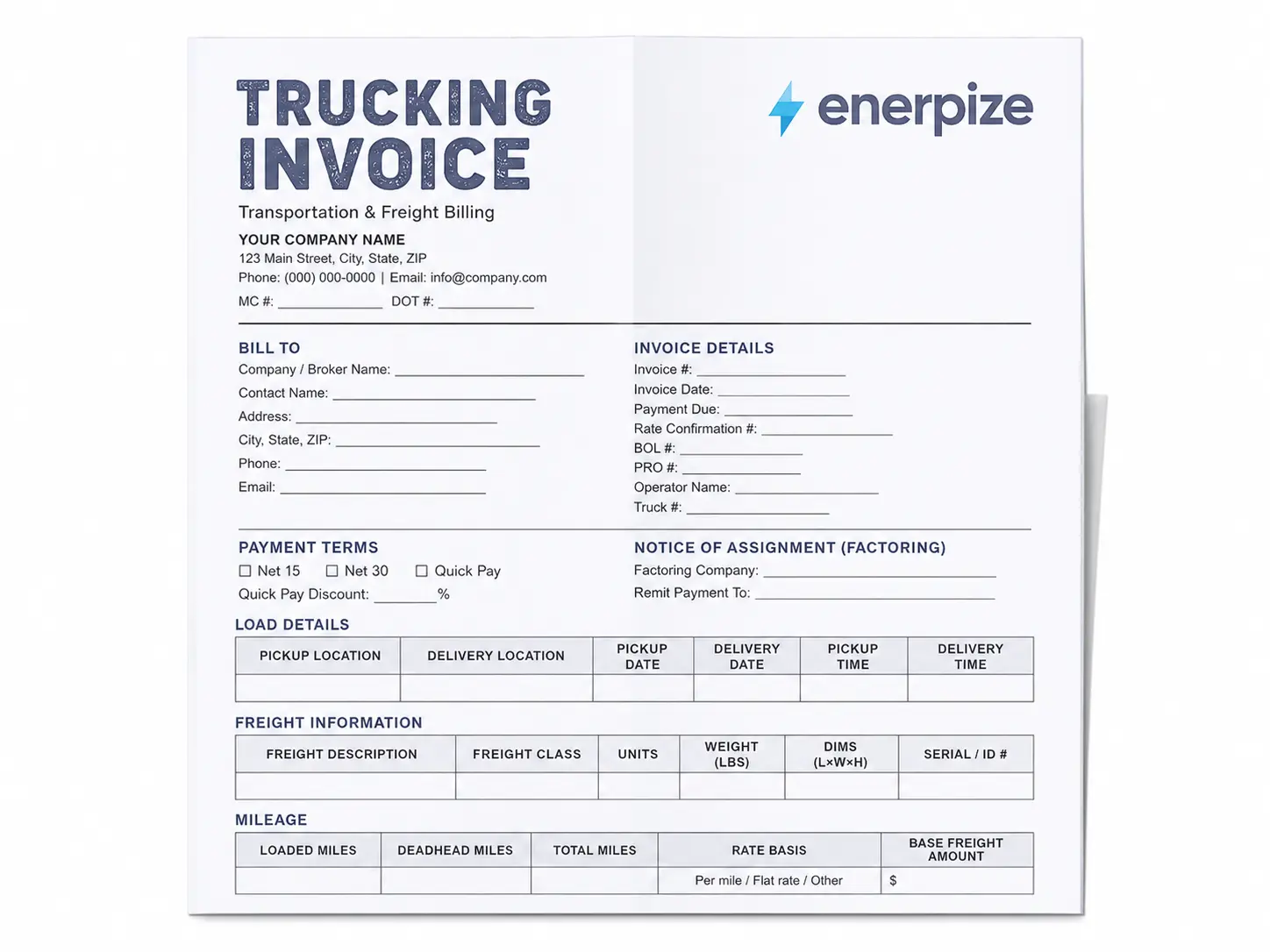
The header carries your business name, address, phone, and email alongside two fields that most templates skip entirely: your MC number and your DOT number. These are not optional for regulated US carriers. Shippers and brokers verify operating authority through the FMCSA SAFER system before releasing payment. The Enerpize template puts both fields in the header where accounts payable can find them immediately.
Invoice Reference Fields
Invoice number, invoice date, payment due date, rate confirmation number, BOL number, PRO number, operator name, and truck number. All in one panel. Every document in the payment chain references the same load. When a broker's AP team searches their system, they search by BOL or rate confirmation. The Enerpize template ensures those references are always present and always visible.
Payment Terms and Notice of Assignment
A dedicated payment terms block lets you select Net 15, Net 30, or Quick Pay and state the discount percentage in the same field. Alongside it, a separate Notice of Assignment block captures the factoring company name and remittance address. This is the field most invoice templates leave out entirely. Missing it is the single most common reason factoring advances get delayed, because the broker sends payment to the carrier instead of the factor.
Load Details
Structured fields for pickup location, delivery location, pickup date, delivery date, pickup time, and delivery time. Not a single description box. Separate fields that match the structure of the BOL and rate confirmation so there is no ambiguity about what moved, where it went, and when.
Freight Information
Freight description, freight class, number of units, weight in pounds, dimensions, and serial or ID number. This level of detail matches the BOL, prevents delivery disputes, and creates the documentation trail you need if a damage claim surfaces later.
Mileage Section with Live Calculations
Loaded miles, deadhead miles, total miles, rate per mile or flat rate basis, and base freight amount. In the Excel version, total miles calculate automatically from loaded plus deadhead, and the base freight amount calculates from loaded miles times your rate. You enter the numbers. The template does the math.
Charges and Accessorials Block
Ten dedicated line items covering every charge a carrier legitimately bills: line haul, fuel surcharge with a percentage field, detention broken out by hours and hourly rate, layover fee, lumper fee, TONU, liftgate service, oversize and overweight permits, tolls and weigh tickets, and a free-form line for anything else. Each charge has its own quantity, rate, and amount column. Nothing gets bundled. Nothing gets questioned.
Multi-Country Tax Field
A single tax block that covers four jurisdictions in one template. US sales tax with a percentage field. Canadian GST/HST with a Business Number field. UK VAT at twenty percent with a VAT registration number field. Australian GST at ten percent with an ABN field. And a zero-rated or tax-exempt checkbox for cross-border and export loads. One template works for a US owner-operator, a Canadian cross-border carrier, a UK haulage company under Making Tax Digital, and an Australian fleet running GST-registered freight. The Australian GST invoice template covers this in detail for carriers operating exclusively in Australia.
Totals with Automatic Calculations
Subtotal pulling from the accessorials block, discount line, tax amount, amount paid, fuel advance deduction, and a total due field that calculates from all of the above. In the Excel version, every calculation is a live formula. Change a line item and the total updates immediately.
Notes and Special Instructions
A freeform field for delivery conditions, shipper instructions, route notes, or any terms specific to the load. Kept separate from the billing calculations so the invoice reads cleanly and the notes do not interfere with the totals.
Signature Block
Operator signature, authorized signature, and date. Three separate fields. The signature block matters for broker relationships that require signed invoices before payment and for any load where a dispute resolution process might require documented authorization.
Every field. Every charge. Every load documented. Run your trucking invoices, trip costs, and driver settlements inside Enerpize without the spreadsheet gymnastics. Start for free.
How to Fill Out a Trucking Invoice Step by Step
No load is identical. But the invoicing process follows the same sequence every time.
Confirm the load details against the rate confirmation before the truck rolls. Miles, stops, agreed accessorial rates, free time before detention kicks in. If anything is unclear, resolve it at the rate confirmation stage, not after delivery when the broker has the leverage.
Complete the haul and collect your proof. Signed BOL, delivery timestamps, odometer or routed mileage from your ELD, receipts for lumper fees and tolls, and timestamped photos if you waited for detention time. These are not optional extras. They are the evidence that supports every line on your invoice.
Open the trucking invoice template and fill in the carrier header fields first: your company name, address, MC number, and DOT number. These stay the same for every invoice. If you are working in Excel, these can be pre-filled so you never retype them.
Add the invoice number sequentially. Fill in the invoice date and the payment due date based on your agreed terms. Enter the rate confirmation number and BOL number. These two references connect your invoice to the load record in the broker's system.
Enter the load details: pickup and delivery locations, dates, and times exactly as documented. Add the freight description, class, weight, and unit count. Fill in your mileage figures and confirm the base freight calculation.
Add every accessorial charge as a separate line. Fuel surcharge, detention, any pass-through fees. Attach your receipts and delivery confirmation.
Calculate the subtotal. Apply any applicable tax for your jurisdiction. Subtract any fuel advance or deposit already received. State the total due clearly at the bottom.
Send the invoice within 24 hours of delivery. The further you get from the delivery date, the harder it becomes to collect on detention and accessorial charges.
Trucking Invoice Requirements by Country
This is the section every competitor skips. A trucking invoice template that works for a US carrier filing with a broker may be missing fields that make it non-compliant for a Canadian cross-border haul, a UK haulage company under Making Tax Digital, or an Australian owner-operator navigating RCTI arrangements. The requirements are different. The consequences of getting it wrong are real.
United States: FMCSA Rules and Carrier Compliance
Trucking invoices in the United States are compliance artifacts, not just billing documents. The Federal Motor Carrier Safety Administration requires that motor carriers operating under household goods authority provide customers with a written, itemized invoice under 49 CFR Part 375. The invoice must match the written estimate within defined tolerances. A carrier cannot collect more than the estimate plus ten percent before releasing the shipment.
For freight brokers, 49 CFR Part 371.3 requires records of compensation received from both carriers and shippers, available for inspection at any time. A trucking invoice that separates broker compensation from line haul charges protects you during an FMCSA audit.
Your MC number and DOT number are not optional. They appear in the header of every invoice, every time. Shippers and brokers verify your operating authority through the FMCSA SAFER system before releasing payment. If you use a freight factoring company, the Notice of Assignment field belongs on the invoice so the shipper knows exactly where to send the check. Missing it is the most common single reason factoring advances get delayed.
Canada: GST/HST on Freight and CRA Invoice Requirements
In Canada, trucking companies registered for GST/HST must include their Business Number and GST/HST registration number on every commercial invoice. The Canada Revenue Agency GST/HST information for freight carriers requires that any invoice over CAD 30 display the supplier's registration number. Any invoice over CAD 150 must also show the recipient's name, the date, a description of the supply, and the GST/HST amount charged separately from the subtotal.
Here is the detail most carriers get wrong: the GST/HST rate that applies depends on the province of delivery, not the province where your company is registered. A carrier based in Ontario delivering freight into British Columbia charges the BC rate of five percent GST, not Ontario's thirteen percent HST. CRA auditors know this. Your invoices should reflect it.
For owner-operators working under a fleet carrier's authority in Canada, invoices issued to the carrier for subcontracted hauls must carry your GST/HST number if your annual revenue exceeds CAD 30,000. Many independent drivers assume the carrier handles all tax reporting. That assumption can become personal liability for unremitted HST.
Cross-border US/Canada loads add another layer. The Canadian portion of the haul is subject to GST/HST. The US portion is zero-rated for Canadian GST purposes under the exported services rules. Invoice the two portions separately, or you are creating a tax problem on both sides of the border.
United Kingdom: VAT, Making Tax Digital, and HGV Billing
Any trucking or haulage business in the United Kingdom with annual turnover above the VAT registration threshold must issue VAT-compliant invoices. A valid UK VAT invoice for freight services includes your VAT registration number, the date of supply, a description of the services, the net amount, the VAT rate applied, and the total VAT charged as a separate line from the net.
Under Making Tax Digital for VAT, all VAT-registered haulage businesses must keep digital records of invoices and submit VAT returns through MTD-compatible software. A paper invoice that is not also stored in a digital system is non-compliant, regardless of how correctly it was formatted.
The standard VAT rate on domestic freight in the UK is twenty percent. International freight from the UK is zero-rated under HMRC Notice 744B, which covers goods transport services for export. If your invoice covers a cross-border load, you must indicate whether the supply is standard-rated or zero-rated, and retain export evidence to justify zero-rating during an HMRC review.
For HGV operators, including your operator licence number on invoices where relevant signals compliance to large shippers and third-party logistics providers who vet carrier bases. The Driver and Vehicle Licensing Agency issues these licences. Carriers who include them on billing documents tend to move through accounts payable faster.
Australia: GST, ABN, and Owner-Operator RCTI Rules
In Australia, trucking and freight businesses registered for GST must issue tax invoices for any supply over AUD 82.50 including GST. A valid Australian tax invoice for freight services must include the words "Tax Invoice," your Australian Business Number, the date of issue, a description of the transport services, the GST amount as a separate figure, and the total price.
If your annual turnover is below AUD 75,000 and you are not registered for GST, you issue a regular invoice without GST and without the "Tax Invoice" label. Displaying "Tax Invoice" when you are not GST-registered is a compliance error that can result in the recipient claiming a false GST credit on their BAS. Our Australian invoice without GST template is built for exactly this scenario.
Owner-operators working under a principal carrier's contract in Australia often operate under a Recipient Created Tax Invoice arrangement. Under an RCTI, the carrier issues the tax invoice on the owner-operator's behalf rather than the owner-operator issuing it themselves. This is common in Australian trucking because fleet managers process hundreds of driver settlements per week. The ATO authorizes RCTI arrangements under a written agreement between both parties.
Australian trucking businesses may also claim Fuel Tax Credits on diesel used in heavy vehicles. The fuel quantity claimed must be traceable back to load records. An invoice that captures fuel surcharge amounts as a separate line from base freight creates the paper trail the ATO expects during an FTC review. Current rates are published quarterly by the ATO.
Trucking Invoice for Owner-Operators vs. Freight Companies
The document structure is the same. The priorities are different.
Owner-Operator Invoice Checklist
An owner-operator invoicing a freight broker directly is dealing with accounts payable teams that process hundreds of invoices per week. Speed and clarity are the only things that matter to them.
Your invoice needs to arrive within 24 hours of delivery with the signed POD attached. The BOL number and rate confirmation number need to match what is in their system. Every accessorial needs to be itemized and traceable to timestamps or receipts. If you waited two hours at the receiver, the invoice shows "Detention: 2 hours at $65/hour" with the in-time and out-time noted.
Quick Pay is worth understanding before you sign rate confirmations. Many brokers offer to pay within two to five business days in exchange for a one to three percent discount on the invoice total. On a $1,800 load, a two percent discount costs $36 and gets your money in 48 hours instead of 30 days. For operators managing fuel costs on a weekly basis, that math often makes sense. State your Quick Pay terms on the invoice so the broker can choose, and show the discount as a separate line so you both see exactly what it costs.
If you use a factoring company, your contractor invoice template and trucking invoice both need the Notice of Assignment field completed. The factoring company advances you a percentage of the invoice value, then collects from the broker directly. Missing the NOA field means the broker pays you, not the factor, and you now have a problem with both parties.
Fleet and Carrier Invoice Differences
A fleet operation billing multiple loads per week needs a different approach than a single owner-operator. Consolidated invoicing, where multiple loads for the same broker are billed on a single invoice at weekly or monthly intervals, reduces paperwork on both sides. The invoice lists each load as a separate line item with its own BOL reference, origin, destination, miles, rate, and total. All signed PODs attach as a single document package.
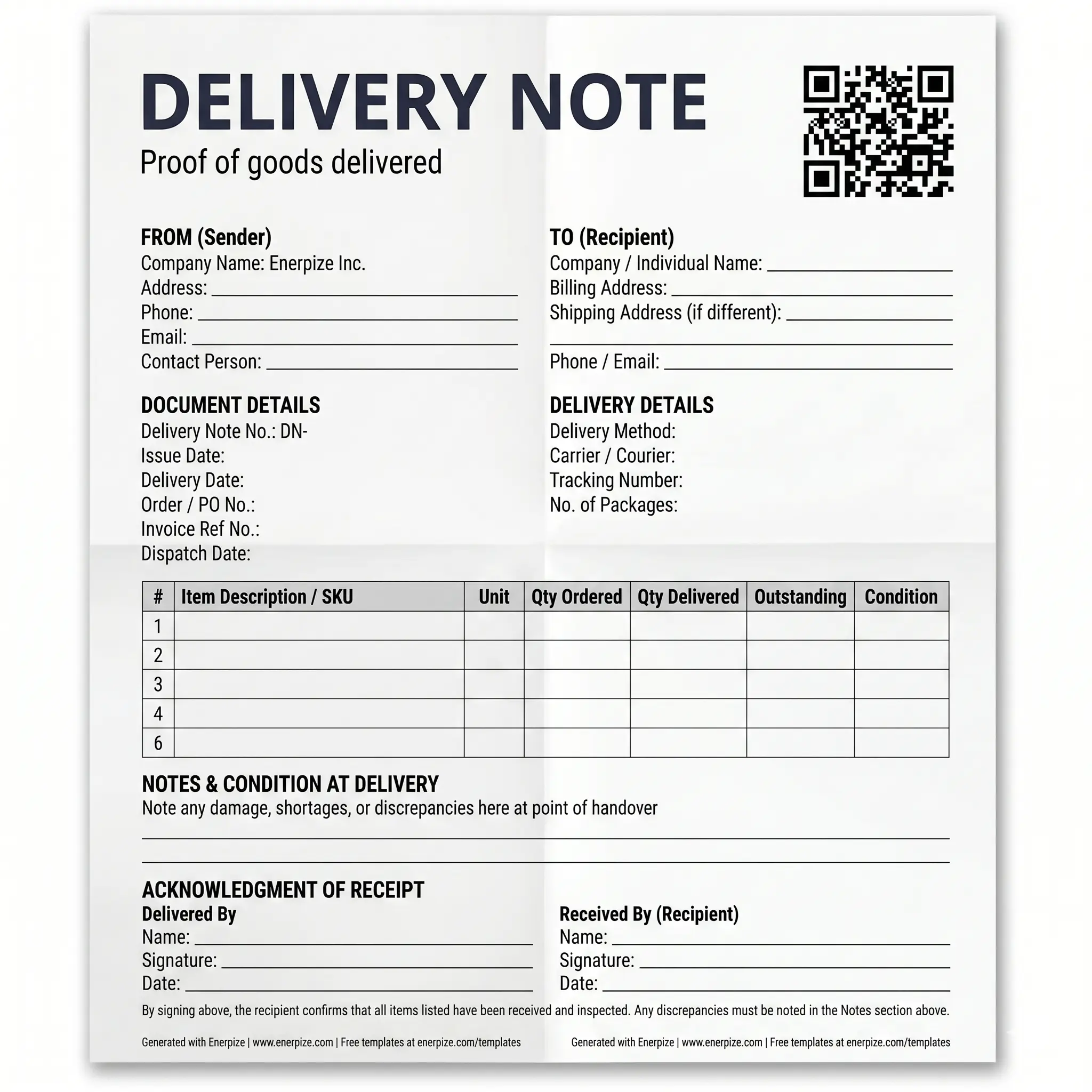
Fleet carriers also need to track per-trip profitability, not just invoice totals. A delivery note for each load, cross-referenced against the invoice, gives you the documentation chain from dispatch to payment. When a shipper questions a charge six weeks after delivery, you have the complete paper trail.
For fleets running construction site deliveries or materials transport, the construction invoice template covers the overlap between freight billing and project-based invoicing, particularly where loads are tied to specific job sites and cost centers.
How Enerpize Handles Trucking and Transportation Invoicing
A template works for one load. It starts to break when you are running a fleet, billing across multiple clients, tracking trip profitability, and trying to close your books without re-entering data from a Word document into your accounting system. That is where Enerpize comes in.
Enerpize is built for transportation companies that need the full picture in one system, not a stack of disconnected spreadsheets.
Send invoices and accept online payment
Generate customized invoices for each trip or load and send them via email. Accept credit cards, PayPal, and cash. Owner-operators dealing with brokers who offer Quick Pay can get paid the same day the invoice is sent rather than waiting for a check to clear.
Track your company's finances automatically
Every invoice issued flows directly into your profit and loss report. For fleet operators running multiple loads per week, this eliminates the manual reconciliation between your invoice records and your accounting books at month end. You see income, expenses, and net profit per period without manually building the report.
Create a file for each trip
Add revenue, direct expenses, and vehicle costs per trip type. This maps directly to how a per-load cost center works: each haul is tracked individually, the invoice reflects the actual cost structure, and you know whether that lane is profitable before you take the next load on it.
Manage assets and calculate vehicle depreciation
Add your trucks as assets, set the depreciation method, and track book value over time. When a shipper pushes back on your rate, you can show the actual cost of running an aging fleet rather than guessing at it.
Track driver and staff performance
Assign trips to drivers, track their output, and pull performance reports. For companies billing clients on driver-specific service level agreements, the data is already in the system when you need to back up a charge.
Manage your fleet, trips, drivers, and invoices in one place. Start for free.
Common Trucking Invoice Mistakes That Delay Payment
Carriers do not lose money because they did bad work. They lose it because the paperwork gave the broker a reason to stall.
Bundling all charges into one line is the most common mistake. "Additional fees: $340" tells accounts payable nothing. They cannot match it to an approved charge, so they deduct it or put the invoice on hold. Break out every charge. Every single one.
Sending the invoice without the signed POD attached is the second fastest way to sit on receivables for 60 days. Brokers and shippers will not process payment without proof of delivery. Attach it to the first email.
Missing the DOT and MC numbers means some accounts payable systems cannot even create a vendor record for you. The invoice sits in a queue until someone manually resolves it, and nobody is in a hurry to do that for a $1,200 check.
Rounding miles without a source gives the broker an opening to dispute the base freight charge. Show routed miles from a named source, your ELD system or a routing tool, so the number is traceable.
Not including a payment due date means the broker pays when they feel like it. State the terms. State the date. Follow up on day one if it passes.
Forgetting to net out a fuel advance creates an overbilling situation that stops payment entirely while both sides go back and forth. Record the advance when you receive it. Subtract it from the invoice total. Show the remaining balance clearly.
For freelance and independent operators billing across multiple service types, the freelance invoice template covers the overlap between trucking billing and general service invoicing for situations where a single engagement includes both transport and ancillary services.
Key Takeaways
- A trucking invoice must include the carrier's MC and DOT numbers, a BOL reference, itemized accessorial charges, and payment terms to be accepted by most brokers and factoring companies without revision.
- US carriers operating under FMCSA household goods authority cannot collect more than ten percent above the written estimate before releasing the shipment, making invoice accuracy a legal obligation and not just a billing preference.
- Canadian trucking companies must apply GST/HST based on the province of delivery, not the province of registration. Cross-border hauls require the Canadian and US portions to be invoiced separately.
- UK haulage businesses above the VAT threshold must store invoices digitally under Making Tax Digital rules. A correctly formatted paper invoice that is not also stored digitally is still non-compliant.
- Australian owner-operators working under fleet carrier contracts can operate under RCTI arrangements, where the carrier issues the tax invoice on their behalf. Most generic invoice template pages do not explain this at all.
- Accessorial charges including detention time, fuel surcharges, and TONU fees must be itemized as separate line items, not bundled into the base freight rate. Bundled invoices are the leading cause of shipper short-pays and factoring rejections.
Frequently Asked Questions
What is a trucking invoice template?
A trucking invoice template is a pre-formatted billing document that trucking companies, owner-operators, and freight carriers use to request payment for transportation services. It includes fields for carrier and client details, load information, mileage, fuel surcharges, accessorial charges, and payment terms. A proper truck invoice template goes further than a generic invoice by capturing BOL numbers, MC and DOT numbers, detention time, and country-specific tax fields.
What should a trucking invoice include?
A complete trucking invoice includes your carrier name, MC number, DOT number, invoice number, invoice date, and payment due date. It also includes the rate confirmation number, BOL number, pickup and delivery locations and dates, freight description, weight and freight class, mileage breakdown, line haul charge, fuel surcharge, any accessorial charges as separate line items, applicable tax, and a total due. If you use a factoring company, it also needs a Notice of Assignment field.
How do I create a trucking invoice in Excel?
Download the free Enerpize trucking invoice template in Excel format. Your carrier details and MC and DOT numbers pre-fill the header. Add the invoice number, date, BOL reference, and rate confirmation number. Enter the load details including pickup, delivery, and mileage. The base freight amount calculates automatically from loaded miles times your rate. Add accessorials as separate lines in the charges section. The subtotal and total due calculate from the entries above. Save and send with the signed POD attached.
What is the difference between a trucking invoice and a bill of lading?
A bill of lading is a shipping document that travels with the cargo. It identifies the goods, their origin and destination, and serves as a receipt when the consignee signs it at delivery. A trucking invoice is the billing document sent to the broker or shipper after delivery to request payment. The signed BOL is typically attached to the invoice as proof of delivery.
How do I invoice as an owner-operator?
As an owner-operator, you invoice the freight broker or shipper directly after each delivery. Use a transportation invoice template that includes your MC and DOT numbers, the rate confirmation number from the broker, and the BOL number from the load. Itemize every charge, including fuel surcharge and any detention time, as separate lines. Attach the signed POD and send within 24 hours of delivery. If you factor your invoices, include your factoring company's Notice of Assignment details so the broker remits payment to the correct party.
What is a fuel surcharge on a trucking invoice?
A fuel surcharge is a variable fee added to the base line haul rate to offset fluctuations in diesel fuel costs. It is typically calculated as a percentage of the base line haul rate and adjusted weekly based on the DOE national diesel average. On a trucking invoice, the fuel surcharge appears as a separate line item showing the percentage applied, the base it is calculated from, and the dollar amount. Bundling it into the base rate makes it invisible to accounts payable and creates disputes.
How do I charge for detention time on a trucking invoice?
Detention time is billed when loading or unloading extends beyond the free time stated in the rate confirmation, typically two hours. Record your arrival time, the time loading or unloading started, and the time it ended. Bill detention as a separate line: "Detention: X hours at $Y/hour." Attach timestamped documentation, whether from your ELD, timestamps on BOL annotations, or photos. Most brokers pay documented detention without dispute. Undocumented detention claims almost always get rejected.
Does a trucking invoice need a DOT number?
Yes. Your DOT number and MC number belong in the header of every trucking invoice you send. Shippers and brokers use these numbers to verify your operating authority in the FMCSA SAFER system before processing payment. Some accounts payable systems cannot create a vendor record for your company without them, which means your invoice sits unprocessed until someone manually resolves it.
Do Australian owner-operators need to issue a tax invoice?
Yes, if you are registered for GST and the supply is over AUD 82.50 including GST. If you are not GST-registered because your annual turnover is below AUD 75,000, you issue a regular invoice without the "Tax Invoice" label. Owner-operators working under a fleet carrier's contract may also operate under a Recipient Created Tax Invoice arrangement, where the carrier issues the invoice on your behalf. This requires a written RCTI agreement between both parties, authorized by the ATO.
What is a TONU fee and how do I invoice for it?
TONU stands for Truck Ordered Not Used. It applies when a carrier arrives at the pickup location and the load is cancelled. Most rate confirmations specify a TONU fee, typically between $200 and $500 or a percentage of the agreed freight charge. Invoice for it by noting the scheduled pickup time, your arrival time, the reason for cancellation, and the TONU amount as a dedicated line. Attach timestamped proof of your arrival, whether a photo, ELD record, or a notation on the BOL. Carriers who document TONU properly get paid. Carriers who do not, do not.
How long does a carrier have to submit an invoice?
There is no universal federal rule for general freight carriers, but most broker-carrier agreements specify a submission window, often between 90 and 180 days from the delivery date. Beyond that window, many brokers will not pay. Some factoring companies also have their own submission deadlines. Submit invoices as close to delivery as possible. Waiting weeks to invoice is how accessorial charges disappear and how otherwise legitimate freight bills become uncollectable.
What payment terms do trucking companies typically use?
Standard payment terms for freight invoices are Net 30, meaning payment is due 30 days after the invoice date. Many brokers offer Quick Pay options at a discount of one to three percent for payment within two to five business days. Owner-operators with tight cash flow often accept Quick Pay to avoid factoring costs. Direct shipper relationships sometimes offer Net 15. State your preferred terms on every invoice and include a clear due date so the payment window is never ambiguous.
About the Author
Omar El Bahr is a Senior Digital Growth Specialist at Enerpize, where he leads SEO, content strategy, and organic growth across international markets. He is a Forbes Communications Council contributor and has written for Entrepreneur on business communication and digital strategy.
Disclaimer: This template and the information on this page are provided for reference purposes only. Enerpize does not provide legal, tax, or accounting advice. Tax rates, compliance requirements, and regulations vary by country, state, and business type and may change over time. Consult a qualified accountant or tax professional for advice specific to your situation.