

Posted on 4 December 2025
Levered Free Cash Flow Template Excel & Google Sheets
- The levered FCF Template is available in Excel and Google Sheets.
- It projects cash flow available to equity holders after all debt obligations.
- Enables accurate valuation, scenario analysis, and capital structure planning.
- Ideal for financial analysts, CFOs, startup founders, and investors managing or evaluating leveraged businesses.


What is The Levered Free Cash Flow Template?
The Levered Free Cash Flow FCF template provides a structured methodology for calculating the residual cash flow available exclusively to equity shareholders.
This metric, often interchangeable with Free Cash Flow to Equity (FCFE), is fundamentally defined as the cash remaining after a company has fully satisfied all operating expenses, necessary capital expenditures (CapEx), and all mandatory financial obligations, including interest and principal debt repayments.
Unlike Unlevered Free Cash Flow, which isolates the operational performance from the financing structure, LFCF delivers a precise, post-financing assessment of the firm's financial health and its capacity to reward its owners.
The calculation requires adjusting Net Income for non-cash items (such as depreciation and Amortization), factoring in changes in working capital, subtracting Capital Expenditures, and, crucially, incorporating the net impact of mandatory debt service and any new debt raised. A positive LFCF confirms the business's ability to generate distributable cash flow while adhering to its capital structure commitments, making it an indispensable tool in corporate finance and equity valuation models.
What Does The Levered Free Cash Flow Template Contain?
1- Revenue & Operating Items
- Revenue: Projected top-line sales, growing at 5% annually in this example.
- COGS: Direct costs tied to production, shown as negative values (e.g., –$45,000 in 2025).
- Gross Profit: Revenue minus COGS—indicates core operational efficiency.
- Operating Expenses: Includes SG&A, R&D, and other non-COGS costs.
- EBIT: Earnings before interest and taxes—key measure of operational profitability.
- Tax Rate & Cash Taxes: Applied uniformly at 25%; taxes calculated as EBIT × rate.
- NOPAT: Net Operating Profit After Tax = EBIT × (1 – Tax Rate). Serves as the starting point for unlevered cash flow.
2- Cash Flow from Operations & Investing
- Depreciation & Amortization (D&A): Non-cash add-back to NOPAT.
- Changes in Working Capital: Reflects cash tied up (or released) in receivables, inventory, and payables. Negative values indicate cash outflow (e.g., –$2,000 in 2025).
- Capital Expenditures (CapEx): Cash spent on long-term assets (e.g., equipment, software). Shown as negative.
- Unlevered Free Cash Flow (UFCF): NOPAT + D&A + ΔWC + CapEx. Represents cash available to all capital providers before debt payments.
3. Levered Free Cash Flow (LFCF)
- Interest Expense (Cash): Actual cash interest paid on debt (declining over time, suggesting debt paydown).
- Debt Principal Repayments: Mandatory amortization of loan balances (e.g., –$5,000 in 2025).
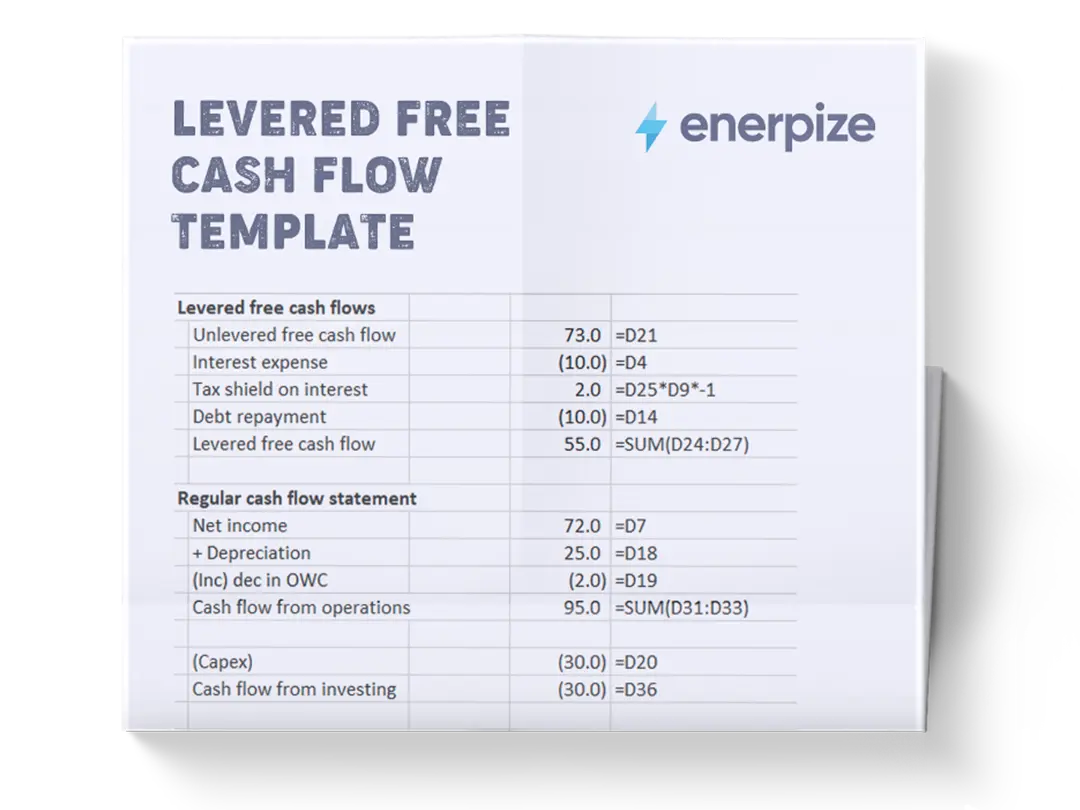
- Levered Free Cash Flow (LFCF): UFCF – Interest – Principal Repayments. This is the cash remaining for equity holders.
If you want to calculate LCFC effortlessly, you can use our Online Levered Free Cash Flow Calculator to get results instantly.
How to Use The Levered Free Cash Flow Template
1- Input Your Business Assumptions
Replace placeholder values (e.g., Revenue, COGS %, OpEx growth) with your company’s actual or forecasted data. Maintain consistent growth logic—e.g., if revenue grows 5% annually, ensure COGS and OpEx scale accordingly unless structural changes are expected.
2- Adjust the Tax Rate
Update the tax rate field if your jurisdiction or effective tax rate differs from 25%. Remember: cash taxes should reflect actual payments, not just accounting provisions.
3- Model Working Capital Realistically
Don’t treat ΔWC as a static percentage. Analyze historical ratios (e.g., DSO, DIO, DPO) to project how receivables, inventory, and payables will evolve with scale. A growing business often requires more working capital—hence the increasing negative values in the template.
4- Validate CapEx Forecasts
CapEx should align with your growth strategy. Are you expanding facilities? Upgrading tech? Tie each year’s CapEx to specific initiatives to ensure credibility.
5- Refine Debt Schedule
The current template shows declining interest and principal, indicative of a fixed amortization loan. If your debt structure differs (e.g., interest-only period, bullet payment), rebuild the interest and repayment rows accordingly. Use your loan amortization schedule as a source.
6- Calculate LFCF Accurately
Ensure LFCF = UFCF – Cash Interest – Principal Repayments. Do not subtract non-cash interest (e.g., PIK). Only actual cash outflows reduce LFCF.
7- Use LFCF for Decision-Making
- Valuation: Discount projected LFCFs at your cost of equity (not WACC) to derive equity value.
- Liquidity Check: If LFCF is consistently positive and growing, you have room for dividends or buybacks.
- Red Flags: Negative LFCF despite positive EBIT? Investigate debt burden or working capital drag.
Related Templates
Importance of Levered Free Cash Flow Template
Serve as Equity Valuation Anchor
LFCF is the fundamental input for the Discounted Cash Flow (DCF) valuation method when determining the intrinsic value of the company’s equity. By projecting the LFCF over a forecast period and discounting those flows using the Cost of Equity (since LFCF represents cash available to equity holders), analysts can accurately derive the present value of the equity claims. This is the only cash flow metric that truly isolates the value attributable solely to shareholders.
Ensures Capital Structure Sustainability
The calculated LFCF serves as a critical barometer for assessing a company's debt capacity and the long-term sustainability of its current capital structure. A consistent and ample LFCF demonstrates that the entity can generate sufficient operating cash to comfortably service its interest expense and mandatory principal repayments, thereby reducing financial risk. Conversely, a narrow or negative LFCF signals immediate liquidity concerns and suggests that the existing debt load may be financially debilitating.
Indicates Shareholder Return Potential
A robust and expanding Levered Free Cash Flow is the primary indicator of a company’s ability to return capital to its shareholders. The residual cash represented by LFCF is what management can allocate to discretionary activities, specifically including the issuance of dividends, executing share repurchase programs (buybacks), or funding extraordinary debt reduction. The magnitude of LFCF directly correlates with the potential for direct shareholder reward.
Reveals Operational Risk
Monitoring the trend and volatility of LFCF provides early warnings regarding operational efficiency and financial stability. Fluctuations, particularly those resulting in persistently low or negative figures, often reveal underlying issues such as unsustainable Capital Expenditure demands, excessive debt burdens, or structural deficiencies in working capital management. It is a necessary metric for comprehensive risk assessment before any investment decision.
Revealse Debt Capacity Assessment
By explicitly incorporating debt service obligations, the template reveals whether a company can sustain its current capital structure. If LFCF turns negative or becomes volatile, it may signal over-leverage and the need for refinancing or equity infusion.
Sets Performance Benchmarking
Tracking actual LFCF against forecasted values helps finance teams identify operational inefficiencies, timing mismatches in working capital, or unexpected debt burdens, enabling faster course corrections.
Who Can Use The Levered Free Cash Flow Template?
Equity Research and Portfolio Managers
These professionals exclusively utilize the LFCF template for proprietary valuation models, particularly within the Discounted Cash Flow (DCF) framework, which aims to determine an investment thesis. By standardizing the LFCF calculation across peer groups, they achieve an apples-to-apples comparison of the true distributable cash flow, enabling accurate price targets, buy/sell/hold recommendations, and portfolio allocation decisions based on intrinsic value.
Corporate Finance and Strategic Management
Internal corporate finance teams rely on the LFCF template for strategic capital allocation and forecasting. The metric serves as a quantifiable constraint on discretionary spending, guiding crucial decisions related to growth initiatives—such as funding capital-intensive upgrades, underwriting research and development (R&D), or executing operational expansions. Management uses LFCF to ensure that growth is financed internally without compromising debt service requirements.
Lending Institutions and Credit Analysts
Lenders and credit analysts require the LFCF template to conduct thorough due diligence on a borrower’s repayment capacity. The LFCF provides concrete evidence of cash flow available after all mandatory fixed charges are met. A consistently strong LFCF history indicates lower credit risk, which directly impacts the terms, size, and cost of secured and unsecured credit facilities extended to the company.