

Posted on 10 March 2026
Equity Reconciliation Template Excel & Google Sheets
- The equity reconciliation template is available in Excel and Google Sheets.
- It provides a clear view of equity changes over time.
- Streamlines tracking of stock issuance, repurchases, and dividends.
- Simplifies reconciliation between stock records and retained earnings.


What is the Equity Reconciliation Template?
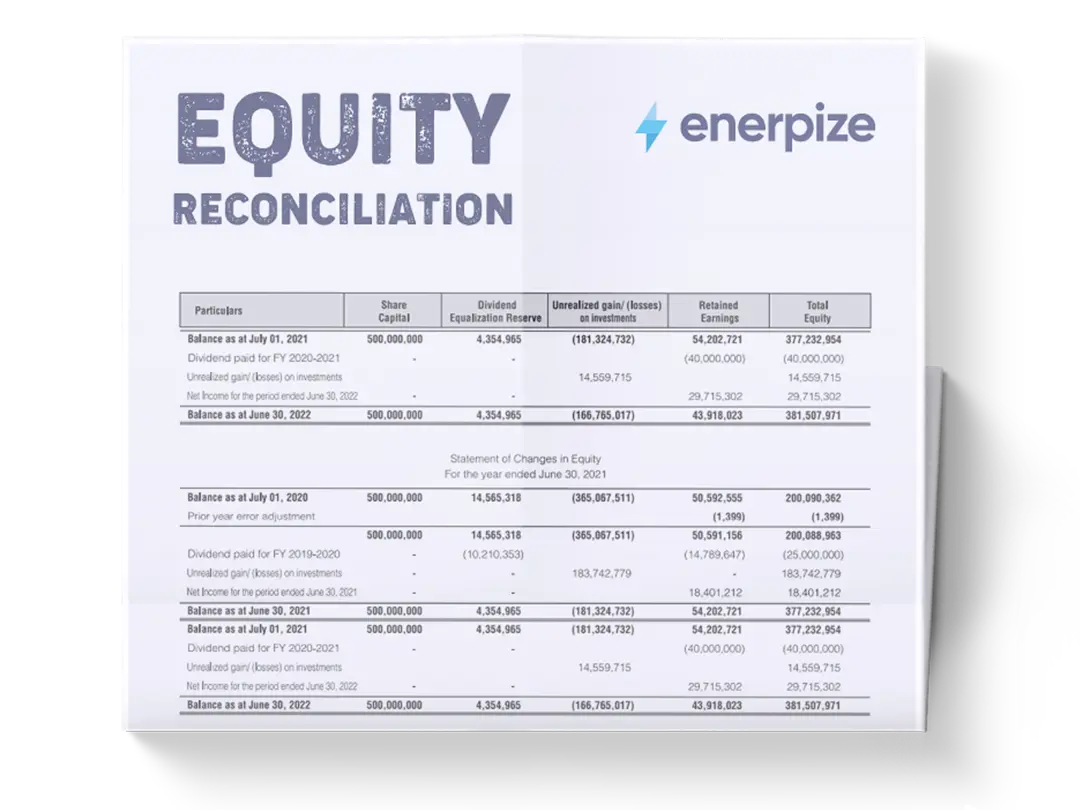
An Equity Reconciliation Template tracks all changes in a company’s equity during a specific period. It consolidates data on common and preferred stock, retained earnings, dividends, and owner transactions into a single, easy-to-use framework.
By standardizing the recording of equity movements, the template ensures transparency, minimizes errors, and supports accurate reporting to stakeholders. It provides a chronological overview of beginning balances, share issuances, repurchases, net earnings, and dividends, linking each activity to its impact on total equity.
What Does the Equity Reconciliation Template Contain?
Stock Balance:
Tracks beginning balances, share issuances, and repurchases for each class of stock. Provides total shares and par value including capital in excess of par. This ensures clarity in shareholder ownership and facilitates reconciliations between records.
Common Stock A:
Captures the number of shares, par value, and capital in excess of par for Class A common stock. Useful for distinguishing voting rights or specific investor allocations.
Common Stock B:
Reserved for Class B shares. In the provided template, no shares are currently recorded. This section allows for future expansion if additional stock classes are introduced.
Preferred Stock:
Details the number of shares, par value, and capital in excess of par for preferred shareholders. Provides a snapshot of equity subject to preferential dividends or liquidation rights.
Total Stock:
Summarizes all stock classes to show the cumulative shares and total par value plus capital in excess of par. Essential for monitoring overall ownership dilution or growth.
Average Price of Shares Issued/Repurchased:
Calculates the average cost per share for issuances and buybacks. Helps evaluate the financial impact of equity transactions on the company’s capital structure.
Retained Earnings Balance:
Shows the beginning balance, adjustments from net earnings, and any distributions like dividends. Reflects the cumulative profits retained for reinvestment.
Owner Contributions and Withdrawals:
Tracks additional capital injections and personal withdrawals by owners. Ensures that changes outside regular operations are properly recorded.
Dividends Paid:
Records all dividend distributions and decreases retained earnings. Provides visibility into cash returned to shareholders.
Net Earnings (Loss):
Reports the period’s net income or loss. This figure directly impacts retained earnings and, ultimately, total equity.
Balance: End of Period:
Displays final balances for all sections, including stock totals, retained earnings, and total equity. Enables verification that all transactions have been accurately reconciled.
How to Use the Equity Reconciliation Template
1. Prepare Beginning Balances
Input the beginning-of-period stock balances for each class (Common Stock A, Common Stock B, Preferred Stock) including the par value and capital in excess of par. Enter the beginning retained earnings and owner contributions or withdrawals from prior records.
2. Record Stock Issuances
Add new shares issued during the period in the relevant stock class.
Input corresponding par value and any additional paid-in capital.
The template automatically updates total stock values, providing a clear view of shareholder dilution.
3. Record Stock Repurchases
Deduct the number of shares repurchased and their associated par value plus excess capital. Verify that total stock adjusts correctly, ensuring the reconciliation reflects both issuance and buyback activity.
4. Track Net Earnings
Enter net earnings (or losses) for the period. This directly updates retained earnings, reflecting profits retained for reinvestment.
5. Record Dividends and Owner Transactions
Input dividends paid, which decrease retained earnings. Document owner contributions and withdrawals, ensuring changes in equity are fully captured.
6. Calculate Ending Balances
The template will sum all stock classes and retained earnings to display the total equity at period end. Cross-verify totals against general ledger or other financial records to confirm accuracy.
7. Review and Analyze
Analyze average prices of shares issued and repurchased to assess the impact on overall capital cost.
Review changes in total equity to ensure transactions align with the financial strategy.
Use the reconciliation to prepare reports for investors, auditors, or internal decision-making.
Related Templates:
Importance of Equity Reconciliation Template
Ensures Accurate Shareholder Records
By capturing every issuance, repurchase, and dividend, the template guarantees that shareholder ownership is always accurately documented. This precision is critical for avoiding disputes, maintaining investor confidence, and supporting compliance with corporate governance standards. Clear records allow management to quickly verify equity positions and resolve discrepancies without lengthy manual audits.
Supports Strategic Decision-Making
An up-to-date reconciliation of equity enables executives to make informed decisions about funding, dividend policies, and stock issuance strategies. Understanding how transactions affect retained earnings and total equity helps businesses plan for growth, evaluate capital needs, and optimize shareholder value. Without a clear equity overview, decisions risk being made on incomplete or inaccurate data.
Simplifies Audit and Compliance Processes
Equity reconciliations create a robust audit trail for internal and external reviews. Regulatory authorities, investors, and auditors can verify all transactions from beginning balances through net earnings and distributions. The template reduces errors, highlights inconsistencies, and ensures compliance with accounting standards, minimizing risk of penalties or financial misstatements.
Enhances Operational Efficiency
Automating equity tracking through a structured template saves time and reduces reliance on ad-hoc spreadsheets or manual calculations. Teams can quickly generate reports, monitor shareholder activity, and reconcile accounts, freeing resources for analysis and strategic planning. This efficiency supports smoother month-end and year-end close processes.
Who Can Use an Equity Reconciliation Template?
Startup Founders and Small Business Owners
Managing equity is critical for early-stage companies seeking investor confidence. The template enables founders to track ownership changes, monitor stock issuance, and document dividends accurately, supporting transparency and strategic capital management.
Financial Controllers and Accountants
Controllers benefit from the structured layout to maintain precise equity records, reconcile multiple stock classes, and report changes to management. The template provides a ready-to-use framework to streamline monthly and quarterly reporting processes.
Investors and Board Members
Shareholders and board members can review reconciliations to verify ownership stakes and understand retained earnings and dividend impacts. It offers transparency into how company decisions affect equity distribution, empowering informed oversight and governance.
Audit and Compliance Teams
Auditors and compliance professionals rely on detailed templates to verify equity transactions and confirm adherence to accounting principles. The structured format supports rapid verification, error detection, and regulatory compliance reviews.
Looking for Beyond Just Equity Tracking?
While our Equity Reconciliation Template helps you maintain precise ownership and earnings records, businesses often need more advanced capabilities. That’s where Enerpize, our all-in-one ERP platform, comes in.
With Enerpize Online Accounting Software, you can:
- Automate real-time equity updates and shareholder reporting
- Integrate equity tracking with broader financial and operational systems for seamless data flow
- Gain enterprise-level insights across investments, cash flow, and stakeholder management
If you’re ready to move beyond spreadsheets, Enerpize brings enterprise-grade control to growing teams.