

Posted on 19 April 2026
Shareholder Equity Template Excel & Sheets
- The shareholder equity template is available in Excel and Google Sheets.
- Evaluate assets, liabilities, and equity with precision to support smarter financial decisions.
- Compare book value and intrinsic value to uncover real business worth and investor insights.
- Make confident, data-driven decisions with a structured equity framework.


What is the Shareholder Equity Template?
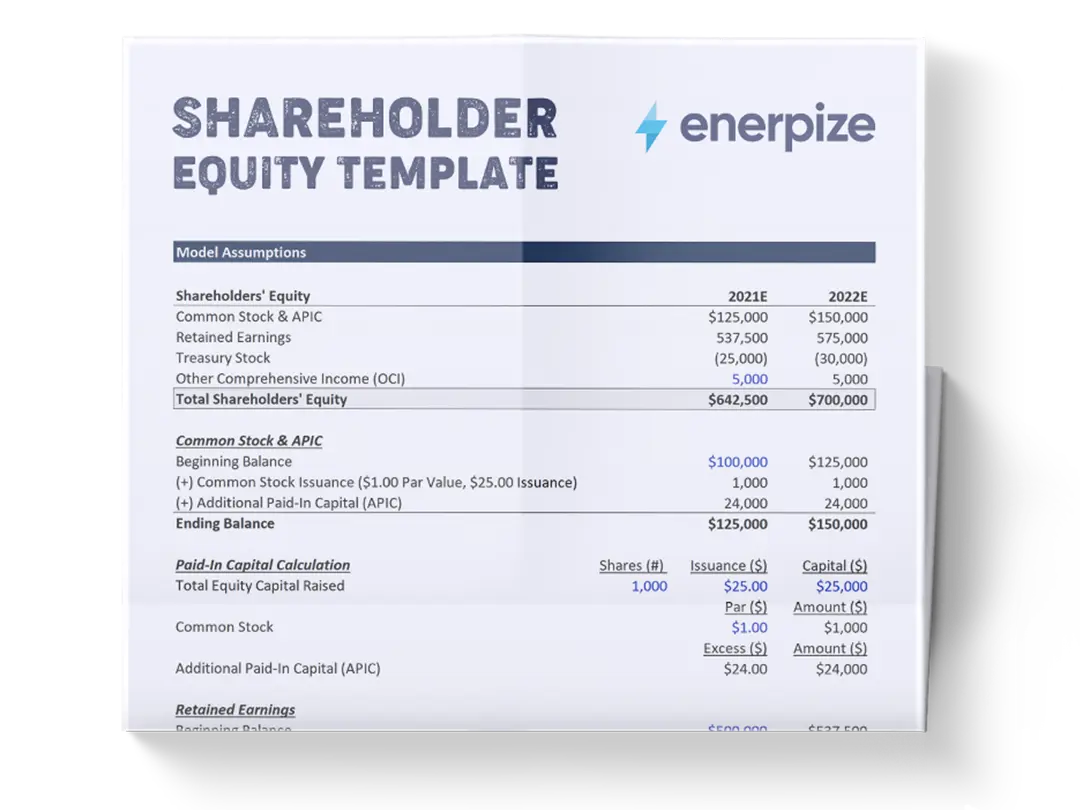
A shareholder equity report template calculates and presents the net value of a business by reconciling its assets and liabilities while also incorporating valuation methodologies such as discounted cash flow (DCF). It provides a dual-layer view of equity: the accounting-based book value derived from the balance sheet, and the intrinsic value based on projected future cash flows.
It enables businesses to assess financial health, validate the accounting equation, and estimate enterprise value with greater clarity. This makes it an essential tool for financial reporting, investment analysis, and strategic planning, especially for organizations that need both compliance-grade accuracy and forward-looking valuation insights.
What Does The Shareholder Equity Template Contain?
Business Details
Captures identifying information, including Business Name, Business Address, Business Phone, and Business Email, to ensure the template is properly attributed and traceable.
Balance Sheet - Book Value
Represents the accounting-based valuation of the business by summarizing assets, liabilities, and resulting equity.
Assets
Lists the company’s owned resources, including Cash and Inventory, culminating in Total Assets.
Liabilities
Details financial obligations such as Accounts Payable and Debt, summed into Total Liabilities.
Equity
Represents the residual value of the business after liabilities are subtracted from assets.
Liabilities + Equity
Validates the accounting equation by confirming that total liabilities and equity equal total assets.
Intrinsic Valuation - DCF Method
Provides a forward-looking valuation using discounted cash flow principles.
NPV of Cash Flow
Represents the present value of projected future cash flows.
Plus: Cash
Adds current cash reserves to the valuation.
Less: Debt
Subtracts outstanding debt to arrive at a net equity value.
Equity
Final intrinsic valuation result based on DCF calculations.
How to Use The Shareholder Equity Template
1- Enter Business Information First
Start by filling in the Business Details section. Input your company’s name, address, phone number, and email. This step ensures your financial document is properly labeled and ready for reporting, sharing, or auditing purposes.
2- Populate the Balance Sheet (Book Value Section)
Move to the Balance Sheet - Book Value section and begin with assets:
- Enter your cash balance based on current bank records.
- Input inventory value based on your latest stock valuation.
- Confirm that Total Assets reflects the sum of these figures.
Next, fill in liabilities:
- Add Accounts Payable (outstanding supplier obligations).
- Include Debt (loans or financing obligations).
- Verify that Total Liabilities is correctly calculated.
Finally:
- Confirm Equity is calculated as Total Assets minus Total Liabilities.
- Check that LIABILITIES + EQUITY equals Total Assets. This step validates the integrity of your financial data.
3- Input Intrinsic Valuation Data (DCF Section)
Proceed to the Intrinsic Valuation - DCF Method section:
- Enter the NPV of Cash Flow, which should come from your financial projections or valuation model.
- Add your current Cash balance.
- Subtract total Debt.
The resulting Equity figure represents your company’s intrinsic value based on expected future performance.
4- Cross-Compare Book Value vs. Intrinsic Value
Use both sections together:
- Book Value shows what your company is worth based on recorded financials.
- Intrinsic Value shows what it should be worth based on future earnings.
A significant gap between the two can indicate underpricing, overvaluation, or growth opportunities.
5- Validate Financial Consistency
Double-check:
- Asset totals match liabilities plus equity
- No missing liabilities or overstated assets
- DCF inputs are realistic and based on defensible assumptions
This step prevents flawed valuation conclusions.
6- Use the Template for Decision-Making
Apply insights from the template to:
- Evaluate funding needs
- Prepare for investor discussions
- Assess financial stability
- Guide strategic planning
7- Update Regularly
This template should not be static. Update it periodically as:
- Financial positions change
- New liabilities arise
- Cash flow projections evolve
Consistent updates ensure ongoing accuracy and relevance.
Related Templates
Financial Analysis Report Template
Free Balance Sheet Excel Template
Importance of Shareholder Equity Template
Provides a clear and structured view of business value
By consolidating assets, liabilities, and equity into a single framework, the shareholder equity template delivers a transparent snapshot of a company’s financial standing. This clarity is essential for identifying whether the business is financially stable, over-leveraged, or underutilizing its resources. In real-world scenarios, business owners often struggle with fragmented financial data spread across multiple sheets or systems, making it difficult to assess true value.
This template eliminates that confusion by aligning all key components into one cohesive view. As a result, decision-makers can quickly interpret financial health and take corrective or growth-oriented actions with confidence.
Bridges accounting data with strategic valuation insights
Unlike basic financial templates, this structure goes beyond historical accounting by incorporating intrinsic valuation through discounted cash flow analysis. This dual perspective allows businesses to compare what they currently own versus what they are expected to generate in the future. For example, a startup with low book value but strong projected cash flows can justify higher valuations during fundraising. Without this combined approach, companies risk relying solely on backward-looking data.
The template enables a more strategic understanding of value, which is critical for negotiations, investor relations, and long-term planning.
Enhances financial accuracy and accountability
The built-in structure reinforces the accounting equation, ensuring that assets always equal liabilities plus equity. This validation mechanism acts as a safeguard against common financial errors such as misreporting liabilities or overstating assets. In practice, even small inconsistencies can lead to major issues during audits or investor reviews. By forcing alignment across all financial components, the template reduces these risks significantly. It also creates a level of accountability within finance teams, as every figure must reconcile logically within the framework.
Supports smarter financial and investment decisions
Access to both book value and intrinsic valuation empowers stakeholders to make more informed decisions. Whether evaluating expansion opportunities, securing funding, or managing debt, having a reliable equity calculation is essential. For instance, businesses can determine whether they are undervalued before entering investor discussions or assess if taking on additional debt is financially viable. Without such structured insights, decisions are often based on incomplete or outdated data. This template transforms raw numbers into actionable intelligence that drives growth and sustainability.
Who Can Use the Shareholder Equity Template?
Startup founders and entrepreneurs
For founders, understanding the true value of their business is critical—especially when raising capital or pitching to investors. This template provides a straightforward way to calculate both book value and intrinsic valuation without requiring advanced financial tools. Many early-stage businesses lack formal financial systems, leading to unclear or inconsistent valuation narratives. By using this template, founders can present structured, credible financial data that strengthens investor confidence. It also helps them track how their equity evolves as the business grows, ensuring better control over ownership and financial strategy.
Finance teams and accounting professionals
Accountants and finance teams benefit from the template’s structured approach to reconciling financial data. It simplifies the process of validating the balance sheet while also introducing valuation insights that go beyond standard reporting. In day-to-day operations, finance professionals often need to prepare reports, support audits, and advise leadership. This template serves as a reliable reference point for all those activities. It reduces manual calculations, improves accuracy, and enables deeper financial analysis without requiring complex systems.
Investors and financial analysts
Investors and analysts use shareholder equity calculations to evaluate whether a business is worth investing in. This template provides both historical financial context and forward-looking valuation, which are essential for making informed investment decisions. In practice, analysts often compare book value to intrinsic value to identify undervalued opportunities. Without a structured template, this process can become time-consuming and prone to inconsistencies. By standardizing the calculation, the template allows for quicker, more reliable analysis across multiple businesses or scenarios.
Business managers and strategic decision-makers
Managers responsible for growth, budgeting, and operations can use this template to align financial insights with business strategy. It helps them understand how operational decisions impact overall equity. In real-world scenarios, managers often make decisions without fully seeing their financial implications. This template bridges that gap by connecting financial data to strategic outcomes. As a result, managers can make more informed decisions that support profitability and long-term sustainability.
Looking for Beyond Just Equity Calculation?
While this shareholder equity template helps you calculate book value and estimate intrinsic business value, businesses often need more advanced capabilities.
That’s where Enerpize, our all-in-one ERP platform, comes in.
With Enerpize Online Accounting Software, you can:
- Manage and automate all accounting operations, including journal entries, financial tracking, and reporting in one centralized system
- Track cash flow, revenue, expenses, and generate real-time financial reports without manual spreadsheet updates
- Gain deeper insights with integrated P&L statements, income reports, and asset management tools to support smarter business decisions
If you’re ready to move beyond spreadsheets, Enerpize brings enterprise-grade control to growing teams.