

Posted on 23 April 2026
Equity Roll Forward Template & Statement of Changes in Equity | Excel
- The equity roll forward template is available in Excel and Google Sheets.
- It tracks all equity movements from beginning balance to ending equity in one structured view for complete transparency.
- Helps validate financial accuracy by reconciling net income, dividends, and capital activity in a single workflow.
- Supports audit readiness and decision-making with a clear breakdown of ownership changes over time.


What is the Equity Roll Forward Template?
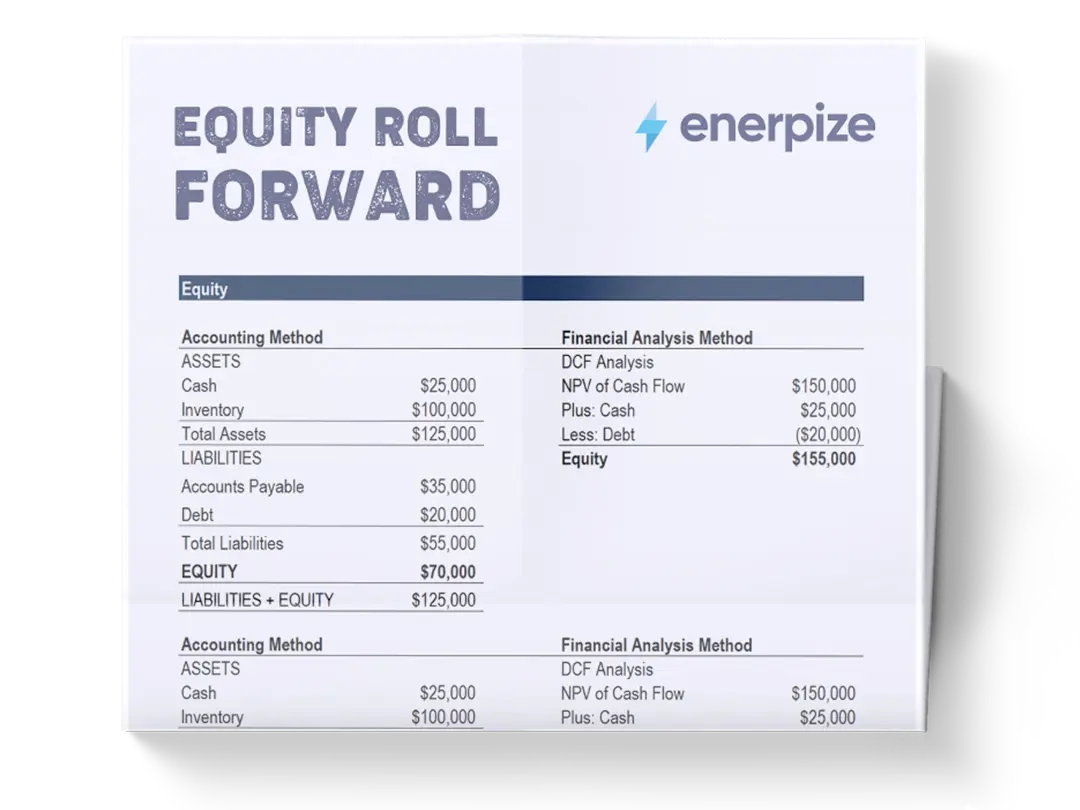
An Equity Roll Forward Template tracks and reconciles changes in a company’s equity over a specific period. It provides a clear bridge between the opening (beginning) equity balance and the closing (ending) equity balance by systematically accounting for all movements, such as net income, dividends, capital contributions, and share buybacks. This ensures that every equity-related transaction is documented in a logical sequence, allowing businesses to validate financial accuracy and maintain consistency across reporting periods.
By consolidating these changes into a single, traceable format, the template plays a critical role in financial analysis, audit preparation, and strategic decision-making, particularly when assessing ownership structure and retained earnings performance. This document is also called a statement of changes in equity, the formal term used in financial reporting and required as a primary statement under IFRS. Both names describe the same reconciliation from opening to closing equity.
Stop reconciling equity by hand at period-end. Enerpize tracks every equity-affecting transaction automatically and keeps opening and closing balances in sync. Start for free
What Does The Equity Rollforward Template Contain?
Business Details:
Captures essential company information, including business name, address, phone number, and email. This section ensures that the template is properly attributed and can be referenced or audited with clear ownership identification.
Description:
Lists the specific equity components that contribute to changes in total equity. These include beginning equity, net income, dividends, capital contributions, share buybacks, and ending equity.
Amount:
Represents the financial value associated with each equity component. Each entry reflects how a specific activity impacts the overall equity position—either increasing or decreasing it.
Beginning Equity:
The starting balance of equity at the beginning of the reporting period, broken into Share Capital, Retained Earnings, and Total Equity. This serves as the baseline from which all changes are measured.
Net Income:
The profit generated during the period, which increases equity when retained in the business.
Dividends:
Distributions made to shareholders, reducing retained earnings and overall equity.
Capital Contributions:
Additional investments made by owners or shareholders increase the company’s equity.
Share Buybacks:
Represents the company repurchasing its own shares, reducing total equity.
Ending Equity:
The final calculated equity after accounting for all additions and deductions, shown as the resulting Share Capital, Retained Earnings, and Total Equity. This figure should reconcile with the balance sheet.
A Worked Equity Roll Forward
Beginning Equity: $180,000. Add Net Income for the period: $45,000. Subtract Dividends paid: $15,000. Add Capital Contributions from a new investor: $25,000. Subtract Share Buybacks: $10,000. Ending Equity: $225,000.
That ending figure is what should appear on the balance sheet's equity section for the same date. If it doesn't match, the discrepancy is almost always a transaction missing from one statement or the other, not an error in the formula itself.
Net income, dividends, capital contributions, buybacks, entering each one manually is where reconciliation errors creep in. Enerpize pulls these directly from your ledger. Start for free
How to Use The Equity Roll Forward Template
1. Input Business Information First
Start by completing the Business Details section. Enter your company’s name, address, contact number, and email. This step ensures that your template is properly documented and can be referenced in financial reports or audits without confusion.
2. Establish the Beginning Equity
Locate the Beginning Equity row and input the opening balance for the reporting period. This figure should match the closing equity from the previous period’s financial statements. Accuracy here is critical, as every subsequent calculation depends on this baseline.
3. Record Net Income for the Period
Enter the company’s Net Income for the period. This value is typically derived from the income statement. Since retained earnings increase equity, this amount will be added to the beginning balance.
4. Account for Dividends Distributed
Input any Dividends paid out during the period. These distributions reduce retained earnings and must be subtracted from equity. Ensure that the amount reflects actual payouts, not declared but unpaid dividend
5. Add Capital Contributions
If owners or investors injected additional funds into the business, record these under Capital Contributions. This step is essential for accurately reflecting ownership changes and increases in equity.
6. Include Share Buybacks
Enter any Share Buybacks made by the company. Since repurchasing shares reduces total equity, this amount should be treated as a deduction.
7. Calculate and Verify Ending Equity
Once all components are entered, compute the Ending Equity using the following structure, updating Share Capital and Retained Earnings separately so the Total Equity figure reflects both components accurately.
Verify that the calculated ending equity aligns with your balance sheet. If there is a discrepancy, review each input for errors or omissions.
8. Review for Consistency and Accuracy
Perform a final check to ensure all entries are complete and logically consistent. Cross-reference values with financial statements such as the income statement and cash flow statement to validate accuracy.
Equity Roll Forwards Under IFRS
Under IAS 1, this document is a mandatory primary financial statement, not something that can be folded into the notes. It must separately show total comprehensive income, transactions with owners such as dividends and share issuances, and the effect of any prior-period restatements. Deloitte's IFRS-to-US-GAAP comparison confirms IFRS also expects disaggregated disclosure of individual equity reserves, such as a revaluation surplus or a currency translation reserve, not just a single combined equity figure.
Equity Roll Forwards Under US GAAP
US practice calls this the Statement of Stockholders' Equity rather than a statement of changes in equity, and the underlying components carry different names: common stock instead of share capital, additional paid-in capital instead of share premium, treasury stock instead of treasury shares. According to EY's US GAAP versus IFRS comparison, both frameworks require the changes in stockholders' equity to be presented, though US GAAP is less prescriptive about structure than IFRS. Public companies present it in full under SEC Regulation S-X; private companies have more flexibility to satisfy the same disclosure through notes rather than a standalone statement, though many prepare the full version anyway for lender or investor reporting.
Importance of Equity Roll Forward Template
Provides a Clear Audit Trail of Equity Movements
An equity roll forward template creates a structured record of every change affecting ownership value within a business. Instead of relying on fragmented financial data, finance teams can trace how equity evolves from one period to the next in a single view. This is particularly valuable during audits, where transparency and traceability are essential.
Improves Financial Accuracy and Reconciliation
One of the most common challenges in financial reporting is ensuring that equity balances align across different statements. This template eliminates guesswork by consolidating all equity drivers into a single reconciliation framework. By explicitly accounting for net income, dividends, and capital activity, it reduces the likelihood of misstatements or overlooked transactions. This accuracy is critical not only for internal reporting but also for external stakeholders who rely on precise financial data. Over time, consistent use of the template strengthens the integrity of the company’s financial records.
Enhances Strategic Decision-Making
Understanding how equity changes over time provides valuable insights into a company’s financial health and growth strategy. For example, frequent dividends may indicate strong profitability but could also limit reinvestment opportunities. Similarly, recurring capital contributions might signal expansion or cash flow challenges. By organizing these elements clearly, the template allows decision-makers to evaluate trends and make informed strategic choices. This level of visibility is especially important for businesses planning fundraising, restructuring, or scaling operations.
Simplifies Period-End Reporting and Analysis
Closing financial periods often involves reconciling multiple accounts and verifying balances across reports. The equity roll forward template streamlines this process by centralizing all relevant data in one place. Finance teams can quickly confirm whether ending equity aligns with the balance sheet, reducing the time spent on manual checks. This efficiency becomes increasingly valuable as transaction volume grows. Instead of navigating complex spreadsheets, teams can rely on a standardized format that accelerates reporting without compromising accuracy.
Who Can Use Equity Roll Forward Template?
Small Business Owners and Entrepreneurs
For small business owners managing their own finances, tracking equity changes can quickly become confusing, especially when dealing with profits, withdrawals, and reinvestments. This template provides a straightforward structure that simplifies these calculations and ensures nothing is overlooked.
Accounting Professionals and Bookkeepers
Accountants and bookkeepers benefit from the consistency and structure this template provides. It standardizes how equity movements are recorded, reducing variability and the risk of errors across reporting periods. This allows professionals to focus less on manual reconciliation and more on higher-value tasks such as financial analysis and advisory. Additionally, having a clear equity roll forward improves collaboration with auditors and management by providing a transparent, easy-to-follow summary of changes.
Finance Managers and Controllers
Finance leaders rely on accurate, consolidated data to oversee company performance and ensure compliance. The equity roll forward template supports this by offering a reliable method for reconciling equity balances and validating financial statements. It also enables managers to monitor trends in retained earnings, capital structure, and shareholder activity. This insight is crucial for budgeting, forecasting, and strategic planning, particularly in growing organizations with complex financial operations.
Investors and Financial Analysts
Investors and analysts use equity data to assess a company’s financial stability and growth potential. This template provides a clear breakdown of how equity changes over time, making it easier to evaluate profitability, dividend policies, and capital management. By reviewing these components in a structured format, analysts can identify patterns, assess risk, and make more informed investment decisions. The transparency offered by the template enhances confidence in the accuracy of financial reporting.
Looking for Beyond Just Tracking Equity Changes?
While this Equity Roll Forward Template helps you reconcile ownership movements and validate financial accuracy, businesses often need more advanced capabilities. That’s where Enerpize, our all-in-one ERP platform, comes in.
With Enerpize accounting software, you can:
- Automate journal entries and track equity-related transactions seamlessly within a unified accounting system
- Monitor cash flow, income, and expenses in real time with integrated reporting and financial dashboards
- Generate detailed financial reports, including P&L and statements, to support smarter, data-driven decisions
If you’re ready to move beyond spreadsheets, Enerpize brings enterprise-grade control to growing teams.
Frequently Asked Questions
What is the difference between an equity roll forward and a statement of changes in equity?
None, in substance. They're two names for the same reconciliation from opening to closing equity. "Equity roll forward" is more common in internal finance and audit work; "statement of changes in equity" is the formal term used in IFRS reporting.
How often should an equity roll forward be prepared?
At minimum annually, alongside your other financial statements. Businesses with frequent equity activity, new investors, dividend payments, buybacks, often prepare one quarterly.
What if my ending equity doesn't match the balance sheet?
Check for a transaction recorded on one statement but not the other first, a dividend declared but not yet reflected, or a capital contribution booked to the wrong period. The formula itself rarely breaks; a missing line item almost always does.
Does a sole proprietorship need this statement?
Not formally. Sole proprietors don't have share capital or shareholder equity in the corporate sense, so this template is more relevant once a business is structured as a corporation or has outside investors.
Can Enerpize generate this automatically?
Yes. Enerpize tracks equity-affecting transactions as they happen and keeps the roll forward current without manual reconciliation at period-end.
About the Author
Omar El Bahr is a Senior Digital Growth Specialist at Enerpize, where he leads SEO, content strategy, and organic growth across international markets. He is a Forbes Communications Council contributor and has written for Entrepreneur on business communication and digital strategy.
Disclaimer: This template is provided for general informational purposes only and does not constitute accounting or legal advice. Reporting requirements vary by jurisdiction and accounting framework; consult a qualified accountant for guidance specific to your business.