

Posted on 4 June 2026
Free Delivery Note Template Download: Excel, Word, PDF & Google Sheets
- Accompanies every shipment with a complete record of what was sent, what was received, and what remains outstanding.
- Tracks ordered versus delivered quantities per line item, with the outstanding balance calculating automatically in the Excel version.
- Provides a signed paper trail for proof of delivery, dispute resolution, and VAT audit documentation across the UK, South Africa, and Kenya.
- The delivery note template is available in Word, Excel, PDF, Google Sheets, and Google Docs.
A delivery note template is a structured shipment document used by businesses to confirm the goods delivered to a customer, record quantities against the original order, and obtain a recipient signature that serves as proof of delivery.


What Is a Delivery Note?
A delivery note is a document that travels with a shipment of goods. It lists what was sent, in what quantities, and gives the recipient a structured way to check the delivery against the original order. Once the recipient verifies the contents, they sign it. That signature turns a working document into proof of delivery.
It goes by several names depending on your industry and country. Dispatch note. Goods received note. Packing slip. Delivery slip. The function is the same regardless of what you call it.
Here is what a delivery note is not. It is not an invoice. An invoice requests payment and carries prices, tax rates, and payment terms. A delivery note records what was physically handed over. Prices are typically excluded on purpose so that warehouse staff focus on verifying quantities, not values. Using a delivery note as a substitute for a VAT invoice is a specific compliance error. In the UK, HMRC flags it explicitly.
Want delivery notes that generate automatically from your invoices? Start Free with Enerpize
What to Include in a Delivery Note Template
Most free templates online give you a text box and a signature line. That is not enough for a business that ships regularly, handles partial orders, or operates in a country where delivery documentation feeds into your tax audit trail.
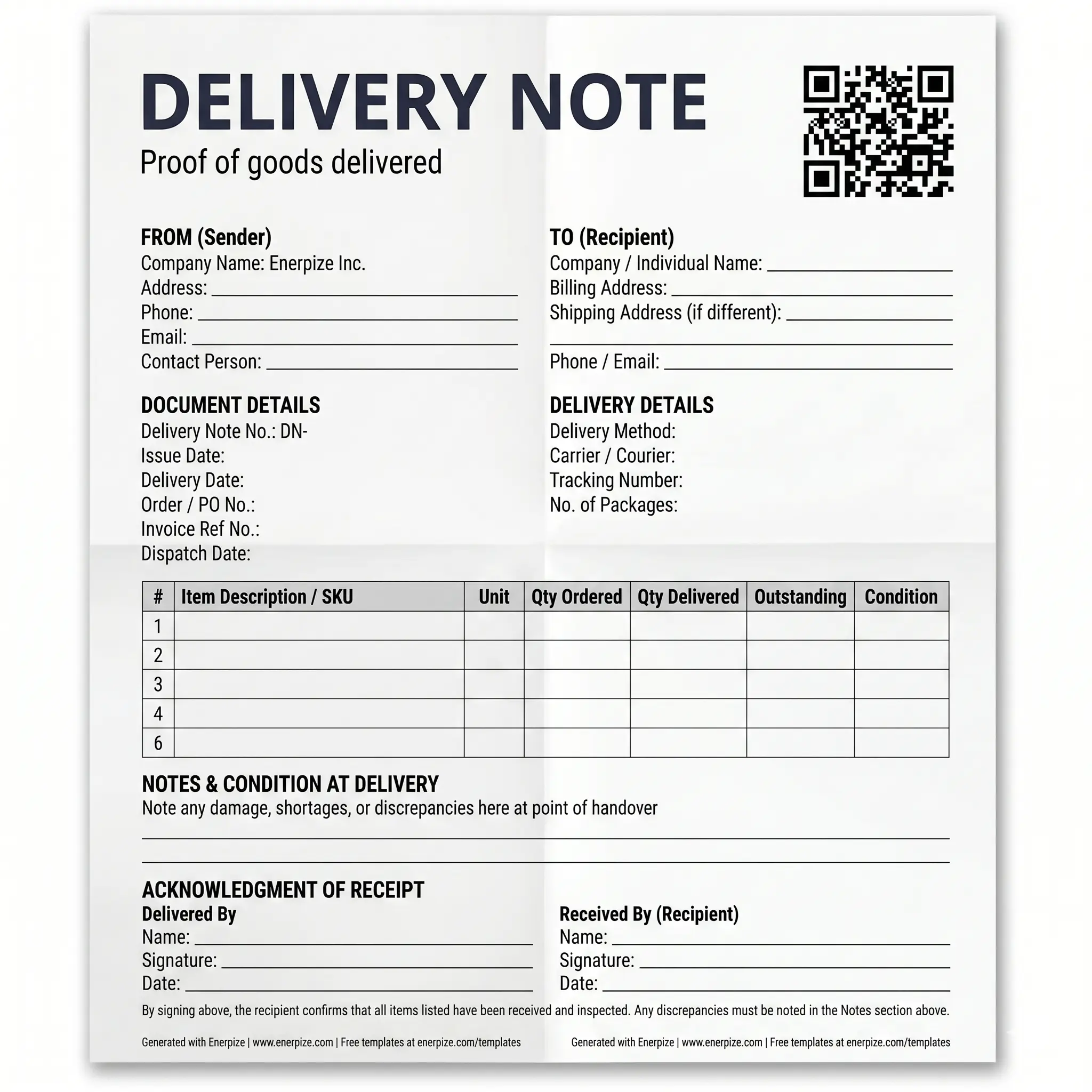
Here is every field a complete delivery note template needs:
| Field | Why It Matters |
|---|---|
| Delivery Note Number | Sequential reference for tracking and matching to the invoice and PO |
| Issue Date | When the document was created |
| Delivery Date | When goods were physically handed over — separate from issue date |
| Dispatch Date | When goods left the sender's premises |
| Order / PO Reference | Enables three-way matching: PO, delivery note, invoice |
| Invoice Reference Number | Links this delivery to the corresponding billing document |
| Sender Details | Company name, address, phone, email, contact person |
| Recipient Details (Bill To) | Business name and billing address |
| Recipient Details (Ship To) | Delivery address if different from billing address |
| Item Description / SKU | What was shipped, product name and code |
| Unit | Each, box, kg, pallet — clarifies how quantity is measured |
| Quantity Ordered | What was on the original order |
| Quantity Delivered | What was actually sent in this shipment |
| Outstanding | Ordered minus delivered — essential for partial deliveries |
| Delivery Method | Courier, road freight, own vehicle |
| Carrier Name | The transport company used |
| Tracking Number | Reference for following the shipment |
| Number of Packages | Total package count in this consignment |
| Condition Notes | Space for the recipient to flag damage or discrepancies at handover |
| Recipient Signature | Signed confirmation that goods were received and inspected |
| Sender Signature | Confirmation from the delivering party |
The most important pair of fields on that list is quantity ordered and quantity delivered. Most templates collapse them into one column. Businesses running partial shipments, phased stock releases, or back-order fulfillment need both fields to track what is still outstanding without maintaining a separate spreadsheet.
What Our Delivery Note Template Includes
The Enerpize delivery note template was built after reviewing twelve competitor templates and identifying the gaps that cause real problems in practice.
Separate billing and shipping address fields
The person paying and the person receiving the goods are not always at the same address. B2B deliveries to branch locations, third-party warehouses, or drop-ship recipients need both fields.
Ordered vs. delivered quantity with auto-calculating outstanding
In the Excel version, the Outstanding column calculates automatically. Order 50 units, deliver 30, and the outstanding field shows 20 without you touching it. This matters for partial shipment reconciliation and for keeping your purchase cycle clean.
Condition notes section
A dedicated field for the recipient to record damage, missing items, or discrepancies at point of handover. A delivery note without this field is significantly weaker as a dispute document. Contested claims are far harder to resolve without contemporaneous condition notes written at the moment of delivery.
Dual signature block
One signature for the person who delivered the goods. One for the person who received them. Both carry name, signature, and date. An unsigned delivery note has materially less evidential weight in any commercial dispute.
Full document linking fields
Delivery Note Number, PO Reference, Invoice Reference, and Dispatch Date are all present. These four fields are what make three-way matching work: PO, delivery note, invoice. Without them, your accounts payable team is reconciling manually.
Available in Excel (with live Outstanding formula), Word, PDF, Google Sheets, and Google Docs.
Delivery Note vs Invoice vs Packing Slip
People confuse these documents constantly. Here is the difference in one table.
| Document | Purpose | Includes Prices? | Requires Signature? | Triggers Payment? |
|---|---|---|---|---|
| Delivery Note | Confirms what was physically delivered | No | Yes, recipient signs | No |
| Invoice | Requests payment for goods or services | Yes | No | Yes |
| Packing Slip | Internal picking and packing reference | Sometimes | No | No |
| Bill of Lading | Carrier contract and goods title document | No | Carrier signs | No |
| Goods Received Note | Buyer's internal confirmation of receipt | No | Internal only | No |
| Proof of Delivery | Legal confirmation of delivery completion | No | Yes, legally significant | No |
The rule is simple. Delivery notes travel with the goods. Invoices follow after delivery is confirmed. Never substitute one for the other.
How to Use the Delivery Note Template
Step 1: Fill in document details. Assign a unique sequential delivery note number. DN-001, DN-002, and so on. Enter the issue date, delivery date, dispatch date, and PO reference. Link to the corresponding invoice number.
Step 2: Enter sender information. Your company name, address, phone, email, and the name of the contact person managing the shipment.
Step 3: Enter recipient information. Distinguish between billing address and shipping address. These are frequently different in B2B transactions. The finance team is in one office. The warehouse receiving the delivery is somewhere else entirely.
Step 4: List the items delivered. For each line item, enter the description, SKU if applicable, unit, quantity ordered, and quantity delivered. In the Excel version, the Outstanding column calculates without manual input.
Step 5: Add delivery logistics. Method, carrier, tracking number, package count. These fields matter most when a dispute arises about whether the goods arrived at all.
Step 6: Document condition at handover. If anything is damaged, missing, or does not match the order, the recipient notes it here before signing. This is the strongest protection against disputed claims that surface days or weeks after delivery.
Step 7: Get both signatures. The delivering party signs. The receiving party signs. Both print their name and date the document. This is what converts a working document into legal proof of delivery.
Step 8: Retain copies. In the UK, business records including delivery documentation must be retained for a minimum of six years under HMRC requirements. In Kenya, KRA requires at least five years. In South Africa, SARS expects the same. Match your retention period to the market you operate in.
Skip the manual process. Generate delivery notes directly from your invoices in Enerpize. Start Free with Enerpize
How Enerpize Connects Delivery Notes to Your Entire Operation
A standalone delivery note template answers one question: did the goods arrive? Enerpize answers the questions that come after.
What was actually received versus what was ordered? Which warehouse does it go to? Does this close the purchase order or is there still an outstanding balance? What does the supplier owe you if something arrived damaged? Which products are now back above the reorder threshold?
Those questions do not answer themselves. And when you are running multiple shipments across multiple warehouses simultaneously, a signed PDF sitting in someone's email is not a system. It is a starting point.
When a delivery arrives, three things need to happen simultaneously. The stock count updates. The purchase cycle closes. The supplier record reflects what was actually received versus what was ordered. Doing those three things manually is where businesses bleed time, create reconciliation errors, and discover discrepancies at the worst possible moment, usually during a stocktake or a supplier dispute.
Enerpize Inventory Management Software
Enerpize inventory management software tracks every product movement in real time. When goods are confirmed as received, stock quantities update across all warehouses instantly. Not at the end of the day. Not at the next count. Instantly. The system tracks inbound and outbound movements by product, group, or bundle, and lets you assign products across unlimited warehouses with pricing and fulfillment optimized per location. It also generates barcoded packing slips so your warehouse team can identify products at the point of receipt without manual lookup. The delivery note you hand to the recipient corresponds directly to the stock movement recorded in the system. One action. Two records updated.
Enerpize Stocktaking Module
Stocktaking closes the loop on the other side. Once goods are received and logged, Enerpize compares actual stock quantities against registered levels automatically. If the delivery note says 50 units arrived but the system count shows 48, the discrepancy surfaces immediately. Not at the next full stocktake. Not when a customer places an order you cannot fulfill. Right now, while the driver is still on site and the conversation about the missing units can still happen. Low-stock thresholds trigger automatic reminders so replenishment decisions are made with accurate post-delivery data, not pre-delivery estimates that no longer reflect reality.
Enerpize Purchase Management System
The purchase management system connects the whole cycle from the moment the purchase order is raised to the moment the supplier invoice is paid. When a delivery arrives and quantities are confirmed as received, Enerpize automatically updates the requisition. If only part of the order arrived, the outstanding balance carries forward. No manual note. No separate tracking sheet. The system knows what came in and what is still owed. The purchase invoice is then matched against what was actually delivered, not against what was originally ordered, which is the reconciliation step that most manual processes skip entirely.
The AI invoice processing feature goes further: it extracts supplier name, invoice number, items, quantities, and prices automatically from uploaded invoices, eliminating the manual re-entry that most businesses still rely on and the transcription errors that come with it. The result is a complete, unbroken chain from purchase order to delivery confirmation to invoice payment, with no gaps in the record and no reliance on anyone remembering to update a spreadsheet.
Every stage of that chain generates a document. The purchase order. The delivery note. The goods received confirmation. The supplier invoice. The payment record. In Enerpize, those documents are linked. Pull up any one of them and the full transaction history is there.
For businesses in Kenya, South Africa, and the UK where delivery documentation feeds directly into VAT audit trails, that connected record is not a convenience. It is a compliance advantage. When a tax authority requests supporting documentation for a transaction, the answer is not a folder of PDFs assembled under pressure. It is a transaction record that was built correctly from the day the order was placed.
Generate delivery notes from your invoices automatically. Track what arrived. Close the purchase cycle without manual reconciliation. Start Free with Enerpize
Delivery Note Template for Businesses in the United Kingdom
A signed delivery note is prima facie evidence that goods were delivered. In a UK commercial dispute, that signature shifts the burden of proof to the party claiming non-delivery. That is not a technicality. That is the difference between winning and losing a claim.
What UK businesses need to know.
HMRC requires VAT-registered businesses to retain business records, including delivery documentation, for a minimum of six years. Businesses subject to Making Tax Digital for VAT must store these records digitally in HMRC-compatible formats. The six-year rule applies to VAT records including every document that supports each taxable supply. Miss it and you risk denied input tax claims, penalties, and an audit with no paper trail to stand on.
A delivery note is not a VAT invoice. HMRC is explicit on this point: a delivery note cannot be used by the recipient to reclaim input VAT. If your customer is VAT-registered, you must issue a separate VAT invoice regardless of whether a signed delivery note exists. Using a delivery note as a VAT invoice is a specific compliance failure, not a grey area.
For goods moving between Great Britain and the EU post-Brexit, a delivery note is a supporting document but does not replace customs documentation. UK government guidance on export declarations makes clear that a commercial invoice, packing list, and commodity codes are all still required separately.
The standard limitation period for contract claims in England and Wales is six years from the date of breach under the Limitation Act 1980. A signed delivery note dated at the point of handover is frequently the document that determines whether a claim succeeds or fails within that window.
What to add to your delivery note for UK B2B transactions:
Your company's full registered name. Not just the trading name. Limited companies must use the name as registered at Companies House. Trading names alone are not sufficient for audit purposes.
A clearly separated shipping address field. The billing contact and the receiving warehouse are frequently in different locations.
A condition notes field. Particularly important for freight deliveries where damage at handover must be documented before the driver leaves the site.
Sequential delivery note numbering. It mirrors HMRC's expectation for sequential invoice numbering and produces a clean, unbroken audit trail.
Practical note for UK SMBs. Attach the signed delivery note to the corresponding invoice in your accounting system at the time of delivery confirmation. When HMRC requests supporting documentation during a VAT audit, the linked document chain, PO, delivery note, invoice, payment, is the cleanest possible evidence of a complete and legitimate transaction.
Delivery Note Template for Businesses in South Africa
South Africa's VAT system is governed by Section 20 of the Value-Added Tax Act No. 89 of 1991, administered by SARS. The most important document under this system is the tax invoice. Delivery notes play a supporting but legally distinct role.
Delivery note versus tax invoice in South Africa
A delivery note is not a tax invoice and cannot be used to claim input VAT. SARS operates a three-tier tax invoice system: transactions above R5,000 require a full tax invoice carrying both supplier and recipient details. Transactions between R50 and R5,000 may use an abridged tax invoice. The delivery note confirms what was physically received. The tax invoice is what creates the VAT deduction right. Conflating the two is a compliance error that SARS auditors specifically look for.
Where delivery notes matter for SARS compliance
When SARS audits a VAT return and questions whether a purchase actually occurred, the auditor requests supporting documentation. SARS requires vendors to hold supporting documents at the time the VAT return is submitted. A signed delivery note corroborating the date and quantity of delivery strengthens the audit trail alongside the tax invoice. Without it, the vendor's position weakens significantly. The tax invoice alone tells SARS what was invoiced. The delivery note tells SARS what was actually received.
What to include on a South African delivery note:
Delivery date. SARS requires tax invoices to be issued within 21 days of the date of supply. Your delivery note anchors the physical delivery date, which is the trigger for that 21-day window. Without a dated, signed delivery note, the supply date becomes a point of dispute in any audit.
Accurate item descriptions that match the corresponding tax invoice exactly. If the descriptions differ, SARS may query whether the supply matches the invoice at all.
Quantities delivered. If these differ from the tax invoice, be prepared with documentation explaining the discrepancy before SARS asks.
Recipient signature. It establishes that goods were received and supports the vendor's claim that a taxable supply was made on a specific date.
Practical note for SA businesses
The SARS VAT Act also prescribes specific record-keeping obligations for vendors. Business records are generally expected to be retained for five years. Issue the delivery note at the time of physical delivery. Sign it. File it with the corresponding tax invoice. That pairing is what makes a SARS audit response straightforward rather than stressful.
Delivery Note Template for Businesses in Kenya
Kenya has one of the most advanced digital tax infrastructures in Africa. Since 2024, all businesses operating in Kenya, not just VAT-registered ones, are required to issue electronic tax invoices through KRA's eTIMS system. That context shapes exactly how delivery notes function in Kenyan commerce.
Delivery notes and eTIMS
The Tax Procedures (Electronic Tax Invoice) Regulations 2024 apply to any person conducting business in Kenya. eTIMS is mandatory for tax invoices. Delivery notes are a separate operational document that accompanies goods physically. They are not transmitted through eTIMS. But they serve a critical supporting function: a signed delivery note is the physical evidence that a supply was made, which is what justifies the corresponding eTIMS invoice in the record.
Record retention in Kenya
KRA requires businesses to keep records for a minimum of five years, including documents that support invoiced transactions. Since January 2026, KRA validates declared income and expenses against eTIMS data. A delivery note that corroborates the item, quantity, and date on the corresponding eTIMS invoice makes the transaction audit-proof. One without the other creates a gap that KRA's automated validation is now specifically designed to detect.
What Kenyan businesses should include on their delivery note:
The seller's KRA PIN. This creates a direct cross-reference to the corresponding eTIMS invoice and confirms the identity of the supplying party.
Delivery date. This is the physical supply date that the eTIMS invoice should reference. The two dates should align. Where they do not, an explanation is needed.
Item descriptions matching the eTIMS invoice line items exactly. Discrepancies between the physical delivery note and the electronic invoice are a trigger for KRA queries under the 2026 validation framework.
Recipient signature and date. Physical proof of delivery that complements the digital tax record. Digital invoices alone do not confirm that goods arrived.
Reference to the eTIMS invoice number. This links the paper delivery confirmation directly to the electronic tax record and makes the full transaction traceable end to end.
Practical note for Kenyan SMBs
Businesses supplying buyers with annual turnover below KES 5 million operate under buyer-initiated invoicing rules. The buyer issues the eTIMS invoice on the seller's behalf. In those transactions, a signed delivery note from the seller is the primary physical record that the supply occurred at all. The eTIMS invoice was generated by the buyer. The delivery note is the only document the seller controls. It carries more operational and legal weight in that scenario than in any standard vendor-invoiced transaction.
Delivery Notes in Regulated Industries
Most competitors treat delivery notes as a generic form. They are not. The fields that matter vary significantly by what you ship and who regulates it.
Food and pharmaceuticals
Delivery notes in these sectors require lot numbers, batch codes, expiry dates, and temperature handling notes. This enables product recalls to trace goods from manufacturer to end destination. In the UK, food business operators are subject to General Food Law Regulation (EC) 178/2002, retained in UK law post-Brexit, which mandates traceability one step back and one step forward across the supply chain.
Construction
Delivery notes for construction materials need project reference numbers and site recipient names, not just company-level recipient details. A signed delivery note is frequently required to support a progress payment claim, proving that materials billed under a payment application were physically on site. Without it, the claim is contested.
Wholesale and manufacturing
These sectors need batch or serial number columns and strict quantity reconciliation. Outstanding balance tracking is particularly important when goods are supplied in multiple installments against a single purchase order.
E-commerce and retail
Return policies and customer-facing language matter more here. A delivery note used as a packing slip in a consumer context often includes a returns reference code and customer order number alongside the standard fields.
Key Takeaways
- A delivery note is not an invoice. It confirms what was physically delivered. It does not request payment and cannot be used to reclaim VAT in the UK, South Africa, or Kenya.
- The most critical fields most free templates are missing: separate billing and shipping address, ordered versus delivered quantity split, outstanding balance, condition notes at handover, and dual signature block.
- A signed delivery note is prima facie evidence in a UK commercial dispute. An unsigned one has materially less evidential weight.
- In South Africa, a signed and dated delivery note anchors the physical supply date — which triggers the 21-day window SARS gives vendors to issue a tax invoice.
- In Kenya, a delivery note is the only physical record the seller controls under buyer-initiated invoicing rules for suppliers below the KES 5 million threshold. It carries more weight there than in any standard transaction.
- Record retention varies by market. Six years in the UK. Five years in Kenya and South Africa. Match your filing practice to the country you operate in.
- Three-way matching — purchase order, delivery note, invoice — is the accounting control that prevents payment for goods never received. All three linking fields must be on the document.
- Regulated industries need additional fields. Food and pharma need lot numbers and expiry dates. Construction needs project references. A generic template does not cover these.
Frequently Asked Questions
Is a delivery note a legal requirement?
In most jurisdictions, delivery notes are not legally mandatory. But a signed delivery note is one of the strongest forms of proof of delivery in commercial disputes. It also supports VAT audit trails in the UK, South Africa, and Kenya. In regulated industries such as food and pharmaceuticals, delivery documentation with traceability information may be required by sector-specific regulations regardless of general commercial law.
What is the difference between a delivery note and an invoice?
A delivery note confirms what was physically delivered. It contains no prices and does not request payment. An invoice is a financial document that requests payment and includes prices, tax, and payment terms. Both are needed. The delivery note proves delivery occurred. The invoice creates the payment obligation. Using one as a substitute for the other is a compliance error, particularly for VAT-registered businesses.
What is the difference between a delivery note and a packing slip?
A packing slip is primarily an internal picking and packing document used in the warehouse. It may not include full customer details or a signature block. A delivery note is an external commercial document presented to the customer at point of delivery and signed by the recipient. The terms are sometimes used interchangeably but in a formal B2B context they represent distinct documents with different purposes.
Should a delivery note include prices?
Generally no. Prices are excluded from delivery notes so that warehouse staff focus on verifying quantities rather than values. This is also practical when goods are being delivered to a third party or re-sold. The receiving party should not see the seller's cost. Some industries include unit prices. If yours does, make sure the delivery note is clearly separate from the tax invoice.
How long should I keep delivery notes?
It depends on your jurisdiction. In the UK, HMRC requires VAT-registered businesses to retain business records for a minimum of six years. In Kenya, KRA requires at least five years. In South Africa, SARS expects the same. Even in countries with shorter requirements, keeping delivery notes for the life of any related contract plus the statute of limitations for commercial claims is best practice.
What is a goods received note?
A goods received note is the buyer's internal document confirming that goods were received and inspected. It mirrors the seller's delivery note and is used for three-way matching in the buyer's accounts payable process: purchase order, delivery note from the seller, goods received note internally, then invoice. If the three documents align, the invoice is approved for payment. If they do not, the discrepancy is investigated before payment is released.
Can I use a delivery note template in Excel?
Yes, and it is the most practical format for businesses that ship regularly. An Excel delivery note template can include live formulas. The Enerpize Excel template calculates the outstanding quantity automatically for each line item. Order 100 units, deliver 60, and the outstanding column shows 40 without any manual input. Download it free above.
What is the difference between a delivery note and a bill of lading?
A delivery note is exchanged between seller and buyer confirming what was delivered. A bill of lading is a formal transport document issued by the carrier. It serves as a contract of carriage, a receipt for the goods, and in some cases a title document. For most domestic B2B deliveries, a delivery note is sufficient. For freight, LTL, or international shipments, a bill of lading is required in addition to a delivery note, not instead of it.
Stop building delivery notes manually. Enerpize generates them from your invoices automatically, updates your stock, and closes the purchase cycle without re-entry. Start Free with Enerpize
About the Author
Omar El Bahr is Senior Digital Growth Specialist at Enerpize, a cloud ERP platform serving 40,000+ SMBs across Australia, Kenya, and global markets. He covers organic growth strategy, construction invoicing systems, and SMB finance workflows. Forbes Communications Council contributor.