

Posted on 5 August 2026
SOP Template: Word, Excel, PDF, Google Docs and Sheets Download
- Available in Word, Excel, PDF, Google Docs, and Google Sheets, free to download with no signup required
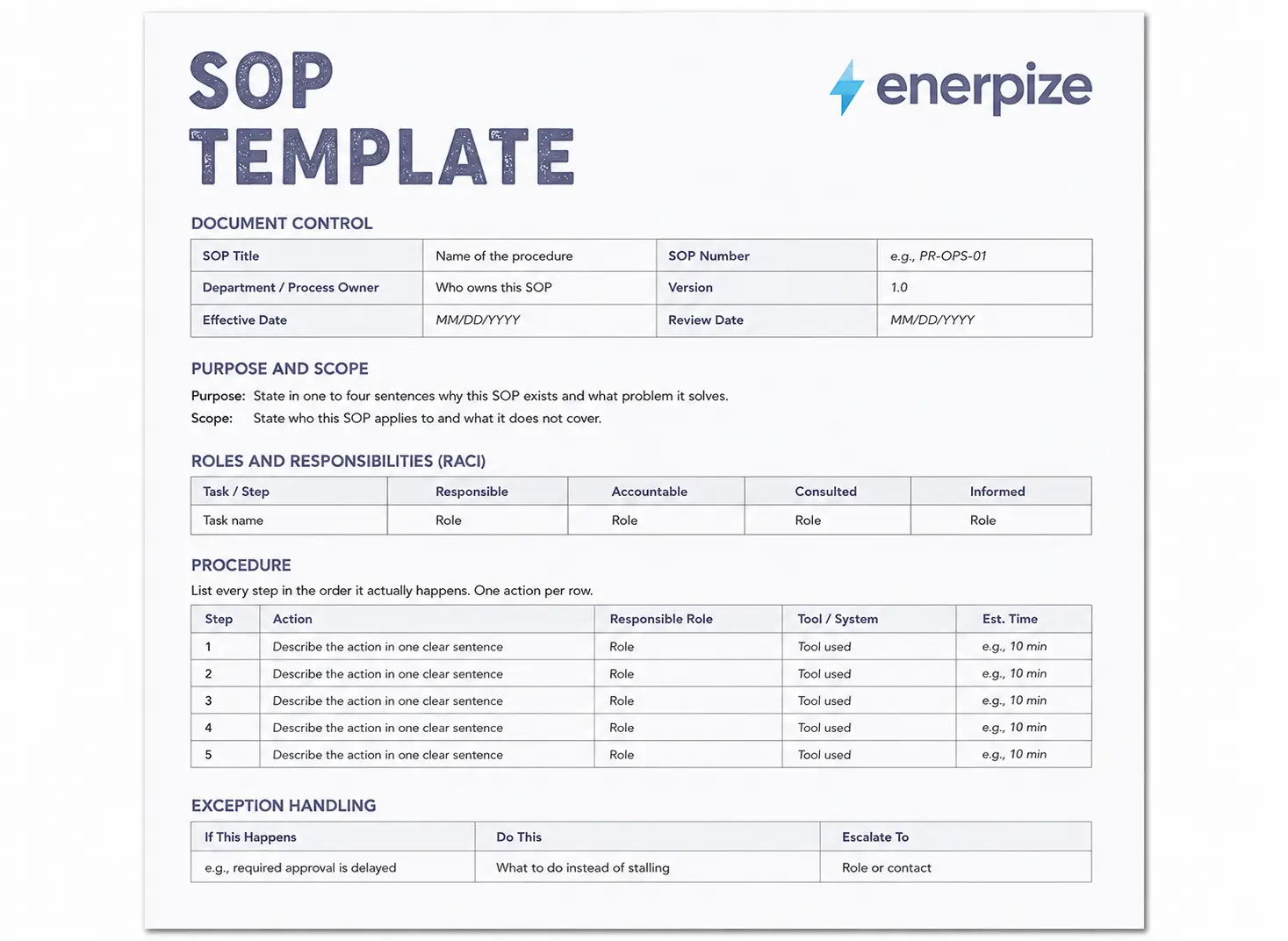
- Covers purpose, scope, responsibilities, procedure steps, exception handling, and success metrics in one structured document
- Built with a RACI matrix, a tools and systems field, and a condensed quick reference checklist, none of which show up in most SOP templates
- Calculates review overdue status automatically in the companion Excel register
An SOP template is a pre-formatted document that lays out the steps of a process, who is responsible for each step, and how to know the process is actually working, giving a business a repeatable way to run the same task the same way every time.


What Is an SOP?
SOP stands for standard operating procedure. Strip away the acronym and it is really just an answer to a simple question. If someone new had to do this task tomorrow, with nobody around to explain it, could they get it right from the document alone? Most businesses find out the answer is no, usually right when the one person who knows the process is on vacation.
A government issued SOP template defines it as a way to set team expectations and identify what training or coaching a task requires. That is the honest version. An SOP is not there to look official on a shelf. It exists so a process survives the person who built it leaving the room.
Every solid sop template shares four ingredients: purpose, scope, responsibilities, and the procedure itself. Miss any one of those and the document stops being useful the first time something unexpected happens.
Writing SOPs for processes that already run inside your business software closes the gap between the document and the actual work. Register free with Enerpize
What the Enerpize SOP Template Includes
I looked at a stack of real SOP examples before building this one, government templates, university lab procedures, and internal SOP management guides. They all get the basics right. They all miss the same handful of things, and those gaps are exactly what this sop template fixes.
A RACI Matrix Instead of a Paragraph of Names
Most SOP templates list responsibilities as a block of text under each role. That works until three people touch the same step and nobody is sure who actually owns the decision. This template uses a RACI structure instead, Responsible, Accountable, Consulted, Informed, so every task has one clear owner rather than a paragraph everyone reads differently.
A Tools and Systems Field Nobody Else Includes
Every procedure happens somewhere, in a piece of software, a shared drive, an inbox. Almost no sop template I reviewed has a field for naming that. This one does. Each step lists the tool it happens in, so training someone on the SOP also trains them on where the work actually lives.
Exception Handling and Metrics, Not Just the Happy Path
Standard SOP templates describe what happens when everything goes right. This one adds a section for what happens when it does not, a delayed approval, a missing input, a step that fails. It also asks a question most templates skip entirely. How do you know this procedure is working, not just that someone followed it? That is the success metrics section, and it is the difference between a document and an actual management tool.
The Four Parts of Every SOP
Purpose and Scope
Purpose says why the SOP exists in one to four sentences. Scope says who it applies to and, just as important, who it does not. Skip the scope and you end up with a procedure everyone assumes covers their situation, right up until it does not.
Responsibilities
This is where the RACI matrix does its work. Every task gets a Responsible party who does it, an Accountable party who owns the outcome, anyone who needs to be Consulted before a decision, and anyone who just needs to be Informed after. Use job titles here, not names. People change roles. Titles do not.
Procedure
The actual sequence of steps, written in the order they happen, one action per line. Active voice reads clearer than passive. Write "enter the amount" instead of "the amount should be entered." It sounds like a small thing until you are the person following the SOP at 6am trying to figure out who "should" be doing what.
A procedure that lives only in a document tends to drift from what actually happens. Tying it to the software running the process keeps both in sync. Register free with Enerpize
SOP Examples by Industry
The four part structure holds regardless of industry, but the content inside it changes a lot.
Retail
A retail sop template usually covers opening and closing checklists, stock counts, and return handling, the kind of procedure that lives inside a retail management setup once it moves off paper.
Automotive
An automotive sop template centers on inspection steps, service intake, and equipment checks, something our auto repair shop management tools handle directly, alongside the broader auto care services side of the business.
HR
An HR sop template covers onboarding, documentation, and approvals, something our payroll and contracts setup connects directly to once the procedure is written.
The Test That Matters
What stays constant across every sop example is the test from the top of this page. Could someone new follow it without a live explanation. If the industry specific content answers yes, the format did its job.
How to Write an SOP
Step 1: Confirm the SOP Is Actually Needed
Not every task needs a formal procedure. If it happens once, or the outcome barely changes no matter how it is done, a full sop template is overkill. Save the effort for processes that repeat and matter.
Step 2: Write the Purpose and Scope First
Before touching the procedure itself, nail down why this exists and who it covers. It sounds backward to start here, but writing the steps before the scope is how SOPs end up bloated with edge cases that belong in a different document entirely.
Step 3: Assign the RACI Roles
Figure out who is Responsible, Accountable, Consulted, and Informed before writing a single procedure step. Trying to retrofit this after the steps are written almost always reveals a step nobody actually owns.
Step 4: Draft the Procedure in Chronological Order
List every step exactly as it happens, not as it should ideally happen. If the real process has a workaround baked into it, document the workaround. An SOP describing an idealized version of the work that nobody follows is worse than no SOP at all.
Step 5: Add Exception Handling and Metrics
Ask what breaks this procedure and what to do about it. Then ask how success gets measured. Both of these get skipped constantly, and both are what separate a document from a management tool.
Step 6: Review, Approve, and Set a Revision Date
Get sign off from whoever owns the process, and set a date to revisit it. Procedures that are never reviewed go stale the moment the underlying process changes, and nobody notices until something breaks.
SOP Template vs Work Instructions
People use these terms interchangeably, which causes more confusion than it should. An SOP describes the overall process at a level general enough to apply across situations. A work instruction gets into the specific, detailed how of one particular task within that process. A research safety SOP program is a good real world example, the SOP covers the general safety procedure, while separate work instructions handle the specifics of individual chemicals or equipment.
If your sop template keeps needing exceptions and sub notes for every situation, that is usually a sign some of that content belongs in a work instruction instead, not crammed into the main procedure.
Confirmed four real, current sources before writing this, since I don't want to guess at gov URLs for a page like this.
SOP Requirements by Country
Safety and quality regulators do not require the exact same paperwork, but the core expectation is close to identical everywhere. Write down how the work gets done, keep it current, and be able to prove someone followed it.
United States
OSHA's guidance on standard operating procedures treats the SOP as a core piece of evidence, the document a business points to when it needs to show a task was performed safely and consistently. OSHA does not hand businesses a required sop template, but it does expect the procedure to reflect what workers actually do, not what the policy manual assumes they do.
Australia
Work health and safety in Australia runs through state and territory law built on the model WHS Act, with Safe Work Australia publishing the national guidance that underpins it. SOPs here often get called safe work procedures instead, but the substance matches, a step by step method paired with the hazards at each step and how to control them. A sop template used in Australia needs to hold up against that risk management structure, not just describe the task.
United Kingdom
The Health and Safety at Work Act 1974 requires employers to provide safe systems of work, and HSE's guidance on operating procedures is explicit that clear, accurate procedures are the most effective way to prevent and control major incidents. A UK sop template typically sits inside a broader safe system of work, procedure plus risk assessment plus training record, rather than standing alone.
Canada
CCOHS, the Canadian Centre for Occupational Health and Safety, functions as the national resource businesses turn to for procedure and hazard control guidance, though actual enforcement runs through provincial, territorial, or federal OHS law depending on where the business operates. A sop template built for a Canadian workplace should be checked against whichever jurisdiction's regulations actually apply, since requirements are not identical from one province to the next.
How Enerpize Handles Operational Procedures
An SOP describes a process. It does not run the process. That gap, between the document sitting in a shared drive and the actual work happening day to day, is where most SOPs quietly go stale.
Inventory Procedures Map to a Real Module
If the SOP covers product movement, warehouse assignment, or stock tracking, that procedure has a direct counterpart in Inventory. Products, warehouses, and stock levels get tracked in real time rather than relying on someone remembering to follow written steps.
Stocktaking SOPs Get a Structured Process, Not Just a Written One
Stocktaking is one of the more common SOPs a business writes and then fails to follow consistently, since a written count procedure is easy to skip when things get busy. Stocktaking turns that procedure into something repeatable and trackable instead of a document someone has to remember to open.
Purchase Approval SOPs Get Built-In Responsibility Tracking
A purchase approval SOP usually exists to answer one question, who signs off before money goes out. Purchase Management handles that same chain as part of the actual purchasing workflow, so the RACI matrix in your SOP reflects who actually has approval rights in the system, not just on paper. If the process also touches new hire paperwork, our employee contract template keeps that side of onboarding consistent with the SOP covering it.
Key Takeaways
- An SOP template needs four parts to work, purpose, scope, responsibilities, and the procedure itself, and missing any one weakens the whole document.
- A RACI matrix beats a paragraph of names for clarity on who actually owns each step.
- Every real sop template should include a tools and systems field, exception handling, and success metrics, three things most templates skip entirely.
- Work instructions and SOPs are not the same document. Work instructions handle detailed how, SOPs handle general process.
- Writing the procedure in the order it actually happens, workarounds included, matters more than writing it the way it should ideally happen.
- A written SOP and the software running the actual process should reflect the same reality, or the document drifts out of date fast.
Frequently Asked Questions
What is an SOP in business?
An SOP, or standard operating procedure, is a documented process that tells someone exactly how to complete a task consistently, including who is responsible for each step and what to do if something goes wrong.
What should be included in an SOP template?
At minimum, purpose, scope, responsibilities, and the procedure steps. A stronger sop template also includes a RACI matrix, the tools used at each step, exception handling, and success metrics.
How do you write an SOP?
Confirm the process actually needs a formal procedure, write the purpose and scope first, assign RACI roles, draft the steps in the order they really happen, add exception handling and metrics, then get sign off and set a review date.
What is the difference between an SOP and a work instruction?
An SOP describes a process in general terms. A work instruction gets into the specific, detailed steps of one task within that process. Complex procedures often need both.
How often should an SOP be reviewed?
There is no universal answer, but a common approach is to review new SOPs within a year of release and then every one to three years after, sooner if the underlying process changes significantly.
Can one SOP template work for every industry?
The four part structure works across industries, but the content inside it should reflect the specific process, a manufacturing sop template and an HR sop template will look very different once you get past purpose and scope.
About the Author
Omar El Bahr is a Senior Digital Growth Specialist at Enerpize, where he leads SEO, content strategy, and organic growth across international markets. He is a Forbes Communications Council contributor and has written for Entrepreneur on business communication and digital strategy.
Disclaimer
This template is provided for informational purposes only and does not constitute legal, compliance, or professional advice. It should not be construed as compliant with any specific industry regulation or standard. Consult a qualified compliance professional before adopting it for regulated processes.