

Posted on 10 August 2026
Texas Residential Lease Agreement Template: Free Download PDF, Word, & Google Docs
- Downloads as a free Texas residential lease agreement PDF, Word document, or Google Doc, no sign up required
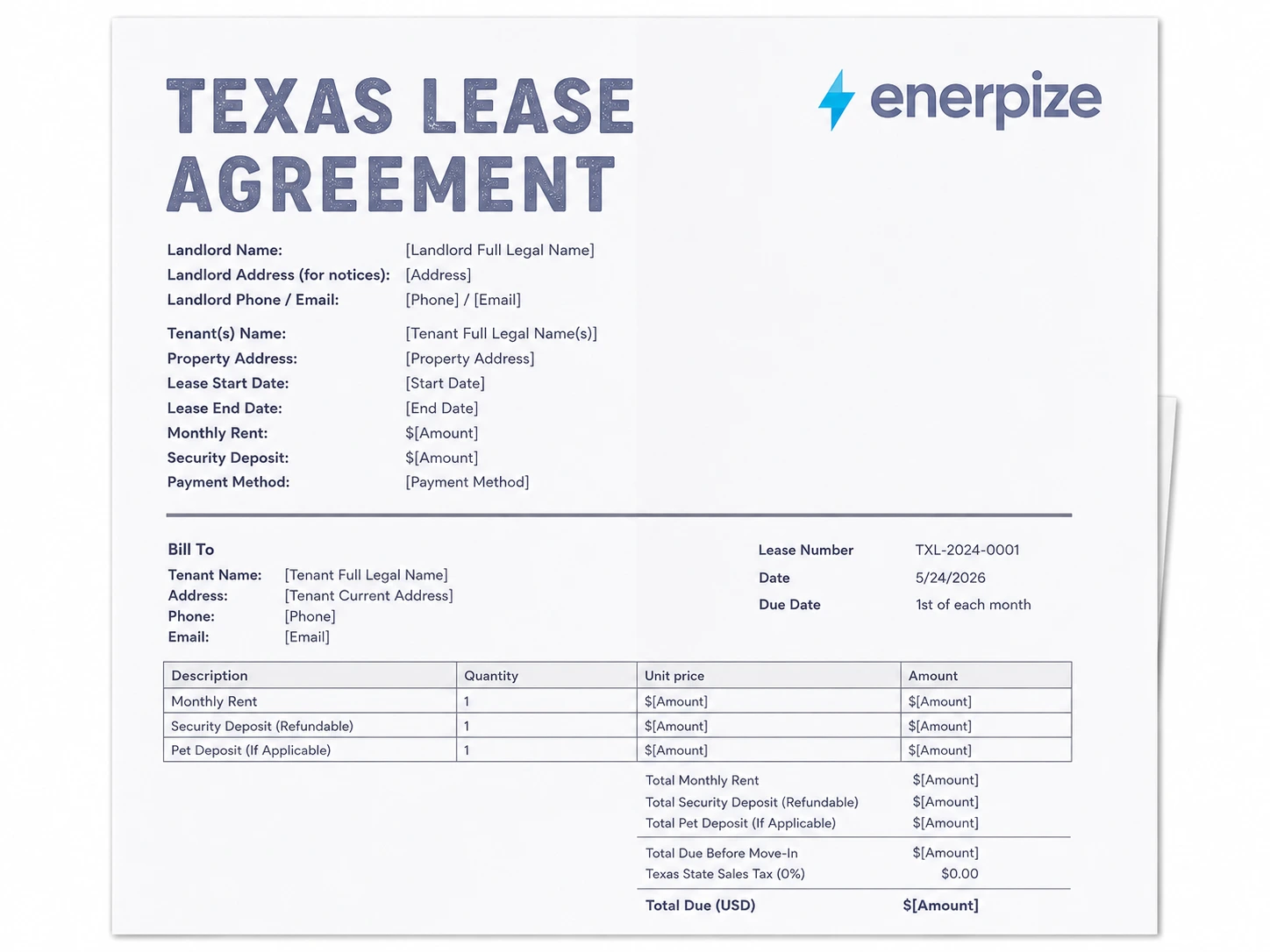
- Covers the landlord and tenant details, the property, the lease term, the rent, and the security deposit in one document
- Built with the Texas specific disclosures Chapter 92 actually requires, including the flood notice under Section 92.0135
- Structured so the entry terms, the late fee rule, and the security deposit return date are spelled out instead of left blank
A Texas residential lease agreement is a legally binding contract that sets the rent, the term, and the disclosures a landlord must give a tenant renting a home in the state.


What Is a Texas Residential Lease Agreement
Ask ten Texas landlords what belongs in a lease and you will get ten different answers. Ask a Texas court, and the answer gets a lot shorter. Whatever protects both sides when something goes wrong. That is really all a lease is. Not a formality you sign on move in day and forget about. A record of who agreed to what, and when.
This document is the written contract between a landlord and a tenant for a house, apartment, condo, or duplex rented anywhere in Texas. It sets the term, the rent, the security deposit, and the responsibilities each side carries once the keys change hands. Under Texas Property Code Chapter 92, it governs everything from how the deposit gets returned to what the landlord has to disclose before you sign.
Texas does not technically require a lease to be in writing. Section 92.001 of the Property Code defines a lease as any written or oral agreement establishing the terms of a tenancy, so a verbal handshake is enforceable in theory. Try collecting on a handshake in court, though, and you will understand why almost nobody does it that way. A written residential lease agreement Texas landlords and tenants can both point back to protects everyone the way a seatbelt does. Not because you expect to need it, but because you really do not want to find out the hard way that you did. The Texas State Law Library keeps its own plain language guide to leases if you want a second source beyond this page.
Some people call this document a Texas rental agreement instead of a lease. Chapter 92 does not care which term you use. The rules apply either way. Renting a house or an apartment falls under our residential lease agreement template, while renting out office or retail space calls for a commercial lease agreement instead, since Texas treats the two very differently once a dispute lands in court. Licensed Texas REALTORS also work from their own Texas REALTORS residential lease contract and TREC forms for narrower situations, like the Seller's Temporary Residential Lease TREC publishes for a buyer who takes possession before closing wraps up.
Want to track this lease once it is signed, the rent, the renewal date, and the security deposit deadline, without another spreadsheet? Start free with Enerpize
What the Enerpize Texas Residential Lease Agreement Template Includes
A template is only as good as what it assumes you already know. Ours assumes nothing.
Every Disclosure Chapter 92 Requires
This document includes every disclosure Chapter 92 currently requires, not a version from whenever the template was first written. That means the flood notice under Section 92.0135, kept as its own signed section rather than a single checkbox easy to skip past. It means the owner and manager identification required under Section 92.201, with a field for the emergency contact number Section 92.020 calls for. It means the smoke alarm and security device language under Subchapters D and F, spelled out instead of assumed.
An Entry Section That Tells You the Truth
It also means the entry section says what is actually true. Texas sets no fixed notice period before a landlord can enter a rental property. Chapter 92 leaves that number to the lease itself. This template gives you the field to fill in and put in writing, instead of quietly presenting a number as if the legislature passed it into law.
Built Straight From the Property Code
Every clause ties back to the section of the Property Code it comes from, so you are never guessing where a rule came from or whether it still holds. If you need something broader than a state specific document, the lease agreement template covers the same core clauses without the Texas citations attached.
Texas Landlord Tenant Law You Need to Know
Every Texas residential lease agreement lives inside Chapter 92 of the Property Code, whether the parties realize it or not. The sections below cover what actually comes up: deposits, disclosures, entry, fees, and how the whole thing ends. None of this replaces reading your own Texas residential lease agreement line by line, but it tells you what the law requires regardless of what the document in front of you says.
Security Deposits in Texas
Texas does not cap how much a landlord can charge for a security deposit. None. A landlord could ask for three months rent and stay inside the law, though good luck renting the unit at that price. What the law does control is what happens after you move out.
Under Section 92.103 of the Property Code, once a tenant surrenders the property and gives the landlord a forwarding address in writing, the landlord has 30 days to return the deposit, minus any lawful deductions. Miss that window without a valid reason, and Section 92.109 lets the tenant recover damages, including up to three times the amount wrongfully withheld plus attorney fees. That is not a slap on the wrist.
If the landlord keeps part of the deposit, Section 92.104 requires a written, itemized list of what was deducted and why. Normal wear and tear does not count as damage. A worn carpet after three years of a family living on it is not the same thing as a hole punched through drywall, and Texas law treats them very differently.
The Flood Disclosure You Cannot Skip
Here is where a lease can fall behind, not because anyone cut corners on purpose, but because this rule is newer than most people realize. Section 92.0135 of the Property Code requires landlords to tell tenants two things in writing. Whether the dwelling sits in a 100 year floodplain, and whether it has flooded at all in the last five years.
Senate Bill 2349, effective September 1, 2025, tightened how that notice has to be delivered. It has to be a separate written document, or its own clearly identified section of the lease, and it has to be signed by both the landlord and the tenant, not just handed over and forgotten. Skip it, and if the tenant later suffers a real loss from flooding, the tenant can walk away from the lease and get prepaid rent back.
If you are unsure whether a property sits in a flood zone, FEMA keeps a public flood map searchable by address at no cost. Check it before you write is or is not aware in the lease. Guessing is not a defense.
Landlord Entry in Texas
This one surprises people. Texas Property Code Chapter 92 sets no fixed notice period before a landlord can enter a rental property. Not 24 hours. Not 48. Nothing.
That does not mean a landlord can walk in whenever they feel like it. Tenants keep their right to quiet enjoyment of the property regardless, and entry that crosses into harassment carries its own legal exposure. It means the notice period has to live in the lease itself, because the legislature never wrote one into the statute.
Twenty four hours has become something close to an informal standard, since it shows up in so many leases, including the Texas Apartment Association's own lease contracts. Informal does not mean required, though. Put the number you actually agree on in writing, and both sides know exactly where they stand.
Late Fees and the Grace Period
A landlord cannot charge a late fee the moment rent is overdue. Section 92.019 requires the rent to remain unpaid for at least two full days after the due date before any fee applies, and that fee has to be written into the lease and reasonable.
Reasonable has a number attached to it. A fee is presumed reasonable if it stays at or under 12 percent of one rental period's rent for a property with four units or fewer, or 10 percent for anything larger. Go over that without a documented reason, and the landlord ends up arguing actual damages instead of relying on the safe harbor the law provides.
One more number worth knowing. A bounced check or failed payment fee cannot exceed $30, under the Texas Business and Commerce Code. Once rent starts coming in on schedule, a rent receipt template documents each payment. Texas law does not require receipts, but they save arguments later if a dispute over payment history comes up.
Ending a Lease in Texas
A fixed term lease ends on the date it says it ends, no notice required unless the lease itself says otherwise. A month to month tenancy works differently. Under Section 91.001, either party can end it with written notice, and the tenancy closes out at the end of the current rental period after that notice, generally around 30 days out.
There are exceptions built into the law that no lease can override. A tenant who is a survivor of family violence, sexual assault, or stalking can end a lease early under Sections 92.016 and 92.0161. A servicemember with military orders can do the same under Section 92.017. Those rights exist regardless of what the lease says, and a lease that tries to waive them does not hold up in court.
Once the lease is signed, the unit, the renewal date, and the rent do not have to live in your memory. Start free with Enerpize
How to Fill Out a Texas Lease Agreement
Filling this out in the right order saves you from circling back later. Here is the sequence that actually works.
Name the Landlord and Tenant
Start with full legal names, not nicknames, for the landlord and every adult tenant. Include a mailing address for the landlord, since Section 92.201 requires tenants to be able to reach the owner or the management company on request.
Describe the Property and Set the Term
Enter the property address, note whether it is a house, apartment, or condo, and pick the term. One year remains the most common of the typical apartment lease terms in Texas, though month to month arrangements are just as enforceable if that is what both sides want.
Set the Rent and the Security Deposit
Enter the monthly rent, the due date, and the security deposit amount. Note how the deposit will be returned and within what window, even though the law already sets the outer limit at 30 days after surrender.
Add the Required Disclosures
This is the step people rush. Include the flood notice under Section 92.0135 as its own signed section, the lead based paint disclosure if the home was built before 1978, the owner and manager identification, and the early termination rights for family violence and military deployment.
State the Entry and Late Fee Terms
Write down the number of hours notice required before entry, since Texas law leaves that number to you. Set the late fee amount and confirm it does not kick in before two full days past the due date.
Sign and Store Copies
Both parties sign, and under Section 92.024, the landlord has to give the tenant a copy of the fully executed lease within three business days. Keep a copy on both sides. It is the document everyone comes back to the first time something goes wrong.
How Enerpize Handles Texas Rental Properties
A signed lease is the start of the relationship, not the end of the paperwork. Once you have one in hand, the real work is keeping track of it. Which unit, which tenant, when the rent is due, when the lease renews.
Units, Rent, and Renewals in One Place
Enerpize's Property Management module organizes your units by type, tracks each unit's upcoming and past reservations, and applies flexible pricing if you run anything with seasonal demand. Rent invoicing and late fee tracking happen automatically once the lease terms are entered, so nobody is manually checking whether day two of the grace period has passed yet. Renewal dates and maintenance tasks live in the same system instead of three separate spreadsheets.
What This Template Does Not Do
None of that replaces the lease itself. Enerpize does not draft, store, or manage the lease document for you, and this template is not a substitute for that. What it does is take everything that happens after signing, the rent, the renewal, the maintenance ticket, and put it somewhere you can actually find it again. If you manage property outside Texas too, the Florida lease agreement template covers that state's own required disclosures, which look nothing like Section 92.0135.
See how a signed Texas lease turns into tracked rent, renewal reminders, and organized units. Start free with Enerpize
Key Takeaways
- Texas sets no cap on how much a landlord can charge for a security deposit, but the landlord has 30 days after the tenant surrenders the property and gives a forwarding address to return it, minus any lawful, itemized deductions.
- The flood disclosure under Section 92.0135 is not optional and is not a checkbox. Since Senate Bill 2349 took effect on September 1, 2025, it has to be its own signed document or section, separate from the rest of the lease.
- Texas Property Code Chapter 92 sets no fixed notice period before a landlord can enter a rental property. Twenty four hours is common practice, not a legal requirement, so the lease itself has to state the number.
- A late fee cannot be charged until rent has been unpaid for at least two full days after the due date, and the fee itself is only presumed reasonable up to 12 percent of rent for smaller properties or 10 percent for larger ones.
- A month to month tenancy can be ended by either party with written notice under Section 91.001, typically closing out around 30 days after that notice is given.
- This Texas residential lease agreement template downloads free in Word, PDF, and Google Docs, with every disclosure tied back to the specific section of the Property Code it comes from.
Frequently Asked Questions
What is a Texas residential lease agreement?
It is a legally binding contract that sets the rent, the lease term, and the disclosures a landlord must give a tenant renting residential property in the state. It is governed mainly by Chapter 92 of the Texas Property Code.
Is there a security deposit cap in Texas?
No. Texas sets no statutory maximum on a residential security deposit. The landlord must return it, minus lawful deductions, within 30 days after the tenant surrenders the property and provides a forwarding address.
Does Texas law require notice before a landlord enters?
No. Chapter 92 of the Texas Property Code sets no fixed advance notice period for landlord entry. The lease itself has to state the terms, since the law leaves that decision to the parties.
What disclosures are required in a Texas lease?
At minimum, the flood or floodplain notice under Section 92.0135, the federal lead based paint disclosure for homes built before 1978, the owner and manager identification under Section 92.201, and the early termination rights for family violence, sexual assault, stalking, or military deployment.
What a Landlord Cannot Do in Texas
A Texas landlord cannot waive a tenant's right to security devices, smoke alarms, or repair of conditions affecting health and safety. A landlord also cannot prohibit a tenant from contacting police or emergency services, or retaliate against a tenant for exercising a legal right.
Can a Landlord Break a Lease in Texas?
Yes, under specific circumstances, most often the tenant's failure to pay rent or a lease violation, following the notice and eviction procedures in Chapter 24 of the Property Code. Outside of a breach, a landlord generally cannot end a fixed term lease early without cause.
Is a Month to Month Lease Legal in Texas?
Yes. A month to month tenancy is fully enforceable in Texas, and either party can end it with written notice under Section 91.001, typically around 30 days out.
Can I Get a Texas Lease Agreement Template for Free?
Yes. This template is free to download in Word, PDF, and Google Docs, with no sign up required.
About the Author
Omar El Bahr is a Senior Digital Growth Specialist at Enerpize, where he leads SEO, content strategy, and organic growth across international markets. He is a Forbes Communications Council contributor and has written for Entrepreneur on business communication and digital strategy.
Disclaimer
This template is for general informational purposes only and is not legal advice. Texas landlord tenant law changes over time, so confirm current requirements against the Texas Property Code or with a licensed Texas attorney before you sign anything.