

Posted on 5 August 2026
W9 Form Template: Word & PDF Download
- Available in Word & PDF, free to download with no signup required
- Matches the current March 2024 IRS revision exactly, no fields rearranged or simplified
- Covers Lines 1 through 7, Part I, and Part II in the same order the IRS puts them
- Built for collecting contractor and vendor tax information before the first payment goes out
A w9 form template is a structured version of the IRS Request for Taxpayer Identification Number and Certification that a business gives to a contractor, freelancer, or vendor to collect the tax information needed for accurate reporting.


What Is a W9 Form?
If you have ever hired a freelancer or paid a vendor who is not on your payroll, you have probably asked for one of these. A w9 form is the IRS document a business uses to collect someone's legal name, address, and taxpayer identification number before paying them. It sounds simple because it is simple. That is also why so many businesses treat it as an afterthought, right up until January, when they realize they never actually collected one.
The form itself never goes to the IRS. You keep it on file. The information on it becomes the backbone of a 1099 you file at year end, so if the w9 form is wrong or missing, the 1099 built from it is wrong too.
Anyone paying an independent contractor $600 or more in a year needs a completed w9 form from that person before the payments start, not after. Waiting until tax season to chase down a w9 form is one of the more avoidable headaches in small business bookkeeping.
Chasing contractors for tax paperwork in January gets old fast. Register free with Enerpize
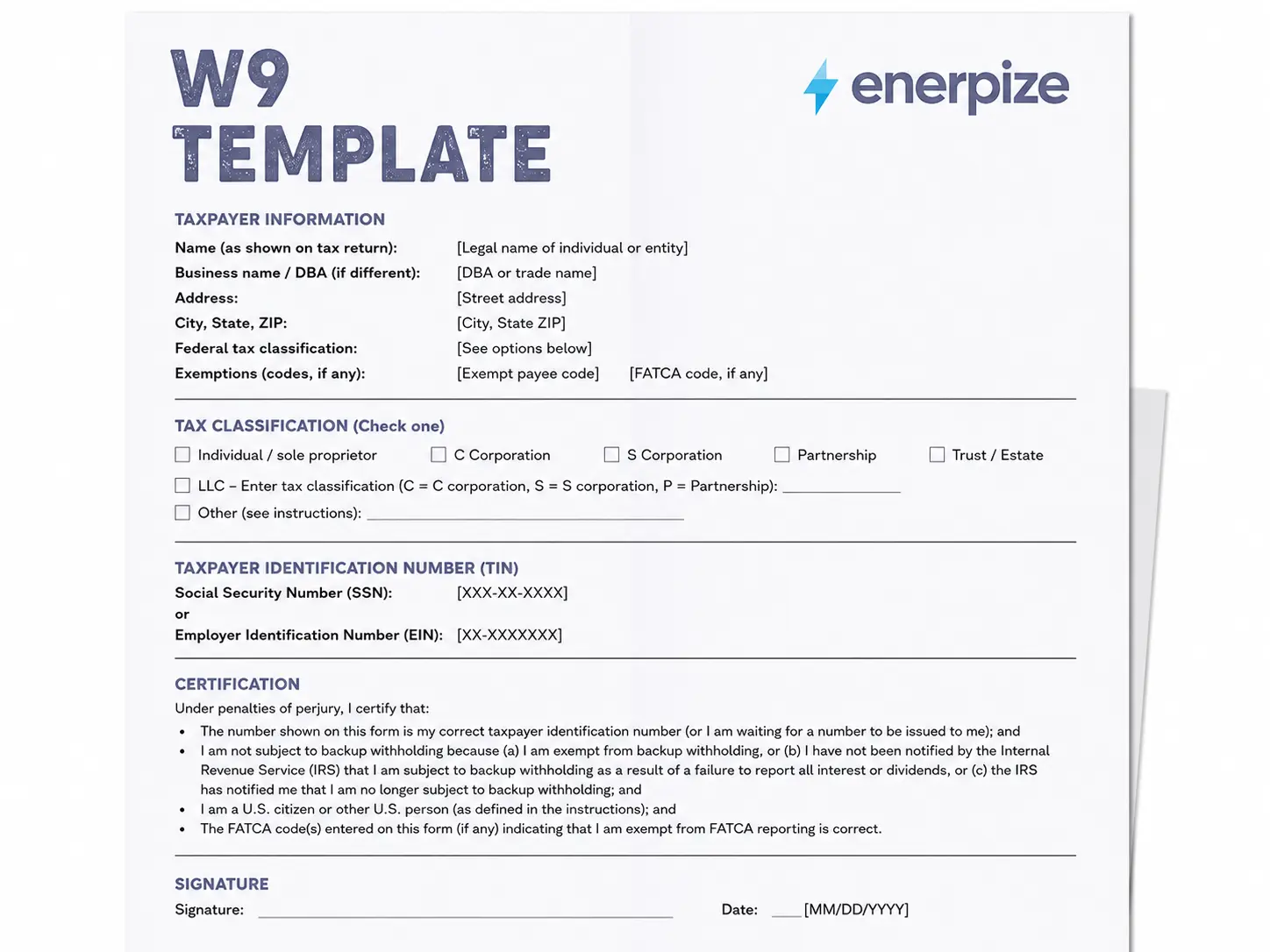
What the Enerpize W9 Template Includes
Every Line, Exactly as the IRS Writes It
A w9 form is not a document you want to reformat. Whoever requests it needs the standard layout, so this template follows the current form line for line, nothing rearranged, nothing simplified.
Where the Information Goes After You Collect It
What Enerpize adds is what happens to a w9 form after it is collected, which is where every competitor page I reviewed while researching this stops short. Purchases & Suppliers in Enerpize lets you build a supplier list the moment you start working with a contractor or vendor, and that record is where the taxpayer identification number a w9 form provides actually belongs, attached to the supplier, not floating in an inbox somewhere. The module already tracks supplier sourcing, payment status, and purchase invoices per supplier, so a contractor's TIN sits next to the same record that later needs it to generate a 1099.
One Record Instead of Three
The AI purchase invoice processing feature extracts supplier name, amounts, and dates automatically from uploaded invoices, which matters here because it is the same supplier record a completed w9 form feeds into. Enter the contractor once, and their w9 information, invoices, and year end totals stay connected rather than living in three different places by January.
None of that changes the form itself. It changes whether you are hunting for a w9 form in an email thread when a 1099 deadline hits, or pulling it from the same supplier record you have been using all year.
W9 Form vs W4 Form
People confuse these two more than almost any other pair of tax forms, and the confusion runs in a predictable direction. Both collect similar personal information. Both matter for tax reporting. But they are used by completely different types of workers.
| Document | Who Fills It Out | Purpose | Withholding |
|---|---|---|---|
| W9 Form | Independent contractors, freelancers, vendors | Provides TIN for 1099 reporting | No withholding arranged |
| W4 Form | Employees | Sets federal income tax withholding | Employer withholds based on the form |
A w9 form does not arrange for any tax to be withheld from a payment. The person receiving the money is responsible for their own income and self employment taxes. A W4, by contrast, exists specifically to tell an employer how much to withhold from every paycheck. If someone hands you a w9 form, you are not withholding anything from what you pay them. If you need the withholding side of this instead, our w4 form template covers that separately.
Who Needs to Fill Out a W9 Form?
Independent contractors and freelancers who are paid $600 or more in a year by a single business. Vendors and service providers who are not employees. Landlords receiving rent from a business. Anyone receiving interest, dividends, or other reportable income from a financial institution that needs their TIN on file.
Full time employees do not fill out a w9 form. They complete a W4 instead, since the entire relationship is structured differently, an employer withholds taxes for an employee and does not for a contractor.
What Is Backup Withholding?
This is the part of the w9 form that trips people up the most, and it deserves more than a one line mention.
Backup withholding is what happens when a business is required to withhold tax from a payment because the person receiving it did not provide a valid TIN, or the IRS has flagged that TIN as incorrect. The rate is 24 percent, and it applies to the gross payment, not some smaller portion of it.
A completed and signed w9 form is what prevents this. When someone certifies their TIN is correct and that they are not subject to backup withholding, the business paying them does not need to withhold anything. Skip the w9 form, or receive an incomplete one, and the safer move for the business is to start withholding until a valid form is on file.
Backup withholding rules are exactly the kind of detail that gets missed when contractor records live in scattered spreadsheets. Register free with Enerpize
How to Fill Out a W9 Form
Here is the line by line process, matched to how the current IRS form actually lays it out.
Line 1: Name
Enter the name exactly as it appears on your tax return. For a sole proprietor or a disregarded entity, this is your personal name, not your business name.
Line 2: Business Name
If you operate under a business name, trade name, or disregarded entity name different from Line 1, enter it here. Leave it blank if it does not apply.
Line 3a: Federal Tax Classification
Check exactly one box, individual or sole proprietor, C corporation, S corporation, partnership, trust or estate, LLC, or other. If you check LLC, you also need to enter the tax classification code in the space provided.
Line 4: Exemptions
Most individuals leave this blank. Certain entities exempt from backup withholding or FATCA reporting enter a code here, covered in the IRS instructions for the requester.
Lines 5 and 6: Address
Your street address, city, state, and ZIP code. This is where any 1099 built from this w9 form will be mailed.
Part I: Taxpayer Identification Number
Your Social Security number if you are an individual or sole proprietor, or your Employer Identification Number if you are another type of entity. The number here must match the name on Line 1 or it can trigger backup withholding.
Part II: Certification
Sign and date the form. This certifies that your TIN is correct, that you are not subject to backup withholding unless otherwise noted, and that you are a US person for tax purposes.
When You Need a New W9 Form
A w9 form does not expire on a set schedule the way some documents do. What actually triggers the need for a new one is a change in the underlying facts. A name change. A new TIN. A shift from sole proprietor to LLC or corporation. A change in exemption status.
Most competitor guides mention this in a single sentence and move on. In practice, it is one of the more common reasons a 1099 ends up wrong at year end, a contractor incorporated mid year, or updated their business name, and nobody asked for an updated w9 form to reflect it. If you are managing several contractors on ongoing work, our contractor invoice template is worth pairing with this one so the billing side and the tax paperwork side stay consistent. Construction subcontractors are a common case where this comes up mid project, and if you're tracking progress billing alongside their w9 form, our AIA style payment application template covers that side of the relationship.
W9 Form vs 1099 Forms
A w9 form exists for one purpose above all others, feeding an accurate 1099 at year end. The two are connected but distinct documents, and neither one substitutes for the other.
The w9 form collects the contractor's information once, ideally before the first payment. The 1099 reports how much you actually paid them, prepared at year end using the information the w9 form already gave you. If you are working with contractors covered under nonemployee compensation, our 1099-NEC template picks up exactly where the w9 form leaves off. If the payment falls under rent, royalties, or another miscellaneous category instead, our 1099-MISC template is the one that applies.
Collecting the w9 form is step one. Getting the 1099 right at year end is step two, and Enerpize connects both. Register free with Enerpize
Key Takeaways
- A w9 form collects a contractor or vendor's legal name, address, and taxpayer identification number before you pay them, and it never goes to the IRS directly.
- Backup withholding at 24 percent applies when a valid, signed w9 form is not on file.
- A w9 form and a W4 form are not interchangeable. One is for contractors, the other is for employees, and only the W4 arranges for tax withholding.
- Request a w9 form before the first payment, not after, to avoid backup withholding complications later.
- Update a w9 form whenever the contractor's name, entity type, TIN, or exemption status changes, not on a fixed yearly schedule.
- The information on a w9 form is what a 1099-NEC or 1099-MISC is built from at year end.
Frequently Asked Questions
What is a w9 form used for?
It collects a contractor, freelancer, or vendor's legal name, address, and taxpayer identification number so a business can accurately report payments made to them, usually on a 1099.
Do I send my w9 form to the IRS?
No. You give it to the business or person who requested it. They keep it on file and use it to prepare a 1099. The w9 form itself is never filed with the IRS.
What is the difference between a w9 form and a w4 form?
A w9 form is completed by independent contractors and vendors to provide their TIN for 1099 reporting. A W4 form is completed by employees to set federal income tax withholding. Only the W4 results in taxes being withheld from payments.
What happens if I do not fill out a w9 form?
The business paying you is required to begin backup withholding at 24 percent of your payments until you provide a completed, valid w9 form.
How often do I need to submit a new w9 form?
There is no fixed schedule. Submit a new one whenever your name, business entity type, taxpayer identification number, or exemption status changes.
Who needs to request a w9 form?
Any business paying an independent contractor, freelancer, or vendor $600 or more in a year should request a completed w9 form before making the first payment.
Is a w9 form the same as a 1099?
No. A w9 form collects the contractor's information. A 1099 reports the actual payments made to them at year end, built using the information the w9 form provided.
About the Author
Omar El Bahr is a Senior Digital Growth Specialist at Enerpize, where he leads SEO, content strategy, and organic growth across international markets. He is a Forbes Communications Council contributor and has written for Entrepreneur on business communication and digital strategy.
Disclaimer
This template is provided for informational purposes only and does not constitute tax, legal, or accounting advice. It should not be construed as compliant with IRS regulations, state tax law, or any other regulatory requirement for your specific situation. This template is not a substitute for professional counsel, and you are strongly advised to consult a qualified tax professional or attorney licensed in your jurisdiction before using or adapting it.
This template is provided on an "as is," "with all faults," and "as available" basis. Enerpize expressly disclaims all warranties of any kind, whether express, implied, statutory, or otherwise, including but not limited to warranties of merchantability, fitness for a particular purpose, or non-infringement.
Enerpize does not warrant or make any representations concerning the accuracy, completeness, or reliability of this template, the information in this article, or any results from its use. Enerpize is not affiliated with, endorsed by, or sponsored by the IRS. Always confirm current instructions against the official IRS Form W9 before filing.