

Author : Madonna Adel
What to Look for When Choosing a Cloud Business Management Platform
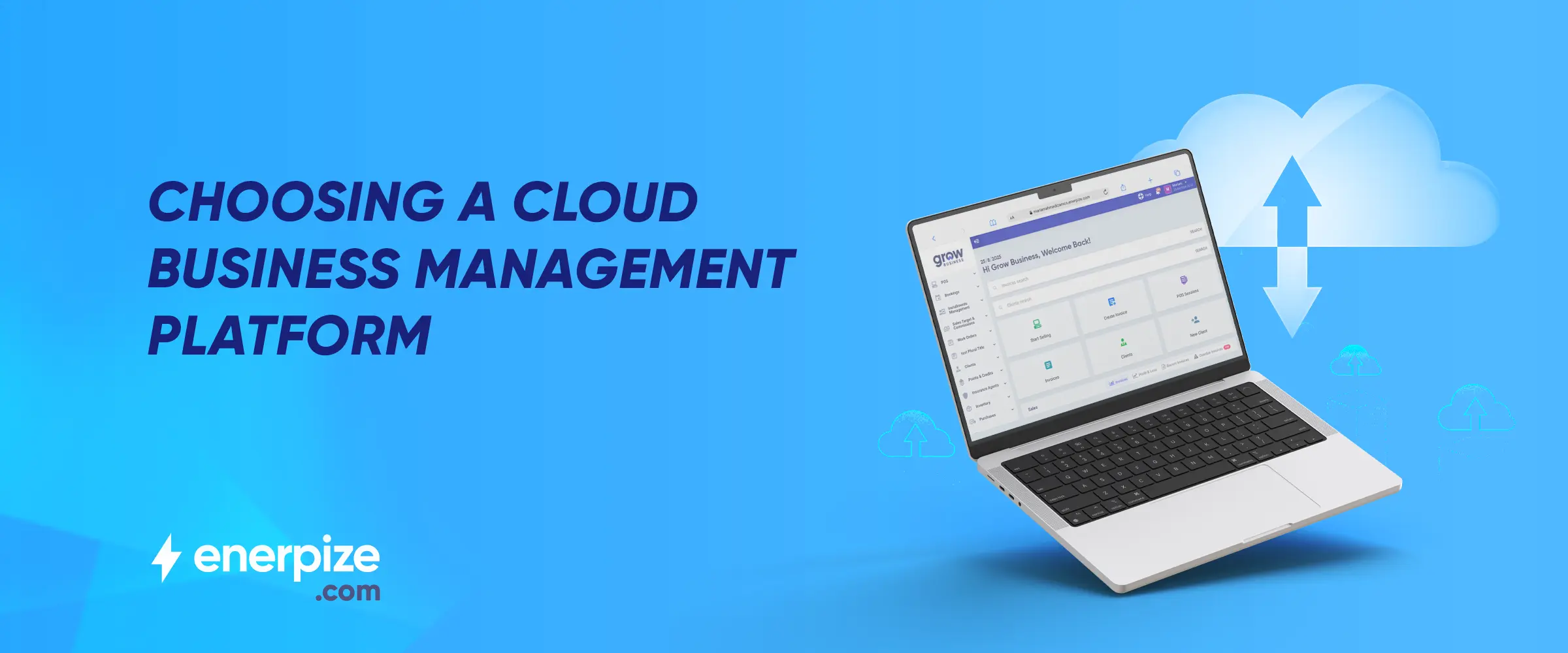
Table of contents:
- Key takeaways
- What Is a Cloud Business Management Platform?
- Why Businesses Choose Cloud Business Management Platforms?
- Core Features to Look for in a Cloud Business Management Platform
- Why Integration and One Unified Database Matter
- Questions to Ask Before Choosing a Cloud Business Management Platform
- Common Mistakes to Avoid When Choosing a Platform
- Enerpize Features to Look At as ERP Software
- FAQs
- Conclusion
Choosing a cloud business management platform is a critical decision that affects how efficiently a company operates and scales. As cloud environments grow more complex—especially with multi-cloud setups- businesses need better ways to manage resources, control costs, and maintain security.
Cloud management platforms help simplify this by providing a single place to monitor, automate, and govern cloud operations. They give IT teams the visibility and control needed to handle complex systems more effectively.
With so many options available, selecting the right platform can be challenging. This guide will help you understand what to look for to choose a solution that fits your business needs and supports long-term growth.
Key takeaways
- A cloud business management platform centralizes control, visibility, and governance across complex cloud environments.
- Choosing the right platform requires aligning features with business goals, not just technical capabilities.
- Core features to prioritize include scalability, security, automation, integration, and multi-cloud support.
- A unified database and strong integration layer are essential for accurate data, efficiency, and collaboration.
- Asking the right questions—and avoiding common mistakes—helps prevent costly decisions and operational issues.
- Platforms like Enerpize combine management, integration, and ERP capabilities into one system to simplify operations and support growth.
What Is a Cloud Business Management Platform?
A cloud business management platform is a system that helps organizations manage and control their cloud-based operations from one place. Instead of handling separate tools for different environments, it brings public, private, and hybrid cloud resources together into a single, unified interface.
At its core, it gives teams visibility into everything running in the cloud—applications, services, workloads, and infrastructure—while also providing the tools to monitor performance, manage usage, and keep costs under control. Most platforms connect to cloud providers through APIs, allowing real-time data to flow in and giving teams an accurate view of system health and resource activity.
As more companies move their operations to the cloud, managing these environments becomes more complex. A cloud business management platform helps reduce that complexity by applying consistent policies, improving oversight, and making it easier to scale without losing control.
These platforms have become a standard part of modern IT operations, especially for organizations dealing with multiple cloud providers. They not only simplify day-to-day management but also support better decision-making by turning scattered cloud data into clear, actionable insights.
Why Businesses Choose Cloud Business Management Platforms?
Businesses choose cloud business management platforms because they simplify the management of increasingly complex cloud environments. A case study shows how manufacturers integrate big data and cloud with ERP systems to improve performance using existing capabilities.
The following highlights the key importance and benefits of using cloud business management platforms:
- Simplifies cloud operations: Centralizes control into a single interface, making it easier to manage resources across different environments without added complexity.
- Provides full visibility: Offers real-time insights into usage, performance, and costs, helping businesses identify inefficiencies and make informed decisions.
- Strengthens security and governance: Enables consistent policy enforcement and easier compliance monitoring across all cloud systems.
- Improves cost control: Helps track spending, detect unused resources, and prevent unnecessary costs caused by poor visibility or cloud sprawl.
- Supports automation: Reduces manual work by automating routine tasks, incident response, and parts of cloud migration, lowering the risk of human error.
- Enables multi-cloud management: Allows businesses to manage public, private, and hybrid cloud environments from one place without dealing with infrastructure differences.
- Enhances scalability and flexibility: Makes it easier to scale resources up or down based on business needs without performance limitations.
- Improves reliability and continuity: Supports better system monitoring and faster response to issues, reducing downtime and maintaining operations.
- Reduces operational overhead by minimizing the need to manage multiple tools and workflows, saving time and resources.
- Helps avoid poor platform choices: Ensures businesses select solutions that fit their needs, avoiding overspending, downtime, or security risks.
For many organizations, these platforms are no longer optional—they are a practical way to stay in control, reduce complexity, and keep cloud operations running smoothly as the business grows.
Core Features to Look for in a Cloud Business Management Platform
Choosing a cloud business management platform is a strategic decision that affects how efficiently an organization operates, scales, and innovates in the cloud. As cloud environments grow more complex, businesses need platforms that reduce friction, improve visibility, and support both current operations and future growth.
The following are the key features to look for in a cloud business management system:
1. Support for Different Cloud Service Models
A strong platform should clearly support and work across the main cloud service types:
- IaaS (Infrastructure as a Service): For managing virtual machines, storage, and networks when organizations need control over infrastructure without physical hardware.
- PaaS (Platform as a Service): For deploying applications without worrying about the underlying infrastructure.
- SaaS (Software as a Service): For accessing fully managed software solutions through the cloud.
Most organizations do not rely on a single model; they combine them. A capable platform should allow seamless integration across all three.
2. Scalability and Flexibility
Cloud usage is dynamic, so scalability is a core requirement. A suitable platform should offer:
- Automatic scaling of resources based on demand
- Pay-as-you-go cost structures
- The ability to operate across multiple regions or zones
This ensures businesses can grow without being restricted by infrastructure limits or fixed capacity.
3. Security, Compliance, and Governance
Security is not optional in cloud environments. A reliable platform should include:
- Encryption for data in transit and at rest
- Identity and access management controls
- Support for compliance standards such as GDPR or HIPAA
- Preventive governance mechanisms to avoid policy violations before they occur
Rather than reacting to issues after they happen, modern cloud platforms should enforce guardrails that ensure consistent compliance from the start.
4. Performance, Reliability, and Transparency
Performance is more than uptime; it’s about consistency and predictability. When evaluating a platform, organizations should consider:
- Historical uptime and reliability records
- Clear service level agreements (SLAs)
- Monitoring and analytics tools for real-time visibility
These elements help ensure workloads run smoothly without unexpected disruptions.
5. Cloud Experience and Developer Enablement
A modern cloud platform should not slow teams down. Instead, it should enable faster delivery and easier adoption by offering:
- Self-service access to cloud environments
- Automation through APIs and Infrastructure-as-Code tools
- Integration with CI/CD pipelines and development toolchains
The goal is to reduce dependency on manual processes and allow teams to work directly with cloud-native capabilities.
6. Level of Abstraction and Control
Different organizations need different levels of abstraction:
- Some prefer resource-level control, in which users provision specific services such as VMs or databases.
- Others benefit from tenant-level abstraction, where entire environments (such as cloud accounts or subscriptions) are provisioned and managed centrally.
The right platform should support both approaches or at least align with the organization’s operating model.
7. Onboarding and Time-to-Cloud
A critical factor often overlooked is how quickly teams can start using cloud resources. Effective platforms focus on:
- Fast, self-service onboarding
- Automated environment provisioning
- Clear access control and budgeting setup
In mature setups, accessing a cloud environment should take minutes, not weeks.
8. Managing Vendor Lock-in and Flexibility
Organizations must consider how easily they can adapt or migrate in the future. Platforms differ in how they handle:
- Dependency on specific cloud providers
- Ability to support multi-cloud environments
- Portability of workloads and configurations
Flexibility here ensures businesses are not restricted by a single ecosystem.
9. Service Breadth and Ecosystem Integration
A strong platform should not exist in isolation. It should integrate with a wide ecosystem of tools, services, and partners, enabling organizations to:
- Extend functionality through external services
- Optimize operations through integrations
- Access specialized capabilities when needed
This reduces complexity and expands what teams can build.
10. Desired State and Continuous Compliance
Modern cloud platforms increasingly move toward a “desired state” approach. Instead of managing step-by-step workflows, organizations define the intended outcome, and the system ensures it is continuously maintained.
This enables:
- Automatic correction of configuration drift
- Consistent infrastructure setup across environments
- Long-term compliance without manual intervention
It shifts cloud management from reactive processes to continuous alignment with defined standards.
Enerpize offers a unified cloud-based business management solution that combines key capabilities into a single platform. It supports multiple cloud service models, ensures scalability, and maintains strong security and compliance while improving visibility and control.
With automation, easy onboarding, and flexible management, Enerpize helps organizations simplify operations, boost efficiency, and manage cloud environments more effectively.
Why Integration and One Unified Database Matter
As businesses continue to rely on multiple systems and growing volumes of data, integration through a unified cloud database has become essential for maintaining efficiency, visibility, and control. It helps organizations connect applications, streamline operations, and ensure that all teams work with consistent and reliable information.
The key reasons for using a cloud integration platform include:
- Breaks down data silos: Brings data from different departments and systems into one connected environment, improving communication and coordination.
- Improves operational efficiency: by automating data flow between systems, reducing manual work, and minimizing errors.
- Ensures data accuracy: Provides a single, consistent source of truth that keeps information updated across all platforms.
- Enhances scalability and flexibility: Allows systems and resources to scale or adapt easily to business needs without disrupting operations.
- Improves visibility and decision-making: Centralized data enables real-time insights, better reporting, and more informed decisions.
- Strengthens security and compliance: Central control makes it easier to manage access, enforce policies, and meet regulatory requirements.
- Boosts collaboration: Enables teams to securely access and share data, improving coordination across departments and remote teams.
- Increases agility and innovation: Frees up time from manual processes, allowing businesses to focus on growth and innovation.
A unified cloud integration platform is not just about connecting systems—it is about creating a smarter, more efficient, and more connected business environment where data works seamlessly across the entire organization.
Enerpize represents a modern cloud integration system designed to unify business operations and simplify data management across all platforms. It improves visibility, automates processes, and ensures data consistency, helping organizations reduce complexity and operate more efficiently in a fully connected environment.
Questions to Ask Before Choosing a Cloud Business Management Platform
Moving to the cloud can improve flexibility, reduce costs, and support growth, but only if the platform you choose fits your business needs. With so many options available, it’s important to look beyond surface-level features and ask the right questions before making a decision.
1. What are your business goals for moving to the cloud?
Start with clarity. Are you trying to reduce infrastructure costs, improve speed, or enable better collaboration? Your objectives will shape what kind of platform you need and how advanced it should be.
2. What services and capabilities are included?
Most providers offer a mix of infrastructure, platforms, and software solutions. Make sure the platform supports the tools and services your business relies on today—and can support you as you head next.
3. How secure is the platform?
Security should be a priority. Look for features like data encryption, access controls, and compliance with recognized standards. Also, understand who is responsible for what when it comes to protecting your data.
4. How does the platform handle scalability?
Your system should grow with your business. Ask how easy it is to increase or reduce resources, and whether scaling can happen without disruption or unexpected costs.
5. What does pricing really look like?
Cloud pricing can vary widely. Understand whether you’re paying based on usage, fixed plans, or a mix of both. Be clear about additional costs like storage, data transfer, or support to avoid surprises later.
6. How easy is onboarding and setup?
A good platform should make it simple to get started. Ask how long it takes to set up environments, assign access, and begin using the system. Fast, self-service onboarding can make a big difference.
7. How is support provided?
Issues happen. What matters is how quickly they’re resolved. Check if support is available 24/7, what channels are offered, and how responsive the provider is when problems arise.
8. Can the platform integrate with your existing systems?
Your business likely depends on multiple tools. Make sure the platform can connect them smoothly and support consistent data flow across systems without heavy manual work.
9. How is data migration handled?
Moving data to the cloud can be complex. Ask about the migration process, potential risks, and how downtime is minimized. A well-planned transition avoids disruptions and data loss.
10. How does the platform support compliance and governance?
If your business operates in a regulated industry, this is critical. Ensure the platform helps enforce policies, manage access, and maintain compliance without adding complexity.
11. Who will manage the environment?
Decide whether your internal team will handle operations or if you’ll rely on external support. This affects not only the cost but also the level of control and expertise you’ll need in-house.
12. What is the provider’s roadmap for innovation?
Cloud technology evolves quickly. Choose a platform that continues to improve, adopt new technologies, and offer capabilities that will keep your business competitive over time.
Choosing a cloud business management platform is not just about current needs—it’s about long-term fit. Asking these questions upfront helps you avoid costly mistakes and ensures the platform you choose can support your operations as your business grows.
Common Mistakes to Avoid When Choosing a Platform
Choosing a cloud platform can shape how your business operates, grows, and handles risk. While the benefits are clear, many companies run into problems not because of the technology itself, but because of avoidable mistakes during the selection process.
Being aware of these pitfalls can save time, money, and operational disruption:
1. Choosing Based on Price Alone
A low-cost option may look appealing at first, but it often comes with trade-offs in performance, security, or support. In many cases, what seems affordable upfront can become expensive later due to limitations or unexpected issues.
2. Assuming All Platforms Are the Same
Cloud platforms vary widely in what they offer. Some provide only basic functionality, while others deliver more advanced capabilities or industry-specific solutions. Treating them as interchangeable can lead to choosing a platform that doesn’t fully meet your needs.
3. Ignoring Scalability and Future Growth
It’s common to focus only on current requirements. However, a platform that cannot scale with your business may quickly become a limitation. Flexibility to grow, add users, or expand services is essential.
4. Overlooking Security and Data Protection
Assuming that all providers offer the same level of security can be risky. Not all platforms meet the same standards, and weak security measures can expose sensitive data and harm your business.
5. Neglecting Performance and Reliability
Performance differences between platforms can directly impact daily operations. Choosing a solution without evaluating its reliability, uptime, or capacity may result in slow systems or unexpected downtime.
6. Forgetting About Integration and Compatibility
A platform should work smoothly with your existing systems. Failing to check compatibility with tools like ERP, CRM, or other business applications can lead to disruptions and inefficiencies.
7. Ignoring Technical Support Quality
Support is often overlooked until something goes wrong. Limited or slow support can delay issue resolution and affect business continuity. It’s important to understand what level of support is included and how responsive it is.
8. Not Testing Before Committing
Jumping into a decision without trying the platform can lead to surprises later. Demos, trials, or references from other businesses can give a clearer picture of how the platform actually performs.
9. Rushing the Migration Process
Moving everything to the cloud at once isn’t always the best approach. A rushed migration can create complications, especially if systems require adjustments along the way. A phased transition is often more manageable.
10. Overlooking Backup and Disaster Recovery
Even with reliable systems, failures can happen. Without a clear backup and recovery plan, businesses risk losing critical data and facing extended downtime.
Avoiding these common mistakes helps ensure that the platform you choose supports your operations today and continues to meet your needs as your business evolves.
Enerpize Features to Look At as ERP Software
Enerpize ERP software brings all business operations into one system, helping organizations manage data, streamline processes, and improve overall efficiency. Enerpize is designed to deliver these capabilities through a flexible and fully integrated platform.
Key Features:
- Centralized Data: Enerpize unifies data from all departments into one system, ensuring accuracy and consistency across finance, sales, HR, and operations.
- Process Automation: Automates tasks such as invoicing, payroll, and inventory updates, reducing manual work and minimizing errors.
- Reporting and Analytics: Provides structured reports and actionable insights to help track performance, identify trends, and support better decision-making.
- Real-Time Visibility: Keeps all data up to date across the system instantly, allowing teams to respond quickly and stay aligned.
- Scalability: Adapts as your business grows, supporting additional users, departments, and expanding operations without disruption.
- Compliance Management: Helps businesses stay aligned with financial regulations, tax rules, and internal policies.
- Sales Management: Includes invoicing, POS, installment tracking, insurance management, commissions, and offers.
- Accounting Tools: Covers expense management, chart of accounts, cost centers, cheque cycles, and asset management.
- Inventory Management: Handles product tracking, purchasing, supplier management, requisitions, and stocktaking.
- Manufacturing Support: Supports production processes and operational workflows.
- HR Management: Manages organizational structure, contracts, attendance, payroll, and employee requests.
- Operations Management: Includes work orders, booking systems, and time tracking tools.
- CRM Capabilities: Provides client management, follow-ups, memberships, and loyalty features like points and credits.
Enerpize combines these features into one unified system, giving businesses the tools they need to operate efficiently, maintain control, and scale with confidence.
FAQs
How to choose a cloud management platform?
Focus on fit, not features. Align the platform with your business goals, ensure strong integration with existing systems, provide scalability, implement solid security controls, and provide clear visibility into performance and costs. Testing the platform before committing is essential.
Is cloud business management software secure?
Yes, when built correctly, it’s designed with security as a core component. Modern platforms include data encryption, access controls, and compliance support, along with governance policies that help prevent issues before they occur.
What is the difference between ERP software and business management software?
ERP software focuses on integrating core business functions such as finance, HR, and inventory into a single system. Business management software is broader—it may include ERP capabilities as well as additional tools for operations, analytics, and cloud management.
Can a cloud platform handle accounting, HR, inventory, and invoicing together?
Yes. Platforms like Enerpize are designed to unify multiple functions in one system, allowing businesses to manage accounting, HR, inventory, invoicing, and more from a single, integrated environment.
Can business management software scale with a growing company?
Yes. Scalability is a key advantage of cloud-based platforms. They allow businesses to add users, expand features, and increase capacity as needed without disrupting operations or requiring major infrastructure changes.
Conclusion
Selecting a cloud business management platform is a long-term decision that goes beyond immediate needs. The right solution should simplify complexity, provide clear visibility, and support both operational efficiency and future expansion.
By focusing on essential features, understanding the value of integration, and carefully evaluating providers, businesses can build a cloud environment that is secure, scalable, and aligned with their strategy.