


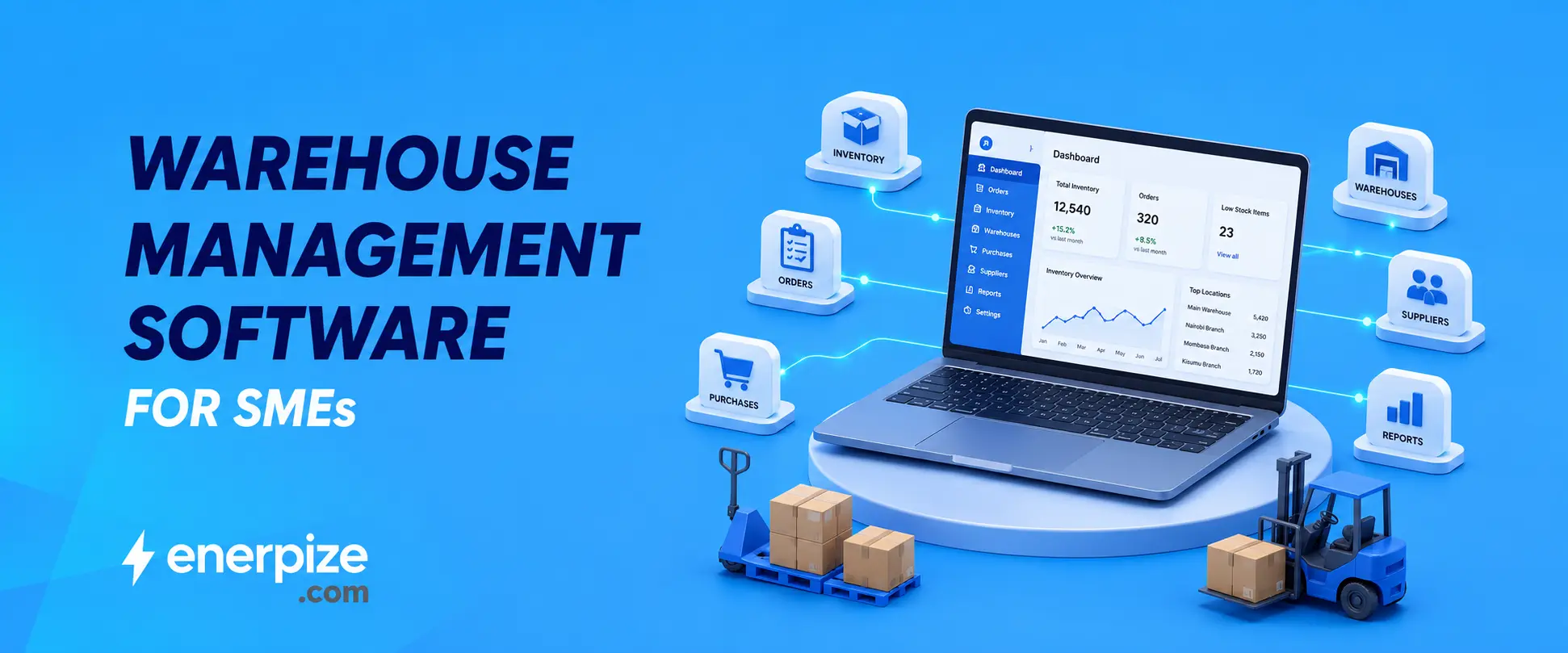
Warehouse Management Software: What SMEs Actually Need (Not an Enterprise System)


Key Takeaways
- Most warehouse management content online is written for one of two extremes, a free tool with hidden caps, or an enterprise system built for companies running robotics and dedicated IT teams.
- Wikipedia's own classification splits WMS into four complexity levels, and almost every growing SME actually needs level two, not level three or four.
- Free warehouse software works right up until you hit a location cap, a user cap, or an order cap, and the caps always arrive at the worst possible month.
- Market estimates for the WMS industry range from roughly $4 billion to $10 billion depending on which research firm you ask, which tells you something about how loosely the category gets defined.
- Enerpize handles multi warehouse tracking, serial and lot numbers, and stock transfers without asking you to become an enterprise IT department first.
Search for warehouse management software right now and you will land on one of two kinds of pages. The first kind ranks free tools and is honest enough to tell you the free plan caps out at fifty orders a month. The second kind is written by corporate companies, and reads like it was built for a company running three automated distribution centers and a fleet of robots.
Neither one is written for the business in between. The one running two or three locations, doing real volume, and absolutely not ready to hire a systems integrator.
This guide is for that business. We will go through what a warehouse management system actually does, how to figure out which level of complexity you genuinely need instead of the level a sales rep wants to sell you, and where free tools quietly stop being free.
Stop choosing between a free tool with a ceiling and a system built for a distribution center you don't have. Start for Free
What a Warehouse Management System Actually Does
Strip away the marketing and a warehouse management system does four things well. It tracks what you have and where it physically sits. It manages what comes in the door, receiving and putaway. It manages what goes out, picking, packing, and shipping. And it gives you enough reporting to know whether any of that is actually working.
Everything past those four things, wave planning, voice picking, robotics integration, yard management, is real functionality that real companies need. It is just not what a business with one or two warehouses and a handful of staff needs on day one, and most of the enterprise-focused content treats it as if it were.
The Four Levels of WMS Complexity (and Which One You Actually Need)
Here is something genuinely useful I found buried in, of all places, Wikipedia's academic entry on warehouse management systems, and I have not seen a single vendor page frame it this cleanly. Researchers split WMS into four complexity levels. A basic system handles inventory and location tracking, barely different from a spreadsheet with better manners. An advanced system can analyze capacity and stock levels and tell you where the inefficiencies are. A controlled system exchanges data with outside systems in real time, manufacturing schedules, incoming trucks, customer orders. An autonomous system uses AI to make its own operational decisions with minimal human input.
Almost every SME reading this needs level two. Maybe level three if you are running multiple locations and want purchasing tied to live stock data. Almost nobody reading this needs level four, and yet a huge share of the content written about warehouse management system WMS buying decisions is written as if level four were the only serious option.
Why Free Warehouse Software Runs Out Before Your Business Does
Free warehouse tools are not a scam. Several are genuinely useful for a business just getting started. But every single free-tier review I looked at, including one that ranked ten free tools in detail, said some version of the same thing. The free plan works until you hit a cap, users, orders, locations, and the cap always shows up right when your business needed the software to keep working, not stop.
One review put it plainly: many "free WMS" products are actually inventory apps with limited warehouse execution, and that mismatch is where teams get stuck. That is the honest version of the pitch. A tool that tracks stock in one location for one person is not the same category as a tool that manages receiving, putaway, and multi-location stock for a growing team, even if both get marketed under the same three letters.
See what happens when your warehouse software grows with you instead of capping out at fifty orders a month. Start for Free
Enterprise Warehouse Management Software vs Free Tools vs Right-Sized SME Software
The genuinely useful market data buried in industry research is that WMS market estimates for 2026 range anywhere from roughly $4 billion to $10 billion depending on which research firm you ask and how they define the category. That spread tells you the category itself is not clearly defined, and vendors exploit that. A company selling a free inventory app and a company selling SAP Extended Warehouse Management both get counted as WMS providers, and both get cited in the same buying guides as if they were interchangeable options for the same buyer.
They are not. An enterprise WMS from SAP, Oracle, or Manhattan Associates is built for warehouses running automated conveyors, voice-directed picking, and dedicated implementation teams measured in months, not days. A free tool is built to get you in the door and hit its ceiling the moment your business does something a spreadsheet-with-buttons was never meant to do. What most growing businesses actually need sits in between, real multi-location tracking, real reporting, real integration with the rest of the business, without the six-figure implementation project.
What to Actually Look For in Warehouse Management Software for an SME
Skip the feature checklist for a second and ask a more useful question. Can this software grow with you for the next two or three years without forcing a rip-and-replace project? A warehouse management software platform that only handles one location is fine until you open a second one. A tool that tracks quantity but not serial numbers or lot expiry is fine until you sell something perishable or something that needs a recall trail.
The specific things worth checking before you commit: does it track stock by serial number, lot number, or expiry date, not just a quantity figure. Does it connect purchasing to actual stock levels so a reorder isn't a guess. Does it sync with your accounting so a stock movement and a financial entry are the same action, not two separate ones somebody has to reconcile later.
Multi Warehouse Inventory Management Without Multi Warehouse Complexity
Here is where the gap between free tools and enterprise systems shows up most clearly. Multi warehouse inventory management in a free tool usually means you can technically add a second location, right up until the free tier caps you at one. Multi warehouse inventory management in an enterprise WMS means wave planning, cross-docking, and yard management features a two-location retailer will never touch.
What actually matters for a growing SME is simpler than either extreme. Real-time stock visibility across every location from one dashboard. The ability to transfer stock between warehouses and see that transfer reflected immediately, not after somebody manually updates two spreadsheets. Authorization control so a warehouse manager in one location isn't accidentally editing stock in another.
How Enerpize Handles Warehouse Management for Growing SMEs
Multi-Warehouse Foundation
Enerpize's inventory module lets you add unlimited products distributed across warehouses, with real-time stock tracking per location and authorizations that can be granted per warehouse or per employee. That is the multi-location foundation most free tools cap you out of and most enterprise systems bury under features you will never use.
Real-Time Stock Per Location
Every warehouse in your account shows its own live stock count, not a blended number across every location that leaves you guessing which site actually has what. A manager assigned to one warehouse sees that warehouse. Nobody is adjusting stock in a location they were never given access to in the first place.
Permissions By Warehouse or Employee
Authorizations attach to a specific warehouse or a specific employee rather than the account as a whole. That distinction matters the moment you have more than one physical location, since a single blanket login for everyone is exactly how stock discrepancies start.
Tracking That Matches What You Actually Store
Stock tracking goes deeper than a single quantity number too. You can track by serial number, by lot number, by lot and expiry together, or by expiry date alone, whichever actually matches what you are storing.
Serial and Lot Number Tracking
A business selling electronics or equipment needs to know exactly which unit went where. Serial number tracking follows an individual item through its entire life in your warehouse, from receiving to sale.
Expiry and Lot-Based Tracking
A business handling anything perishable or batch-manufactured needs the opposite concern, not which single unit but which batch, and how much time is left before it needs to move. Lot and expiry tracking, together or separately, covers that without forcing a workaround built for serial numbers instead.
Barcode Scanning and Cross-Warehouse Movement
Barcode scanning and packing slips move products within and across warehouses, and none of it lives disconnected from the rest of your business. Every inventory update syncs in real time with accounting, sales, operations, and CRM through Enerpize's mobile app, which is exactly the gap that free tools leave open and force you to close manually.
Purchasing Connected to Real Stock Levels
The purchasing side connects directly to this. You can create, forward, and print purchase orders in bulk or to an individual supplier, tied to replenishing stock that's actually running low rather than guessing from memory.
Bulk and Individual Purchase Orders
Whether you are restocking one supplier or several at once, purchase orders generate from the same stock data the warehouse is already tracking, not a separate purchasing spreadsheet someone reconciles afterward.
Supplier Comparison and Payment Tracking
The broader purchase management cycle covers quotation requests, supplier comparisons, and payment tracking, all living in the same system as the stock they affect, so a purchasing decision and its downstream inventory impact are never two separate records.
Warehouse Transfers and Stocktaking
When it comes to physically moving stock between locations, Enerpize supports warehouse transfers and stocktaking audits as a built-in workflow, not a paid add-on bolted on after the fact.
Transfers Between Locations
Moving stock from one warehouse to another keeps its paper trail intact, so a transfer shows up as exactly that, a transfer, rather than a mysterious drop in one location and an unexplained increase in another.
Stocktaking Audits
Physical counts reconcile against system records natively, which matters since this is precisely the feature most free tools either omit entirely or lock behind their paid tier.
Getting Started Before You Commit to Software
If you want a starting point before committing to software at all, Enerpize also has a free warehouse inventory template you can use to get your stock organized first. And if your business runs distribution across multiple sites as its core operation rather than a side function, our supply chain page goes deeper into how Enerpize handles that specifically.
Track stock across every warehouse, connected to purchasing and accounting from day one. Start for Free
FAQs
What is warehouse management software?
Warehouse management software tracks what you have in stock, where it physically sits, and manages the process of receiving, storing, picking, and shipping it. The category ranges from basic inventory apps to enterprise systems running robotics and automated conveyors, which is why the term means very different things depending on which vendor is using it.
What is the difference between inventory management and warehouse management?
Inventory management focuses on quantities and cost, what you have and what it's worth. Warehouse management system software goes further, handling the physical movement of goods, receiving, putaway, picking, and multi-location transfers, not just the count of what's on the shelf.
Do I need a WMS or is an ERP with inventory enough?
For most SMEs running one to a handful of locations, an ERP system in warehouse management with a genuinely capable inventory module covers the actual need. Standalone enterprise WMS platforms earn their cost when you're running automated equipment, robotics, or high-volume distribution centers, which is a different problem than most growing businesses have.
How much does warehouse management software cost for an SME?
Enerpize's plans start from $9.99 a month, with inventory, purchasing, accounting, HR, and CRM included rather than sold as separate modules. Enterprise WMS platforms, by contrast, commonly involve five and six figure implementation projects before the software even goes live.
Can I start with free warehouse software and upgrade later?
You can, and for a very early business that's a reasonable way to start. Just go in knowing the free tier has a ceiling, whether that's users, locations, or monthly orders, and that ceiling tends to arrive right when your business needs the software to keep up, not stop.
About the Author
Omar El Bahr is a Senior Digital Growth Specialist at Enerpize, where he leads SEO, content strategy, and organic growth across international markets. He is a Forbes Communications Council contributor and has written for Entrepreneur on business communication and digital strategy.
Disclaimer: This article reflects warehouse management software market data and vendor comparisons accurate at the time of writing, drawn from published industry research and vendor documentation. Software features and pricing change. Confirm current details directly with any vendor before making a purchasing decision.
Related Articles
 Inventory
ERP Case Study: How a Business With Eight Branches Stopped Selling Stock It Did Not Have
Read more Inventory
What is Healthcare Inventory Management: A Complete Guide
Read more Inventory
Average Inventory: Definition and How To Calculate
Read more Inventory
Vendor Managed Inventory (VMI): Advantages and Disadvantages
Read more Inventory
Efficient Auto Parts Tips
Read more Inventory