


Best Odoo Alternatives in 2026: ERP Software Compared


Last updated: November 11, 2026
What this page covers
Eight Odoo alternatives for 2026, compared on pricing model, fit, and real cost at 10 users, plus what switching involves.
Odoo’s real price
In the US, Standard is $24.90 per user a month in year one on yearly billing, then $31.10; Custom is $49.00, then $61.00. Monthly billing costs $38.90 and $76.20.
The alternatives
Enerpize, ERPNext, Zoho One, Oracle NetSuite, SAP Business One, Microsoft Dynamics 365 Business Central, Acumatica, and Dolibarr.
When to stay on Odoo
Deep manufacturing, many-country localisation, and developers in house who can use its open-source code.
Where Enerpize fits
SMBs that want sales, accounting, inventory, POS, HR, and CRM in one subscription, from $14.95 a month, or $9.99 billed yearly.
What Is Odoo, and Why Are So Many Businesses Looking for Odoo Alternatives?
Picture the moment a small business owner opens Odoo for the first time. The dashboard looks clean. The demo looks impressive. Dozens of apps promise to run the whole company from one login. Six months later, the same owner is on Reddit at midnight typing two words into the search bar: Odoo alternatives.
That search happens often enough to have its own volume on Google. Odoo is a genuinely popular, genuinely capable open-source ERP suite covering accounting, CRM, inventory, manufacturing, HR, point of sale, and ecommerce. It comes in a free, self-hosted Community edition and paid Enterprise plans, Standard and Custom, that unlock the features most businesses need once they get past the demo.
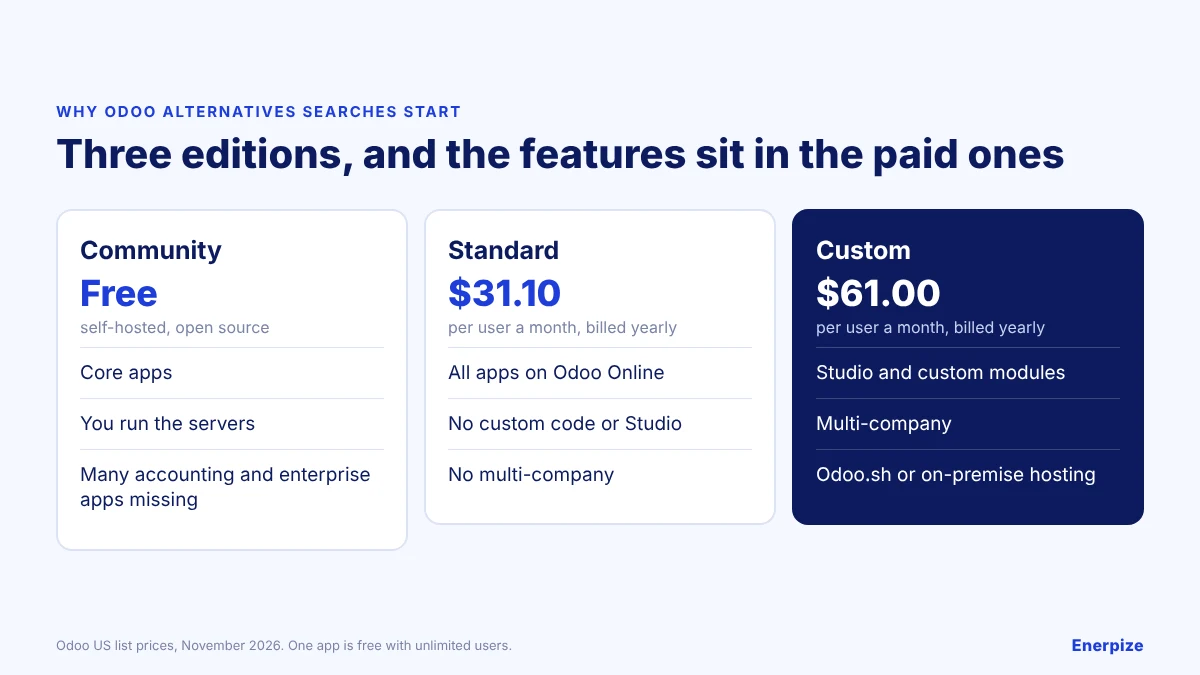
That split is where the search for Odoo alternatives usually starts. A business signs up expecting an all-in-one system and finds that Studio, multi-company, custom modules, and several accounting tools sit in the paid editions, and some only in Custom. Add a per-user fee that grows with every hire and customisation that often needs a developer or partner, and a simpler platform starts to make sense.
This guide walks through the strongest Odoo alternatives in 2026, what each one costs, which one fits your kind of business, and what switching involves. If you are still deciding whether you need an ERP at all, read how ERP software differs from accounting software first.
What Odoo Doesn’t Do Well
Every tool has a ceiling, and it helps to know where Odoo’s sits before you compare Odoo competitors.
Community Is Free, but Not Finished
Community is genuinely free, but several accounting tools, Studio, and a number of business apps are Enterprise-only, and many country compliance packages work best on the paid plans. Self-hosting also costs you server time, setup, and maintenance even without a licence fee.
Per-User Pricing Grows With Every Hire
Every new user adds a monthly fee. A company that grows from 5 to 25 users pays five times the original licence before adding any new feature, and the first-year discount only covers the users on the first order.
Customisation Needs Custom, or a Developer
Studio, Odoo’s no-code customisation tool, is only on the Custom plan, which costs about twice as much as Standard. Anything beyond that means Python and XML work by a developer or an Odoo partner.
A Real Learning Curve
Hundreds of settings across dozens of apps take genuine training time. The common complaint is that Odoo does everything, and making it do the one thing you need takes longer than expected.
Upgrades Can Break Customisations
Because so much of Odoo’s value comes from configuration and custom modules, moving between major versions can break workflows that took months to build.
None of this makes Odoo a bad product. It makes it a product built for a particular kind of team, which is why Odoo alternatives keep showing up in so many searches.
Where Odoo Still Gets It Right
It would be dishonest to list Odoo’s weaknesses without naming where it earns its reputation.
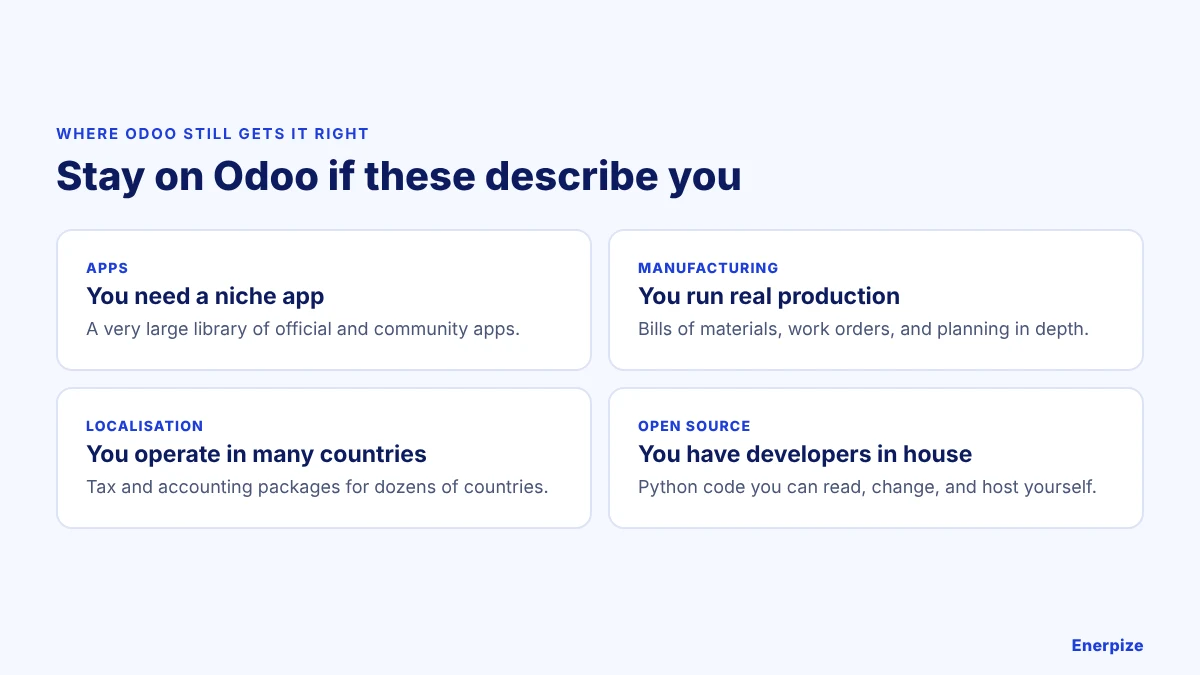
- A huge app library. Years in the market and a large open-source community have produced a library of official and community apps that newer platforms cannot match.
- Mature manufacturing. Bills of materials, work orders, and production planning go deeper than most SMB-focused platforms, Enerpize included.
- Wide localisation. Tax and accounting packages cover dozens of countries, which matters for businesses operating across regions.
- Open-source code. Teams with developers can read, change, and host the code themselves.
If your business needs deep manufacturing, multi-country localisation, and an in-house developer, Odoo remains a reasonable choice. The rest of this guide is for everyone else.
The Best Odoo Alternatives at a Glance
Here is the shortlist of the best Odoo alternatives for 2026 before we go deep on each one.
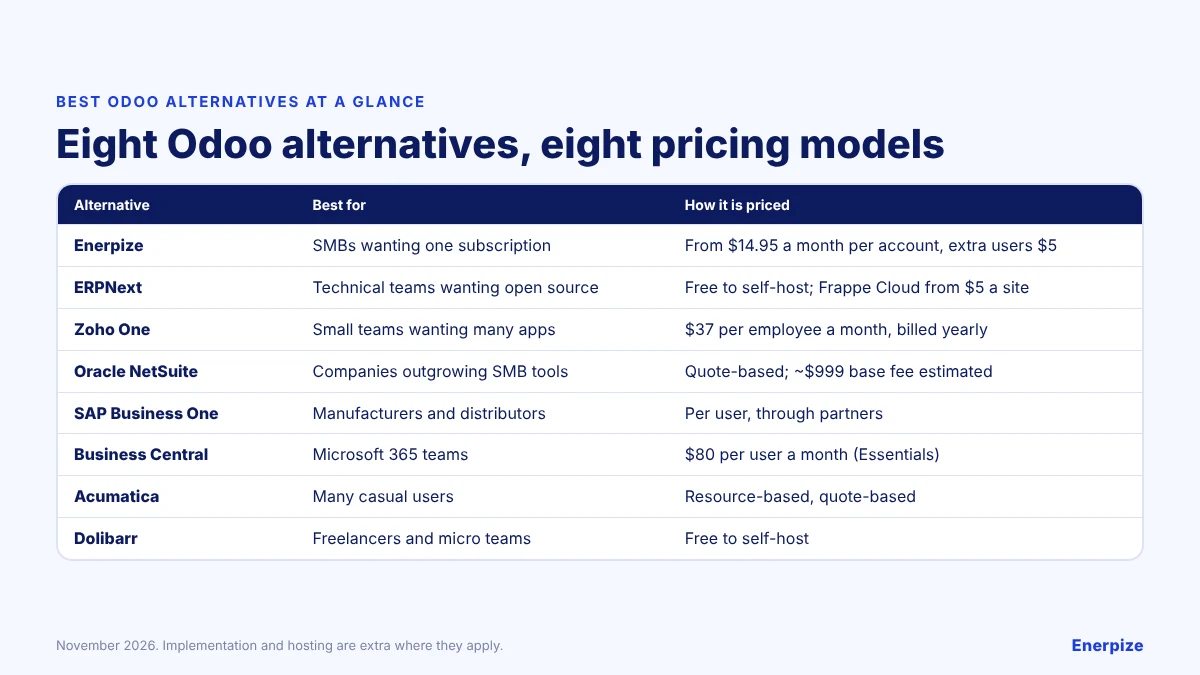
| Alternative | Best for | How it is priced | Type |
|---|---|---|---|
| Enerpize | SMBs wanting one subscription | $14.95 a month, or $9.99 billed yearly, per account; extra users $5 | All-in-one cloud ERP |
| ERPNext | Technical teams wanting open source | Free to self-host; Frappe Cloud from about $5 a site | Open-source ERP |
| Zoho One | Small teams wanting many apps | $37 per employee a month, billed yearly, for all employees | Business app suite |
| Oracle NetSuite | Companies outgrowing SMB tools | Quote-based; base fee estimated near $999 a month | Enterprise cloud ERP |
| SAP Business One | Manufacturing and distribution SMBs | Per user, quoted through partners | SME ERP |
| Microsoft Dynamics 365 Business Central | Teams already in Microsoft 365 | $80 per user a month (Essentials), $110 (Premium) | Cloud ERP |
| Acumatica | Teams with many casual users | Resource-based, quote-based | Cloud ERP |
| Dolibarr | Freelancers and very small teams | Free to self-host | Lightweight open-source ERP and CRM |
Odoo Pricing, Explained
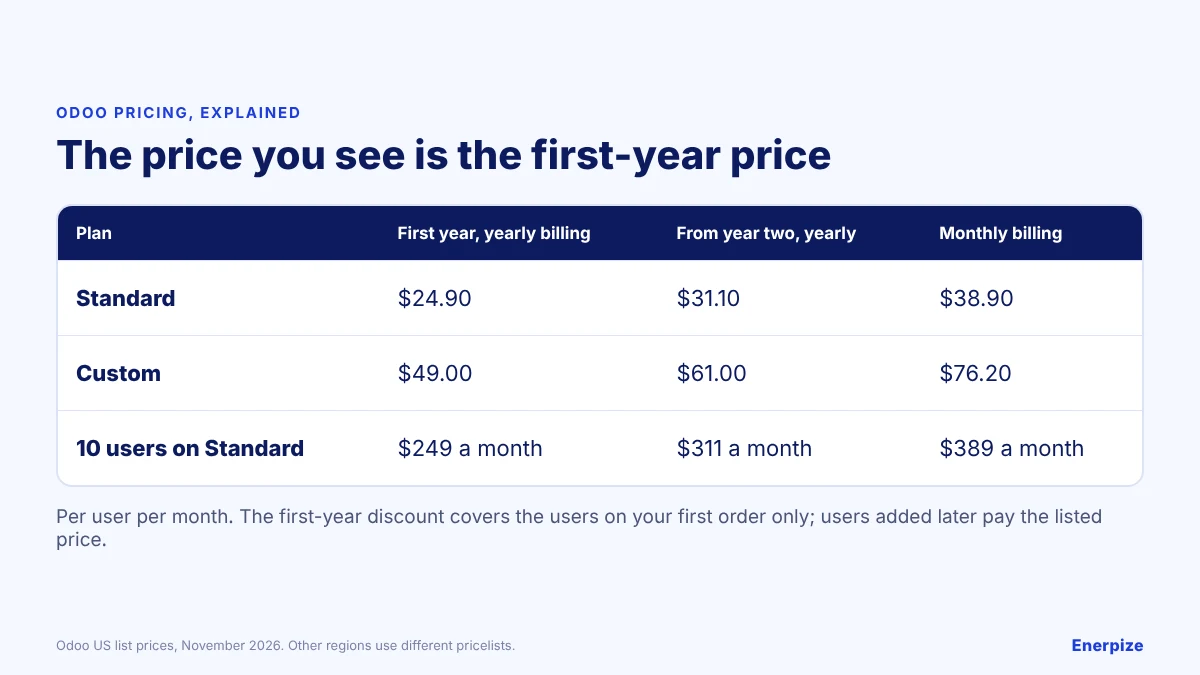
Odoo publishes its prices, but the number you see first is a discounted first-year rate. These are US prices from Odoo’s pricing page as of November 2026; Odoo uses different regional pricelists elsewhere, so figures you find online may reflect another region.
| Plan | First year, yearly billing | From year two, yearly billing | Monthly billing |
|---|---|---|---|
| Standard | $24.90 | $31.10 | $38.90 |
| Custom | $49.00 | $61.00 | $76.20 |
| 10 users on Standard | $249 a month | $311 a month | $389 a month |
⚑ Practical note: Prices are per user per month. The first-year discount covers the users on your first order only; users added later pay the listed price. One app is free with unlimited users.
Enerpize vs Odoo: What a 10-Person Team Pays
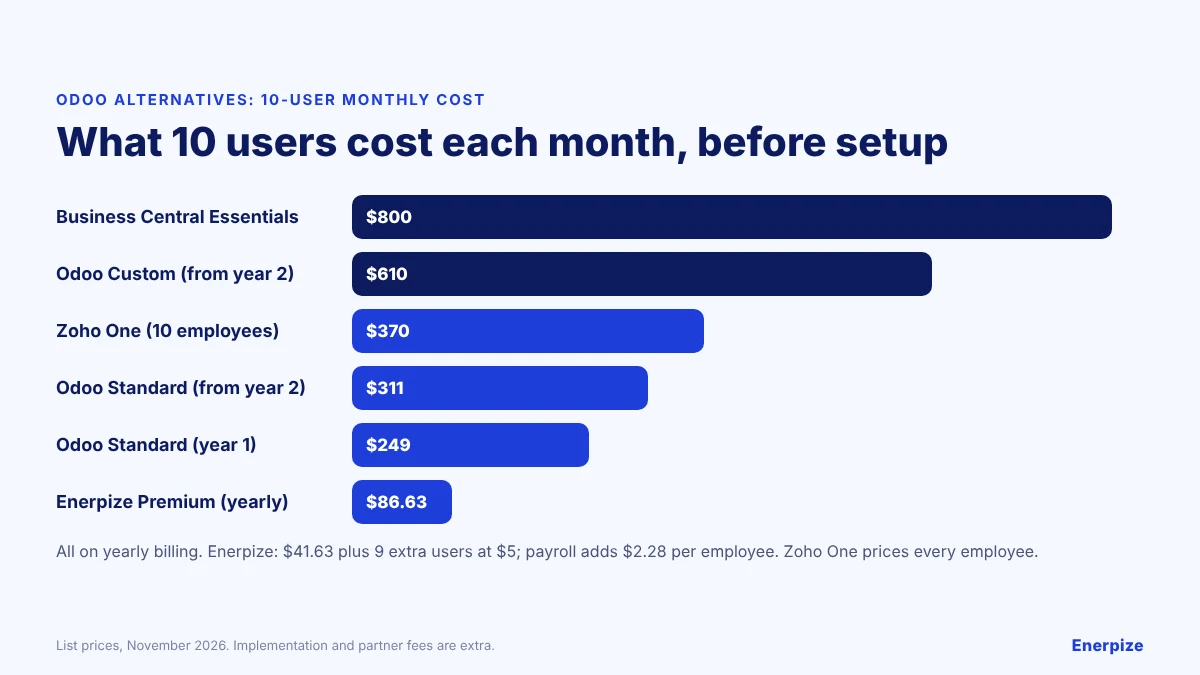
Sticker prices rarely tell the full story, so here is the same 10-person team on each platform.
| Platform | 10 users, per month | How it adds up |
|---|---|---|
| Business Central Essentials | $800 | 10 users at $80 |
| Odoo Custom, from year two | $610 | 10 users at $61.00, billed yearly |
| Zoho One | $370 | 10 employees at $37, billed yearly |
| Odoo Standard, from year two | $311 | 10 users at $31.10, billed yearly |
| Odoo Standard, year one | $249 | 10 users at $24.90, billed yearly |
| Enerpize Premium | $86.63 | $41.63 a month billed yearly, plus 9 extra users at $5 |
On Enerpize, extra branches cost $19 a month from the Advanced plan, and each employee on payroll costs $2.28 a month on yearly billing or $2.70 on monthly billing; see the plans page. On Odoo, partner implementation is the bigger cost: published guides estimate anywhere from about $5,000 for a simple setup to well over $45,000 for a mid-sized company with real customisation.
Feature by Feature
| Area | Enerpize | Odoo |
|---|---|---|
| Edition model | One product; higher plans add capacity and advanced tools | Free Community, then Standard and Custom per user |
| Accounting | Ledger, bank reconciliation, and assets on every plan; cost centres from Advanced | Full accounting on the paid editions |
| Inventory | Barcodes, stocktaking, and purchases on every plan; 2, 3 or 5 warehouses by plan | Inventory app with multi-warehouse |
| POS | On every plan, with a dedicated mobile app | Point of Sale app |
| CRM and loyalty | Client follow-up on every plan; memberships from Advanced; loyalty points on Premium | CRM app; loyalty through POS and apps |
| Operations | Bookings and rental units; lease contracts and manufacturing on Premium | Deeper manufacturing; many apps for niche needs |
| Customisation | Configured from settings | Studio on Custom, or developer work |
| Setup | Self-serve, 14-day free trial | Self-serve on Standard; partners for complex setups |
Enerpize’s CRM module, inventory module, and POS module share one database, so a sale updates stock, the client record, and the ledger at once. Odoo wins on manufacturing depth, localisation breadth, and the size of its app library.
Other Odoo Alternatives Worth a Look
Enerpize is not the only serious option. Here is an honest look at seven other platforms people compare against Odoo.
ERPNext
ERPNext is the closest open-source alternative to Odoo. Built on the Frappe framework, it covers accounting, inventory, manufacturing, and CRM, and nearly everything ships free in the self-hosted edition rather than being split across paid tiers. HR runs as the separate free Frappe HR app. Hosted plans on Frappe Cloud start at about $5 a site a month. Frappe publishes its own ERPNext vs Odoo comparison, and our Enerpize vs ERPNext page covers how it compares with an all-in-one cloud system.
- Strength: free core functionality and an active open-source community.
- Limit: a smaller app ecosystem than Odoo, and a setup that expects technical comfort.
- Best for: technical teams that want open source without Odoo’s edition split.
Zoho One
Zoho One bundles more than 40 apps, including CRM, Books, Desk, and People, for $37 per employee a month on yearly billing. The all-employee plan has to cover everyone in the company, not only the people who log in.
- Strength: many apps under one login and solid individual tools such as Zoho CRM and Zoho Books.
- Limit: apps built by different teams vary in interface and depth.
- Best for: small teams that want breadth more than depth.
Oracle NetSuite
NetSuite is an enterprise cloud ERP and often where companies land once they outgrow SMB tools. Oracle does not publish prices; third-party estimates put the base platform near $999 a month plus about $99 to $125 per user, with partner implementations of several months. Our NetSuite alternatives guide covers it in depth.
- Strength: multi-entity, multi-currency consolidation.
- Limit: cost and complexity rise quickly as modules are added.
- Best for: larger companies with subsidiaries across countries.
SAP Business One
SAP Business One targets small and mid-sized manufacturers and distributors, sold and priced through certified partners.
- Strength: manufacturing depth and multi-warehouse control.
- Limit: partner-led implementation cost and a dated interface.
- Best for: manufacturing and distribution businesses with complex production.
Microsoft Dynamics 365 Business Central
Business Central suits teams already in Outlook, Excel, and Teams. Essentials costs $80 per user a month and Premium $110, after Microsoft’s November 2025 price rise. Our Business Central alternatives guide goes deeper.
- Strength: native Microsoft 365 integration and multi-company support.
- Limit: per-user licensing and partner-led implementation.
- Best for: Microsoft-heavy teams.
Acumatica
Acumatica charges by resources consumed rather than per user, so casual users do not raise the bill.
- Strength: unlimited users and industry editions for construction and distribution.
- Limit: users describe HR and payroll as basic, and pricing is quote-based.
- Best for: growing teams with many occasional users.
Dolibarr
Dolibarr is a lightweight, free open-source ERP and CRM for freelancers, small businesses, and non-profits.
- Strength: a free core with no per-user fee and a shallow learning curve.
- Limit: best suited to small teams, with an older-looking interface.
- Best for: freelancers and micro businesses covering the basics.
Which Odoo Alternative Fits Your Business?
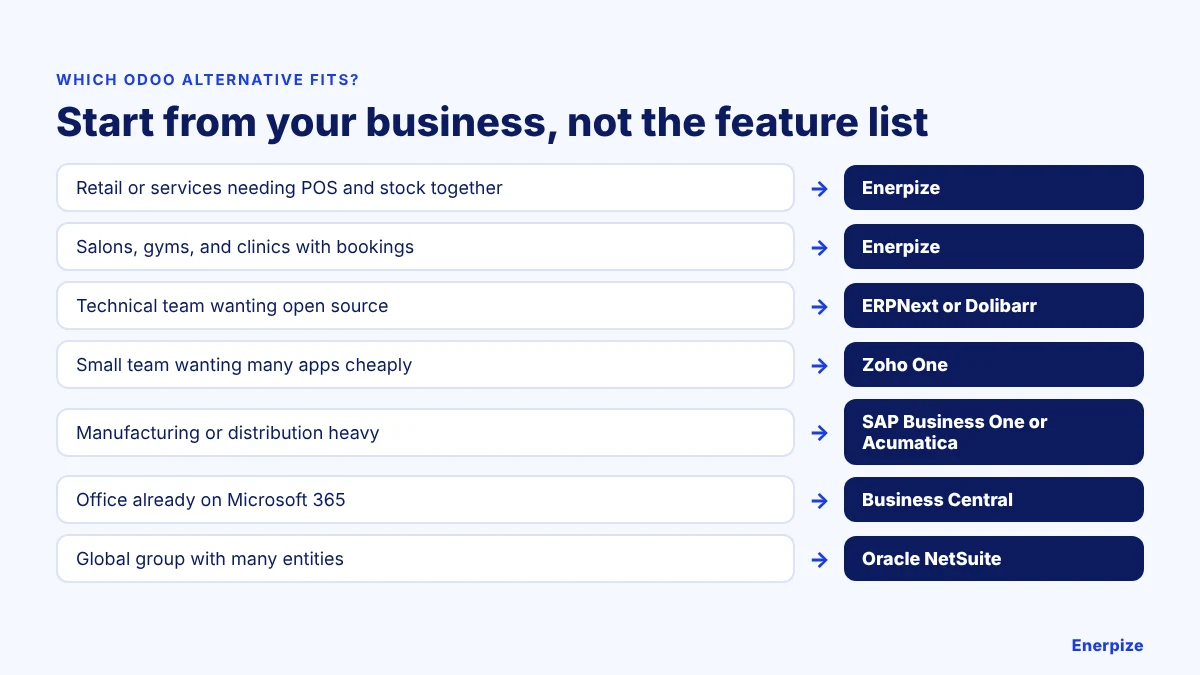
Take a gym or a salon: appointments, membership renewals, and walk-in payments. Take a small furniture workshop: bills of materials and production schedules. Take a consulting firm living in Outlook and Teams. Each one needs a different platform.
| Your business | Better fit | Why |
|---|---|---|
| Retail or service business needing POS and inventory together | Enerpize | POS mobile app and inventory on every plan |
| Appointment or membership business, such as a salon, gym, or clinic | Enerpize | Bookings and client follow-up, with memberships from Advanced and loyalty on Premium |
| Technical team wanting open-source control | ERPNext or Dolibarr | Free self-hosted, source-level customisation |
| Small team wanting many apps cheaply | Zoho One | 40+ apps under one subscription |
| Manufacturing or distribution heavy operation | SAP Business One or Acumatica | Deeper production planning |
| Office already running on Microsoft 365 | Business Central | Native Outlook, Excel, and Teams integration |
| Group with several entities and currencies | Oracle NetSuite | Built for multi-subsidiary consolidation |
| Manufacturer with developers, in many countries | Odoo | Manufacturing depth, localisation, and open code |
How to Choose the Right Odoo Alternative
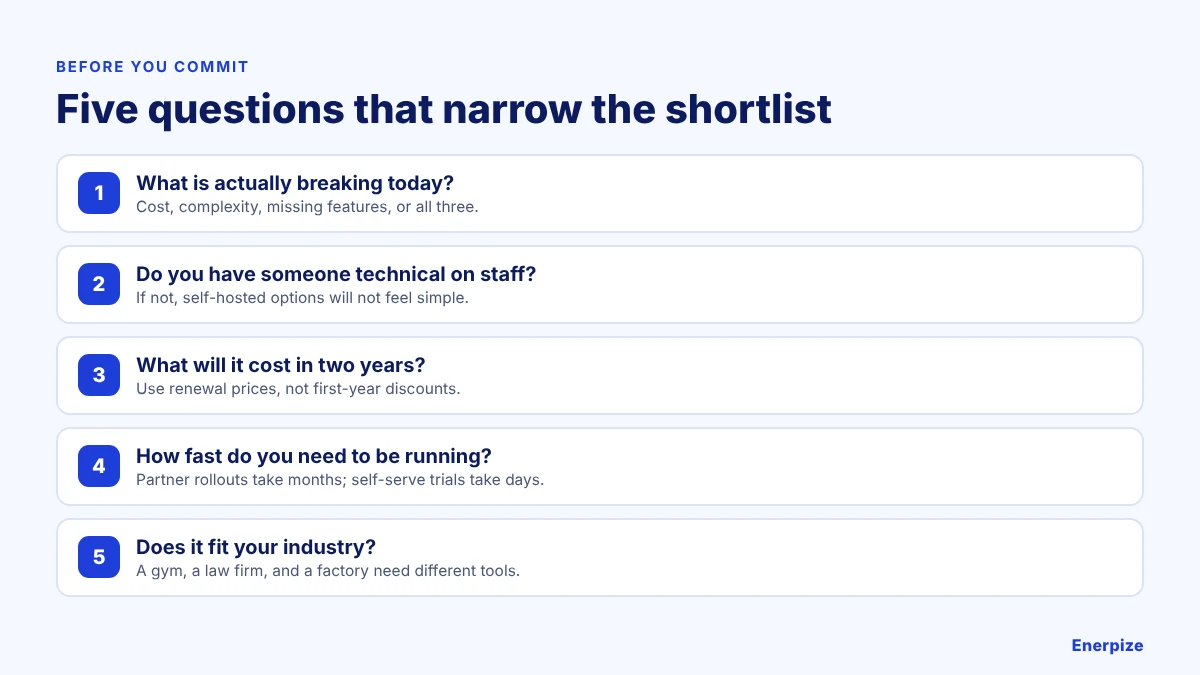
Run through these five questions honestly before you commit.
What Is Actually Breaking Today?
Cost, complexity, missing features, or all three. ERPNext mainly solves cost; an all-in-one platform like Enerpize mainly solves complexity and missing industry tools.
Do You Have Someone Technical on Staff?
If not, cross ERPNext, Dolibarr, and self-hosted Odoo Community off the list. All three assume technical capacity.
What Will It Cost in Two Years, Not Two Months?
Use renewal prices, not first-year discounts, and run the 10-person and 25-person maths before you sign.
How Fast Do You Need to Be Running?
A partner-led rollout is a different commitment from a self-serve trial with no setup fee.
Does It Fit Your Industry?
A law firm, a gym, and a factory do not need the same software, even though all three are small businesses.
Switching From Odoo: What Migration Involves
Moving off Odoo is not a weekend project, but it is not the multi-month ordeal some vendors imply either.
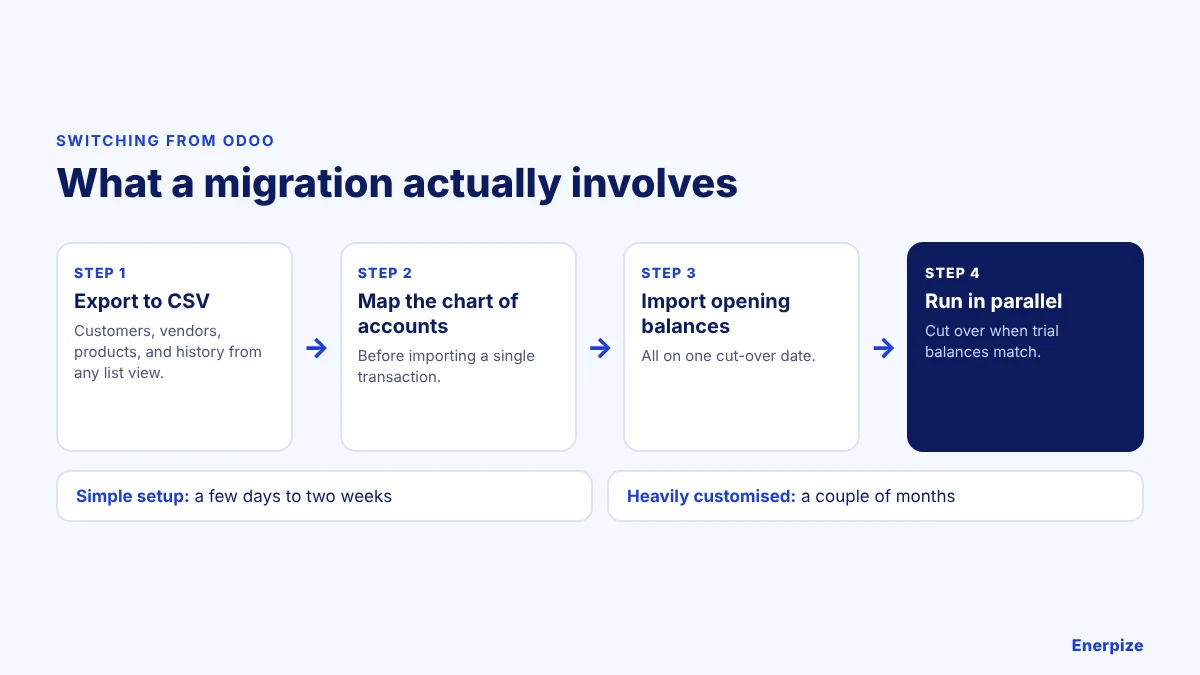
1- Export Your Data
Odoo exports customers, vendors, products, and transaction history to CSV from any list view, which is the format most alternatives import.
2- Map Your Chart of Accounts
Do this before you import a single transaction. A mismatched chart of accounts turns a clean migration into a reconciliation problem three months later.
⚡ Tip: Map analytic accounts as well, so departmental reports survive the move.
3- Import Opening Balances on One Cut-Over Date
Trial balance, receivables, payables, and stock on hand all land on the new system as of the same day, or your first month will not tie out.
4- Run Both Systems in Parallel
Post the same transactions in both systems for a few weeks and compare the trial balance at month end. Cut over when the numbers match.
⚡ Tip: Cut over at the start of a month or quarter.
How Long Does It Take to Switch From Odoo?
| Your Odoo setup | Typical time |
|---|---|
| Simple, little customisation | A few days to two weeks |
| Heavily customised, years of workflow-specific configuration | A couple of months to map, migrate, and test |
The more you customised Odoo, the more mapping the migration needs, which is itself an argument for choosing a platform that fits your business out of the box the second time.
Common Mistakes When Leaving Odoo
✕ Comparing first-year prices
Why it matters: Odoo’s discount ends after 12 months and does not cover users added later.
Fix: Compare renewal prices for your expected headcount.
✕ Rebuilding every custom module
Why it matters: Years of customisations rarely all need to move.
Fix: Keep only what the business still uses.
✕ Skipping the chart of accounts map
Why it matters: Reports stop tying out a few months after go-live.
Fix: Map accounts and analytic accounts before importing.
✕ Underestimating manufacturing needs
Why it matters: Odoo’s manufacturing is deeper than most SMB platforms.
Fix: Test your bill of materials and work orders in the trial.
Frequently Asked Questions
What are the best alternatives to Odoo in 2026?
It depends on what you need. Enerpize suits SMBs that want one subscription, ERPNext and Dolibarr suit technical teams wanting open source, Zoho One suits small teams wanting many apps, Business Central suits Microsoft 365 companies, and NetSuite or SAP Business One suit larger, more complex operations.
What does Odoo not do well?
The main friction points are the split between free and paid editions, per-user pricing that rises with every hire, customisation that needs the Custom plan or a developer, and upgrades that can break heavily customised workflows.
Is there a free alternative to Odoo?
Yes. ERPNext and Dolibarr are free to self-host, though you pay for hosting and setup. Enerpize offers a 14-day free trial with no credit card.
What is the best open-source ERP alternative to Odoo?
ERPNext is generally considered the closest open-source alternative, built on the Frappe framework.
Is ERPNext better than Odoo?
Neither is better for everyone. ERPNext wins on cost and openness, with nearly everything free when self-hosted. Odoo wins on ecosystem size and manufacturing depth.
What is the best Odoo alternative for a small business?
For a small business that wants sales, accounting, inventory, POS, HR, and CRM in one subscription without a setup fee, Enerpize is worth comparing, from $14.95 a month or $9.99 billed yearly.
How much does Odoo cost compared to alternatives?
In the US, Odoo Standard costs $24.90 per user a month in year one and $31.10 after on yearly billing, and Custom $49.00 then $61.00; monthly billing costs $38.90 and $76.20. Implementation commonly adds about $5,000 to $45,000 or more. For 10 users, Enerpize Premium costs $86.63 a month billed yearly, plus $2.28 per employee if you run payroll.
About the Author
Omar El Bahr is a Senior Digital Growth Specialist at Enerpize, where he leads SEO, content strategy, and organic growth across international markets. He is a Forbes Communications Council contributor and has written for Entrepreneur on business communication and digital strategy.
Disclaimer: Odoo, Zoho One, Business Central, and Enerpize figures are published US list prices as of November 2026; Odoo uses regional pricelists, so prices differ by country. NetSuite, SAP Business One, and Acumatica are quote-based, and their figures are third-party estimates. Implementation ranges are from published third-party guides. Confirm current prices with each vendor before deciding.
Related Articles
 Software Reviews
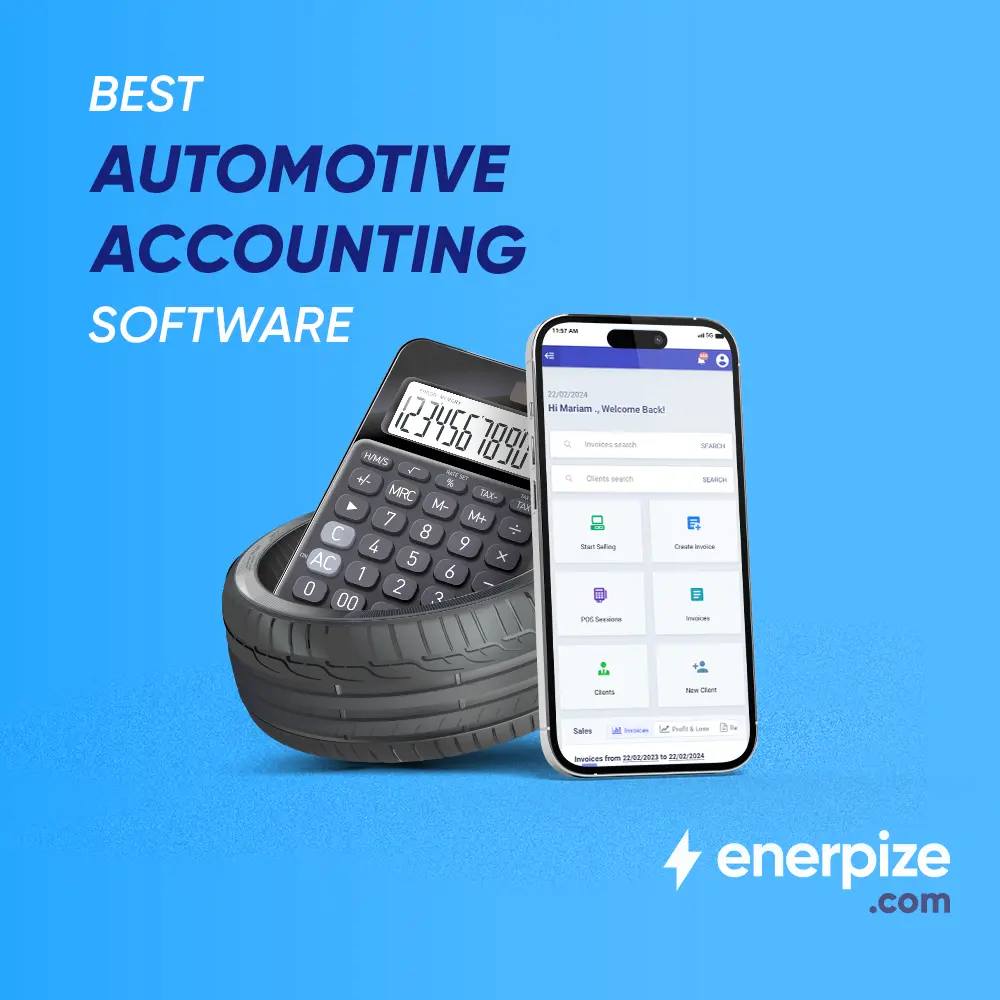
Automotive Accounting Software: How Auto Repair Shops Track Jobs, Parts and Profit
Read more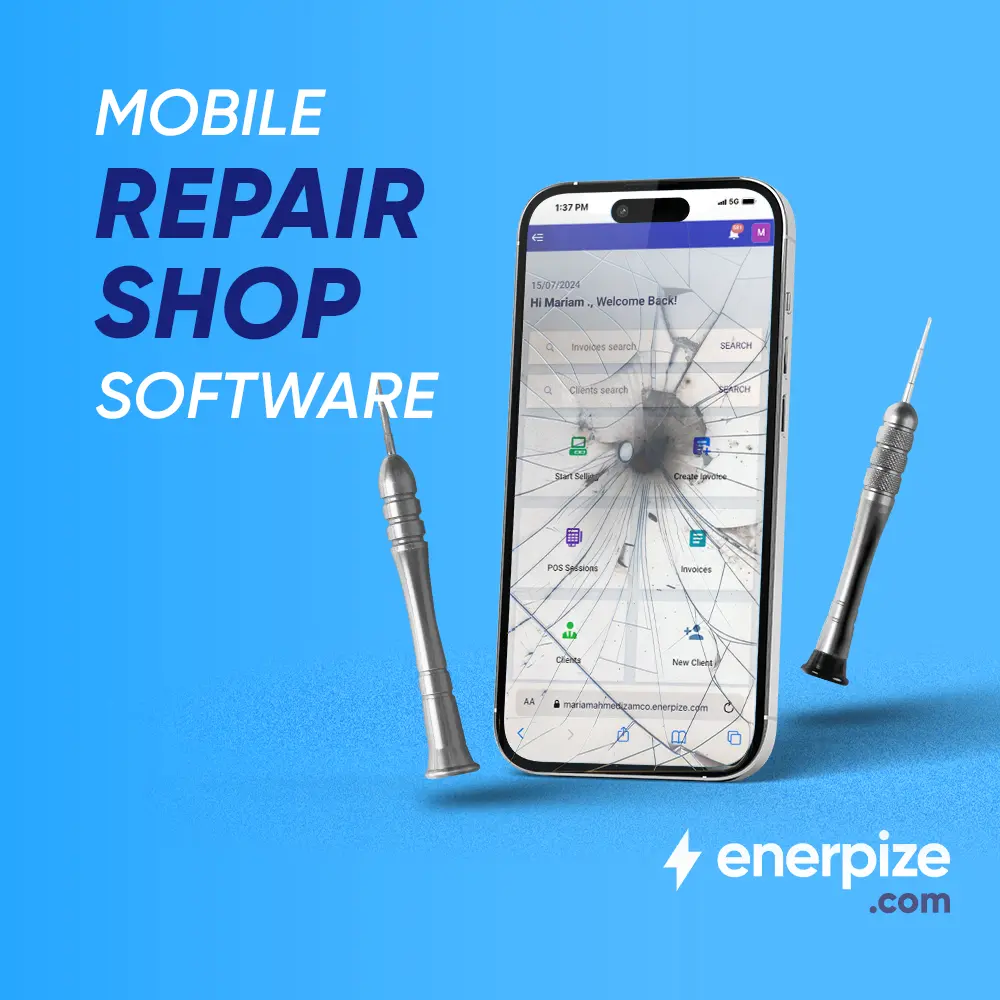 Software Reviews
How Mobile Repair Shop Software Can Boost Your Sales
Read more Software Reviews
Best AI Content Creation Software to Power Your Business Content
Read more Software Reviews
Why Power BI Is the Preferred Business Intelligence Tool for Modern Enterprises
Read more Software Reviews
Best Work Management Software That Boosts Team Productivity
Read more Software Reviews


