

Author : Mayar Emad
General Journal vs. General Ledger: Key Differences & Examples

Table of contents:
- Key Takeaways
- What Is a General Journal?
- What Is a General Ledger?
- General Journal vs General Ledger What’s the Difference?
- How the General Journal and General Ledger Work Together?
- Which Comes First General Journal or General Ledger?
- Format of a General Journal vs Format of a General Ledger
- Why Businesses Need Both a General Journal and A General Ledger?
- General Journal vs General Ledger vs Trial Balance
- Common Mistakes when Confusing the General Journal and General Ledger
- How Accounting Software Automates Journals and Ledgers
- How Enerpize Helps Businesses Manage Their Accounting
- FAQs
- Conclusion
In accounting, the general journal and the general ledger are fundamental records for tracking and organizing financial transactions. Although closely connected, each has a distinct role in the accounting process.
The journal records transactions in chronological order, whereas the ledger consolidates them by account to show balances.
Understanding how these two records differ helps businesses minimize errors and produce accurate financial statements.
Key Takeaways
- The general journal is a chronological record of all transactions and includes important details such as liabilities, equity, and revenue.
- The general ledger is known as a book of final entry, which organizes the transactions by account.
- The general ledger is important for tracking all the significant transactions recorded in the journal.
- One of the most important differences between a general journal and a ledger is the level of detail in entries.
- The general journal appears first as it’s called the book of original entry.
- Businesses need a general journal and a ledger to maintain organized and accurate financial records.
What Is a General Journal?
The general journal is a chronological record of all transactions and includes essential details such as liabilities, equity, and revenue for preparing financial statements. It is known as the book of original entry, because it’s where the transactions are first recorded in chronological order.
What Is a General Ledger?
The general ledger is a summary report that displays the total for each account, the opening balance, and total debit and credit transactions. From here, you can access the detailed transaction report. This report is useful for verifying each account and any transaction that needs to be checked.
The general ledger is known as the book of final entry, that organizes the transactions by account.
The main difference between the general journal and the ledger is that the general journal captures transactions chronologically, while the general ledger organizes transactions by account.
General Journal vs General Ledger: What’s the Difference?
The general journal vs the ledger play different roles in your accounting. The key differences are:
1- Level of details
One of the most important differences between a general journal and a ledger is the level of detail in the entries.
- The general journal serves as your source data, listing the details in order, making it easy to track specific transaction records, for example, for auditing purposes. Or if you need to verify any differences in your financial information.
- On the other hand, the general ledger focuses on the bigger picture, summarizing your transactions and categorizing them into categories such as liabilities and assets to help you better understand your overall financial situation.
2- Transaction type
- The general journal is the record used to document all types of financial transactions.
- The general ledger is important for tracking all significant transactions recorded in the journal and classifying them into five accounting categories: assets, liabilities, owner’s capital, revenues, and expenses.
3- Corrective entries
- The general journal is used to record corrections, whether to fix errors or to make adjustments at the end of the period.
- The general ledger reflects the results of these adjustments, but it’s not what actually makes the changes.
4- Preparations of the trial balance and financial statements
- The general journal keeps an accurate record of every transaction, but it doesn’t directly generate your financial statements. It provides a chronologically ordered list of source data.
- The general ledger organizes the information by account, allowing you to prepare a trial balance.
5- Double-entry accounting
The general journal and ledger are important in double-entry accounting. This means that both sides record each transaction with two entries, a debit entry and a credit entry. This ensures that your accounts remain balanced.
The general journal lists transactions and their debits, but the general ledger organizes them by account.
Here is a comparison table between the general journal vs general ledger:
| Function | General Journal | General Ledger |
| Level of detail | Highly detailed | Basic summary |
| Transaction type | All types. | Reflects journal. |
| Corrective entries | It’s used for corrections. | The general ledger shows the final corrected results. |
| Preparation of trial balance and financial statements. | The financial statements are not used directly. | Organizes the data by account, then creates the trial balance. |
How the General Journal and General Ledger Work Together?
The journal and the general ledger work together in a continuous 2-step accounting cycle: the journal records the basic details of each transaction in chronological order, while the general ledger classifies this data to update the balances of individual accounts.
We will explain the practical steps in detail below:
- Recording transactions: Transactions are first recorded chronologically in the general journal.
- Posting (the ledger): the debits and credits from the journal are transferred to the individual accounts.
- Updating balances: transactions are posted, and the ledger maintains individual accounts for revenue and expenses.
Which Comes First: General Journal or General Ledger?
The general journal appears first. It is called the "book of original entry," and transactions are documented chronologically as they occur. The General Ledger is the second, where those journal entries are posted and classified by certain account types (e.g, cash, revenue, costs) to summarize financial data.
Format of a General Journal vs Format of a General Ledger
General Journal Format
A general journal is arranged by date. It is chronological. Typical columns include:
- Date
- Account title debited
- Account title credited
- Debit amount
- Credit amount
- Description or memo
- Reference number
Example
| Date | Accounts | Debits | Credits |
| 1-4-2026 | Cash | 30,000 | |
| Advertising expense | 30,000 | ||
| 5-4-2026 | Cash | 4,000 | |
| Capital stock | 4,000 |
You may also like: How to Make Journal Entries: A Comprehensive Guide
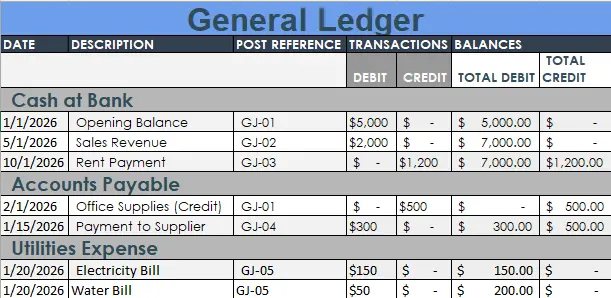
General Ledger Format
A general ledger is arranged by account. Instead of one list by date, it contains separate sections for Cash, Revenue, Rent Expense, Accounts Payable, and more. Typical columns include:
- Date
- Description
- Debit
- Credit
- Running balance
Example
Recommended for you: General Ledger Template in Excel
Why Businesses Need Both a General Journal and A General Ledger?
Every business needs both a general journal and a general ledger, as they play distinct but related roles in the accounting process.
The general journal is the first place where transactions are recorded. It keeps track of every financial event in date order, including the accounts involved, the debit and credit amounts, and a description of each transaction. A general journal makes it easy for businesses to trace the money back to its source documents, such as invoices and receipts.
The general ledger, on the other hand, organizes the same information by account. Instead of listing transactions by date, it groups all entries by account, such as cash, accounts receivable, and sales revenue. The general ledger lets businesses see how each account changes over time.
General Journal vs General Ledger vs Trial Balance
The general journal and general ledger are two key steps in the accounting cycle. They are followed by another important record: the trial balance.
- The general journal records individual transactions.
- The general ledger groups those journal records into separate accounts.
- The trial balance is a summary report that lists the closing balances of all general ledger accounts, divided into two columns: debit and credit.
Three-way comparison table
| Record | Function | Format | Timing |
| General Journal | Initial transaction recording. | Chronological entries. | First step. |
| General ledger | Account classification and balances. | By account. | After journal posting. |
| Trial balance | Tests the balance of accounts. | Summary list of balances. | Before financial statements. |
Explore more on this topic: General Ledger vs Trial Balance: Key Differences
Common Mistakes when Confusing the General Journal and General Ledger
Here are the most common mistakes when confusing the general journal and general ledger to avoid:
1-Thinking They Are the Same Record
Some assume both books contain identical information. While connected, they serve different purposes: one records transactions, the other organizes balances.
2. Assuming Ledger Entries Come First
Transactions should first be recorded in the journal, then posted to the ledger.
3. Confusing Detail With Summary
The journal contains detailed explanations of each transaction. The ledger focuses on totals and balances for each account.
4- Failure to Periodically
Failure to periodically match the general ledger with bank statements.
5- Documentation Issues
Failure to document workflows, integrations, or approval processes.
How Accounting Software Automates Journals and Ledgers
Accounting software helps streamline the traditional process of transferring entries from the journal to the ledger. When a user creates an invoice, records a payment, or enters an expense, the software often:
- Creates the appropriate journal entry automatically.
- Updates the related ledger accounts in real time.
- refreshes balances instantly.
- generates the reports without waiting for manual posting.
How Enerpize Helps Businesses Manage Their Accounting
Enerpize accounting software assists businesses in managing accounting tasks within a single cloud-based platform by linking daily transactions directly to organized financial records. With Enerpize, businesses can:
- Record journal entries with accuracy.
- Efficiently manage the chart of accounts.
- Keep a clear and organized general ledger.
- Monitor balances in real time.
FAQs
Which is more important, a journal or a ledger?
Both the general and the ledger are essential to the accounting process, but they hold different levels of importance.
The general journal is more important for accuracy and auditing, and records transactions in chronological order.
The general ledger is more important for decision-making and reporting because it’s the book of final entries.
What are the three types of ledgers?
The three types of ledgers are the general ledger, the sales ledger, and the purchases ledger.
Conclusion
Understanding the difference between the general journal and the general ledger is crucial to building a robust accounting system. The general journal records transactions in chronological order with complete details, whereas the general ledger categorizes these entries by account to show balances and support reporting. One provides the transaction history, while the other underpins the financial structure essential to daily business operations. Both are integral to the accounting cycle.