




Understanding your business’s net cash flow is essential for maintaining financial health and stability. The net cash flow formula allows you to measure the difference between cash inflows and outflows over a specific period, providing clear insight into your company’s ability to generate cash and manage liquidity effectively.
Key Takeaways
- Net cash flow measures the difference between total cash inflows and outflows over a period.
- It reflects real liquidity, not just accounting profit.
- It is calculated either as: Total inflows − total outflows, or Operating + Investing + Financing cash flows.
- Positive net cash flow supports stability, growth, and financial flexibility.
- Negative cash flow doesn’t always mean failure, but it requires attention and proper management.
- Common challenges include delayed payments, high costs, over-investment, and poor planning.
- Improving cash flow depends on faster collections, controlled spending, and accurate forecasting.
- Net cash flow has limitations and should not be analyzed in isolation.
- Using accounting software can simplify tracking, reporting, and decision-making.
What Is Net Cash Flow?
Net Cash Flow (NCF) refers to the difference between the total cash coming into a business (cash inflows) and the total cash going out (cash outflows) over a specific period. It represents the actual movement of cash within a company, showing whether the business generated more cash than it spent or vice versa.
In simple terms, net cash flow reveals how much cash a company has truly gained or lost during a specific period. This makes it a key indicator of a company’s liquidity, helping assess its ability to cover operating expenses, invest in growth opportunities, and meet financial obligations such as paying debts.
Ultimately, maintaining positive net cash flow is essential for long-term sustainability, as no business can operate effectively without consistently generating more cash than it spends.
Net Cash Flow Formula
To calculate net cash flow, use the following formula to monitor the cash coming into your business and the cash going out:
Net Cash Flow = Total cash Inflows - Total cash Outflows
- Cash Inflows → Money entering the business, representing sources of cash such as sales revenue, investments, or financing.
- Cash Outflows → Money leaving the business, representing uses of cash such as operating expenses, asset purchases, or debt repayments.
People who work in finance calculate net cash flow with the following formula:
Net cash flow = operating cash flow + financing cash flow + investing cash flow
The net cash flow formula measures the difference between cash coming into a business and cash going out over a specific period. It shows how much cash the company actually generates or loses, helping assess its liquidity and overall financial health.
A positive net cash flow means the business generates more cash than it spends, supporting stability and growth. A negative net cash flow indicates that outflows exceed inflows, which may lead to liquidity challenges and difficulty meeting financial obligations.
Formula Breakdown:
1. Cash Flow from Operating Activities (CFO)
Operating cash flow represents the cash generated or used in day-to-day business operations. It includes inflows from the sale of products or services and outflows such as rent, salaries, utilities, and supplier payments.
This section indicates whether the business can sustain itself without external funding. A consistently positive CFO indicates strong core operations, while a negative one may signal underlying issues.
Operating cash inflows include:
- Cash received from customers
- Service or subscription revenue
- Refunds or rebates from suppliers
Operating cash outflows include:
- Salaries and wages
- Rent and utilities
- Payments for inventory or raw materials
- Taxes and insurance
Under the indirect method, the CFO starts with net income and adjusts for non-cash items like depreciation and changes in working capital.
2. Cash Flow from Investing Activities (CFI)
Investing cash flow tracks how a business uses cash for long-term growth. It includes transactions related to assets such as equipment, property, and investments.
While negative investing cash flow often reflects reinvestment in the business (which can be a positive sign), it should be supported by strong operating cash flow.
Investing cash inflows include:
- Proceeds from selling equipment or property
- Returns from investments (interest or dividends)
- Liquidation of financial assets
Investing cash outflows include:
- Purchasing equipment or machinery
- Buying property or facilities
- Investing in technology or software
- Acquiring other businesses
3. Cash Flow from Financing Activities (CFF)
Financing cash flow reflects how a business raises and repays capital. It includes cash movements related to debt, equity, and shareholder distributions.
This section shows how the company is funded and whether it is raising new capital or paying off obligations.
Financing cash inflows include:
- Proceeds from loans or credit facilities
- Funds raised from issuing shares
- Investments from stakeholders
Financing cash outflows include:
- Loan repayments
- Dividend payments
- Share buybacks
For example:
- Operating Cash Flow: +$20,000
- Investing Cash Flow: −$10,000
- Financing Cash Flow: −$5,000
Net Cash Flow = +$5,000
This means the business generated more cash than it spent overall, even after investing in assets and repaying debt, an indicator of healthy cash flow management.
Read Also: Pro Forma Cash Flow Statement: A Comprehensive Guide
How to Calculate Net Cash Flow Step by Step
Calculating net cash flow helps you understand whether your business is generating enough cash to cover its expenses and support growth. The process is straightforward when broken into clear steps:
1- Choose the Time Period
Start by deciding the timeframe you want to analyze. This could be the past 3, 6, or 12 months for a cash flow statement, or a future period if you’re preparing a projection.
2- Calculate Cash Flow from Operating Activities (CFO)
Determine how much cash your core business generates. Add all cash received from sales or services, then subtract day-to-day expenses such as rent, salaries, utilities, and supplier payments.
This step shows whether your business can generate cash from its main operations.
3- Calculate Cash Flow from Investing Activities (CFI)
Next, account for cash related to long-term assets. Add any cash received from selling equipment, property, or investments, and subtract money spent on purchasing or upgrading those assets.
This reflects how your business is investing in its future.
4. Calculate Cash Flow from Financing Activities (CFF)
Identify cash movements related to funding. Add cash received from loans, investors, or issuing shares, then subtract repayments, dividends, or owner withdrawals.
This step shows how your business raises and manages capital.
5. Add All Cash Flow Components
Combine the totals from operating, investing, and financing activities:
Net Cash Flow = CFO + CFI + CFF
This final number represents the net change in cash during the selected period.
6. Evaluate the Results
Once you have the net cash flow, assess what it means for your business:
- A positive result indicates that cash inflows exceed outflows.
- A negative result means the business is spending more cash than it generates.
Use this insight to make decisions about budgeting, investments, or managing expenses.
Recommended for you: Free Cash Flow Statement Template
Tip: Using an accounting software like Enerpize automates net cash flow calculations, tracks all inflows and outflows, and provides real-time net cash flow reports, helping business owners make confident financial decisions.
Net Cash Flow from Operating Activities
Net cash flow from operating activities focuses only on cash generated or used in a company’s core business operations, such as selling products or delivering services. It excludes investing and financing activities, making it the clearest indicator of whether the business can sustain itself from day-to-day operations.
Formula
Net Cash Flow from Operating Activities = Cash Inflows from Operations − Cash Outflows from Operations
- Cash Inflows are cash received from customers, service revenue, commissions, subscription income, and other operating receipts.
- Cash Outflows are Payments to suppliers, salaries and wages, rent, utilities, taxes, insurance, and day-to-day operating expenses.
This formula shows whether the business’s day-to-day operations can sustain themselves. A positive result indicates strong, self-sufficient operations, while a negative result may point to cash shortfalls or operational inefficiencies.
Example
Let’s say a company reports the following during the year:
- Cash received from customers: $80,000
- Cash paid to suppliers: $45,000
- Salaries and operating expenses: $20,000
- Taxes paid: $5,000
Net Cash Flow from Operating Activities = 80,000 − (45,000 + 20,000 + 5,000)
Net Cash Flow from Operating Activities = 80,000 − 70,000 = 10,000
Result: The business generated a positive net cash flow of $10,000, meaning it earned more cash from its operations than it spent during the period.
You might also find this helpful: Direct VS Indirect Method Cash Flow
Net Cash Flow from Investing Activities
Net cash flow from investing activities reflects the cash a company spends or receives from investment-related transactions, such as buying or selling long-term assets, property, or financial investments. It highlights how the business allocates resources for growth and whether it is generating returns on past investments.
Formula
Net Cash Flow from Investing Activities = Cash Inflows from Investing − Cash Outflows from Investing
- Cash inflows include proceeds from the sale of equipment, property, or investments.
- Cash outflows include spending on assets or investments in other businesses.
A negative result often indicates that the company is investing in expansion or asset development, which can be a positive sign. However, consistently negative cash flow without clear returns may suggest ineffective investment decisions.
Example
Assume a company has the following investment activities during the year:
- Purchased new equipment for $25,000
- Sold old machinery for $10,000
- Purchased shares in another company for $5,000
Net Cash Flow from Investing Activities = (10,000) − (25,000 + 5,000)
Net Cash Flow from Investing Activities = 10,000 − 30,000 = −20, 000
Result: The business has a negative net cash flow of $20,000, indicating that it invested more cash than it received during the period, typically a sign of growth or expansion spending.
Net Cash Flow from Financing Activities
Net cash flow from financing activities captures the cash a company receives from or returns to investors, lenders, and owners. It reflects how the business raises capital and manages its financial obligations, whether through issuing shares, taking on debt, repaying loans, or distributing dividends.
This section helps assess how the company funds its operations and how its capital structure is evolving over time.
Formula
Net Cash Flow from Financing Activities = Cash Inflows from Financing − Cash Outflows from Financing
- Cash inflows include proceeds from loans, issuing shares, or owner investments.
- Cash outflows include loan repayments, dividend payments, and share buybacks.
A positive result indicates the company raised more capital than it returned, while a negative result typically means it is repaying debt or distributing profits to shareholders.
Example
Suppose a company had the following financing transactions during the year:
- Took a bank loan of $30,000
- Repaid part of the loan worth $10,000
- Paid dividends to shareholders of $5,000
Net Cash Flow from Financing Activities = 30,000 − (10,000 + 5,000)
Net Cash Flow from Financing Activities = 30,000 − 15,000 = 15,000
Result: The company has a positive net cash flow of $15,000, meaning it raised more cash from financing sources than it paid out. This suggests strong financial support for growth and operations.
Read Also: How to Calculate Levered Free Cash Flow? Formula with Examples
Net Cash Flow Example
Let’s assume a business has the following cash transactions for December 2025:
1. Cash Flow from Operating Activities (CFO)
| Cash Flow from Operating Activities (CFO) | |||
| Inflows | Outflows | ||
| Sales revenue | $50,000 | Wages, rent, utilities | $20,000 |
| Interest income | $500 | Interest payment | $1,000 |
| Total Operating Inflows | $50,500 | Total Operating Outflows | $21,000 |
Net Operating Cash Flow (CFO) = 50,500 − 21,000 = $29,500
2. Cash Flow from Investing Activities (CFI)
| Outflows | |
| Purchase of equipment | $8,000 |
Net Investing Cash Flow (CFI) = −$8,000
3. Cash Flow from Financing Activities (CFF)
| Cash Flow from Financing Activities (CFF) | |||
| Inflows | Outflows | ||
| Loan proceeds | $10,000 | Loan repayment | $5,000 |
Net Financing Cash Flow (CFF) = 10,000 − 5,000 = $5,000
4. Final Net Cash Flow Calculation
Net Cash Flow = CFO + CFI + CFF
= 29,500 − 8,000 + 5,000 = $26,500
Result: The business generated a net cash flow of $26,500 for December.
This means that after covering operating costs, investing in equipment, and managing financing activities, the company increased its cash position by $26,500, indicating strong overall cash performance for the period.
Read Also: How to Calculate Discounted Cash Flow? Formula & Examples
Net Cash Flow vs. Net Income
Two companies may report the same net income, yet one has the cash to grow while the other struggles to stay afloat, highlighting why understanding the difference between net cash flow and net income is essential for a complete view of financial health.
| Aspect | Net Cash Flow | Net Income |
| What it measures | Actual cash moving in and out of the business | Profit after all revenues and expenses |
| Focus | Liquidity (cash position) | Profitability (earnings) |
| Where it appears | Cash Flow Statement | Income Statement |
| Accounting basis | Cash-based (records real cash movement) | Accrual-based (records earned revenue and incurred expenses) |
| Timing of transactions | Recorded when cash is received or paid | Recorded when revenue is earned, or expenses are incurred |
| Includes non-cash items? | No | Yes, such as depreciation |
| Impact of credit sales | Not recorded until cash is collected | Recorded immediately as revenue |
| Impact of large purchases | Full cash outflow recorded immediately | Spread over time |
| Key components | Operating, investing, and financing cash flows | Revenue minus all expenses |
| Purpose | Shows whether the business is generating or losing cash | Shows how profitable the business is |
| Why it matters | Indicates ability to pay obligations and sustain operations | Indicates financial performance and efficiency |
Net Cash Flow vs. Profit vs. Revenue
Revenue, profit, and cash flow are three core measures of business performance. They are closely related, but each answers a different question. Looking at only one of them can give a misleading picture of how a business is really doing.
1- Revenue
Revenue is the starting point. It shows the total value of the business's sales during a specific period. It includes both cash sales and credit sales. For example, if a company invoices $100,000, that amount counts as revenue, even if the cash hasn’t been received yet. Revenue does not account for any costs.
In financial reporting, revenue appears at the top of the income statement and is often called the “top line.” It can also include other income streams such as interest, fees, or royalties, depending on the business model.
Formula: Revenue = Price × Quantity sold
2- Profit
Profit (Net Income) is what remains after subtracting all expenses from revenue. This includes direct costs (like production) and indirect costs (such as payroll, utilities, and taxes). A business can generate high revenue but still have low or negative profit if expenses are too high.
Profit is a key measure of overall performance and efficiency. It reflects how well a company controls its costs and turns revenue into earnings. Net income is often referred to as the “bottom line” because it shows the final result after all expenses, interest, and taxes are deducted.
Formula: Profit = Revenue − Total Expenses
3- Net Cash Flow
Net Cash Flow tracks the actual movement of cash. It records when money enters or leaves the business, not when it is earned or incurred. It includes cash from operations, investing, and financing activities. This makes it the key measure of whether a business can pay its bills and continue operating.
Unlike revenue and profit, net cash flow focuses on liquidity. It shows whether the business has enough cash on hand to cover short-term obligations, reinvest in operations, and handle unexpected expenses. Positive cash flow indicates increasing cash reserves, while negative cash flow may signal potential cash shortages.
Formula: Net Cash Flow = Total Cash Inflows − Total Cash Outflows or Net Cash Flow = CFO + CFI + CFF
Net Cash Flow vs. Free Cash Flow
| Aspect | Net Cash Flow | Free Cash Flow |
| What it measures | Total cash moving in and out of the business | Cash remaining after capital investments |
| Formula | Total Cash Inflows − Total Cash Outflows OR CFO + CFI + CFF | Operating Cash Flow − Capital Expenditures (CapEx) |
| Scope | Covers all cash activities (operations, investing, financing) | Focuses on operating cash after asset spending |
| Purpose | Shows the overall change in cash position | Shows cash available for debt repayment, reinvestment, or distribution |
| What it indicates | Whether cash is increasing or decreasing overall | How much usable cash remains after maintaining or expanding assets |
| Use in analysis | Evaluates overall liquidity and cash movement | Evaluates financial flexibility and spending capacity |
Check our Online Levered Free Cash Flow Calculator
How to Find Net Cash Flow on a Cash Flow Statement?
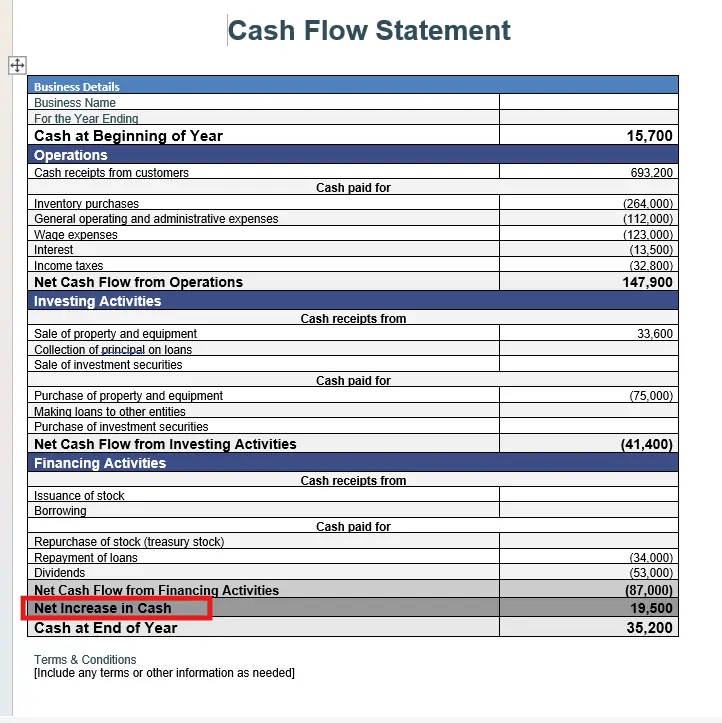
To find net cash flow on a cash flow statement, look for the bottom line of the report. It is usually labeled as: Total change in cash flow, Net Change in Cash, or Net increase in cash.
What Causes Negative Net Cash Flow?
Negative net cash flow occurs when a business spends more cash than it brings in over a given period. This doesn’t always mean the business is failing, but it does signal that cash reserves are being used and may run out if the situation continues.
Here are the most common causes:
1- Delayed Customer Payments
One of the main reasons for negative cash flow is slow or late customer payments. Even if sales are strong, cash doesn’t enter the business until invoices are paid. Long payment terms and weak receivables management can leave a company short on cash.
2- Low Profitability or Tight Margins
When profit margins are small, there isn’t much cash left after covering costs. Any unexpected increase in expenses can quickly push cash flow into negative territory, even during busy periods.
3- High Operating and Overhead Costs
Expenses such as rent, salaries, utilities, and subscriptions can drain cash quickly. If these fixed costs are too high compared to revenue, even a slight drop in sales can lead to cash shortages.
4- Rapid Growth Without Planning
Expanding a business requires upfront spending on inventory, hiring, equipment, or new locations. If revenue doesn’t grow at the same pace, the business can fall into a “growth trap” where costs rise faster than cash inflows.
5- Over-Investing in Assets or Inventory
Spending heavily on equipment, property, or inventory ties up cash. These investments may generate returns later, but in the short term, they reduce available cash and can create pressure on liquidity.
6- Unexpected Expenses
Unplanned costs such as legal issues, system failures, or supplier problems can quickly use up cash reserves. Without a buffer, even a single unexpected expense can push cash flow negative.
7- Poor Pricing Decisions
If products or services are priced too low, revenue may not be enough to cover costs. This leads to situations in which the business is active and generating sales, yet still losing cash.
8- Weak Financial Planning
Without clear forecasts of income and expenses, it’s easy to miss early warning signs. Businesses that don’t track cash flow regularly may run into problems before they have time to react.
You may need: Cash Flow Forecast Template Excel & Google Sheets
9- Tax Mismanagement
Failing to set aside money for taxes can result in sudden cash outflows when payments are due. This can significantly reduce cash balances in a short period.
10- High Debt Repayments
Loan repayments and interest can take up a large portion of available cash. Even profitable businesses can face negative cash flow if debt obligations are too high.
11- Seasonal Fluctuations
Businesses with seasonal sales often experience periods of low revenue. Without proper planning, these slow periods can lead to negative cash flow.
Negative net cash flow doesn’t always mean poor performance, but it does mean the business is using more cash than it generates. If it continues for too long without improvement, it can lead to liquidity problems and difficulty meeting financial obligations.
How to Improve Net Cash Flow
Improving net cash flow comes down to two things: getting cash in faster and keeping cash in the business longer. Most cash flow problems aren’t caused by a lack of sales alone; they’re usually tied to timing, cost control, or poor planning. The following approaches focus on fixing those pressure points.
1- Get Paid Faster and More Consistently
Delayed payments are one of the biggest reasons businesses run short on cash.
- Send invoices immediately after delivering goods or services
- Use clear payment terms and highlight due dates
- Shorten payment terms where possible
- Offer early payment discounts to encourage faster collection
- Follow up on overdue invoices and focus on long-outstanding balances
- Consider invoice factoring if cash is tied up in receivables
The goal is simple: reduce the gap between earning revenue and actually receiving the cash.
2- Control When Cash Goes Out
Managing outflows is just as important as increasing inflows.
- Negotiate longer payment terms with suppliers
- Avoid paying bills earlier than required
- Schedule payments as close to the due date as possible
- Use business credit strategically to delay cash outflows
Strong supplier relationships can also give you flexibility during tight periods.
3- Cut and Control Costs
Even small, unnecessary expenses can drain cash over time.
- Review subscriptions and cancel unused services
- Reduce overhead costs like rent, utilities, or software
- Consider outsourcing non-core functions instead of hiring
- Look for energy-saving or operational efficiencies
Lower fixed costs mean less pressure on cash during slower months.
4- Manage Inventory Carefully
Cash tied up in inventory is cash you can’t use elsewhere.
- Avoid overstocking slow-moving products
- Monitor inventory turnover regularly
- Use just-in-time (JIT) purchasing where possible
- Clear excess stock, even at a discount, to free up cash
Inventory should move, not sit and absorb your working capital.
5- Be Smart About Capital Spending
Large purchases can quickly reduce available cash.
- Lease equipment instead of buying up front to spread costs
- Delay non-essential capital expenditures
- Sell underused assets to generate cash
- Evaluate whether each investment is necessary now or later
The focus is on preserving cash without stopping growth entirely.
6- Use Financing Strategically
External funding can help bridge short-term gaps, but it needs to be managed carefully.
- Use a line of credit as a safety net for timing gaps
- Consider short-term loans for urgent needs
- Explore invoice financing to unlock cash from receivables
- Match financing type to your actual cash flow needs
Financing should support cash flow, not create long-term strain.
7- Forecast and Plan Ahead
Cash flow problems are easier to fix early than when cash runs out.
- Build a weekly or monthly cash flow forecast
- List expected inflows and outflows with timing
- Identify periods where cash may turn negative
- Run scenario planning (e.g., delayed payments, rising costs)
- Update forecasts regularly based on real data
A good forecast turns cash flow from a surprise into something you can manage.
8- Improve Pricing and Sales Strategy
Sometimes the issue isn’t volume, it’s margin.
- Review pricing to ensure it covers costs and market conditions
- Increase prices gradually where possible
- Upsell or cross-sell to existing customers
- Focus on profitable sales, not just more sales
More revenue doesn’t always mean more cash; profitable revenue does.
Healthy net cash flow isn’t about one big fix. It’s the result of consistent control over collections, spending, planning, and operations. Businesses that stay on top of these areas are far more likely to avoid cash shortages, even when sales fluctuate.
Why Net Cash Flow Matters for Businesses
Net cash flow is a practical measure of how much cash a business actually has available, and how effectively it’s being managed. Instead of focusing on multiple overlapping benefits, it’s most useful when viewed through four key areas:
1- Liquidity
Net cash flow indicates whether the business can cover day-to-day expenses such as salaries, rent, and supplier payments without facing short-term cash flow pressure. It’s the clearest indicator of whether operations can continue smoothly.
2- Decision-Making
Consistent cash flow tracking helps owners make informed decisions about spending, payment timing, and resource prioritization. It also highlights when external financing may be needed.
3- Investor and Lender Confidence
Strong and stable cash flow signals financial reliability. It reassures investors and lenders that the business can meet its obligations, making it easier to secure funding or negotiate better terms.
4- Growth Capacity
Positive net cash flow provides the flexibility to invest in expansion, new projects, or equipment without over-reliance on debt. It shows whether growth is being supported by real cash, not just reported profits.
Tip: By using Enerpize Accounting Software, business owners can easily monitor overall cash flow, plan strategically, and ensure liquidity, all in one platform.
Limitations of Net Cash Flow
Net cash flow is a useful measure of liquidity, but it doesn’t tell the whole story. Relying on it alone can lead to incomplete or even misleading conclusions about a business’s financial health.
1- Ignores Non-Cash Items
Net cash flow focuses only on actual cash movement. It excludes non-cash expenses like depreciation and amortization, which still affect overall performance. As a result, cash flow can look strong even when underlying profitability is weaker.
2- Doesn’t Reflect Profitability
A positive cash flow doesn’t necessarily mean the business is profitable. For example, cash inflows from loans or investor funding can improve cash flow temporarily without improving earnings. On the flip side, a profitable business can still face cash shortages due to timing issues.
3- Short-Term Focus
Cash flow highlights immediate liquidity, not long-term financial health. It may overlook whether the business is building sustainable profitability or simply managing short-term cash needs.
4- Timing Distortions
The timing of cash inflows and outflows can skew results. Delayed customer payments or early supplier payments can make cash flow appear weaker or stronger than it actually is, depending on when transactions are recorded.
5- Impact of Large Investments
Major capital expenditures, like purchasing equipment or property, can create negative cash flow in the short term, even if those investments support long-term growth. This can make performance appear worse than it really is.
6- Seasonality and Volatility
In seasonal businesses, cash flow can fluctuate significantly throughout the year. Strong periods may mask weaker ones, making it harder to assess overall performance without a broader view.
7- Excludes Future Obligations
Net cash flow reflects current cash movement but doesn’t account for upcoming commitments such as debt repayments, taxes, or planned expenses. A business may appear liquid today but still face pressure ahead.
8- Can Be Influenced by Financing Decisions
Cash flow can be improved simply by taking on debt or delaying payments. While this boosts short-term cash, it doesn’t always indicate a healthier financial position.
9- Shouldn’t Be Viewed in Isolation
Focusing only on net cash flow can lead to missed opportunities or poor decisions. Businesses still need to consider profitability, costs, and long-term strategy to get a complete picture.
In practice, net cash flow works best when used alongside other financial metrics, not as a standalone measure.
Streamline Calculating Net Cash Flow With Enerpize
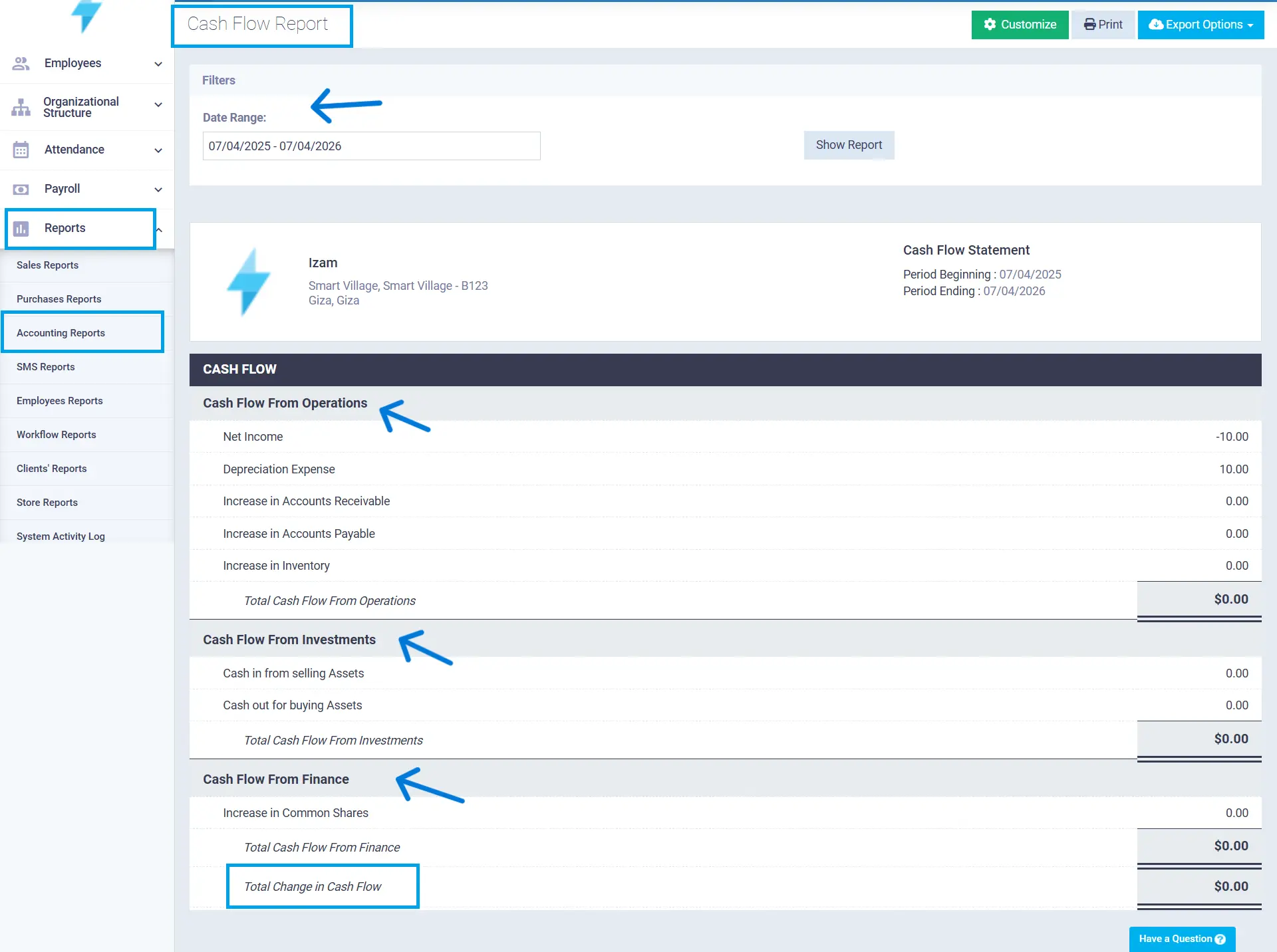
Enerpize Online Accounting Software simplifies how businesses calculate and monitor net cash flow by automating key financial processes and bringing all cash activity into one place.
Automatic Data Import
Integrates with banks and financial platforms to automatically pull transaction data, reducing manual work and improving accuracy.
Cash Flow Statements
Generates cash flow statements that clearly separate operating, investing, and financing activities, giving a complete view of liquidity.
Expense Tracking
Expenses tracking means capturing and categorizing expenses, operating costs, capital expenditures, and financing outflows to ensure all cash movements are properly accounted for.
Income & Revenue Tracking
Tracks income across different revenue streams and aligns it with actual cash inflows, helping you see how much cash the business is generating.
Real-Time Cash Flow Insights
Provides up-to-date cash flow visibility and forecasting tools, helping you anticipate shortfalls, manage liquidity, and plan ahead with confidence.
FAQs
What is the simple definition of net cash flow?
Net cash flow is the difference between total cash inflows and total cash outflows over a specific period, showing whether a business gained or lost cash.
How to Find Net Cash Flow?
To find net cash flow, you need to calculate the total cash inflows and outflows over a specific period. Using the annual net cash flow formula, you can sum all inflows and outflows for the year to determine the net change in cash for your business.
Net Cash Flow = Total Cash Inflows − Total Cash Outflows
Alternatively, you can determine it by summing up the cash flow from three main activities:
Net Cash Flow = Operating Cash Flow + Investing Cash Flow + Financing Cash Flow
Is cash flow the same as net income?
No, cash flow and net income are not the same.
Net income measures profitability and includes non-cash items such as depreciation, while cash flow tracks actual cash inflows and outflows. This is a key point in cash flow vs net income comparisons.
How to Calculate Net Cash Flow from Operating Activities?
To calculate net cash flow from operating activities, subtract cash outflows from cash inflows related to core business operations:
Net Cash Flow from Operating Activities = Cash Inflows from Operations Cash Outflows from Operations
Cash inflows include money received from customers or services, while cash outflows cover payments to suppliers, salaries, rent, and taxes.
Is net cash flow the same as profit?
No, net cash flow is not the same as profit.
What is the difference between net profit and net cash flow?
Net profit reflects earnings after all revenues and expenses are accounted for under accrual accounting, while net cash flow tracks the actual movement of cash in and out of the business.
Is net cash flow the same as NPV?
No, net cash flow is not the same as Net Present Value (NPV).
Net cash flow measures the actual cash coming in and going out of a business during a specific period. In contrast, NPV evaluates the profitability of an investment by comparing the present value of future cash inflows with its costs.
So, while net cash flow tracks cash movement, NPV is used to assess whether an investment is worth pursuing.
Is net cash flow positive or negative?
It can be either:
- Positive when inflows exceed outflows
- Negative when outflows exceed inflows
What is the difference between cash flow and net cash flow?
Cash flow refers to the inflows and outflows of cash, while net cash flow is the result after subtracting outflows from inflows.
How important is net cash flow?
It is essential for assessing liquidity, supporting decision-making, building investor and lender confidence, and enabling business growth.
Is net cash flow on the income statement?
No, it appears in the cash flow statement, not the income statement.
Is net cash flow the same as profit after tax?
No, profit after tax is part of net income, while net cash flow reflects actual cash movement.
How is net cash flow used for forecasting?
It is used to project future inflows and outflows, identify potential cash shortages, and support planning through cash flow forecasts.
Is net cash flow the same as closing balance?
No, net cash flow represents the change in cash, not the ending balance itself.
Is net cash flow the same as operating profit?
No, operating profit measures earnings from operations, while net cash flow includes all cash movements (operating, investing, and financing).
Does net cash flow include depreciation?
No, it excludes non-cash items like depreciation.
Is net cash flow the same as gross profit?
No, gross profit is revenue minus the cost of goods sold, while net cash flow tracks cash inflows and outflows.
Is higher net cash flow better?
Yes, positive (higher) net cash flow indicates better liquidity and financial flexibility.
Is net cash an asset or a liability?
Net cash flow is neither an asset nor a liability.
It is a measure of cash movement (inflows minus outflows) over a period, not something the business owns or owes. Assets and liabilities appear on the balance sheet, while net cash flow is reported in the cash flow statement as a change in cash.
Conclusion
Net cash flow is one of the clearest ways to understand how money actually moves through a business. It goes beyond accounting profit and shows whether the company can sustain its operations, meet obligations, and fund growth with real cash.
By breaking cash flow into operating, investing, and financing activities, businesses can see exactly where cash is coming from and where it’s being used. This makes it easier to spot issues early, manage short-term liquidity, and make better financial decisions.
At the same time, net cash flow works best when viewed alongside other metrics. Timing differences, large investments, or financing activities can affect the numbers in the short term. Businesses that combine cash flow analysis with proper planning, cost control, and forecasting are in a much stronger position to stay stable and grow sustainably.

Related Articles
 Accounting
Contribution Income Statement: A Comprehensive Guide
Read more Accounting
What Are Intercompany Transactions Journal Entries
Read more Accounting
POS Transaction and How It Works?
Read more Accounting
A Comprehensive Guide to Retail POS Systems
Read more Accounting
Reversing Entries Accounting: Purpose and Examples
Read more Accounting