


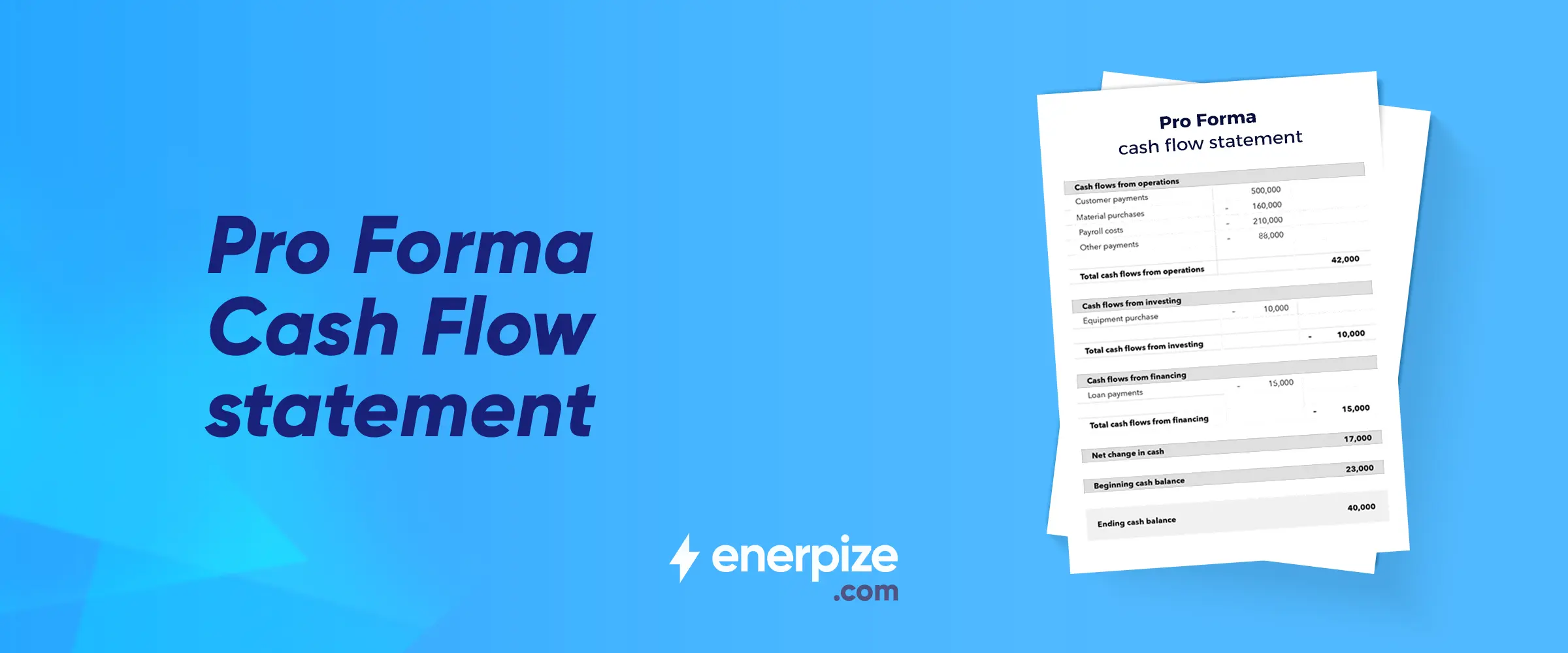


A pro forma cash flow statement is a financial tool businesses use to estimate future cash inflows and outflows. It projects the impact of various activities like operations, investments, and financing decisions.
Companies rely on this statement for budgeting, forecasting, and evaluating the financial impact of future scenarios, such as expansion or new projects.
In this article, you’ll find a clear explanation of cash flow statements, including their purpose, components, different types, and how to create one.
Key Takeaways
- A pro forma cash flow statement estimates future cash movements, useful for budgeting and decision-making.
- It is divided into operating, investing, and financing activities to show cash flow.
- Types of pro forma statements include short-term, medium-term, and long-term, each serving different planning needs.
- While helpful, pro forma statements rely on assumptions and forecasts, making them less accurate than actual financial data.
What Is A Pro Forma Cash Flow Statement?
A pro forma cash flow statement is a financial document that a business prepares to estimate future cash inflows and outflows. It projects the cash effects of operations, investing, and financing activities.
This statement is often used for budgeting, financial forecasting, and evaluating the financial impact of various business decisions or scenarios, such as new investments, expansions, or changes in operational strategies.
What are the Components of A Pro Forma Cash Flow Statement?
The pro forma cash flow statement typically includes the same core components as a regular cash flow statement, but is based on projections and assumptions rather than historical data. The main components are:
1- Operating Activities
This section projects cash flows related to the day-to-day operations of the business. It includes:
- Projected cash receipts from sales or services.
- Expected payments to suppliers and employees.
- Estimated taxes and interest payments.
- Other recurring operating expenses.
This section helps assess whether the company can generate enough cash from operations to sustain itself.
2- Investing Activities
This section outlines projected cash flows from investments in long-term assets, such as:
- Planned purchases or sales of equipment, property, or technology.
- Expected proceeds from the sale of investments.
- Anticipated capital expenditures (CapEx).
Helps identify how much the business plans to invest in future growth.
3- Financing Activities
This section estimates future cash flows related to financing the business, including:
- Expected loans or credit lines.
- Projected repayments of debt.
- Planned issuance or repurchase of equity.
- Anticipated dividend payments.
Shows how the company plans to raise or return capital.
4- Net Cash Flow
This is the sum of the three sections above:
Net Cash Flow = Cash from Operating Activities + Investing Activities + Financing Activities
It reflects the overall projected change in cash over the period.
5- Beginning and Ending Cash Balance
- Beginning Cash Balance: Estimated starting cash for the period.
- Ending Cash Balance: Projected ending cash, calculated as: Ending Cash = Beginning Cash + Net Cash Flow
How to Create A Pro Forma Cash Flow Statement?
Creating a pro forma cash flow statement involves forecasting future cash inflows and outflows based on expected business activities. To ensure accuracy and effectiveness, follow these steps:
1- Gather Financial Data
Start by reviewing historical cash flow data from previous periods. This provides a baseline for estimating future cash movements and helps identify trends.
2- Estimate Cash Inflows
Project all sources of cash coming into the business, such as sales revenue, loans, investments, and other income. Consider seasonality and business growth when forecasting these inflows.
3- Estimate Cash Outflows
Identify and estimate all potential cash expenses, including operating costs, loan repayments, capital expenditures, and other anticipated outflows. Break these down into categories to ensure thorough forecasting.
4- Determine Net Cash Flow
Calculate the net cash flow by subtracting estimated outflows from estimated inflows. This will show whether the business is projected to have a surplus or a deficit of cash.
5- Review and Adjust Assumptions
Ensure that the assumptions you’ve used in your forecasts (such as growth rates, payment terms, etc.) are realistic. Adjust if necessary to ensure they align with the business’s actual or expected conditions.
6- Prepare the Statement Format
Structure the pro forma cash flow statement into sections such as operating activities, investing activities, and financing activities. This makes it easy to track where cash is coming from and going.
7- Monitor and Update Regularly
Once the statement is created, update it regularly based on actual results and changes in business conditions to maintain an accurate view of future cash needs.
Download Now: Free pro forma cash flow statement template in Excel to use immediately!
Pro Forma Cash Flow Statement Example
The following Pro Forma Cash Flow Statement is for the quarter ending March 31, 2025:
| Category | Amount ($) |
| Operating Activities | |
| Net Income | 50,000 |
| Adjustments for Non-Cash Items: | |
| 5,000 |
| 2,000 |
| Changes in Working Capital: | |
| (10,000) |
| 8,000 |
| (7,000) |
| Net Cash from Operating Activities | 48,000 |
| Investing Activities | |
| Purchase of Equipment | (20,000) |
| Proceeds from Sale of Assets | 15,000 |
| Net Cash from Investing Activities | (5,000) |
| Financing Activities | |
| Proceeds from Loan | 30,000 |
| Repayment of Debt | (5,000) |
| Dividends Paid | (3,000) |
| Category | Amount ($) |
| Net Cash from Financing Activities | 22,000 |
| Net Change in Cash | 65,000 |
| Begining Cash Balance | 10,000 |
| Ending Cash Balance | 75,000 |
Let’s break down the calculations:
- Net Cash from Operating Activities = $50,000 + $5,000 + $2,000 - $10,000 + $8,000 - $7,000 = $48,000
- Net Cash from Investing Activities = -$20,000 + $15,000 = -$5,000
- Net Cash from Financing Activities = $30,000 - $5,000 - $3,000 = $22,000
- Net Cash Flow = $48,000 (Operating) - $5,000 (Investing) + $22,000 (Financing) = $65,000
- Beginning Cash Balance: $10,000
- Ending Cash Balance = $10,000 + $65,000 = $75,000
This example shows a clear projection of the company’s expected cash inflows and outflows for a given period, including adjustments for working capital changes and non-cash items. It provides a comprehensive view of how cash is expected to move through the business, helping guide financial decision-making.

Types of Pro Forma Cash Flow Statement
There are three main types of pro forma cash flow statements: short-term, medium-term, and long-term. Each type serves a different purpose, depending on the time horizon and level of accuracy required for financial planning.
1- Short-Term Pro Forma Cash Flow Statement
Typically covering one month or shorter periods (weekly, bi-weekly), this type focuses on managing daily operations. It ensures the business can meet immediate financial obligations like payroll, rent, and short-term debts.
The statement tracks cash inflows (sales, collections, loans) and outflows (expenses, liabilities) to ensure there’s enough cash to cover immediate costs. It is the most accurate, relying on known, near-term data with minimal uncertainty.
2- Medium-Term Pro Forma Cash Flow Statement
This statement spans from 1 to 12 months, often in quarterly or semi-annual intervals. It helps with planning for business activities, such as capital expenditures, debt servicing, and project funding.
It also forecasts changes in working capital and focuses on medium-term plans like expansion or large capital purchases. While moderately accurate, it carries some uncertainty due to external factors and assumptions about growth or market conditions.
3- Long-Term Pro Forma Cash Flow Statement
Covering periods of 1 to 5 years or more, this statement is used for long-term strategic planning. It helps forecast cash for major investments, long-term financing, and growth initiatives like new products or acquisitions.
The long-term view includes projections for significant capital investments and operational changes. It is the least accurate, as it relies heavily on assumptions and external variables, making it more speculative.
Read Also: Direct VS Indirect Cash Flow: A Comprehensive Guide
What is The Purpose of A Pro Forma Cash Flow Statement?
A pro forma cash flow statement plays a critical role in helping businesses manage their finances and plan for the future. By projecting cash inflows and outflows, it provides insights that guide decision-making and long-term strategy.
These purposes are especially important for start-up owners, as they often operate with limited resources and need a clear financial roadmap to secure funding, control spending, and ensure sustainable growth.
The purposes of a pro forma cash flow statement include:
1- Planning and Budgeting
It helps businesses plan for future cash needs by estimating when and how cash will be received and spent. This helps manage working capital and ensure that there is enough cash on hand to cover expenses and investments.
2- Forecasting
It estimates future cash flows based on expected events, such as increased sales, new investments, or the launch of new products. It helps predict the financial impact of these events on the company's cash position.
3- Decision Making
By projecting future cash flows, businesses can make more informed decisions about financing, expansion, or other strategic moves. For example, if a company anticipates a cash shortfall, it might seek a loan or adjust its plans.
4- Improving Cash Management
A pro forma cash flow statement allows management to see potential cash flow gaps in advance, enabling them to take proactive measures to avoid cash shortages or optimize cash usage.
5- Communication with Stakeholders
It is useful for communicating expected future financial conditions to external parties, such as banks, investors, or potential business partners, to help them assess the company’s financial health and prospects.
6- M&A Analysis (Mergers & Acquisitions)
In merger and acquisition scenarios, a pro forma cash flow statement helps evaluate the combined cash position of two businesses post-transaction. It allows both parties to understand the financial viability, potential synergies, and future cash flow expectations of the newly formed entity.
Read Also: Levered FCF: Formula & Calculating

How is a Pro Forma Cash Flow Statement Used in Valuation?
A pro forma cash flow statement is a key tool in business valuation because it provides forward-looking insights into a company’s expected financial performance. Here's how it's used:
1- Forecasting Future Cash Flows
Valuation methods like Discounted Cash Flow (DCF) rely on projected future cash flows. The pro forma cash flow statement provides these projections, helping analysts estimate the company's value based on how much cash it is expected to generate.
2- Assessing Financial Health
Investors and buyers use the pro forma statement to evaluate whether the business is likely to have strong and stable cash flow in the future, which affects its risk level and valuation multiple.
3- Scenario Analysis
It allows valuation professionals to test different business scenarios (e.g., launching a new product, entering a new market) and see how these would impact future cash flows — helping them adjust the valuation accordingly.
4- Supporting Investment Decisions
By showing expected returns and potential cash generation, a pro forma cash flow statement helps investors determine whether the business is a good investment opportunity at its current or projected value.
How to Calculate Pro Forma Cash from Operations?
To calculate pro forma cash from operations, you need to estimate all cash inflows and outflows related to the core operating activities of the business over a future period. Here’s how:
- Start with projected cash inflows: Estimated cash received from sales or services.
- Subtract projected cash outflows, such:
- Expected payments to suppliers.
- Wages and salaries to employees.
- Estimated tax payments.
- Interest payments (if applicable).
- Other operating expenses (e.g., rent, utilities, insurance).
- Use the following formula: Pro Forma Cash from Operations = Projected Cash Receipts from Operations − Projected Cash Payments for Operating Expenses

Pro Forma Cash Flow Statement VS Cash Flow Statement
Understanding the differences between a pro forma cash flow statement and a historical cash flow statement is essential for financial planning and analysis.
While both are tools used to track and evaluate cash movements, they serve different purposes and are based on different types of data. The table below outlines the key distinctions between them:
| Pro Forma Cash Flow Statement | Cash Flow Statement | |
| Definition | A projection or forecast of future cash flows, typically created for planning, budgeting, or financial modeling. | Based on historical data, showing the actual cash inflows and outflows that occurred during a specific period. |
| Basis | It is not based on actual historical data but on predictions and assumptions, providing a forward-looking view of the company’s cash position. | It reports real transactions from the company's operating, investing, and financing activities. |
| Purpose | Estimates how cash will flow in and out of the business based on anticipated events or assumptions, such as sales growth, new investments, or expected expenses. | Provides an accurate snapshot of how cash moved through the business in the past, helping stakeholders assess liquidity and cash flow. |
Limitations of Using Pro Forma Cash Flow Statements
While pro forma cash flow statements are useful for planning and forecasting, they have several limitations:
- Reliance on Assumptions: Pro forma statements are based on assumptions about future events, such as sales growth, expenses, or market conditions. If these assumptions prove inaccurate, the projections can be misleading and may not reflect the actual financial situation.
- Lack of Precision: Since pro forma statements rely on estimates, they are inherently less precise than actual financial statements. This can lead to discrepancies between projected and actual cash flow, which can affect decision-making.
- Inability to Predict Unexpected Events: Pro forma statements can’t account for unexpected events or changes, like economic downturns, regulatory changes, or unplanned expenses. These events can significantly impact cash flow, making the projections less reliable.
- Complexity and Time-Consuming: Creating a detailed pro forma cash flow statement requires gathering a lot of data and making numerous assumptions, which can be time-consuming and complex, especially for businesses with many variables to consider.
How can Enerpize Help in Generating Pro Forma Cash Flow Statement
Enerpize online accounting software can assist in generating a pro forma cash flow statement by providing features that streamline data entry, automate calculations, and organize financial information.
It serves as an effective software for creating pro forma cash flow statements, helping businesses save time and reduce errors in financial forecasting.
- Automated Data Collection: Enerpize can pull data from your accounting records, such as revenue, expenses, and investments, to ensure that all relevant financial information is included in the cash flow statement. This reduces manual data entry errors.
- Forecasting & Projections: Enerpize can help generate future cash flow projections by analyzing historical financial data. By using input assumptions for expected sales, operating costs, and other variables, it can automatically create a forecast for upcoming periods.
- Template Customization: Enerpize likely provides customizable templates for financial statements. This means you can adapt the layout to fit your specific business needs and incorporate any additional details that are important for your business.
- Integration with Other Financial Statements: The software can link your pro forma cash flow statement to other key financial statements (like income statements or balance sheets). This provides a more holistic view of your company's financial health.
- Real-Time Updates: As Enerpize is cloud-based, it can generate cash flow statements with up-to-date financial data. This ensures that your projections are always based on the latest available figures.
Conclusion
A pro forma cash flow statement is more than just a financial forecast — it’s a powerful planning tool. It helps businesses of all sizes anticipate cash needs, support investment decisions, and communicate clearly with stakeholders.
Though based on assumptions, pro forma statements remain essential for budgeting, forecasting, and valuation. With tools like Enerpize accounting software, the process becomes faster, more accurate, and easier to manage.
In short, mastering pro forma cash flow statements gives businesses the insight they need to grow confidently and make smart, data-driven decisions.
FAQs
What assumptions are needed to prepare a pro forma cash flow statement?
To prepare a pro forma cash flow statement, you need to make several key assumptions, including:
- Projected sales growth or revenue over the period
- Payment timelines (e.g., how quickly customers pay and how quickly the business pays suppliers)
- Expected operating expenses, such as salaries, rent, utilities, and taxes
- Capital expenditures (e.g., planned equipment or technology purchases)
- Financing activities, including loans, repayments, or investor funding
- Market conditions or industry trends that could affect cash flow
What are common mistakes when building a pro forma cash flow statement?
Common mistakes when creating a pro forma cash flow statement to avoid include:
- Overly optimistic assumptions: Assuming aggressive revenue growth or underestimating costs can lead to misleading projections.
- Ignoring seasonality or external factors: Failing to factor in slow periods, inflation, or market shifts can distort cash flow.
- Not updating regularly: Pro forma statements should be updated as real data becomes available to reflect changing conditions.
- Forgetting working capital changes: Overlooking accounts receivable, inventory, or payables can skew your operating cash flow.
- Not linking with other financial statements: A pro forma cash flow should align with the projected income statement and balance sheet.
What is the difference between a pro forma and a forecast?
While the terms are sometimes used interchangeably, there are key differences:
- A forecast is a regular projection based on expected future performance, often updated monthly or quarterly. It reflects current trends and actual performance.
- A pro forma statement is usually created for specific scenarios or decisions — like launching a new product, securing investment, or mergers & acquisitions. It’s often more scenario-driven and strategic, not just based on current trends.

Related Articles
 Accounting
GRA-Compliant Accounting Software for Ghanaian Businesses: A Practical Buying Guide
Read more Accounting
Steps to Make Journal Entries: A Comprehensive Guide
Read more Accounting
How To Read an Income Statement: A Comprehensive Guide
Read more Accounting
Cash Flow Statement: Definition & How To Read
Read more Accounting
What Is Tracking Business Expense: A Comprehensive Guide
Read more Accounting