

Posted on 5 February 2026
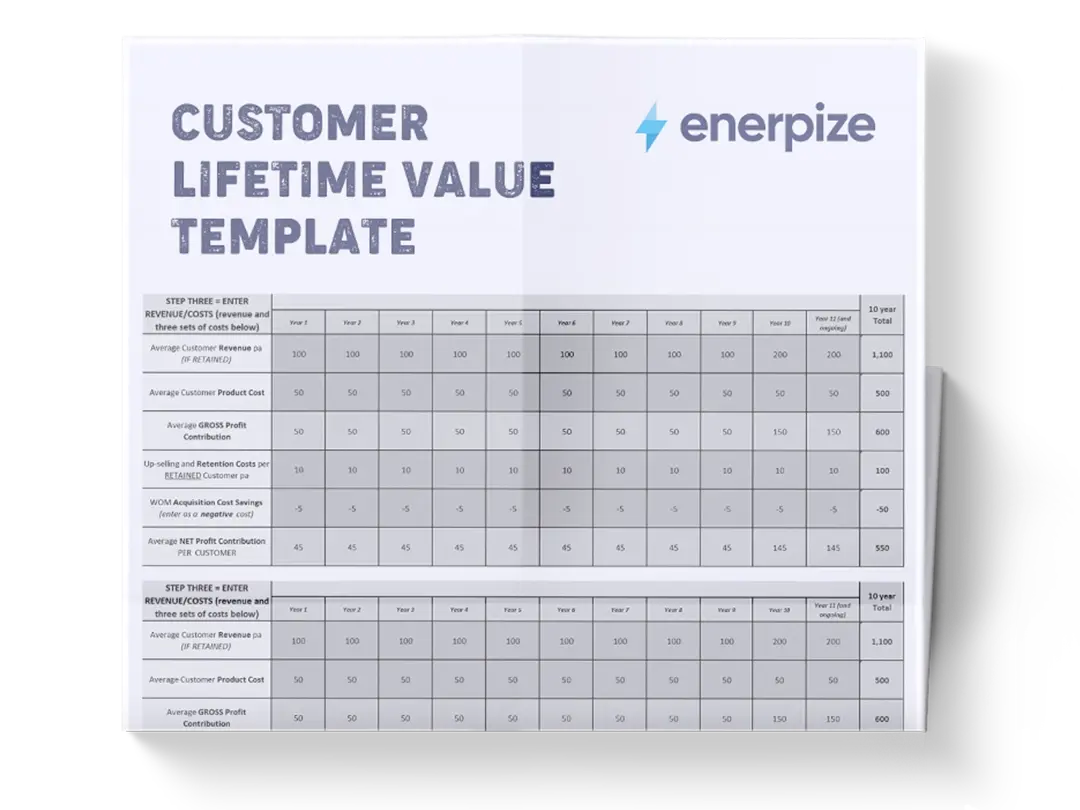
Customer Lifetime Value Template Excel & Google Sheets
- The customer lifetime value template is available in Excel and Google Sheets.
- It tracks lifetime revenue and profitability per customer.
- Optimize acquisition and retention investments.
- Forecast cash flow and growth with precision.


What Is the Customer Lifetime Value Template?
The Customer Lifetime Value CLV Template calculates the projected value that a typical customer will bring to your business over the course of their entire relationship. Instead of guessing what a customer is “worth,” this tool quantifies lifetime revenue, gross profit, acquisition cost impact, and payback timing using entered inputs like average monthly revenue, churn, and margins.
CLV is one of the most important metrics in growth strategy because it informs how much you should spend on acquiring customers, how long you retain them, and where profit comes from beyond the first purchase.
What Does the Customer Lifetime Value Template Contain?
Average Revenue Per User (ARPU) per Month
Captures the mean revenue you earn from each active customer every month. This sets the baseline from which lifetime revenue is extrapolated.
Gross Margin %
Reflects the percentage of revenue left after direct costs of service or goods sold. This figure determines how much of the revenue actually contributes to profit, which is critical in calculating profit‑based CLV.
Avg. Customer Lifespan (Months)
Projects how many months, on average, a customer is expected to remain active before churn. This directly affects total lifetime value.
Monthly Churn Rate %
Shows the percentage of customers you lose each month , a key driver of retention and thus of lifespan duration.
Customer Acquisition Cost (CAC)
Represents the average cost to acquire one new customer, including marketing, sales spend, and onboarding expenses. CAC must be weighed against CLV for profitability.
Gross Profit per Customer per Month
Derived by applying gross margin to ARPU. It reflects how much profit each active customer generates for you every month.
Customer Lifetime Value (CLV)
The core output of the template: the total gross profit expected from a customer over their lifecycle, before accounting for CAC.
Net CLV (After CAC)
Subtracts CAC from overall CLV to show net profit contribution per customer , a crucial decision metric for growth investment.
CLV : CAC Ratio
Shows how many dollars of value you receive for each dollar spent on acquisition. Ratios above industry benchmarks indicate efficient growth.
Payback Period (Months)
Measures how many months it takes to recoup CAC from the gross profit generated by customers, vital for cash‑flow planning.
How to Use the Customer Lifetime Value Template
1- Enter Base Revenue Metrics
Begin with Average Revenue Per User (ARPU) per Month. This should reflect actual realized revenue and be updated monthly. If you have tiered pricing, calculate a weighted average based on active customers in each tier.
Next, fill in your Gross Margin %. Be precise: exclude fixed overhead allocations at this stage. Use only the direct cost of goods sold or service costs tied to delivering product value.
2- Input Retention Indicators
Add your Avg. Customer Lifespan (Months). If you don’t already calculate this, derive it from churn (e.g., 1 / churn rate). Then enter your Monthly Churn Rate % , the percentage of customers you lose in an average month.
3- Add Acquisition Cost
Enter CAC reflecting all acquisition spend divided by total new customers in the period. Include marketing, sales activities, onboarding labor, and promotions that directly contribute to acquisition.
4- Auto-Calculate Profit Patterns
The template uses ARPU and gross margin to compute Gross Profit per Customer per Month. This tells you how much profit you make on average per customer each month.
5- Compute CLV
The template multiplies the monthly gross profit by the average lifespan to calculate Customer Lifetime Value (CLV). This figure shows the total predicted gross profit from the average customer.
6- Adjust for CAC
Subtract CAC from CLV to get Net CLV (After CAC). This ensures you’re evaluating customer value after acquisition expenses , the number that should align with profitability goals.
7- Evaluate Growth Efficiency Metrics
Review the CLV: CAC Ratio. A widely cited benchmark across SaaS and subscription businesses is ~3:1, meaning you generate three dollars in lifetime value for every dollar spent on acquisition. Above this, you have go‑to‑market leverage; below this, growth may be unsustainable.
Next, check Payback Period (Months). This tells you how quickly you recover your CAC, a shorter payback period is vital for cash flow management, especially in early‑stage companies.
8- Interpret and Iterate
Use the derived values to test strategies. For example:
- If churn drops by 1% monthly in retention experiments, what’s the impact on CLV?
- If CAC rises due to competitive bidding on ads, does the CLV: CAC ratio stay within acceptable limits?
- If ARPU increases through upselling, how fast is payback on CAC?
Always refresh inputs monthly or quarterly to maintain accuracy.
Related Template
Importance of a Customer Lifetime Value Template
Aligns acquisition spending with long‑term profitability
A CLV template quantifies the total expected value a customer will produce, enabling marketers and financial teams to set CAC budgets that ensure returns , not just initial purchases. Without this, companies often overspend on acquisition channels that produce short‑term sign‑ups but no lasting revenue. With a CLV framework, spend decisions become anchored in profitability forecasts, preventing cash burn. This is particularly critical during growth phases when pressure to scale can overshadow sustainable unit economics.
Improves retention strategy with tangible ROI signals
By linking churn directly into lifetime calculations, the template makes retention a measurable KPI with dollar value implications. Teams can run experiments to reduce monthly churn and see the impact on CLV, rather than guess whether retention efforts are “helpful.” This turns retention into a revenue engine, not just a customer service objective. Over time, small improvements in churn compound into large increases in lifetime profitability.
Supports smarter customer segmentation & pricing decisions
Rather than treating all customers equally, the template can be duplicated for different cohorts, such as by acquisition channel, geography, or pricing tier. This reveals which segments deliver the highest CLV relative to CAC. You can adjust pricing or invest more heavily in high‑value cohorts while rethinking acquisition for lower‑value ones. This level of insight transforms pricing and product positioning from art into data‑driven strategy.
Enhances forecasting and investor confidence
Financial planning based on CLV provides more accurate future revenue estimates than simple new customer counts or first purchase totals. Investors and leadership teams want models they can trust, where assumptions on retention and spending directly link to forecasted cash flows. A robust CLV template demonstrates discipline and clarity in growth planning , an asset in budgeting cycles and fundraising rounds.
Who Can Use a Customer Lifetime Value Template?
Growth Marketers & Performance Teams
Marketers who manage acquisition channels benefit immediately because they can set realistic CAC targets that align with long‑term revenue, not just lead volumes. A CLV template quantifies the return on different campaigns by connecting campaign costs, churn, and average revenue directly.
Subscription & SaaS Product Leaders
In products where recurring revenue matters most, small improvements in churn or ARPU have outsized effects on lifetime revenue. These teams need precise lifetime calculations to prioritize product roadmap investments that retain users longer, increasing value per customer.
Financial Planning & Strategy Teams
Analysts responsible for budgeting and long‑range planning need metrics that tie customer behavior to revenue streams. The template feeds into cash‑flow models, unit economics dashboards, and investor decks by providing data‑backed predictions of future value.
E‑commerce & Retention Managers
Shops with repeat purchase behavior can use the template to understand whether loyalty programs, personalization, and post‑purchase engagement actually increase lifetime value. This helps justify investments in retention org initiatives with quantifiable results.
Looking for Beyond Just CLV in a Spreadsheet?
While this CLV template helps you quantify customer value and assess acquisition efficiency, businesses often need more advanced capabilities. That’s where Enerpize, our all‑in‑one ERP platform, comes in.
With Enerpize Online CRM Software, you can:
- Combine CLV with real‑time customer data, financials, and forecasting across teams
- Automate customer segmentation, retention analytics, and cross‑channel reporting
- Integrate marketing performance with operations, finance, and product strategy
If you’re ready to move beyond spreadsheets, Enerpize brings enterprise‑grade control to growing teams.