


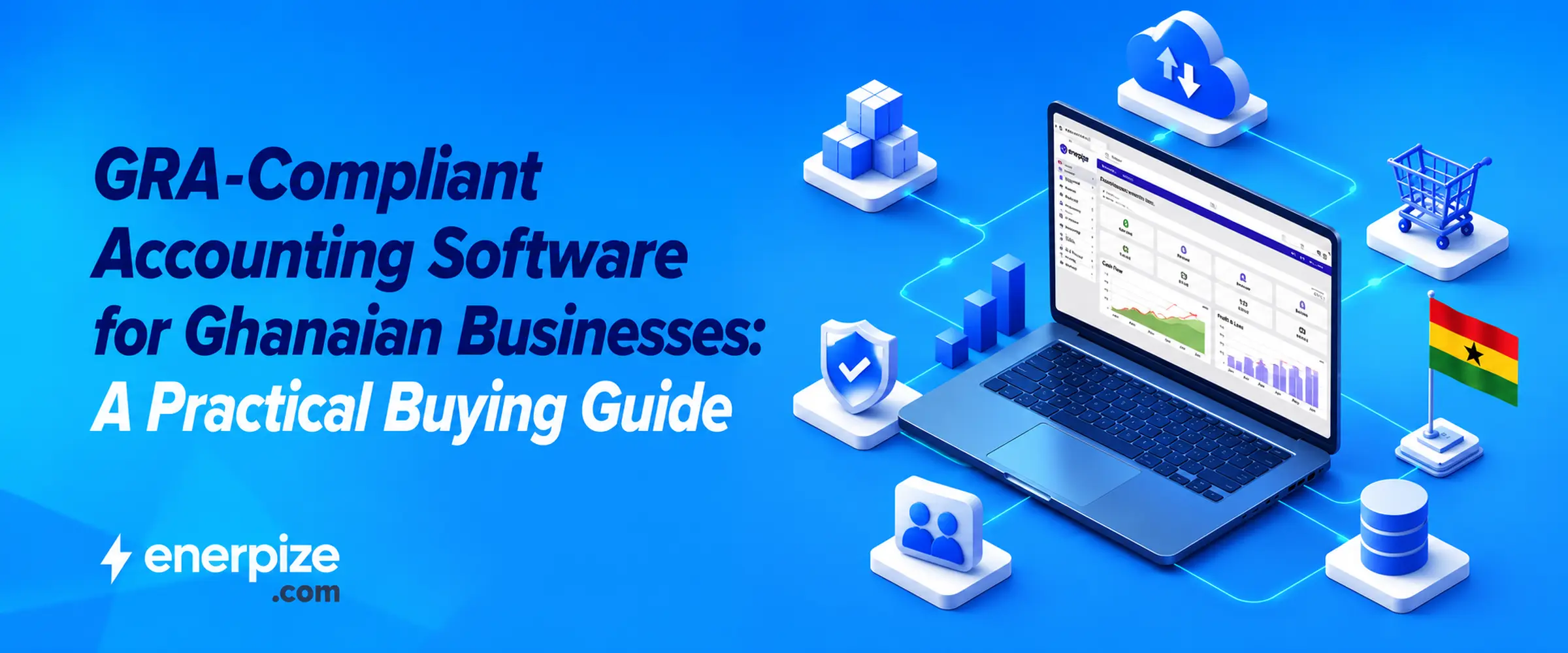
GRA-Compliant Accounting Software for Ghanaian Businesses: A Practical Buying Guide


Key Takeaways
- Ghana's VAT Act 1151 took effect on 1 January 2026 and replaced the old 21.9 percent cascading structure with a unified 20 percent rate.
- NHIL and GETFund are now deductible as input tax for the first time, which changes what your accounting software needs to track.
- The VAT registration threshold for goods businesses jumped from GH₵200,000 to GH₵750,000, and the VAT Flat Rate Scheme has been abolished.
- E-VAT requires invoices to be cleared through the GRA's Virtual Sales Data Controller, and records must be kept for six years.
- Enerpize supports the tax setup, chart of accounts, expense tracking, asset management, and cost tracking structure a growing Ghanaian business needs under the new rules.
Walk into any accountant's office in Accra right now and ask what changed on the first of January. You will get a longer answer than you expect. Ghana's VAT system did not get a small update this year. It got rebuilt from the base up.
If you are still running your books the way you did in 2025, on the old 21.9 percent structure with four separate levies stacked on top of each other, your numbers are already wrong. Not wrong because you made a mistake. Wrong because the rules underneath you changed and nobody sent a memo loud enough to reach every shop in Kantamanto or every service business in Osu.
This guide walks through what actually changed under the new VAT Act, what accounting software Ghana businesses can rely on needs to do differently now, and how to think about buying the right tool instead of the one your competitor happens to use.
Stop reconciling your books against rules that changed three months ago. See how Enerpize handles Ghana's new VAT structure. Start for Free
What Changed Under Ghana's New VAT Act (Act 1151) in 2026
This is the section most software vendors in Ghana still get wrong, and it matters more this year than any other.
The Old System vs the New 20 Percent Rate
Before January 2026, Ghana's effective tax rate on most goods and services sat around 21.9 percent. VAT at 15 percent, NHIL at 2.5 percent, GETFund at 2.5 percent, and a COVID-19 Health Recovery Levy at 1 percent, all stacked cumulatively so each levy added cost before the next was calculated. None of it was deductible. It just sat on top of your price like dead weight.
The Value Added Tax Act, 2025 (Act 1151) changed that from the ground up. The COVID levy is gone entirely. VAT, NHIL, and GETFund are now all calculated on the same base rather than cascading on top of each other, bringing the effective rate down to 20 percent. That is a real reduction, and the Ministry of Finance has said the change alone returns close to 3.7 billion cedis to households and businesses in 2026.
Why NHIL and GETFund Becoming Deductible Actually Matters
Here is the part that changes how you should be thinking about vat accounting software ghana businesses buy. Under the old rules, NHIL and GETFund were non-deductible straight levies. You paid them and that was the end of it. Under Act 1151, both levies are now creditable as input tax, meaning a VAT-registered business can claim them back against output tax, the same way input VAT has always worked.
That sounds like a small technical shift. It is not. If your accounting software cannot separate VAT, NHIL, and GETFund into distinct, trackable lines, you cannot claim what you are legally entitled to claim. You are leaving money on the table every single month because your software was built for the old system.
The VAT Registration Threshold Jump to GH₵750,000
The other major change is who even needs to register. The threshold for businesses supplying goods rose from GH₵200,000 to GH₵750,000 in annual taxable turnover. Service providers remain registrable regardless of turnover, so this relief mostly benefits goods-based SMEs who were previously caught in the VAT net at a much lower revenue level. The VAT Flat Rate Scheme, the old 3 percent option many small retailers used, has also been abolished. If your business was on the Flat Rate Scheme, you are now required to migrate to the standard rate.
What GRA-Compliant Accounting Software Actually Needs to Do
Getting the rate right is only half the job. GRA compliant accounting software needs to handle the full mechanics of how Ghana now processes tax invoices.
Connecting to the E-VAT Virtual Sales Data Controller
Ghana's E-VAT system works as a clearance model. Every invoice from a VAT-registered business has to be transmitted to the GRA's Virtual Sales Data Controller, or VSDC, for validation before it can legally be issued to a customer. The GRA stamps each cleared invoice with a timestamp, a unique invoice ID, and a QR code. An invoice that never gets cleared through the VSDC is not a valid tax document, no matter how professional it looks.
Handling Offline Sales Without Breaking Compliance
Ghana's connectivity is not always reliable, and the GRA built that reality into the system. For offline moments, an invoice can be stamped locally at the point of sale and then transmitted to the GRA within 24 hours once the connection returns. Software that cannot queue invoices offline and sync them automatically once you are back online puts you at genuine compliance risk every time the network drops.
Getting the Invoice Format Right
A compliant invoice under the new rules needs VAT, NHIL, and GETFund broken out as separate, clearly labeled lines rather than folded into one number. Invoicing software for small business Ghana owners choose needs to produce this format automatically. Manually splitting three tax lines by hand on every single invoice is exactly the kind of task that leads to errors, and errors on a VAT invoice are what trigger a closer look from GRA auditors.
See how Enerpize handles VAT, NHIL, and GETFund as separate, trackable lines on every invoice. Start for Free
Ghana Tax Rates and Filing Obligations at a Glance
Before comparing software, it helps to have the actual numbers in one place.
| Tax | Rate | Notes |
|---|---|---|
| VAT | 15% | Standard rate under Act 1151 |
| NHIL | 2.5% | Now deductible as input tax |
| GETFund Levy | 2.5% | Now deductible as input tax |
| Effective combined rate | 20% | Down from approximately 21.9% |
| COVID-19 Health Recovery Levy | Abolished | Repealed under the COVID-19 Health Recovery Levy Repeal Act, 2025 |
| VAT registration threshold (goods) | GH₵750,000 | Up from GH₵200,000 |
| VAT registration threshold (services) | No threshold | Registrable regardless of turnover |
| Record retention | 6 years | Digital records accepted and expected |
Filing itself has not gotten any lighter. VAT returns are generally due monthly, and under the Revenue Administration Act, 2016 (Act 915), late filing carries a penalty of GH₵500 plus GH₵10 for every day the return remains outstanding. Failing to register when you are required to can attract a penalty of up to two times the VAT that should have been paid. Non-issuance of a proper VAT invoice is treated as a criminal offense, not just an administrative slip.
Accounting Software vs Invoicing Software vs Full ERP: What Ghanaian Businesses Actually Need
Not every business needs the same tool, and this is where a lot of buying decisions in Ghana go wrong.
A pure invoicing app is fine if all you need is to send a professional bill and get paid. It will not help you track NHIL and GETFund as input credits, manage stock, or produce a proper profit and loss statement. Accounting software for small business Ghana owners actually need goes a step further, handling the full bookkeeping cycle, tax lines, and financial reporting in one place.
For a retailer or a business carrying physical stock, accounting software alone is still not the whole picture. Inventory management software Ghana retailers rely on separately from their books creates the same reconciliation gap you would see anywhere else. Stock sits in one system, the accounting sits in another, and someone has to manually match the two every month. An integrated platform that combines accounting and inventory removes that gap entirely, since a sale updates both the stock count and the ledger from the same action.
Record Keeping, Penalties, and What Happens If You Get This Wrong
The GRA expects VAT records, including invoices, credit notes, and supporting documentation, to be kept for a minimum of six years. Digital records are not just accepted, they are the practical expectation now that E-VAT runs through a certified system.
GRA returns software Ghana businesses use needs to produce clean, exportable records for exactly this reason. If a GRA auditor asks for six years of invoices and your business has a mix of paper booklets, WhatsApp screenshots, and a spreadsheet someone stopped updating in March, that audit is going to take a long time and go badly. If you can open a dashboard and hand over organized, timestamped digital records, it goes considerably faster and with far less exposure.
The GRA has also made clear that this is not just about paperwork. Under sections 78 and 82 of the Revenue Administration Act, failing to issue a proper VAT invoice is a criminal offense, not a fine you can quietly absorb. That is a serious escalation from how many small business owners in Ghana still think about tax compliance.
Tax Setup That Handles Ghana's New 20 Percent Structure
This is where the right software earns its keep. Enerpize's accounting software supports multiple automatic tax settings, with custom tax names, rates, and codes rather than one blended tax figure. For a Ghanaian business, that means VAT at 15 percent, NHIL at 2.5 percent, and GETFund at 2.5 percent can each be configured as their own distinct rate, calculated on the same base the way Act 1151 now requires, and shown as separate lines on every invoice.
That structural setup, three distinct tax rates calculated correctly on the same base, is the foundation any accounting software in Ghana businesses adopt needs before anything else about compliance can work. It is separate from GRA's own E-VAT clearance system, which handles the actual submission and validation of each invoice.
A Chart of Accounts Built for Input Tax Tracking
Since NHIL and GETFund are now deductible as input tax, a business needs its books to actually separate and track those credits rather than burying them inside a general expense line. Enerpize's chart of accounts is automated and fully customizable, with main and sub accounts that mirror directly into a general ledger. That means a Ghanaian business can set up dedicated accounts for NHIL input credit and GETFund input credit specifically, instead of guessing at the number when it comes time to file.
Expense Tracking That Keeps You Ready for a GRA Audit
Record retention under Act 1151 is six years, and the businesses that struggle during a GRA audit are almost always the ones with disorganized paper trails. Enerpize's expense management tools let you scan receipts on the go, with AI-powered extraction that pulls amount, date, vendor, and tax details automatically instead of requiring manual entry for every single expense. Every record carries an audit trail, which is exactly what a GRA auditor wants to see when they ask a business to justify six years of input tax claims.
Fixed Asset Management for Growing Ghanaian Businesses
Once a business crosses the new GH₵750,000 threshold and formalizes its books, fixed assets stop being an afterthought. Enerpize's asset management module tracks every asset from purchase through disposal, using GAAP-compliant depreciation methods including straight-line, declining balance, and units of production. For a growing Ghanaian business now facing more scrutiny on its financial statements, having a proper asset register with an accurate depreciation schedule is no longer optional, it is part of being taken seriously by a bank, an auditor, or the GRA itself.
Cost Centers for Tracking Profitability by Department or Branch
For any Ghanaian business running more than one branch, or splitting operations across departments, knowing where the profit actually comes from matters more now that input credits flow differently than they did a year ago. Enerpize's cost center tools let you assign income, expenses, and journal entries to specific departments or locations automatically, so a business owner can see which branch or product line is actually carrying the company rather than guessing from a single blended number.
Run your accounting, invoicing, and tax setup from one platform built around how Ghanaian businesses actually operate. Start for Free
FAQs
Is my business required to register for VAT in Ghana?
If you supply goods and your annual taxable turnover exceeds GH₵750,000, registration is compulsory under Act 1151. If you supply services, you are generally required to register regardless of turnover, unless specifically exempted. Businesses below the goods threshold can still register voluntarily.
What is GRA-compliant accounting software?
GRA compliant accounting software is a system that can correctly apply Ghana's current tax structure, VAT at 15 percent, NHIL at 2.5 percent, and GETFund at 2.5 percent as separate, deductible lines, and produce invoices formatted the way the GRA now requires under the E-VAT system.
Do I need E-VAT integration if I'm a small business?
If you are VAT-registered, E-VAT applies to you regardless of size. The GRA has been onboarding businesses in phases since 2022, and by 2026 the expectation is that all VAT-registered taxpayers issue invoices through a Certified Invoicing System connected to the VSDC.
What happens if I don't issue a proper VAT invoice?
Non-issuance of a VAT invoice is treated as a criminal offense under the Revenue Administration Act, with penalties that can include fines and potential imprisonment. Beyond the legal risk, missing or incorrectly formatted invoices also mean you cannot claim input tax credits you are otherwise entitled to.
How much does GRA-compliant accounting software cost in Ghana?
Enerpize's plans start from $9.99 a month, with accounting, invoicing, inventory, HR, and CRM included rather than sold as separate add-ons. A 14-day free trial with no credit card required gives a Ghanaian business enough time to see how the tax setup actually performs against real transactions before committing.
About the Author
Omar El Bahr is a Senior Digital Growth Specialist at Enerpize, where he leads SEO, content strategy, and organic growth across international markets. He is a Forbes Communications Council contributor and has written for Entrepreneur on business communication and digital strategy.
Disclaimer: This article reflects Ghana's VAT Act 1151, GRA E-VAT requirements, and related tax facts accurate at the time of writing. Tax law changes. Confirm your current obligations directly with the GRA or a registered Ghanaian tax practitioner before making business or compliance decisions.

Related Articles
 Accounting
Main Differences Between Income Statement and Balance Sheet
Read more Accounting
What Is Accrued Liability for Small Business: A Detailed Guide
Read more Accounting
Error of Commission: Definition, Examples, and How To Avoid
Read more Accounting
Pro Forma Cash Flow Statement: A Comprehensive Guide
Read more Accounting
What Is A Profit And Loss Statement In Business: A Complete Guide
Read more Accounting