

Posted on 28 April 2026
EBITDA Template Excel & Sheets
- The EBITDA template is available in Excel and Google Sheets.
- It consolidates income statement and cash flow data into a structured format, making it easier to isolate operational performance without the distortion of financing or tax factors.
- Helps users understand how reported profits translate into actual liquidity.
- Businesses can interpret performance trends, compare periods, and improve forecasting accuracy.


What is the EBITDA Template?
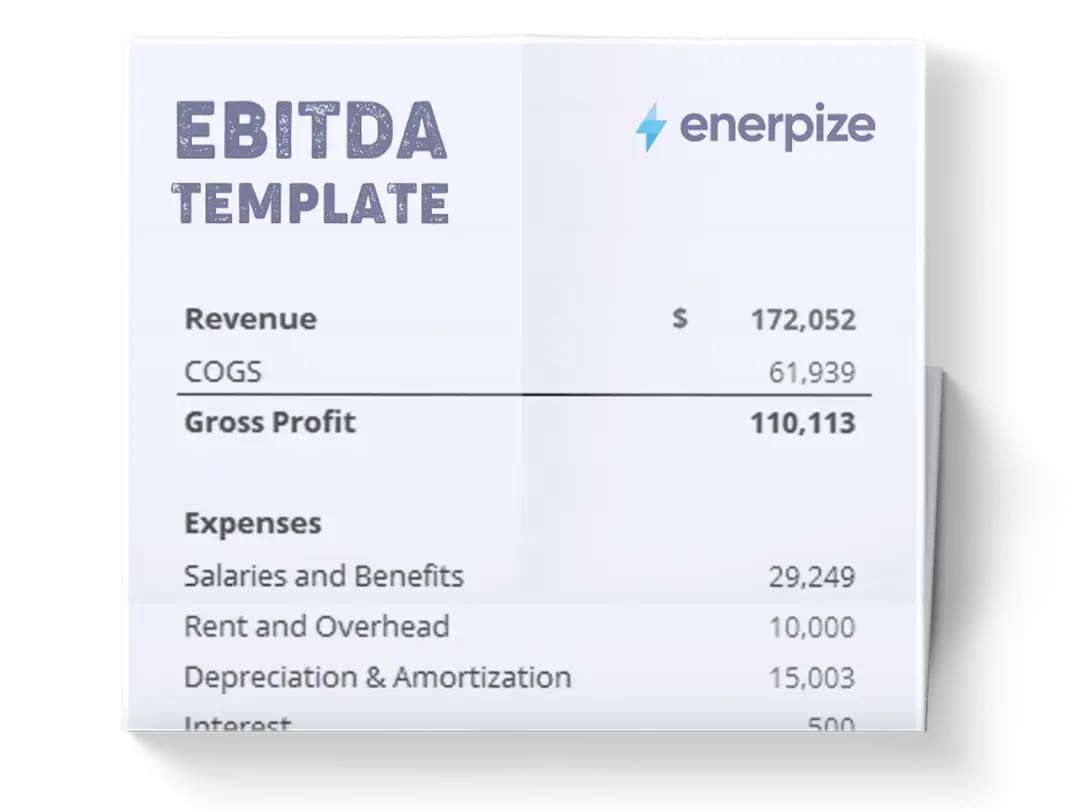
An EBITDA Template measures a company's operating profitability by isolating earnings before interest, taxes, depreciation, and amortization. It is built primarily on top of the income statement and cash flow statement to help users understand how much profit a business generates from its core operations, without the influence of financing decisions, tax structures, or non-cash accounting adjustments. This makes it especially useful for evaluating operational efficiency and comparing performance across companies or time periods.
What Does The EBITDA Template Contain?
Income Statement
The Income Statement section captures the business’s profitability over a defined period. It includes revenue, cost of goods sold, gross profit, operating expenses, operating profit, interest expense, earnings before taxes, tax expense, net income, and EBITDA. Each line represents a progressive breakdown of revenue into increasingly refined profitability measures, ending in net income and EBITDA for operational evaluation.
Cash Flow Statement
The Cash Flow Statement section translates accounting profit into actual cash movement. It includes cash from operating activities (net earnings, depreciation and amortization, working capital adjustments, and total operating cash flow), cash from investing activities (such as investments in property, equipment, or businesses), and cash from financing activities (including debt repayment, equity issuance, and dividends). It concludes with net cash movement and closing cash balance.
How to Use The EBITDA Template
1- Start with the Income Statement Data
Begin by entering revenue and subtracting the cost of goods sold to calculate gross profit. From there, input operating expenses to determine operating profit. Continue down the structure by adding interest expense, tax expense, and finally net income. This forms the foundation of the EBITDA calculation.
2- Calculate EBITDA from Core Operating Data
Once operating profit and net income are established, add back non-cash and non-operational expenses such as depreciation and amortization. This step isolates true operational profitability, removing financial structure and accounting adjustments that may distort performance.
3- Populate the Cash Flow Statement
Transfer net earnings into the operating activities section. Then adjust for depreciation, amortization, and changes in working capital. After that, record investing activities like asset purchases or investments, followed by financing activities such as debt repayment or dividends. This connects accounting profit to actual liquidity.
4- Reconcile EBITDA with Cash Position
Compare EBITDA results with cash from operations to assess how efficiently profit converts into cash. Differences between the two often highlight working capital inefficiencies or timing gaps in revenue collection and expense recognition.
5- Finalize Net Cash Position
Complete the template by calculating the net cash increase or decrease. Add this to the opening cash balance to determine the closing cash balance, ensuring full financial cycle visibility from profit generation to liquidity position.
Related Templates
Importance of EBITDA Template
Isolates true operational performance
By removing interest, taxes, depreciation, and amortization, the EBITDA Template allows businesses to focus strictly on operational profitability. This is critical because net income alone can be heavily influenced by financing decisions or accounting policies that do not reflect day-to-day business performance. With EBITDA, companies gain a clearer view of how efficiently their core operations generate profit. This helps leadership identify whether performance issues are operational or financial in nature. As a result, decision-makers can take more targeted corrective actions.
Improves financial comparison across companies and periods
Different companies often operate under different tax regimes, capital structures, and depreciation methods, making direct comparison difficult. The EBITDA Template standardizes profitability by stripping away these variables. This enables investors, analysts, and managers to compare performance across competitors or historical periods more fairly. It is especially useful in mergers, acquisitions, and valuation scenarios. The consistency it provides makes financial benchmarking significantly more reliable and actionable.
Strengthens investment and valuation decisions
Investors frequently rely on EBITDA as a key indicator of a company’s earning potential. The template helps present this metric in a structured and transparent way, making it easier to assess business viability. It highlights whether a company can generate sufficient earnings from operations to support growth, debt obligations, or expansion. This clarity reduces uncertainty in valuation models and investment analysis. Ultimately, it improves confidence in financial decision-making at both internal and external levels.
Enhances cash flow understanding and financial control
Many businesses report profits but struggle with cash shortages due to timing differences in payments and expenses. The EBITDA Template bridges this gap by linking profitability with cash flow statements. It helps users identify whether earnings are converting into actual cash or being absorbed by working capital cycles. This insight is crucial for managing liquidity, planning investments, and avoiding cash flow crises. It ensures businesses remain financially stable even during periods of growth or operational expansion.
Who Can Use the EBITDA Template?
Financial analysts and investment professionals
Financial analysts rely heavily on EBITDA to evaluate company performance and compare investment opportunities. The template provides a structured way to break down earnings and understand operational efficiency without accounting distortions. This helps analysts build more accurate valuation models and investment recommendations. It also supports deeper trend analysis across industries and competitors. For professionals dealing with large financial datasets, the template simplifies complex interpretation into a clear operational benchmark.
Business owners and startup founders
For founders and business owners, understanding profitability beyond net income is essential for growth planning. The EBITDA Template helps them see whether their core business model is actually profitable before financial and tax effects. This is especially important for startups managing tight cash flow and scaling operations. It highlights whether growth is sustainable or masking operational inefficiencies. By using the template, founders can make more informed strategic decisions about hiring, expansion, and pricing.
Finance managers and controllers
Finance managers use the EBITDA Template to monitor internal performance and support executive reporting. It helps them track operational profitability while reconciling financial statements with cash flow realities. This ensures more accurate budgeting, forecasting, and variance analysis. Controllers benefit from its structured format when preparing monthly or quarterly reports. It also improves communication between accounting teams and leadership by providing a consistent financial narrative.
Accountants and auditors
Accountants and auditors use the template to validate financial data and ensure reporting accuracy. EBITDA calculations help verify that operational figures align with accounting records and supporting documents. The structured breakdown makes it easier to trace discrepancies and ensure compliance with financial reporting standards. Auditors also use it to assess whether financial statements fairly represent business performance. This improves transparency and reduces the risk of reporting errors or misinterpretation.
Looking for More Than Just EBITDA Tracking?
While this EBITDA Template helps you isolate operational profitability and understand core business performance, growing companies often need deeper automation, integrated reporting, and real-time financial control. That’s where Enerpize, our all-in-one ERP platform, comes in.
With Enerpize online accounting software, you can:
- Automatically generate income statements and profit & loss reports aligned with your EBITDA analysis, reducing manual financial consolidation.
- Manage income, expenses, and cost centers in one unified cloud accounting system for more accurate and scalable financial tracking.
- Integrate accounting, inventory, HR, and CRM modules to connect financial performance with real business operations.
If you’re ready to move beyond spreadsheets, Enerpize brings enterprise-grade control to growing teams with automated accounting, real-time reporting, and fully integrated financial systems.