

Posted on 7 July 2026
Free Therapy Invoice Template Download: Excel, Word, PDF & Google Sheets and Docs
- Available in Word, Excel, PDF, Google Docs, and Google Sheets, free to download with no sign up required.
- Covers session fees, sliding scale adjustments, insurance reimbursement, CPT codes, and cancellation charges in one structured document.
- Built with country specific fields for US NPI numbers, UK HMRC recordkeeping, Australian GST, and South African VAT in one template.
- Calculates subtotal, sliding scale adjustment, insurance reimbursement, and balance due automatically in Excel and Google Sheets.
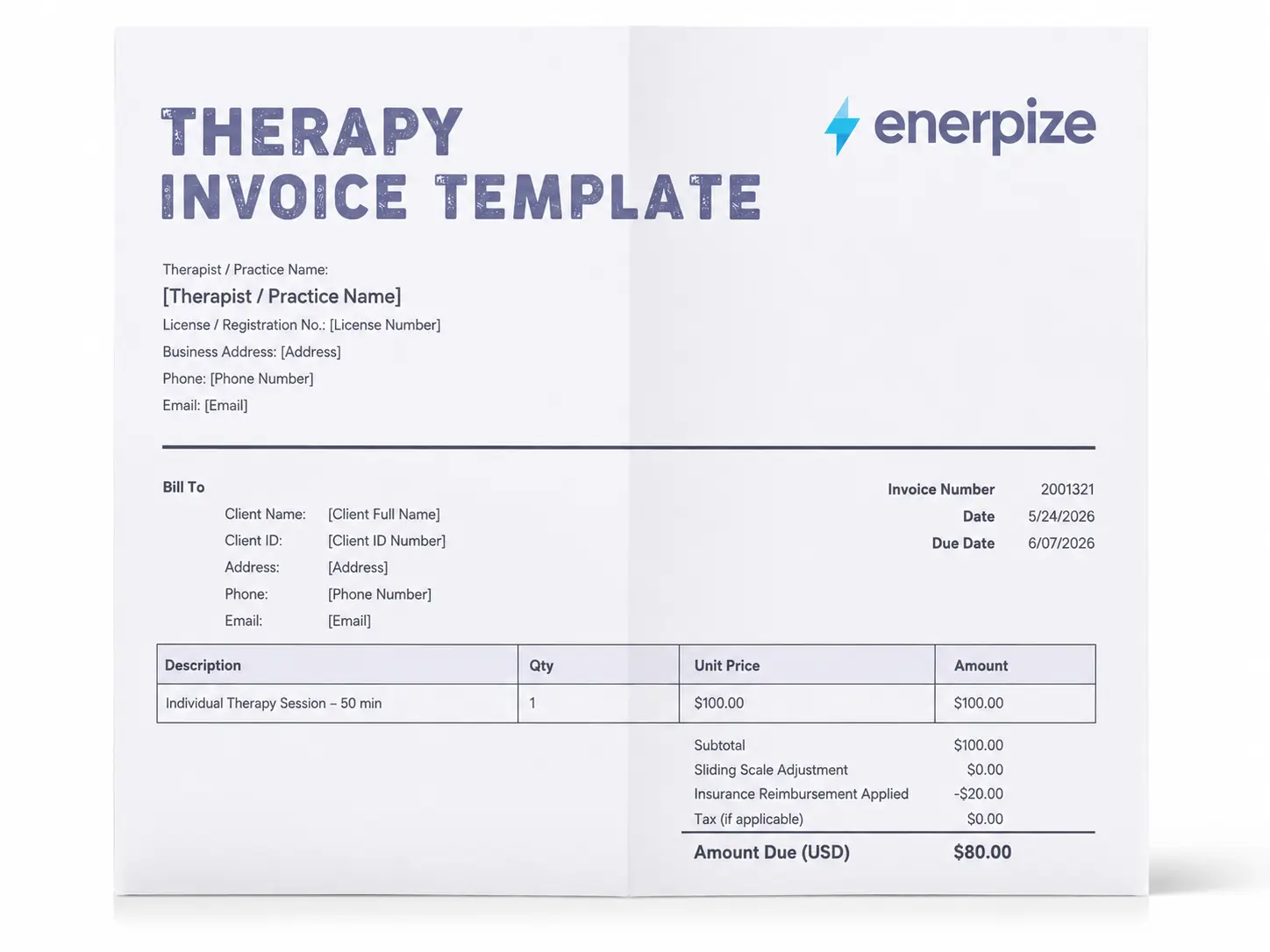
A therapy invoice template is a pre formatted billing document that records session details, fees charged, and payments applied, giving both the therapist and the client a clear record of every session.


What Is a Therapy Invoice?
Picture the end of a Tuesday session. Your client just spent fifty minutes working through something hard. The last thing either of you wants right now is a conversation about money. That is exactly why a proper invoice exists. It does the talking so you do not have to.
A therapy invoice is the document that turns a session into a paid, recorded transaction. It states what happened, when it happened, what it cost, and what the client owes after any insurance or sliding scale adjustment. Nothing more. It is not a clinical record. It is not a treatment summary. It is a billing document, and the moment you start treating it like anything else, you have created a privacy problem you did not need. If you are billing for a broader range of health services beyond therapy sessions, our medical invoice template covers that wider use case.
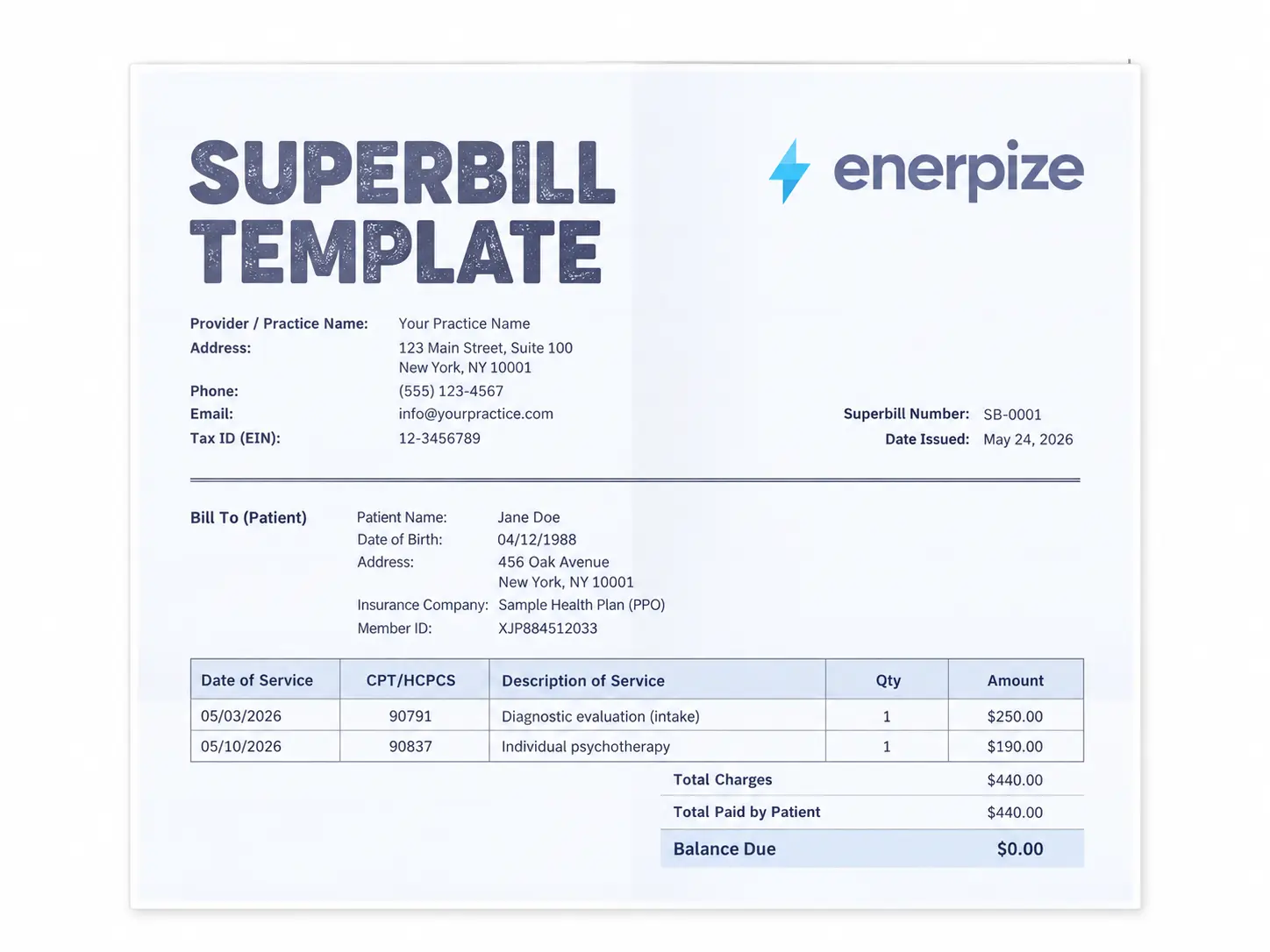
Here is the distinction that trips up almost every new practitioner. A superbill and an invoice are not the same thing, even though they often get used interchangeably. An invoice is what you hand your client for the session they just had. A superbill is a more detailed version built specifically so a client can submit it to their insurer for out of network reimbursement, and it usually carries CPT codes and a diagnosis code that a standard invoice does not need. Confusing the two is how therapists end up disclosing more than a client agreed to, or less than an insurer requires.
Want invoices that generate automatically after every session? Start for free.
Therapy Invoice vs. Superbill vs. Receipt
Three documents, three jobs, and most competitor templates online blur all three into one form. Here is where each one actually stands.
| Document | Purpose | Includes CPT/Diagnosis Codes? | Used For Insurance? | Issued When |
|---|---|---|---|---|
| Therapy Invoice | Requests payment for a session | Optional | Sometimes | After or before each session |
| Superbill | Supports client's own insurance claim | Yes, typically | Yes, client submits it | On request, usually monthly |
| Receipt | Confirms payment already received | No | No | After payment clears |
The rule is simple. An invoice asks for money. A receipt confirms money arrived. A superbill helps your client get some of that money back from their insurer. Do not make one document try to do all three jobs at once. If your client just needs proof of payment already made, our receipt template is the right document instead.
What to Include in a Therapy Invoice Template
Most free templates floating around online give you a name field, a date, and a total. That covers you for exactly one session with one client who never asks a question. The moment you run a real practice, with sliding scale clients, insurance submissions, and the occasional late cancellation, you need more structure than that.
The Fields a Complete Therapy Invoice Needs
| Field | Why It Matters |
|---|---|
| Invoice Number | Sequential reference for your own records and for the client's |
| Invoice Date and Due Date | Separates when the bill was issued from when payment is expected |
| Session Date | The actual date of service, not the billing date |
| Session Duration | Fifty minutes and ninety minutes are not the same charge |
| CPT or Service Code | Needed if the client will submit for reimbursement |
| Practitioner License Number and NPI | Establishes you as a credentialed provider |
| Client ID | Useful for recurring clients without exposing full case history |
| Insurance Provider and Policy Number | Only if the client is billing through insurance |
| Sliding Scale Adjustment | Shows the standard rate and the reduction, not just a lower number with no explanation |
| Insurance Reimbursement Applied | What the payer covered, separate from what the client owes |
| Cancellation Fee Policy | Stated once, applied consistently |
| Payment Method and Terms | How and when you expect to be paid |
The two fields almost every free template skips entirely are the sliding scale adjustment and the insurance reimbursement applied as their own line items. Most templates just show one final number. That is fine until a client asks why their bill changed from last month, and you have no line item to point to.
What NOT to Include on a Therapy Invoice
This is the section nobody else writes, and it is the one that matters most if you are trying to protect your client rather than just get paid.
An invoice is not the place for session content. No clinical notes. No details about what was discussed. No specific diagnostic language beyond what insurance strictly requires for reimbursement. The moment a diagnosis code sits next to a name and an address, that document becomes something a client did not necessarily agree to have floating around in their email inbox or their partner's mailbox.
Keep the description neutral. "Individual Therapy Session, fifty minutes" tells the client and the insurer everything they need. It does not tell anyone what was actually said in that room, and it should not. If a client specifically requests a superbill for reimbursement purposes, that is a different document with a different, more detailed purpose, and it should be issued separately and deliberately, not folded into a routine invoice by default.
What Enerpize Therapy Invoice Template Includes
Sliding Scale Shown as Three Separate Lines
Standard rate, adjustment, and final amount all appear individually instead of one collapsed number. If a client or an accountant ever asks why the total looks different from last month, the answer is already sitting on the page.
Insurance Reimbursement as Its Own Line Item
Reimbursement sits between the subtotal and the amount due, not buried in a notes field. The client sees exactly what insurance covered and what they owe directly.
Built for Four Regulators at Once
US NPI and IRS retention guidance, UK HMRC six year retention, Australian GST and ATO rules, and South African SARS VAT thresholds are all accounted for in the same base template, so it holds up regardless of which market you practice in.
Cancellation and Confidentiality Built Into the Document
Both sit directly on the invoice itself. No separate policy PDF the client has to go track down.
Skip rebuilding this from scratch every month. Automate recurring client billing with Enerpize. Start for free.
How to Use the Therapy Invoice Template
Step 1: Fill in Provider Details
Add your name, license number, practice address, NPI, and professional association membership. This is what tells the client, and if needed the insurer, exactly who is billing them.
Step 2: Add Client and Insurance Details
Enter the client's name, client ID, contact details, and if applicable their insurance provider and policy number. Keep it to what billing actually requires.
Step 3: Record the Session
Enter the session date, duration, and CPT or service code if one applies. This is the part that changes every invoice. Everything else is largely fixed once you set it up. The same session by session structure applies if you bill for supervision or consulting hours alongside therapy, in which case our consulting invoice template is worth a look.
Step 4: Apply Sliding Scale or Insurance Adjustments
If the client is on a sliding scale, show the standard rate and the adjustment as separate lines. If insurance is covering part of the cost, show that reimbursement as its own line too.
Step 5: State Your Cancellation Policy
Write it once, clearly, and keep it consistent across every invoice you send. A policy that changes client to client is not a policy, it is a negotiation, and negotiations invite disputes.
Step 6: Send and Retain a Copy
Send the invoice to the client, and keep your own copy filed against that client's record. Retention periods vary by country, and we cover exactly how long below.
Therapy Invoice Template for the United States
An invoice in the US needs to work two ways at once. It has to satisfy the client asking a straightforward billing question, and it has to hold up if that same invoice ends up supporting an insurance reimbursement claim or an IRS review of your practice income.
What US Practitioners Need to Know
Your NPI should appear on every invoice a client might submit for insurance purposes. Without it, most insurers will not process the claim at all. The IRS recordkeeping guidance for small businesses and the self employed recommends keeping income and expense records, invoices included, for at least three years, and longer if you have reported a loss or hold property related to the practice. If you are a solo practitioner, that invoice is also your income record come tax season, so treat the numbering and filing with the same seriousness you would want from any other financial document. If you operate as a solo practitioner billing independently rather than through a group practice, our freelance invoice template follows the same numbering and retention logic.
CPT codes matter more in the US than almost anywhere else on this list, since most private insurers require them for any reimbursement claim regardless of whether you bill in network or out of network.
Therapy Invoice Template for the United Kingdom
The UK operates on a different assumption than the US. Most therapy and counselling services fall under an exemption structure rather than standard VAT, but that does not mean recordkeeping gets any looser.
What UK Practitioners Need to Know
HMRC's guidance on VAT recordkeeping sets a six year minimum retention period for business records tied to VAT, and while many independent therapists are not VAT registered, the same six year discipline is worth applying to your invoices regardless, since it is the standard your accountant will expect and the standard HMRC applies broadly to business records. If you do register for VAT once your practice crosses the registration threshold, your invoices need to meet HMRC's standard invoicing requirements from that point forward, not retroactively.
Keep your invoice numbering sequential and unbroken. An accountant reviewing your books, or HMRC reviewing them for you, reads a gap in invoice numbers as a red flag before they read anything else on the page.
Therapy Invoice Template for Australia
Australia's system hinges on one number more than anything else: seventy five thousand dollars in annual turnover, the threshold at which GST registration becomes mandatory.
What Australian Practitioners Need to Know
Below that threshold, you are not required to register for or charge GST, and many solo therapy practices sit comfortably under it. Above it, your invoices need to function as valid tax invoices under ATO requirements, which means your ABN, the GST amount charged, and the phrase "tax invoice" all need to appear clearly on the document.
The ATO's recordkeeping guidance for business sets a five year retention period for most business records, invoices included. Some allied health services carry GST exemptions depending on how they are classified, so if you are unsure whether your specific therapy service is GST free, that is worth confirming directly with your accountant rather than guessing on the invoice template.
Therapy Invoice Template for South Africa
South Africa's VAT system, governed by SARS, runs on clear thresholds that determine exactly what kind of invoice you are legally required to issue.
What South African Practitioners Need to Know
Transactions above five thousand rand require a full tax invoice, carrying both the practitioner's and the client's details in full. Transactions between fifty rand and five thousand rand can use an abridged tax invoice with a shorter set of required fields. Below fifty rand, no formal tax invoice is required at all. Most individual therapy sessions will land in that first bracket without much effort, so it is worth building the full tax invoice habit early rather than switching formats mid practice. For the full tax invoice format SARS expects outside therapy specifically, our South Africa invoice template lays out every required field.
SARS record retention for VAT purposes runs five years, matching Australia's window and falling one year short of the UK's. If your practice ever faces a SARS query on declared income, a clean, dated, sequentially numbered invoice trail is the fastest way to close that conversation.
Sliding Scale and Package Billing: Documenting It Correctly
Sliding scale fees are one of the more ethically loaded parts of running a therapy practice, and almost nobody documents them properly. The instinct is to just charge the lower number and move on. That instinct creates a problem the moment anyone, an accountant, a future employer, an insurance auditor, looks at your books and cannot explain why one client paid one hundred and fifty dollars for the exact same service another client paid one hundred dollars for.
Show both numbers. Standard rate, then sliding scale adjustment as a separate deduction, then the final amount due. That is not extra paperwork for its own sake. That is the difference between a documented clinical accommodation and an unexplained discount that raises questions nobody wants to answer under scrutiny.
Package billing works the same way. If a client prepays for a block of ten sessions at a discounted rate, show the full package value and the discount as two separate lines, then track remaining sessions in your own system rather than relying on memory or a sticky note. The invoice for session four of that package should still show which package it is drawing down, not just a flat session fee that looks identical to a one off appointment.
How Enerpize Connects Therapy Invoicing to Practice Management
A therapy invoice template answers one question. What does the client owe for this session. It does not answer what happens next. Which sessions are still unbilled for this client. Whether the insurance co payment was applied correctly. What the caseload looks like this week across every therapist in the practice. Those questions live outside a static Word or Excel file, and answering them manually is exactly where solo practitioners and small practices lose hours every single month.
Client Records That Hold More Than a Name and Address
Enerpize's CRM lets a practice maintain a running client file rather than starting from scratch on every invoice. Session history and attached documents sit against the client record itself, so when it is time to bill, you are not reconstructing the last three months from memory. Appointment reminders can go out automatically, confirming a client's next session without you having to think about it.
Insurance Co Payment Rules Applied Automatically
Practices that bill through insurance can classify providers into categories, set co payment rates per plan, and have those rules apply to invoices automatically instead of recalculating the split by hand every single time. The invoice then shows what the client owes, what insurance covers, and the co payment amount as three separate figures instead of one number nobody can fully explain later.
Staff and Caseload Visibility for Group Practices
For practices running more than one clinician, sessions and clients can be assigned to specific therapists, with activity tracked so a practice manager can see caseload and follow up status without chasing down individual staff. That visibility matters the moment a solo practice becomes a group practice, which is exactly when spreadsheet based invoicing starts to fall apart.
One Connected Financial Record
Every invoice ties back into the same accounting system, so income, outstanding balances, and per client history sit in one place instead of getting reconstructed from a folder of separate files every tax season. It is the same principle behind Enerpize's chart of accounts and financial reporting, just applied here to therapy practice billing specifically instead of general clinic billing.
Ready to stop rebuilding invoices from scratch every week? Start for free.
Key Takeaways
- A therapy invoice requests payment for a session. A superbill supports an insurance claim. A receipt confirms payment already received. Treat them as three different documents, not one document doing three jobs.
- Never include clinical notes or specific session content on an invoice. Keep the description neutral and limited strictly to what billing requires.
- Sliding scale adjustments and insurance reimbursement should always appear as their own visible line items, not collapsed into one final number nobody can explain later.
- The US requires an NPI for most insurance reimbursement claims. The UK expects six year record retention regardless of VAT registration status. Australia's GST threshold sits at seventy five thousand dollars in annual turnover. South Africa requires a full tax invoice above five thousand rand.
- Record retention varies by country. Three years minimum in the US, six years in the UK, five years in Australia and South Africa.
- A signed, dated, sequentially numbered invoice trail is the single fastest way to close out any tax authority query about your declared income.
- Package billing should show the full package value and the discount as two separate lines, not one flat number that looks identical to a standalone session.
Frequently Asked Questions
Is a therapy invoice the same as a superbill?
No. A therapy invoice requests payment for a session and is what you hand a client routinely. A superbill is a more detailed document built specifically for insurance reimbursement, typically carrying CPT codes and a diagnosis code, and is usually issued only when a client specifically requests one for their insurer.
Should a therapy invoice include a diagnosis?
Generally no, unless the client has specifically requested a superbill for insurance reimbursement purposes. A routine invoice should describe the service neutrally, such as "Individual Therapy Session, fifty minutes," without disclosing clinical detail the client did not agree to share.
Can I charge a cancellation fee on a therapy invoice?
Yes, provided your cancellation policy is stated clearly and applied consistently to every client. Most practices use a notice window between twenty four and forty eight hours, with a fee charged at or near the full session rate for late cancellations or no shows.
How long should I keep therapy invoices?
It depends on your country. The US recommends at least three years under IRS guidance. The UK recommends six years to match HMRC's VAT recordkeeping standard. Australia and South Africa both sit at five years. When in doubt, match the longer window your accountant recommends for your specific situation.
Do I need a CPT code on every therapy invoice?
Only if the client intends to submit the invoice for insurance reimbursement. If you are billing a private pay client with no insurance involvement, a CPT code is optional and many practices leave it off entirely.
What is the difference between sliding scale and a standard discount?
A sliding scale fee is typically tied to a client's documented financial circumstances and applied as an ongoing accommodation. A standard discount is usually a one time or promotional reduction. Both should appear as a separate line item showing the standard rate and the adjustment, rather than a single reduced number with no explanation attached.
Can I use this template for group therapy sessions?
Yes. List the session type clearly as group therapy rather than individual, and note participant count if your practice bills per session rather than per participant. The same field structure applies either way.
About the Author
Omar El Bahr is a Senior Digital Growth Specialist at Enerpize, where he leads SEO, content strategy, and organic growth across international markets. He is a Forbes Communications Council contributor and has written for Entrepreneur on business communication and digital strategy.
Disclaimer: This article is for general informational purposes only and does not constitute legal, tax, or financial advice. Tax rules, thresholds, and retention periods vary by jurisdiction and change over time. Always confirm current requirements with a licensed accountant, tax advisor, or your local tax authority before relying on any figure or rule stated here.