

Posted on 9 June 2026
Free Photography Invoice Template Download — Excel, Word, PDF & Google Sheets
- Bills clients for photography sessions, editing, licensing fees, travel, and every other service in one clean, professional document.
- Calculates your subtotal, deposit deduction, tax, and balance due automatically using live formulas in the Excel version.
- Covers all four pricing models photographers use: hourly rate, project rate, day rate, and service plus expenses plus licensing.
- Includes country-specific tax guidance for the United States, United Kingdom, Canada, and Australia.
- The photography invoice template is available in Word, Excel, PDF, Google Sheets, and Google Docs.
A photography invoice template is a pre-formatted billing document that photographers and studios use to charge clients for sessions, post-production work, image licensing, and related services.


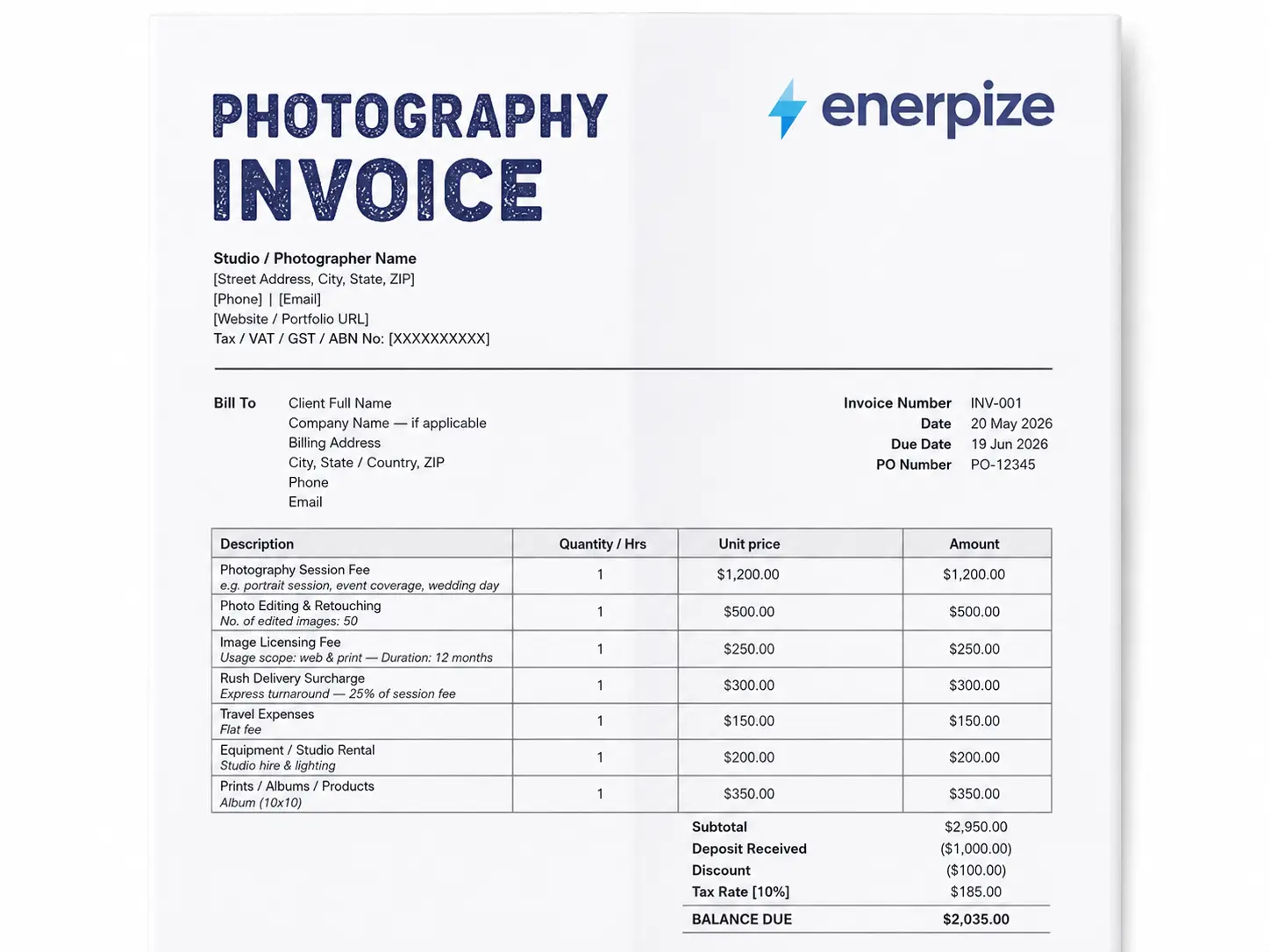
You finished the shoot. Delivered the gallery. Now you are staring at a blank page trying to remember what to charge for and how to format it. That blank page is where cash flow goes to die.
A photography invoice template solves that. One document. Every field already there. Session fee, editing, licensing, travel, deposit deduction, tax. You fill it in, export to PDF, and send it. The client gets clarity. You get paid.
Stop building invoices from scratch every time. Enerpize lets you create, send, and track photography invoices in minutes, with automatic payment reminders built in. Start for free.
What Is a Photography Invoice Template?
A photography invoice template is a structured billing document used by freelance photographers, portrait studios, wedding photographers, commercial photographers, and videographers to request payment from clients after completing a job or reaching a billing milestone.
It is not just a receipt. It is a formal record of the work performed, the agreed rates, the licensing terms attached to the images, and the outstanding balance. It is also your first line of defense if a payment dispute ever comes up, because it puts everything in writing before the money changes hands.
The invoicing side of photography gets overlooked more than it should. You can shoot a flawless wedding, deliver a gallery of 800 edited images, and still find yourself chasing payment three months later because the invoice did not include a due date, a late fee clause, or a licensing section that told the client exactly what they were paying for. The template fixes all of that before it becomes a problem.
Enerpize's photography studio management software takes this further by connecting your invoices directly to your client records, booking calendar, and payment tracking, so you always know what has been paid and what is still outstanding across every active project.
What to Include in a Photography Invoice
Most photographers underestimate how many fields a complete invoice actually needs. A name and a number is not enough. Here is every element a professional photography invoice must contain.
Photographer and studio details
- Your full name or studio name
- Business address
- Phone number and email
- Website or portfolio URL
- Tax registration number: VAT number (UK), GST/ABN (Australia), HST number (Canada), or EIN (US, if applicable)
Client details
- Client full name
- Company name, if the client is booking on behalf of a business
- Billing address
- Phone and email
- Purchase order number, if the client's accounts payable department requires one
Invoice reference fields
- Invoice number, unique and sequential for every invoice you issue
- Invoice date
- Payment due date
- Project or job reference name
Shoot details
- Shoot type (wedding, portrait, commercial, real estate, event)
- Shoot date and location
- Deliverables agreed upon
Itemized services table
- Photography session fee
- Photo editing and retouching, with the number of edited images
- Image licensing fee, with the usage scope and duration
- Rush delivery surcharge, if applicable
- Travel expenses
- Equipment or studio rental
- Prints, albums, or physical products
Totals section
- Subtotal
- Deposit already received, shown as a deduction
- Discount, if applicable
- Tax rate and tax amount
- Balance due
Payment section
- Bank name, account name, account number, sort code or routing number
- Accepted payment methods
- Payment terms and due date
Terms and conditions
- Late payment clause
- Copyright retention statement (images remain your property until full payment is received)
- Licensing terms
- Cancellation or rescheduling policy
The most commonly missed field across every competitor template on the market right now is the licensing section as a separate billable line item, not buried in the terms text. When a client uses your images commercially, the licensing fee is legally distinct from the session fee. Separating them on the invoice protects your copyright and removes any ambiguity about what the client has actually purchased.
Photography Billing Models and How to Show Them on the Invoice
Your billing model determines how you structure the line items on every invoice. There are four models in common use. The right one depends on the project type, the client, and how predictable the scope of work is.
Hourly Rate
You charge for the time spent on the project plus any direct costs incurred. The invoice shows total hours worked, your hourly rate, and a separate line for each reimbursable cost.
Example line item: Portrait session, 3 hrs @ $150/hr = $450
This model works well for event photography, corporate shoots, and any project where the time commitment is uncertain at the outset. The client knows exactly what they are paying for, and you are covered if the job runs long.
The downside is that experienced photographers can complete a job faster than less experienced competitors, which means your efficiency works against you on the invoice. If you shoot a three-hour event in two hours because you are good at your job, you earn less than someone who took longer.
Project Rate
You set a fixed price for the entire project, calculated internally from your estimated hours and costs. The invoice shows one line item or a package breakdown rather than a time log.
Example line item: Wedding photography package, full day coverage + 500 edited images = $3,200
This model suits any project with a clearly defined scope. Weddings, portrait packages, and real estate shoots are the most common applications. You capture the full value of your expertise rather than being penalized for being efficient.
Day Rate
You charge a set fee per day or half day, with a defined maximum number of working hours within that rate. The invoice shows the number of days or half days and the agreed rate.
Example line item: Corporate event coverage, 1 day rate (up to 8 hrs) = $1,200
Day rates work for multi-day projects that are not long-term retainer arrangements. They give the client predictable costs and give you protection against scope creep within a single day.
Service, Expenses, and Licensing
This is the commercial photography billing model. You charge for your time, all direct costs, and a separate licensing fee for the images based on how, where, and for how long they will be used.
Example breakdown:
- Commercial product shoot, 6 hrs @ $200/hr = $1,200
- Props and materials = $180
- Commercial usage license, web + print, 12 months = $800
The licensing fee is not arbitrary. It reflects the commercial value the client extracts from the images beyond the session itself. A product image used in a national print campaign has far more commercial value than a headshot used on a personal LinkedIn profile. The Association of Photographers provides usage calculators to help you price licensing correctly based on usage type, reach, and duration.
Photography Invoice Templates by Type
Different shoot types have different billing requirements. A wedding invoice is not the same document as a real estate photography invoice or a commercial licensing agreement. Each type has at least one unique field that the others do not need.
Freelance Photography Invoice Template
The freelance photography invoice template is the most flexible version. It accommodates hourly billing, project rates, and mixed-service billing, making it the right choice for photographers who work across multiple genres and client types. The key addition is an expenses section, since freelance photographers often absorb travel, equipment, and post-production costs that need to be reimbursed.
Our freelance invoice template covers the full scope of freelance billing, not just photography.
Wedding Photography Invoice Template
Wedding photography invoices need a deposit line and a delivery timeline field. Most wedding photographers take a 25 to 50 percent booking deposit to secure the date, with the remaining balance due before or on the wedding day. The invoice must clearly show the deposit already paid, the balance remaining, and the agreed delivery date for the edited gallery and any physical products like albums.
Real Estate Photography Invoice Template
Real estate photography invoices need a property address field. The client is usually a real estate agent or agency, so a PO number field is often required. Licensing terms are critical here because agents frequently want to use images across multiple listings platforms, social media, and print materials. Every usage type should be specified.
Event Photography Invoice Template
Event invoices often use a day rate or hourly rate structure with a detailed expenses breakdown. Equipment rental, parking, travel, and assistant fees are all common reimbursable costs. The event date and location are essential reference fields because agencies and corporate clients use them to match invoices to their internal purchase orders.
Portrait Photography Invoice Template
Portrait invoices typically use a package rate structure. The invoice should list the package name, what it includes (session time, number of edited images, print credits), and any add-ons purchased. Retouching and express delivery are the most common upsells and should each appear as a separate line item.
Commercial Photography Invoice Template
Commercial photography invoices are the most complex. They require a full licensing section that specifies usage type (editorial, advertising, social media, broadcast), territory (local, national, global), exclusivity (exclusive or non-exclusive), and duration. The licensing fee is always a separate line item, never bundled into the session fee.
Photo Studio Invoice Template
A photo studio invoice needs a studio hire fee as a distinct line item, separate from any photography services. If the client is renting the studio without a photographer, the invoice is purely a space and equipment rental document. If a photographer is also involved, both the studio fee and the photography fee appear as separate billable lines.
Tired of building a new invoice every shoot? Enerpize saves your client details, service rates, and tax settings so you can generate a complete photography invoice in under two minutes. Start for free.
How to Write an Invoice for Photography Services
This is the question that gets more impressions in Google than almost any other photography invoicing query, and the answer most pages give is a generic list that applies to any freelancer. Here is the actual process specific to photography.
Step 1: Choose your billing model. Hourly, project, day rate, or service plus expenses plus licensing. The choice determines how you structure every line item on the invoice.
Step 2: Open the template in your preferred format. Excel and Google Sheets if you want live formulas that calculate totals automatically. Word or Google Docs if you prefer to type figures manually and format the document yourself. PDF if you are sending a locked, print-ready file to the client.
Step 3: Fill in your studio details and logo. Your name, address, phone, email, and tax registration number all go in the header. A logo is not optional if you want the invoice to reflect your brand. It takes 30 seconds to add and immediately separates a professional photographer from someone who just started out.
Step 4: Add the client details and shoot reference. Client name, billing address, shoot type, shoot date, and shoot location. For corporate clients, add their PO number here. This is the reference information their accounts payable team will use to match your invoice to their internal records.
Step 5: List every service as a separate line item. Session fee, editing, licensing, travel, equipment rental, prints. Each one on its own line with a quantity or hours figure, a rate, and an amount. Never bundle services into a single line item if they can be separated. Bundling creates disputes.
Step 6: Add the licensing fee as its own line if images will be used commercially. Specify the usage scope, territory, exclusivity, and duration in the description field of that line item.
Step 7: Apply the correct tax rate for your country and jurisdiction. See the country-specific guidance below.
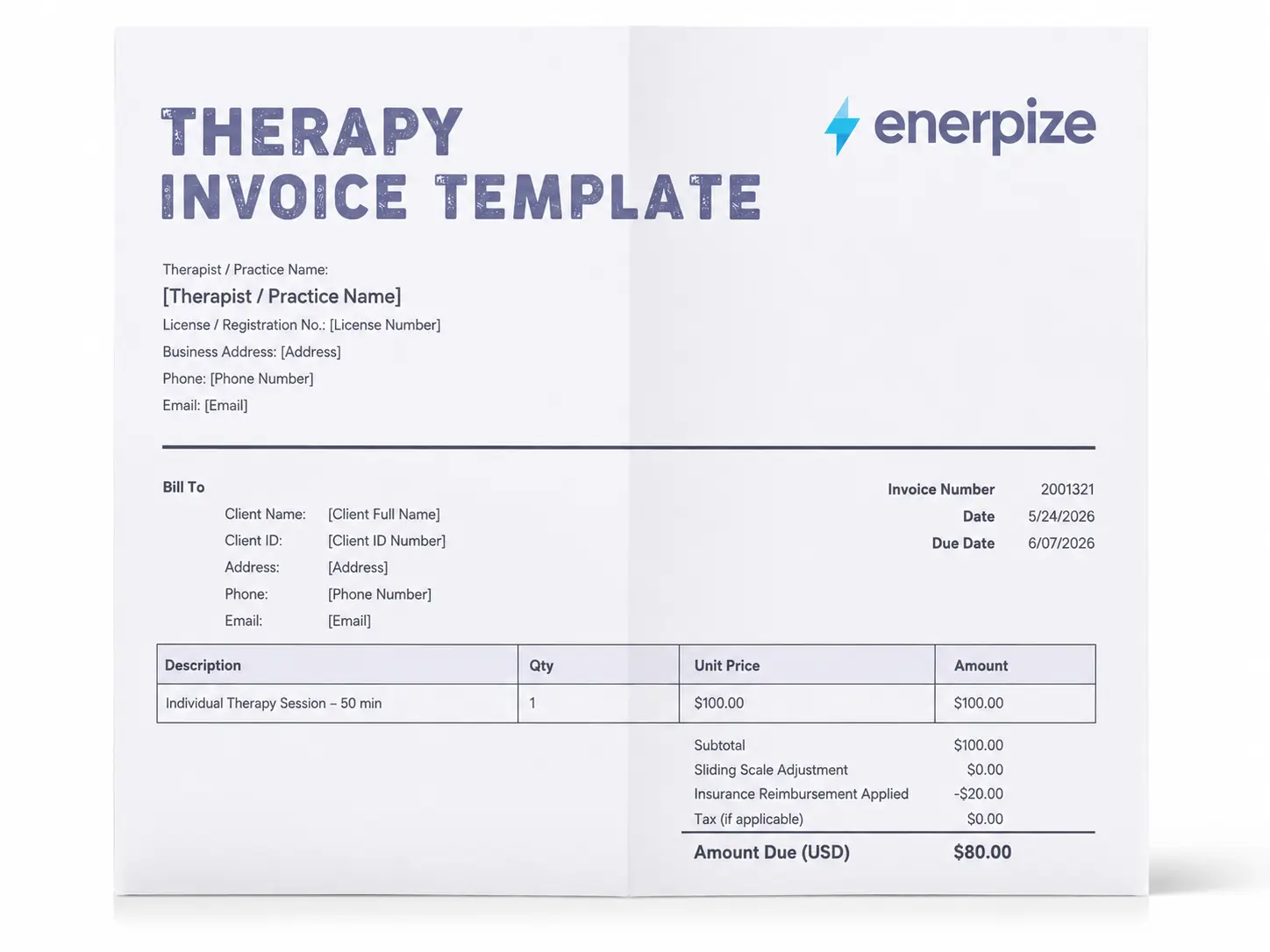
Step 8: Deduct any deposit already paid. Show the deposit as a negative line in the totals section: Deposit Received ($500). The balance due should reflect only what is still owed.
Step 9: Set the payment due date and list accepted payment methods. Standard terms for photographers are net 14 or net 30. Corporate clients often require net 30. Add your bank details or payment link here.
Step 10: Add your late payment clause. A simple sentence in the terms section is enough. The existence of a written clause is what matters, not the length of it.
Step 11: Export to PDF and send. Never send the editable version of the invoice to a client. Export a PDF, keep the editable file for your records, and send the PDF.
Tax Rules for Photography Invoices by Country
This is the section that most photography invoice template pages skip entirely. It is also the section that causes the most problems for photographers who invoice internationally or who are not sure whether their services are taxable in their home market.
United States: Sales Tax on Photography Services
Sales tax rules for photographers in the United States vary by state, and the variation is significant. There is no single federal rule. Some states, including Oregon, Montana, New Hampshire, and Delaware, have no sales tax at all. Others treat photography as a service exempt from sales tax. Others apply sales tax to physical products like prints and albums but not to the digital photography service itself. A smaller number of states, including Texas and some others, treat photography as part of the fabrication process for a physical product and apply sales tax to the full invoice.
Before you add a tax line to any invoice in the US, verify the rules for the state where the services were performed. The IRS Publication 334, Tax Guide for Small Business, covers broader tax obligations for small business photographers and is worth bookmarking for your annual filing.
United Kingdom: VAT on Photography Services
In the United Kingdom, VAT at the standard rate of 20 percent applies to photography services once you are VAT registered. As of 2025, the registration threshold is £90,000 in annual taxable turnover. Below that threshold, you are not required to register or charge VAT, and you should note on your invoices that no VAT is charged.
Once registered, your VAT number must appear on every invoice you issue. The tax line shows the VAT rate, the VAT amount, and the net figure separately. UK photographers working for clients in other countries should familiarise themselves with the place of supply rules, which affect whether UK VAT applies to international photography jobs. HMRC's VAT registration guidance covers thresholds, registration steps, and invoicing requirements in full.
Canada: GST, HST, and QST
Canadian photographers must collect GST at 5 percent once registered. In participating provinces, HST replaces GST at a combined rate: 15 percent in Nova Scotia, New Brunswick, Newfoundland and Labrador, and Prince Edward Island, and 13 percent in Ontario. Quebec photographers must collect both GST and QST (9.975 percent) as separate charges.
Your GST or HST registration number must appear on every invoice once you are registered. The Canada Revenue Agency's GST/HST guide for small businesses covers registration requirements, thresholds, filing periods, and remittance obligations.
Australia: GST on Photography Services
Australian photographers are required to register for GST and charge 10 percent GST on all taxable supplies once their annual turnover reaches or exceeds AUD $75,000. Your ABN must appear on all tax invoices. Invoices of AUD $1,000 or more require a full tax invoice with the GST amount stated separately. Invoices between AUD $82.50 and $1,000 qualify for a simplified tax invoice format. Below AUD $82.50, no tax invoice is required. If you are below the $75,000 registration threshold and choose not to register, note on your invoices that no GST is charged, since GST-registered clients need to know whether they can claim an input tax credit.
For photographers based in Australia who issue invoices in other currencies for international clients, the ATO's rules on GST-free exports may apply. The Australian Tax Office's GST guide for small business covers registration, taxable supplies, and invoicing requirements. Our Australian GST invoice template covers the standard layout for compliant Australian tax invoices, and the no-GST version handles invoices for photographers below the registration threshold.
How to Handle Deposits, Rush Fees, and Travel on a Photography Invoice
These three line items cause more confusion on photography invoices than anything else. Here is how to handle each one correctly.
Deposits: A deposit is not a separate invoice. It is a deduction on the final invoice. When you collect a 50 percent deposit at booking, you show the full project value in the line items, then deduct the deposit in the totals section as a negative figure labeled "Deposit Received." The balance due reflects only what is still owed. This approach keeps a complete record of the total contract value while accurately showing the outstanding amount.
Rush fees: A rush fee is a separate line item, not an adjustment to the session rate. Label it clearly as "Rush Delivery Surcharge" and state the percentage or flat amount in the description field. Common rush fee structures are 25 to 50 percent of the session fee for turnaround within 48 hours. Having it as its own line item makes it visible and agreed-upon, which removes any argument about it later.
Travel: Travel is either a mileage-based reimbursement or a flat fee. Show the calculation in the description field: "[X] miles @ $[rate]/mile" or "Travel to [location], flat fee." If you are claiming fuel, accommodation, or parking as separate reimbursable costs, each one gets its own line. Never bundle travel into the session fee. Clients want to see what they are paying for, and blending costs together looks like padding.
Why Enerpize Is More Than a Photography Invoice Generator
The invoice is one document. The business behind it is ten moving parts.
Enerpize's photography studio management software is built specifically for photography studios and covers every one of them.
Session and Project Management
Create projects, assign photographers, organize shooting schedules and venues, and track progress from booking to delivery. Every active job has its own record, with expenses, incomes, and invoices attached to it.
Invoicing and Quotations
Build and send professional invoices and quotations directly from the platform. Track which are paid, which are outstanding, and which are overdue, without a separate spreadsheet. Invoice clients on the go from any device.
Team Management
Set permissions per team member, manage freelancers, track attendance and leaves, and monitor activity logs across your entire roster. Everyone knows what they are responsible for and you always know what is actually happening.
Client Management
Build detailed client profiles with notes and venue preferences, schedule sessions and follow-up calls or emails, and manage repeat bookings from a single CRM view. No lead goes cold. No client gets forgotten.
Equipment and Inventory
Track your gear, manage purchase orders to suppliers, and maintain a live view of stock levels across your studio. Know what you have, what is out on a job, and what needs replacing.
Studio Accounting
Track income and expenses per project, monitor profit and loss in real time, and accept payments online and offline. Get a clear picture of which jobs are actually making money.
Photography Invoice Template Formats
Excel Photography Invoice Template
The Excel photography invoice template is the most powerful version for photographers who bill frequently. Live formulas calculate the total for each line item as you enter your quantity and rate. The subtotal, tax, deposit deduction, and balance due all update automatically. There is no manual arithmetic, and there is no risk of a calculation error on an invoice you send to a client.
The Excel version is also the easiest to maintain over time. Your rates, tax rate, and payment details live in the file. You update them once and every subsequent invoice reflects the change.
Word Photography Invoice Template
The Word photography invoice template suits photographers who prefer full visual control over the layout and want to customize the design to match their brand. You enter all figures manually, which means you are responsible for the arithmetic, but the format is clean and completely editable. Once complete, export to PDF before sending.
PDF Photography Invoice Template
A PDF invoice is a locked, presentation-ready document. It is ideal for sending to clients who should not be editing the file. The fixed layout renders consistently across every device and every email client. Use the editable template to build the invoice, then export to PDF as the final deliverable.
Google Docs and Google Sheets Photography Invoice Template
The Google Docs and Google Sheets versions are cloud-native. They auto-save, they are accessible from any device, and they can be shared with a studio manager or accountant without emailing attachments back and forth. The Google Sheets version includes live formulas identical to the Excel version. The Google Docs version is the cloud equivalent of the Word template.
Key Takeaways
- A photography invoice template must include a licensing section as a separate billable line item, not buried in the terms, because it is legally distinct from the session fee and protects your copyright.
- The right billing model (hourly, project rate, day rate, or service plus expenses plus licensing) should be stated explicitly on every invoice, not left to a verbal agreement that the client may remember differently.
- Tax rules for photographers differ by country and by US state. Verify whether your services are taxable before issuing your first invoice, and include your registration number once you are registered.
- Deposits should appear as a negative deduction in the totals section of the final invoice, showing the full contract value alongside what has already been paid and what remains due.
- A late payment clause and a clear due date increase the probability of on-time payment. The clause does not need to be long. It needs to exist.
- Enerpize automates the full invoicing cycle for photography businesses, from generating the invoice to sending automatic payment reminders, so you spend time behind the camera rather than chasing outstanding balances.
Frequently Asked Questions
What is a photography invoice template?
A photography invoice template is a pre-formatted billing document that photographers use to charge clients for sessions, editing, licensing, travel, and related services. It includes all the fields required to produce a legally valid invoice, a professional layout, and a totals section that calculates the balance due after deposits, discounts, and tax.
What should be included in a photography invoice?
A complete photography invoice includes your business details, client details, a unique invoice number, the invoice date and due date, an itemized table of all services and costs, a licensing section if images will be used commercially, the applicable tax rate, a deposit deduction if one was collected, the balance due, your bank or payment details, and a late payment clause.
How do I invoice for photography services in the United States?
Issue an invoice with your business name, address, and tax identification number. Add a tax line only if the state where services were performed requires it. Sales tax rules vary significantly by state. Some states exempt photography services entirely. Others apply tax to physical products like prints but not digital services. Verify your state's rules before adding any tax line to a US photography invoice.
Do photographers need to charge VAT in the UK?
UK photographers must charge VAT at 20 percent once their annual taxable turnover reaches or exceeds £90,000. Below that threshold, VAT registration is not required and no VAT should be charged. Once registered, the VAT number must appear on every invoice.
What is a photography licensing fee and how do I add it to an invoice?
A licensing fee is a separate charge for the right to use your images beyond the scope of the session itself. It is not the same as the session fee. Add it as its own line item in the services table. In the description field, specify the usage type (web, print, advertising, broadcast), the territory (local, national, global), exclusivity, and the license duration.
What is the difference between a photography invoice and a receipt?
An invoice is a request for payment issued before or at the time payment is due. A receipt confirms that payment has already been received. Every photography job needs both. Issue the invoice when the job is complete or at the agreed billing milestone, and issue a receipt once full payment clears.
How do I handle deposits on a photography invoice?
Show the deposit as a negative line in the totals section of the final invoice, labeled "Deposit Received" with the amount in parentheses. The line items show the full value of all services. The deposit deduction reduces that figure to the outstanding balance. Never issue a final invoice that only shows the remaining balance, since it creates no record of the total contract value.
What payment terms should photographers use?
Most independent photographers use due on receipt or net 14 for individual clients. Corporate clients typically expect net 30. Whatever terms you set, state the due date explicitly on the invoice rather than relying on the client to calculate it from the issue date. A specific calendar date is clearer than a number of days.
Should I charge sales tax on photo editing services?
It depends on your location. In most US states, photo editing is treated as a service and may be exempt from sales tax, while physical prints are taxable. In some states, editing is considered part of the fabrication process for a physical product and is therefore taxable. In Australia, editing services are taxable supplies subject to 10 percent GST for registered businesses. In the UK, editing is a standard-rated service subject to 20 percent VAT for registered photographers.
Can I use a free photography invoice template for commercial shoots?
Yes, with one important addition. Commercial shoots require a licensing section that specifies the usage rights the client is purchasing. A generic template does not include this by default. Add a licensing line item to the services table, specify the usage scope and duration in the description, and include your licensing terms in the terms section. The download versions of this template include a pre-labeled licensing line for exactly this purpose.
About the Author
Omar El Bahr is a Senior Digital Growth Specialist at Enerpize, where he leads SEO, content strategy, and organic growth across international markets. He is a Forbes Communications Council contributor and has written for Entrepreneur on business communication and digital strategy.
Disclaimer: The information on this page is provided for general informational purposes only. It does not constitute legal, tax, or financial advice. Tax rules for photography services vary by country, state, and individual business circumstances and are subject to change. Always consult a qualified accountant or tax professional for advice specific to your situation before issuing invoices or making tax decisions for your business.