

Posted on 17 June 2026
Free UK Invoice Template Download: Excel, Word, PDF & Google Sheets and Docs
- Available in Word, Excel, PDF, Google Docs, and Google Sheets, free to download with no signup required
- Covers VAT registration number, VAT rate and amount, net subtotal, and gross total in one HMRC compliant document
- Built with separate VAT and non VAT versions, so sole traders under the £90,000 threshold and VAT registered limited companies both get a template that fits how they actually invoice
- Calculates VAT, subtotal, and balance due automatically in Excel and Google Sheets
A UK invoice template is a pre-formatted billing document that records the goods or services supplied, the VAT charged where it applies, and the amount owed, giving both the business and the client a clear, HMRC compliant record of the transaction.


What Is a UK Invoice Template?
There is a particular kind of silence that follows the question "when can I expect payment?" It is the silence of someone scrolling back through old emails, pretending they never saw yours. Every freelancer, electrician, and small business owner in the United Kingdom has lived this moment at least once. The work was finished well. The client seemed happy. Then the invoice went out looking like it was thrown together in five minutes, missing half of what HMRC actually requires, and the money quietly stopped moving.
That gap between work finished and money received is rarely about a client refusing to pay. Nine times out of ten, it is about the invoice itself.
Nearly half of all UK small business invoices run overdue, with businesses waiting an average of 27 days past issue just to get paid, and late payment costs the UK economy an estimated £11 billion a year, according to 2024 research for the Department for Business and Trade. A properly built invoice will not fix a client who genuinely does not want to pay. It removes every excuse the rest of them use to stall.
Strip away the jargon and a UK invoice template is just a form with very specific blanks. Every one of those blanks exists because somewhere, at some point, a business left it empty and either chased an unpaid bill for months or got an unwelcome letter from HMRC.
Think of it as a checklist wearing a billing document's clothes. Your name and VAT number go at the top so the client knows exactly who they are paying. The line items go in the middle so there is no argument about what was delivered. The VAT, if you charge it, sits clearly on its own so your accountant does not have to guess where it hides inside the total. And the payment terms sit at the bottom, doing the unglamorous job of actually getting you paid on time.
Whether you are a sole trader sending out three invoices a month or a VAT registered limited company sending three hundred, a UK invoice template gives you the same starting point every time.
This matters more than it sounds. A client who is VAT registered cannot reclaim VAT on a purchase if your invoice is missing the details that prove it. Get the format right once, and you stop relearning this lesson invoice by invoice.
If you are invoicing outside the UK, this template will not fit. Enerpize has separate templates built for South Africa, Kenya, Tanzania, and Australia, each built around that country's own tax rules rather than adapted from this one.
Typing the same details into every invoice gets old fast. Enerpize remembers your VAT number and bank details so you don't have to. Start for free.
What the Enerpize UK Invoice Template Includes
Most invoice templates floating around online were built once and forgotten. Ours was built around the two situations that actually decide how a UK business invoices: are you VAT registered or not.
That distinction sounds small until you have actually filled in a VAT invoice without a VAT field on it, which is a more common mistake than you would think. A document with "VAT" in its title and no VAT registration number, no VAT rate, and no VAT amount calculated anywhere on it is not a VAT invoice. It is a regular invoice wearing a VAT invoice's name tag, and HMRC will treat it that way too.
VAT Version Fields
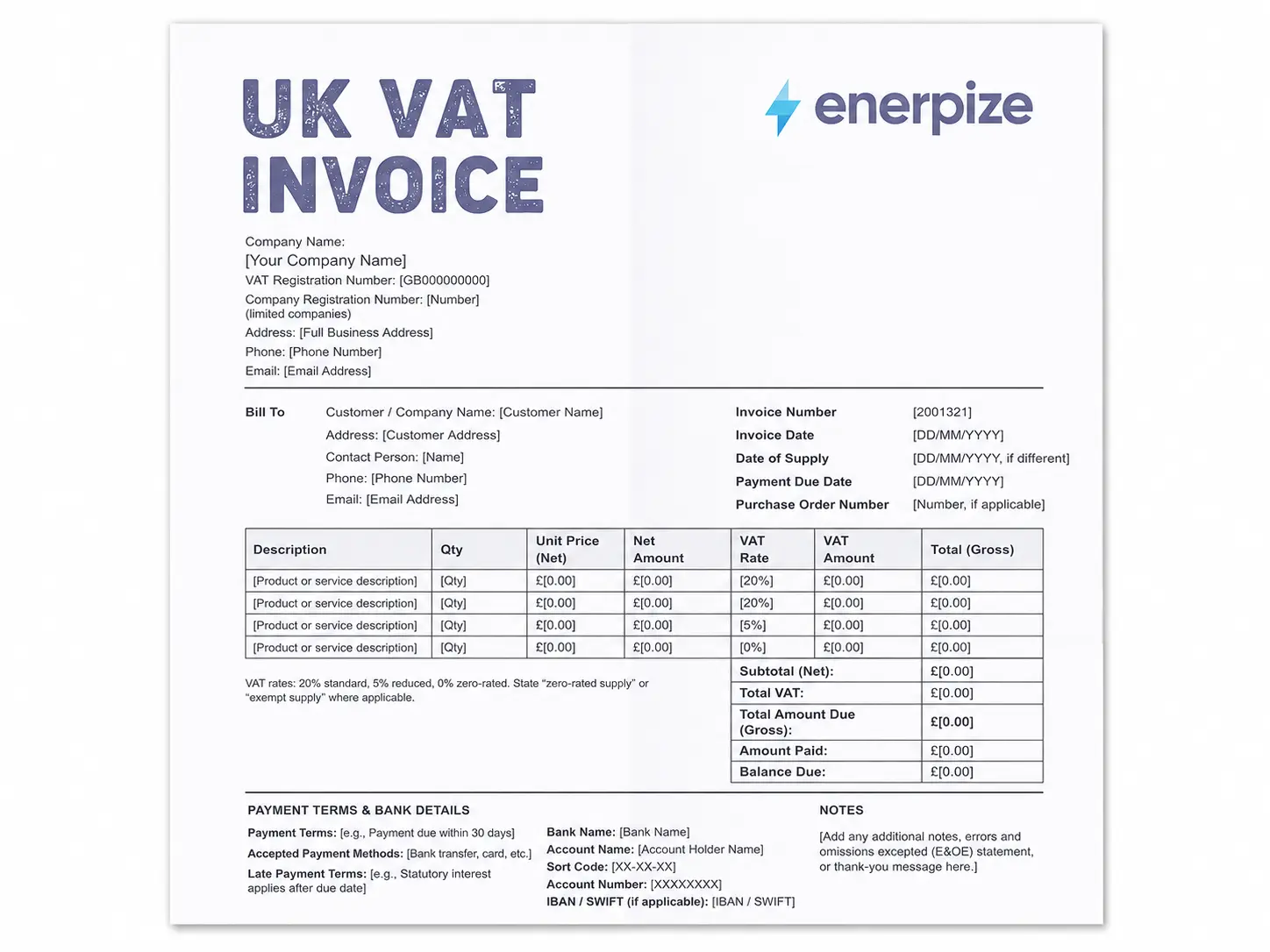
The VAT version of the Enerpize UK invoice template includes:
- Your VAT registration number, displayed clearly near your business details
- A net amount, VAT rate, and VAT amount column for every line item, not just a single total at the bottom
- A subtotal, total VAT, and total amount due, broken out separately so nothing is buried inside one number
- Date of supply, shown separately from the invoice date whenever the two differ
- Standard, reduced, and zero rate handling, so you are not stuck reusing one VAT rate for every line
Non VAT Version Fields
The non VAT version strips out the VAT mechanics entirely and keeps the rest of the structure businesses below the £90,000 threshold actually need:
- Company and client details, invoice number, and invoice date
- A clean line item table for quantity, unit price, and amount
- Payment terms, due date, and bank details
- A notes section for anything the client needs to know before paying
Search "hmrc invoice template" or "free invoice template uk" and you will find plenty of blank grids online. Most treat VAT as an afterthought, one field bolted onto a template that was designed for a market that does not run on VAT at all. This one was not adapted from somewhere else. It was built around the £90,000 threshold, the three UK VAT rates, and the exact fields HMRC expects, from the ground up.
Where the Enerpize UK invoice template earns its keep is what happens after you stop filling in templates by hand. The wider Enerpize platform turns a quote into a payable invoice in one click, sends automatic payment reminders so you are not the one chasing clients, and gives customers a self service portal to view statements and pay online. It reconciles against 40 or more banks, supports over 135 currencies and payment methods, and already processes more than 66 million transactions a month for businesses like yours. A free template gets one invoice right. A connected invoice generator UK businesses can rely on gets every invoice right, automatically, from now on.
UK Invoice Requirements: The HMRC Checklist
HMRC is fairly specific about what has to appear on a UK invoice, and the requirements differ slightly depending on whether you trade as a sole trader or a limited company. According to HMRC's own guidance, every invoice you issue must include:
- A unique, sequential invoice number
- Your business name, address, and contact details
- Your customer's name and address
- A clear description of the goods or services provided
- The date the goods or services were supplied
- The date of the invoice
- The amount or amounts being charged
- The VAT amount, if applicable
- The total amount owed
Sole Trader Invoices
If you trade as a sole trader, your invoice also needs your own name, alongside any trading name you operate under, plus an address where legal documents can reach you if you are using that trading name instead of your personal one. A lot of new freelancers skip this step because it feels redundant next to the business name field, but HMRC treats it as a separate requirement, not an optional extra.
This is also exactly what people mean when they search for a self employed invoice template UK businesses can actually rely on, since a sole trader and a self-employed person are the same thing in HMRC's eyes. If you are still building your invoicing process from scratch, the Enerpize sole trader invoice template and freelance invoice template are built around exactly this requirement.
Limited Company Invoices
Limited companies have a different obligation. Your invoice needs to show your full registered company name exactly as it appears on your certificate of incorporation, not a shortened version or a trading name unless that trading name is also formally registered. If you choose to list your directors on the invoice, you need to list all of them, not just whoever happens to run sales.
VAT Invoice Extra Fields
VAT registered businesses carry extra weight on every invoice. On top of the standard fields, a VAT invoice needs your VAT registration number, the VAT rate applied to each line, the VAT amount charged, and the total both including and excluding VAT. HMRC's VAT invoice rules also require you to keep these records for at least six years, which is considerably longer than the few weeks some free invoice generators casually suggest. Get into the habit of saving every invoice you issue and receive in one place rather than scattered across email threads, because six years is a long time to rely on your inbox search function.
UK Invoice vs Quote vs Receipt vs Credit Note
People mix these up constantly, and mixing them up is exactly how payment gets delayed. Here is the difference in one table.
| Document | Purpose | Includes Prices? | Legally Requires VAT Details? | Triggers Payment? |
|---|---|---|---|---|
| Invoice | Requests payment for goods or services already delivered | Yes | Yes, if VAT registered | Yes |
| Quote | Proposes a price before work begins | Yes | No | No |
| Receipt | Confirms payment has already been received | Yes | Sometimes | No, payment already happened |
| Credit Note | Corrects or reduces a previously issued invoice | Yes, as a negative amount | Yes, if the original was a VAT invoice | No, it reduces what was owed |
The rule is simple. A quote comes before the work. An invoice comes after it. A receipt comes after the invoice is paid. A credit note only shows up when something on the original invoice needs fixing. Confuse any two of these and you either ask for money you have not earned yet or forget to ask for it at all.
UK VAT Invoice vs No VAT Invoice: Which One Do You Need?
This is the question that trips up more new business owners than anything else on this page: do you need a UK VAT invoice template, or does the simpler non-VAT invoice template cover everything your business actually requires? The honest answer depends entirely on your turnover, not on how established your business feels.
The £90,000 VAT Registration Threshold
You must register for VAT once your taxable turnover passes £90,000 in any rolling 12 month period, not a fixed tax year. That figure has held since April 2024, and a lot of older invoicing guides online still quote the previous £85,000 threshold, which has not been accurate for some time now. Cross £90,000 and you generally have 30 days from the end of that month to notify HMRC. Fall back below £88,000, the deregistration threshold, and you may be able to apply to come off VAT again.
Until you cross that line, charging VAT is entirely optional. Plenty of small businesses register voluntarily anyway, usually because it lets them reclaim VAT on their own purchases, or because larger VAT registered clients simply expect it. There is no wrong answer here, only the one that fits your numbers.
Standard, Reduced, and Zero VAT Rates
Once you are VAT registered, not every sale gets taxed the same way. HMRC sets three VAT rates: the standard rate of 20 percent, which covers most goods and services, a reduced rate of 5 percent for specific categories like home energy, and a zero rate of 0 percent for essentials such as most food and children's items. If a sale qualifies for the zero rate or is exempt entirely, your invoice should say so explicitly rather than just leaving the VAT field blank, since blank and zero mean different things to an auditor.
How to Fill Out the Enerpize UK Invoice Template
Filling in a UK invoice template properly takes about five minutes once you know the order. Here is the sequence that avoids the most common mistakes.
Step 1: Add Your Business and VAT Details
Start with your company name, address, contact details, and VAT registration number if you have one. Get this section right once and you will rarely touch it again.
Step 2: Add the Client's Billing Information
Fill in your client's name, address, and a contact person if you have one. This is also where a purchase order number goes, if your client's accounts department requires one before they will release payment.
Step 3: List Each Item With Net Price and VAT Rate
Add each product or service on its own line, with the quantity, unit price, and the VAT rate that applies to it. Not every line needs the same rate, so do not assume one rate covers the whole invoice just because it usually does.
Step 4: Let the Template Calculate VAT and the Total Due
In the Excel and Google Sheets versions, the net amount, VAT amount, and total update automatically as soon as you enter quantity and price, so you are never doing this math by hand or risking a typo in the total.
Step 5: Set Payment Terms and Bank Details
Add your payment terms, due date, and full bank details. An invoice without bank details is a polite suggestion, not a request for payment.
Step 6: Download or Send
Save the finished invoice as a PDF and send it straight to your client, or print it if that is still how your client prefers to receive paperwork.
This works fine until your client list grows. Enerpize generates invoices in a click and tracks who's paid, all from one dashboard. Start for free.
Invoicing Under the Construction Industry Scheme (CIS)
Construction businesses in the UK play by an extra set of rules most other industries never have to think about. Under the Construction Industry Scheme, contractors deduct tax directly from a subcontractor's payments before the subcontractor ever sees the money, then pass that deduction on to HMRC as an advance against the subcontractor's tax bill.
The deduction rate depends on registration status. Subcontractors registered with HMRC have 20 percent deducted, unregistered subcontractors lose 30 percent, and subcontractors with gross payment status are paid in full with nothing withheld. That difference between 20 and 30 percent matters in real terms: on a £4,000 invoice it is the gap between losing £800 and losing £1,200.
There is a second wrinkle worth knowing about. Since 1 March 2021, most CIS registered construction services between VAT registered businesses fall under the domestic VAT reverse charge, which means the subcontractor invoices without adding VAT at all and notes on the invoice that the customer must account for the VAT themselves. Skip that note and the invoice comes back rejected.
It is one of the more frequently missed details in construction invoicing, and getting it wrong in either direction tends to bounce the invoice straight back. If construction invoicing is genuinely your day to day work, the Enerpize construction invoice template doubles as a practical CIS invoice template, built with the reverse charge already accounted for rather than bolted on afterward.
How Enerpize Handles UK Invoicing
A blank invoice template answers one question. What do I put where? Enerpize answers the question that actually determines whether you get paid: what happens after you hit send?
Every invoice you create automatically applies the right VAT rate, remembers your client's details for next time, and drops straight into a dashboard where you can see, at a glance, which invoices are paid, which are overdue, and which client you need to chase this week. Payment reminders go out on a schedule you set, not one you have to remember to run yourself. Clients get a self service portal where they can view their statement and pay online, which quietly removes the "I never received it" excuse from the equation entirely.
For VAT registered businesses specifically, Enerpize keeps every invoice on file well past the six year HMRC retention window, searchable rather than buried in an inbox, and formatted the way Making Tax Digital for VAT expects digital records to look. When an HMRC enquiry does land, and eventually one usually does for a growing business, the answer is not a scramble through old email folders. It is a report that already exists.
Stop building invoices manually. Enerpize applies your VAT rate automatically and tracks who's paid. Start for free.
Common UK Invoicing Mistakes That Delay Payment
Most late payments are not a client problem. They are an invoice problem wearing a client's name.
The biggest one is labeling an invoice as a VAT invoice without actually including a VAT registration number or a VAT calculation anywhere on it. It happens more often than you would expect, usually because someone copied an old invoice template and just changed the title. The second most common mistake is leaving out the date of supply when it differs from the invoice date, which matters more than it seems for VAT reporting purposes. The third is simply forgetting bank details, which turns a finished invoice into a document that looks complete but cannot actually be paid.
A blank, properly structured starting point solves most of this before it ever becomes a problem. The Enerpize blank invoice template exists for exactly that reason, as a clean base that already has every required field in the right place, so there is nothing left to forget.
Key Takeaways
- HMRC requires every UK invoice to include a unique invoice number, business and client details, a description of the work, dates, and the total owed.
- VAT registration becomes mandatory once your taxable turnover passes £90,000 in any rolling 12 month period, not a fixed tax year.
- VAT registered invoices need three extra fields on top of the standard ones: your VAT number, the VAT rate per line, and the VAT amount charged.
- UK VAT runs at three rates: 20 percent standard, 5 percent reduced, and 0 percent zero rated, and exempt or zero rated sales should say so explicitly.
- Construction businesses under CIS deal with deduction rates of 20, 30, or 0 percent depending on registration status, plus a domestic VAT reverse charge on most B2B work since March 2021.
- Nearly half of all UK small business invoices run overdue, and late payment costs the UK economy an estimated £11 billion a year.
- Keep every VAT invoice for at least six years, since that is the retention period HMRC actually enforces.
Frequently Asked Questions
Do I need to charge VAT on a UK invoice?
Only if you are VAT registered, which becomes mandatory once your taxable turnover passes £90,000 in any rolling 12 month period. Below that threshold, charging VAT is optional, though some businesses register voluntarily to reclaim VAT on their own costs.
What must a UK invoice legally include?
At minimum, a unique invoice number, your business name and address, your client's name and address, a description of the goods or services, the invoice date, the supply date, the amount charged, and the total owed. VAT registered businesses add a VAT number, rate, and amount on top of this.
What is the difference between a sole trader invoice and a limited company invoice?
A sole trader invoice needs the trader's own name alongside any trading name used. A limited company invoice needs the full registered company name exactly as it appears on the certificate of incorporation, and if directors are listed, all of them must be.
Can I create a UK invoice template for free?
Yes. It is free to download in Word, Excel, PDF, Google Docs, and Google Sheets, with no signup required.
What is the VAT registration threshold in 2026?
£90,000 in taxable turnover over any rolling 12 month period. This has been unchanged since April 2024, despite some older guides online still quoting the previous £85,000 figure.
Do CIS subcontractors invoice differently?
Yes. Contractors deduct 20 percent from registered subcontractors or 30 percent from unregistered ones before payment, and most CIS registered B2B construction work falls under the domestic VAT reverse charge, meaning the subcontractor does not add VAT directly.
How long do I need to keep UK invoices for?
At least six years for VAT records, regardless of what some free invoice generators suggest. HMRC can request to see them throughout that period.
That silence after asking when payment is coming gets a lot quieter once your invoice has already answered every question a client or HMRC could ask of it. A UK invoice template will not chase a payment for you, but it stops giving clients an excuse to stall, and that is most of the battle.
Ready to stop chasing payments? Start for free.
About the Author
Omar El Bahr is a Senior Digital Growth Specialist at Enerpize, where he leads SEO, content strategy, and organic growth across international markets. He is a Forbes Communications Council contributor and has written for Entrepreneur on business communication and digital strategy.
Disclaimer
This article is for general information only and is not tax or legal advice. UK VAT and invoicing rules can change, so confirm current requirements with HMRC or a qualified accountant before relying on them for your own business.