

Posted on 5 July 2026
Free Catering Invoice Template Download: Excel, Word, PDF & Google Sheets and Docs
- Available in Word, Excel, PDF, Google Docs, and Google Sheets, free to download with no sign-up required
- Covers menu pricing, staffing hours, equipment rentals, service charges, and deposit tracking in one structured document
- Built with tax fields that separate taxable food and beverage lines from non-taxable labor and rental lines
Calculates per-person totals, tax, deposit applied, and balance due automatically in Excel and Google Sheets
A catering invoice template is a pre-formatted billing document that records the menu served, the guest count charged, the staff and rentals provided, and the payment terms agreed, giving both the caterer and the client a clear record of every event.


What Is a Catering Invoice Template?
You know that moment right after an event ends. The last guest has left, the chafing dishes are cold, and you are standing in someone's kitchen at eleven at night trying to remember whether you charged for the extra seventeen guests who showed up uninvited.
That memory is exactly why this document exists.
A catering invoice is the paper trail that turns a night of cooking, serving, and cleanup into an actual payment. It tells the client what they ordered, what it cost, what they already paid, and what they still owe. Without it, you are trusting people to remember a verbal agreement made three weeks before the event, and trust is a terrible accounts receivable strategy.
Most caterers learn this the hard way. You quote a wedding at 125 guests, the final count comes in at 142, someone adds a bartender the week before, and by the time the event wraps you have five different numbers floating around in three different text threads. A template forces all of that into one place before you send the bill, which is the entire point.
Stop guessing at guest counts and chasing deposits. Enerpize keeps your whole catering business in one place. Start for free.
What the Enerpize Catering Invoice Template Includes
Most catering templates online are built by invoicing software companies who have never actually run a catering event. You can tell, because they give you three generic line items and call it done.
We built ours differently. Every field on this template exists because it maps to something a caterer actually needs to bill for, not because it looked good in a mockup.
Event and Client Details
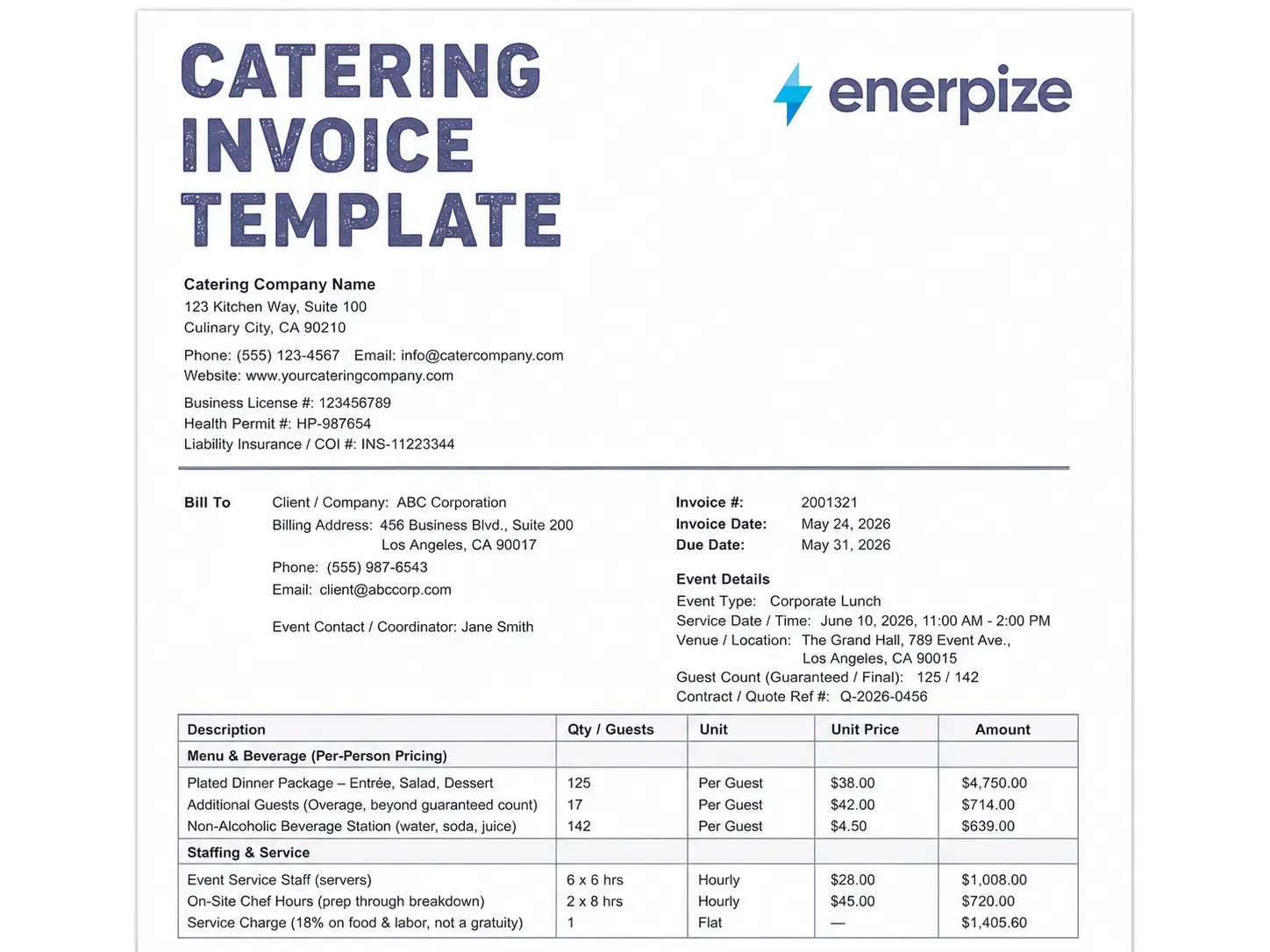
The template opens with the event type, service date and time, venue address, and the guest count broken into guaranteed minimum and final count. Most invoices only ask for a single guest number. Catering does not work that way. You quote a minimum, the client confirms a final headcount closer to the date, and your invoice needs to show both so nobody argues about which number the bill is based on.
Menu and Beverage Pricing Per Person
This is where the template earns its keep. Every menu line is priced per guest, not as a flat lump sum, because that is how caterers actually price food. Plated dinners, buffet packages, beverage stations, all broken into guest count multiplied by per-person rate, so the math is visible instead of buried.
Staffing and Service Charges
Servers, bartenders, and chef hours get their own section, priced by the hour, separate from food. Right below that sits the service charge line, clearly labeled as a service charge and not a gratuity, because that distinction matters legally in a lot of states and it matters even more to your serving staff.
Equipment, Rentals, and Delivery
Chafing dishes, linens, centerpieces, delivery and setup fees, all itemized separately from food and labor. This is the section most templates skip entirely or bury inside a single "miscellaneous" line, which is exactly how disputes start.
Tax Split and Deposit Reconciliation
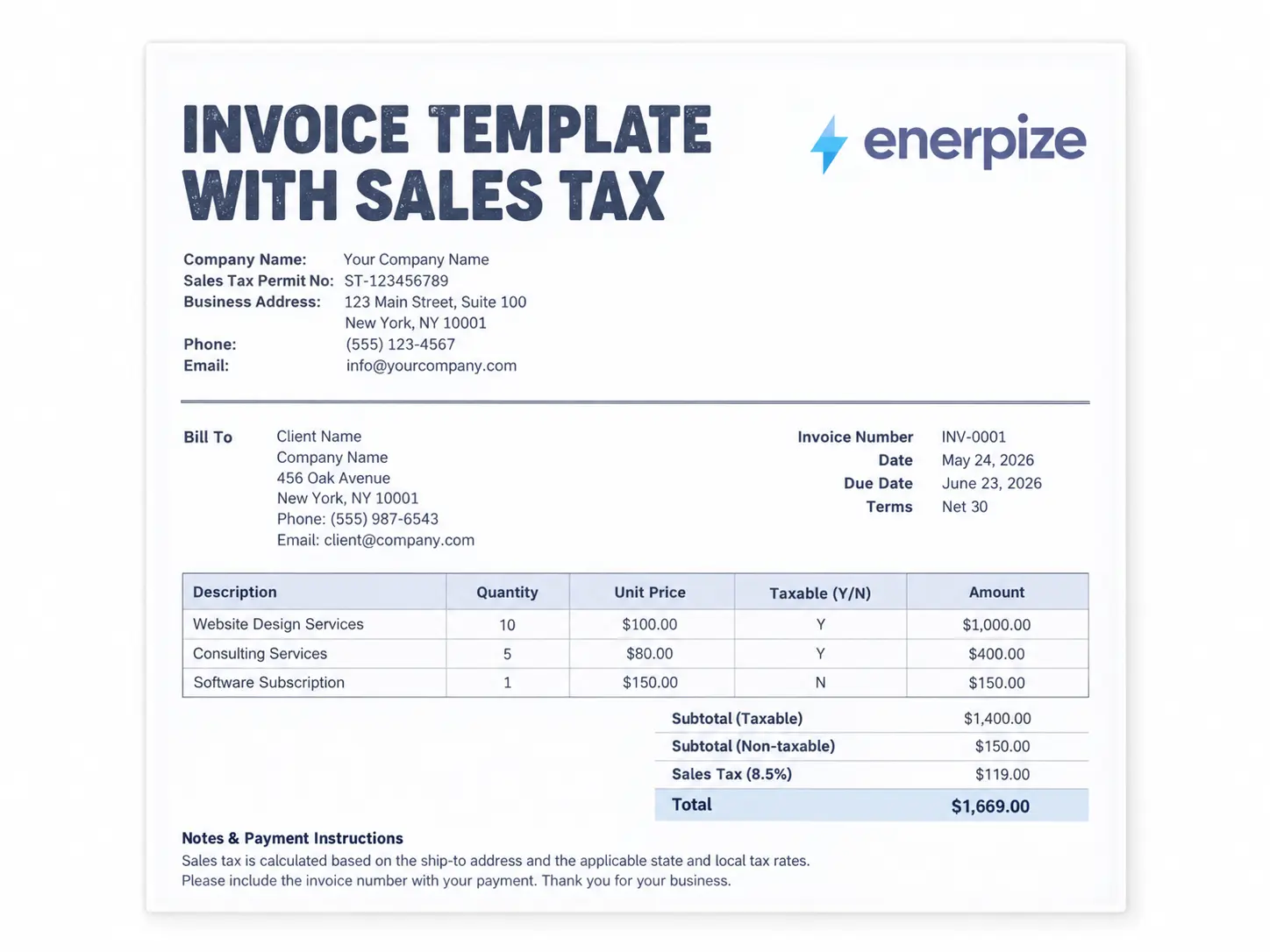
Here is the differentiator. Our template separates the taxable subtotal, which is food and beverage in most jurisdictions, from the non-taxable subtotal, which is typically labor and rentals. Then it shows the deposit already paid as its own line, subtracted from the total, so the balance due is the actual number the client needs to pay, not something they have to calculate themselves. Almost nothing else on the market does this split automatically. Most templates give you one flat total and expect you to manually work out what portion was taxed and what the client already paid you weeks ago.
How to Price a Catering Job
Pricing catering is not guesswork, even though it often feels that way at two in the morning while you are staring at a spreadsheet.
Step One: Confirm the Guest Count and Menu
Get a guaranteed minimum in writing. Lock the final count seven to ten days before the event. Everything else in your pricing depends on this number being solid.
Step Two: Calculate Food and Beverage Cost Per Person
Add up your ingredient cost for the confirmed menu, divide by the guest count, and you have your raw food cost per head. Markup from there to cover your margin.
Step Three: Add Labor Separately
Chefs, servers, and bartenders get billed by the hour, not folded into the per-person food rate. This keeps your labor costs visible and adjustable if the event runs long.
Step Four: Add Rentals and Delivery
Equipment, linens, delivery, and setup are pass-through or marked-up costs, and they belong on their own lines so the client can see exactly what they are paying for.
Step Five: Apply Tax to the Correct Lines Only
In most US states, prepared food and beverage are taxable while labor and rental fees often are not. Check your specific state's rules, since this varies, but do not apply a blanket tax rate to the entire invoice without checking first.
Step Six: Subtract the Deposit and Show the Balance
Whatever percentage you collected at booking gets deducted here, and the number left over is what the client actually owes.
Tired of rebuilding this math every single quote? Enerpize calculates it for you automatically. Start for free.
Catering Invoice Template for the United States, United Kingdom, and Canada
United States
Sales tax on catering varies by state, but a useful reference point is New York, where the New York State Department of Taxation and Finance's guidance on caterers and catering services states plainly that a caterer's entire charge to a customer, including food, beverages, rentals, and service charges, is generally taxable, even when those items are separately stated on the invoice. That is different from the simple food versus labor split some caterers assume, so check your own state's specific rules rather than copying another state's approach.
United Kingdom
VAT on catering in the UK is charged at the standard rate, currently 20 percent, and HMRC treats catering as a supply of services rather than a straightforward sale of food. HMRC's guidance on catering and takeaway food, VAT Notice 709/1, sets out exactly when this standard rate applies, including third-party food and drink supplied for events like weddings, conferences, and parties, which covers most catering work directly.
Canada
GST or HST applies to catering services across Canada, with the rate depending on the province since HST provinces combine federal and provincial tax into one rate while others charge GST and provincial sales tax separately. The Canada Revenue Agency's guidance on food and beverage providers confirms that catering is treated as its own defined supply, distinct from simple food sales, which is worth knowing if you also handle institutional or campus catering contracts.
Common Catering Invoicing Mistakes to Avoid
Bundling Everything Into One Total
If your invoice shows a single number with no breakdown, clients cannot verify what they are paying for, and that is exactly when they start disputing charges after the fact.
Forgetting to Apply the Deposit
This sounds obvious until you are the fifth invoice into a busy wedding season and you accidentally bill the client for the full amount instead of the remaining balance. Show the deposit as its own line every time.
Not Separating Taxable and Non-Taxable Charges
Taxing your labor and rental fees when your state does not require it means either overcharging your client or eating the difference yourself when they push back.
Leaving the Service Charge Ambiguous
If your service charge is not a gratuity, say so directly on the invoice. Servers and clients both deserve clarity on where that money is going.
Skipping the Guest Count Lock Date
Without a clear cutoff for final headcount changes, you are exposed to last-minute additions that blow up your food cost with zero notice.
How Enerpize Supports Catering Businesses Beyond the Invoice
A template solves today's invoice. But most catering businesses eventually hit the same wall. Spreadsheets and static templates cannot track a booking from inquiry to final payment, and they definitely cannot keep kitchen inventory, staff schedules, and client history in sync. That is the gap Enerpize's catering and event management software is built to close.
Think about how many separate files a busy caterer juggles in a single week. One spreadsheet for bookings, another for guest counts, a group chat for staff schedules, a shoebox of receipts for equipment rentals, and a notebook somewhere with the deposit amounts scribbled in. None of it talks to each other, and none of it catches the mistake until the mistake has already cost you money. That is the actual problem a template cannot solve, because a template is a single document, and a catering business is not a single document. It is a dozen moving parts that all need to agree with each other at the same time.
Order and Event Workflow
Every booking becomes a trackable order with an assigned coordinator, logistics plan, and venue details attached, so nothing about a wedding or corporate lunch lives only in someone's email thread. If the venue changes two weeks before the event, or the client adds a second bar station, that update lives in the order itself rather than in a reply buried forty messages deep in an inbox.
Billing That Mirrors the Quote
Quotations and invoices are created and sent online, tied directly to bookings, product sales, and facility usage, so the final invoice a client receives actually matches what was booked instead of a re-typed version of it. This is the same principle behind our quotation template, except instead of a static document you fill out by hand, the quote and the invoice are connected from the start, so nothing gets lost in translation between the two.
Kitchen and Equipment Inventory
Stock, equipment, and facility usage are tracked as inventory transactions, and purchase orders go out to suppliers directly from the system, which matters for a business juggling chafing dishes, linens, and perishables across multiple events in the same week. Run three weddings back to back and you already know what happens when nobody is tracking which rental company has your centerpiece stock. Someone finds out the hard way, usually the night before an event.
Staffing and Coordination
Tasks and permissions can be delegated to servers, chefs, and coordinators, with attendance, activity logs, and expenses tracked per person, which covers the staffing side of catering that a static invoice template can only itemize after the fact. Your invoice can tell a client that six servers worked six hours each. It cannot tell you, in real time, whether all six actually clocked in. The system can.
Client Relationship History
Customer profiles carry booking history, scheduled follow-ups, and reminders, so a repeat corporate client or a wedding referral does not start from zero the next time they book. This pairs naturally with how many caterers already track freelance invoice style relationships with independent contractors and vendors they bring in event to event, since the same client history logic applies on both sides of the business.
Accounting Tied to the Event
Cash flow, invoices, equipment purchases, and profit and loss get tracked together, with payments accepted online or offline, so a caterer can see event-level profitability instead of reconciling everything manually once the season ends. You find out which event types actually make you money and which ones just feel busy, and that distinction is worth more than most caterers realize until they finally see it laid out.
Stop juggling spreadsheets between bookings, staff, and invoices. Run your whole catering business from one place with Enerpize Start for free.
Key Takeaways
- A catering invoice template should separate food and beverage from labor, rentals, and delivery, since these often get taxed differently.
- Guest count should always show both a guaranteed minimum and a final locked count to avoid billing disputes.
- Service charges must be clearly labeled as distinct from gratuity to stay transparent with clients and staff.
- Deposits should appear as their own line item, subtracted from the total, so the balance due is immediately clear.
- Tax rules for catering vary by state, province, and country, so always confirm your local requirements before finalizing rates.
- A template speeds up billing, but a connected system like Enerpize tracks the entire event lifecycle from booking through final payment.
Frequently Asked Questions
How do I bill for guest count changes after the initial quote?
List a guaranteed minimum and a final count deadline, usually seven to ten days before the event. Add an overage rate for guests added after that deadline. For example, a quote based on 125 guaranteed guests at 38 dollars per person, with a final count of 142, would add 17 guests at an overage rate of 42 dollars per person.
What is the difference between a service charge and a gratuity on a catering invoice?
A service charge is a mandatory fee the business sets, typically covering administrative costs, setup, or staffing coordination, and it belongs to the business unless stated otherwise. A gratuity is a discretionary tip intended for staff. State this distinction clearly on the invoice, since several jurisdictions have specific disclosure rules around service charges.
Do I charge sales tax on the entire catering invoice?
Usually not the entire invoice. Most jurisdictions tax food and beverage while treating labor and certain rental fees as non-taxable, but the exact split depends on your state or country. Check your local tax authority's guidance before finalizing your rate.
When should I send the final catering invoice?
Send it within 24 to 48 hours after the event while the details are still fresh for both sides. Many caterers collect a deposit at booking and issue the final invoice covering the remaining balance shortly after the event wraps.
How much deposit should I require to book a catering event?
Twenty five to fifty percent at booking is standard, with larger events and weddings often on the higher end of that range. State the deposit percentage and its refund policy clearly in your terms before the client signs anything.
Author Bio
Omar El Bahr is a Senior Digital Growth Specialist at Enerpize, where he leads SEO, content strategy, and organic growth across international markets. He is a Forbes Communications Council contributor and has written for Entrepreneur on business communication and digital strategy.
Disclaimer: This template and article are provided for general informational purposes only and do not constitute tax, legal, or accounting advice. Tax treatment of catering services varies by jurisdiction. Consult a qualified accountant or tax professional before finalizing your invoicing practices.