

Posted on 29 April 2026
Recruitment Budget Template Excel & Sheets
- The recruitment budget template is available in Excel and Google Sheets.
- It is a structured tool used to plan, organize, and track all costs related to the hiring process.
- It is important because it provides financial clarity, helps control recruitment spending, and ensures hiring activities align with business goals.
- It improves decision-making by making recruitment more efficient, cost-effective, and strategically planned.


What Is The Recruitment Budget Template?
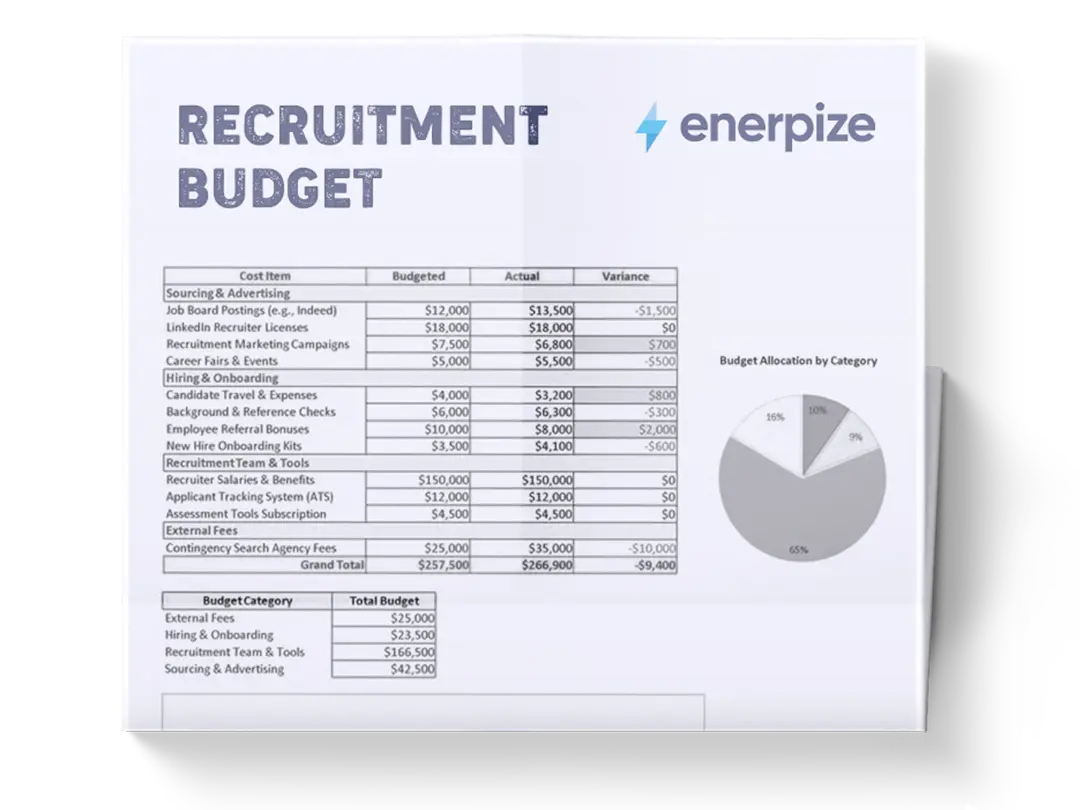
A recruitment budget template is a structured financial planning tool for organizing, tracking, and managing all costs associated with hiring. It provides a clear framework for estimating both fixed and variable recruitment expenses, such as hiring team costs and job advertisements.
What Does The Recruitment Budget Template Contain?
A recruitment budget template typically contains the following elements:
1- Salary costs of the hiring team
Includes HR staff, hiring managers, and interviewers. Costs are calculated by multiplying the time spent on recruitment activities by hourly wages.
2- Job boards and advertising
Covers all free and paid job postings, including subscription fees. Calculated by multiplying the number of postings by the cost per post.
3- External recruiting costs
Fees paid to recruitment agencies, headhunters, or recruiting software providers are usually a flat fee or a percentage of the new hire’s salary.
4- Employer branding and events
Includes career fairs, conferences, recruitment events, social media campaigns, and branding materials.
5- Hiring technologies
Costs of systems such as career pages, application portals, CRM tools, applicant tracking systems, recruiting analytics tools, and background check services.
6- Partnerships
Fees related to affiliations with universities or other institutions are used to source candidates.
7- Assessments
Costs of candidate testing or skill evaluations, calculated per candidate.
8- Internal recruitment teams
Salaries of in-house recruiting teams, based on hours spent on hiring activities.
9- Budget structure elements
Includes fixed costs, variable costs, recurring costs, and the defined time period for the budget.
10- Recruitment cost analysis
Tracks cost-per-hire using the formula:
(Internal costs + external costs) ÷ total number of hires
11- Performance tracking (KPIs)
Compares projected vs. actual expenses and KPIs to measure efficiency and identify gaps.
12- Hiring forecasts
Estimates annual hiring needs based on growth plans, turnover rates, and expected vacancies.
13- Buffer allocation
Reserved funds to cover unexpected recruiting expenses or opportunities.
How To Use The Recruitment Budget Template?
Using the template this way keeps your recruitment budget organized, measurable, and flexible enough to adjust as hiring needs change. Here are the steps to make a recruitment template:
1- Review past performance
Analyze key metrics such as time-to-fill, cost-per-hire, source efficiency, and recruiter productivity.
2- Forecast hiring needs
Estimate the number of hires based on growth, turnover, and potential vacancies.
3- Identify and categorize costs
List all recruitment expenses and split them into fixed (salaries, tools) and variable (ads, campaigns).
4- Allocate budget by role
Assign higher budgets to critical roles and lower budgets to easier or high-volume roles.
5- Include tools and improvements
Budget for recruiting technology and process improvements like pre-screening and referrals.
6- Add branding and external costs
Include events, partnerships, and external recruiters.
7- Set a buffer
Reserve part of the budget for unexpected hiring costs.
8- Track cost per hire
Measure efficiency using: (internal + external costs) ÷ total hires
9- Monitor and adjust regularly
Compare planned vs. actual results and update the budget as needed.
10- Invest in candidate experience
Improve hiring outcomes by focusing on candidate experience and recruiter skills.
Related Templates
Importance of a Recruitment Budget Template
A recruitment budget template plays a key role in making hiring more structured, efficient, and aligned with business needs. It is not just about tracking costs; it helps guide decisions and improve overall hiring outcomes:
- Provides financial clarity: It gives HR and finance teams a clear view of available resources and their usage. This prevents overspending on job ads, agencies, or tools, and helps track the return on investment of each hiring activity.
- Aligns hiring with business goals: A defined budget ensures recruitment supports company objectives such as growth, expansion, or new projects. It allows teams to forecast talent needs, identify hiring gaps, and plan ahead rather than react late.
- Helps prioritize spending: By tracking results from different sourcing channels, the budget makes it easier to focus on what works best. Companies can invest more in effective channels and reduce spending on low-performing ones.
- Improves hiring efficiency: Recruitment involves time and effort from multiple teams. A budget allows investment in tools and processes that reduce manual work, streamline tasks, and improve productivity.
- Supports employer branding: Activities like career pages, social media campaigns, and recruitment events require funding. A budget ensures these efforts are planned and maintained, helping attract stronger candidates.
- Enables scalable growth: Whether hiring increases due to expansion or unexpected needs, a budget prepares the company to respond quickly without disrupting operations or overloading teams.
- Encourages better use of tools: With proper planning, companies can invest in recruitment technologies and use them effectively, rather than relying on outdated or manual methods.
- Reduces time-to-hire and cost-per-hire: Clear budgeting helps expedite hiring decisions, improve offer acceptance, and avoid costly last-minute recruitment.
- Improves collaboration across departments: Creating and managing the budget requires input from HR, finance, and hiring managers, ensuring better alignment and transparency in hiring plans.
- Supports decision-making and justification: A structured budget provides data that helps explain recruitment spending to leadership and justify investments in hiring, tools, and resources.
Overall, a recruitment budget template ensures that hiring is planned, cost-effective, and aligned with long-term business growth while helping attract and retain the right talent.
Who Can Use The Recruitment Budget Template?
The recruitment budget template is primarily used by the Human Resources (HR) department, which typically manages the recruitment budget and tracks all hiring-related expenses.
Looking For More Than Just A Budget Template?
If you’re looking for more than just a budget template, Enerpize online HR management software provides a complete system that supports both recruitment planning and budget control through real HR operations.
- Builds a clear organizational structure: Creates departments, job roles, levels, and branches, helping define hiring needs more accurately for budget planning.
- Supports workforce and hiring planning: Gives a structured view of the organization, making it easier to estimate recruitment requirements and related costs.
- Automates employee contracts: Generates ready-made contracts with salary components, helping standardize and forecast hiring expenses.
- Simplifies payroll and compensation tracking: Automates payroll runs and payslips, improving visibility of salary costs linked to new hires.
- Reduces manual HR workload and costs: Automates contracts, payroll, and administrative processes, helping reduce inefficiencies that affect recruitment budgets.
- Connects recruitment planning to real HR data: Links hiring needs to actual employee structure, payroll, and performance, providing a more accurate and practical approach than a standalone budget template.
Overall, instead of just tracking recruitment costs, Enerpize helps manage the entire HR process that drives those costs in the first place.