

Posted on 7 October 2026
UAE E-Invoicing Readiness Checklist (Free Excel and Word Download)
- Free e-invoicing UAE readiness checklist in Excel, Word, PDF, Google Sheets and Google Docs, with no sign-up required
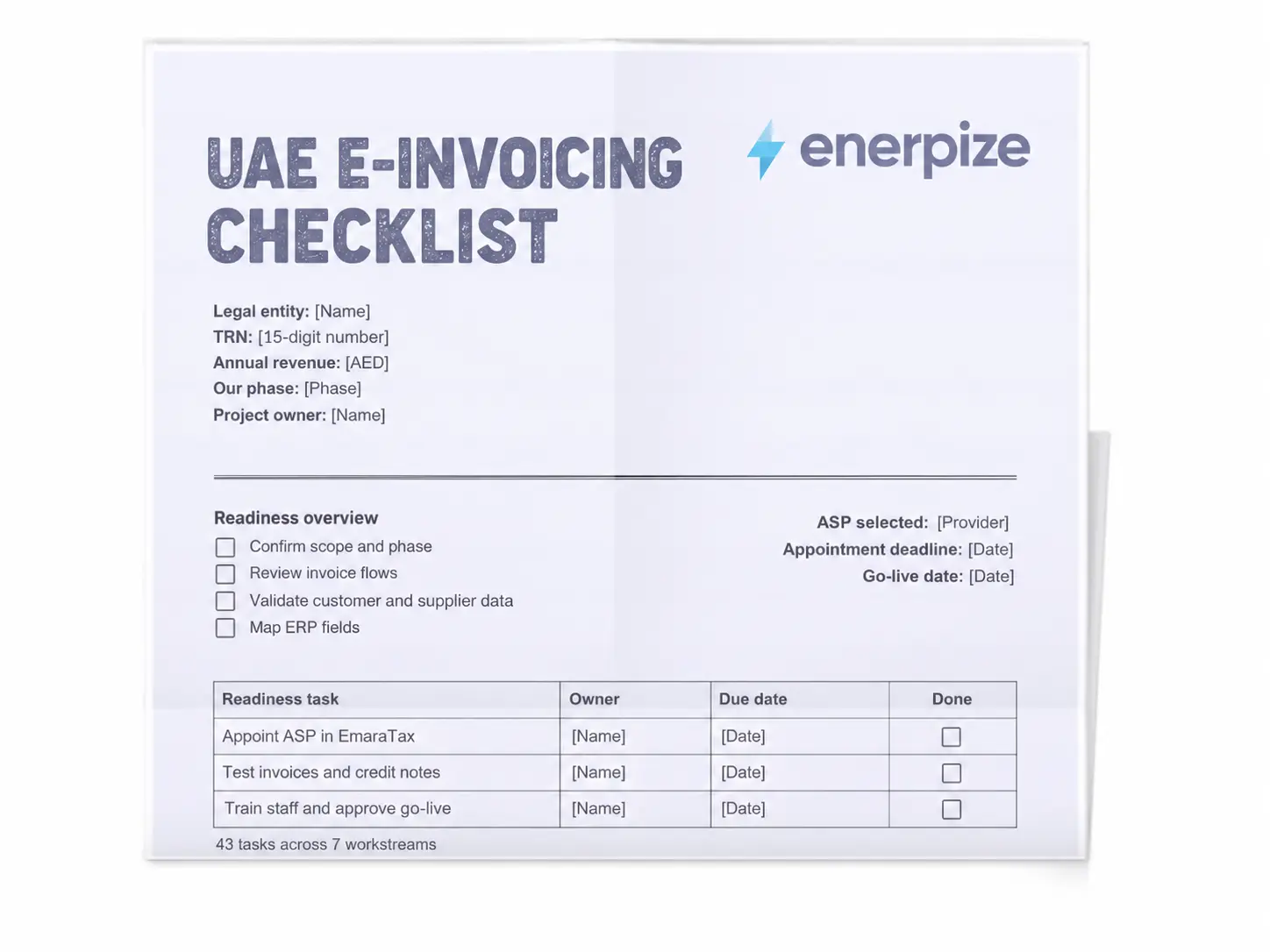
- Covers 43 tasks across 7 workstreams, from scoping and master data to ASP appointment, testing and go-live, each with an owner, a due date and a status
- Built around UAE rules: a phase finder for the AED 50 million threshold, a TRN to TIN to Peppol ID converter, and penalty amounts from Cabinet Decision No. 106 of 2025
- Calculates days left to each entity's ASP deadline and go-live date, schedules every task backwards, and totals penalty exposure with monthly caps automatically in Excel and Google Sheets
E-invoicing in the UAE is the mandatory exchange of invoices and credit notes as structured PINT AE data through a Ministry of Finance Accredited Service Provider, with tax data reported to the Federal Tax Authority. It starts on 1 January 2027 for businesses earning AED 50 million or more, and PDFs stop counting.


What Is E-Invoicing in the UAE?
Somewhere in Dubai right now, an accountant is exporting a PDF, attaching it to an email and pressing send.
It feels like invoicing. It looks like invoicing. From your go-live date, the law will treat it as something else: a picture of an invoice.
So, what is e-invoicing in the UAE once you strip away the acronyms? It is your invoice rebuilt as structured data that software can read, check and route without a human squinting at it. Ministerial Decision No. 243 of 2025 created the Electronic Invoicing System, and Ministerial Decision No. 244 of 2025 set the dates. Together they cover business to business (B2B), business to government (B2G), government to business and government to government transactions.
New to the wider topic? Our guide to invoice management covers the basics first.
What Counts as an E-Invoice, and What Doesn't
The Federal Tax Authority keeps it short. An e-invoice is "a structured form of invoice data that is issued and exchanged electronically between a supplier and a buyer and reported electronically to the UAE Federal Tax Authority."
Then comes the sentence that ends a lot of habits. PDFs, Word documents, images, scanned copies and emails are not e-invoices. Full stop.
The system recognizes six document types:
- Tax invoice
- Self-billed electronic tax invoice
- Tax credit note
- Self-billed electronic tax credit note
- Commercial invoice, for supplies that do not need a VAT tax invoice
- Credit note
You can still email a PDF copy. It simply has no tax standing.
The 5-Corner Model in Plain English
Think of it as a courier service that also sends a carbon copy to the tax office.
You, the supplier, are corner one. Your Accredited Service Provider (ASP) is corner two. Your buyer's ASP is corner three. Your buyer is corner four. The FTA sits in corner five, and the FTA e-invoicing platform receives the tax data from both providers.
That is the 5-corner model, built on the Peppol network that many countries already use for e-invoicing. Your provider validates the invoice, sends it on and reports the tax data at the same time. Every business gets a Peppol address made of the prefix 0235 plus its 10-digit Tax Identification Number, which is simply the first ten digits of its 15-digit TRN.
One detail surprises people. The FTA does not approve each invoice before your customer receives it. Validation happens at the provider layer, which is why your choice of provider matters so much.
What Actually Changes for a Small Business
You will not upload invoices to a government portal one by one. Your system sends the data to your ASP, and the ASP does the rest. What changes is discipline. Customer legal names must match trade licenses. TRNs must be right. Corrections go through credit notes, not quiet edits to last week's invoice. And invoices from your suppliers will arrive as data, so your purchasing side needs to be ready too.
E-Invoicing in the UAE: Timeline and Deadlines
Mandatory implementation runs in three waves, and every in-scope business has two dates, not one. The first is the date you must appoint a provider. The second is the date you must be live. Miss the first and the penalty clock starts before you have issued a single e-invoice.
Here is the UAE e-invoicing timeline as it stands on 7 October 2026:
| Phase | Who | Appoint an ASP in EmaraTax by | Mandatory go-live |
|---|---|---|---|
| Voluntary and pilot | Any business, plus invited pilot taxpayers | Optional | Open since 1 July 2026 |
| Phase 1 | Annual revenue of AED 50 million or more | 30 October 2026 | 1 January 2027 |
| Phase 2 | Annual revenue below AED 50 million | 31 March 2027 | 1 July 2027 |
| Government entities | Federal and local government bodies | 31 March 2027 | 1 October 2027 |
Phase is decided per legal entity, not per group, so three subsidiaries can land in different phases.
For the invoice itself, including the fields your tax invoice needs today, see our UAE invoice template.
The 30 October 2026 Deadline Extension, Explained
Ministerial Resolution No. 66 of 2026 moved the Phase 1 appointment date from 31 July 2026 to 30 October 2026.
Read the fine print. The go-live date did not move. It is still 1 January 2027.
So the extension gave large businesses more time to choose, and less time to build. On the day this page was updated, Phase 1 businesses had 23 days left to appoint a provider. If that is you, the UAE e-invoicing deadline is not a 2027 problem. It is this month's problem.
Choosing a Provider Is Not Appointing One
This is the trap I see most often. A finance team signs with a provider, ticks the box and moves on. The law does not care about your contract. The appointment counts when you complete it in EmaraTax: log in with UAE PASS, check your company details are current, open the E-INVOICING tile and select your provider. Sign the contract first, then appoint, then save the confirmation somewhere your auditor can find it.
How Long Implementation Really Takes
Accredited providers commonly quote 60 to 90 days from appointment to go-live for a typical business.
Now do the math. A Phase 1 business that appoints on 30 October has 63 days until 1 January, and the holidays sit in the middle. A Phase 2 business that appoints on 31 March gets 92 days until 1 July. Either way, the real UAE e-invoicing deadline is the last day you can start testing, not the date on the decision.
Who Must Comply With the UAE E-Invoicing Mandate
Here is the part that catches people out. The UAE e-invoicing mandate applies to any person conducting business in the UAE, whether or not they are registered for VAT.
The current exclusions are narrow:
- Sovereign activities of government entities that do not compete with the private sector
- International passenger air transport with an electronic ticket, and related airline services with an electronic miscellaneous document
- International air cargo documented by an airway bill, for 24 months only
- Financial services that are VAT exempt or zero-rated
- Supplies to consumers (B2C), which sit outside the current scope
Free Zones, Non-VAT-Registered Businesses and VAT Groups
Free zone does not mean free pass. When Gulf News asked the FTA's Director General, Abdulaziz Mohammed Al Mulla, about free zones in September 2026, his answer was direct: "As per law, all are required to register."
VAT groups get one concession. Transactions between members of the same VAT group have a 24-month grace period that runs from 1 January 2027 to 31 December 2028. Everything those members sell outside the group is fully in scope, and each member still needs its own TIN and its own Peppol identifier.
Selling Only to Consumers? You Still Receive E-Invoices
A retailer with zero B2B sales might assume this has nothing to do with them. It does. Your suppliers will send you e-invoices through the network. You need a provider and a Peppol address to receive them. The obligation runs in both directions.
UAE E-Invoicing Requirements: What Every E-Invoice Must Carry
A PDF can hide a messy customer record behind a nice logo. Structured data cannot.
The UAE e-invoicing requirements follow the Ministry of Finance Mandatory Field Requirements, which map to the PINT AE data dictionary. The fields below are the ones your finance team should recognize on sight:
| Field | Why It Matters |
|---|---|
| Document type and "Tax Invoice" title | Tells every system which of the six categories it is reading |
| Unique sequential invoice number | Duplicates are rejected before they reach your customer |
| Issue date, and supply date if different | Sets the tax point and your reporting period |
| Supplier legal name, address and TRN | Must match your FTA registration exactly |
| Buyer legal name, address and TRN | The buyer TRN is required when the buyer is VAT registered |
| Buyer Peppol participant ID | 0235 plus the buyer's 10-digit TIN; it is how the invoice finds them |
| Line description, quantity and unit | Lump-sum lines with no unit cause validation problems |
| Unit price and net amount before VAT | The base every tax calculation starts from |
| Tax category and VAT rate per line | Standard 5%, zero-rated, exempt, out of scope, reverse charge or margin scheme |
| VAT amount, shown in AED | Required in AED even when you invoice in another currency |
| Gross total and currency code | What the buyer actually owes, in which currency |
| Reference to the original invoice | Mandatory on every credit note |
If you also need a VAT layout for everyday use, our VAT invoice template shows the 5% calculation in practice, and our credit note template shows what a clean reference to the original invoice looks like.
Here is my honest take after looking at a lot of invoice data. The field that breaks most often is not the technical one. It is the buyer's legal name. "Marina Tower, attention Mr Khalid" is not a legal entity. Fix that in your customer list now and half of your rejection problems disappear before they exist.
What the Enerpize UAE E-Invoicing Readiness Checklist Includes
I did not want to publish another list of tips you read once and forget.
A useful checklist should tell you more than what to do. It should tell you when, who owns it, and what it costs if it slips. So we built this UAE e-invoicing compliance checklist as a working tool against the actual rulebook: Ministerial Decisions No. 243 and No. 244 of 2025, Ministerial Resolution No. 66 of 2026, Cabinet Decision No. 106 of 2025, the UAE Electronic Invoicing Guidelines version 1.1, the Mandatory Field Requirements, and the Ministry of Finance list of 64 accredited providers as it stood on 7 October 2026.
The Deadline Clock
The Phase Finder tab takes each legal entity's annual revenue and type, then returns its phase, its ASP deadline, its go-live date and a live countdown in days. Red means under 30 days. Amber means under 90. Nobody in your team can say they did not know.
Forty-Three Jobs, One Owner Each
The Readiness Checklist holds 43 tasks across seven workstreams, from scope and governance to go-live controls. Pick an entity, and every due date schedules itself backwards from that entity's deadline. Overdue tasks turn red on their own.
The Data Mirror
The Master Data Audit tab is where the real work happens. Paste in customers and suppliers, and it compares legal names, checks every TRN has 15 digits and builds each 0235 Peppol ID. Overseas buyers get the export endpoint automatically.
The Invoice Map
Invoices leak from places nobody remembers, like a POS till or a sales team spreadsheet. The Invoice Flow Inventory lists every channel you send and receive through and totals your yearly documents.
The Penalty Meter
Type in how late you are and how many invoices missed the system, and the Penalty Calculator applies the Cabinet Decision No. 106 amounts and monthly caps for you. It is the fastest way I know to get a budget approved.
The Provider Scorecard
Nine weighted criteria, three providers side by side, and one hard rule: any provider not fully accredited gets flagged "Do not appoint until accredited", whatever its score.
The Bilingual Glossary
Twenty-five terms in English and Arabic under one heading, UAE e-invoicing and الفوترة الإلكترونية الإمارات, from e-invoice (فاتورة إلكترونية) to accredited service provider (مزود خدمة معتمد للفوترة الإلكترونية). Your Arabic-speaking and English-speaking colleagues can finally argue about the same thing.
The Deadline Card and Sign-Off Sheet
The Word version adds a one-page deadline card for the finance desk, the full checklist with tick boxes, and a steering committee sign-off page.
All of it is free, editable and ungated. No email wall. No demo call.
PDF Tax Invoice vs UAE E-Invoice
| PDF tax invoice | UAE e-invoice | |
|---|---|---|
| Format | Visual document | Structured XML following PINT AE |
| How it travels | Email, print, portal upload | Through your ASP over the Peppol network |
| FTA visibility | Only during an audit | Tax data reported as each invoice is exchanged |
| Legal standing after your go-live | Readable copy only | The legal tax document |
| How you correct it | Often edited and resent | Only through an electronic credit note |
| QR code | Optional | Not required under the current framework |
| Language | Any | English is accepted; Arabic is not mandatory |
After your go-live date, the XML is the invoice. The PDF is just a picture of it.
How to Use the UAE E-Invoicing Readiness Checklist
Think of this UAE e-invoicing compliance checklist as a relay race. Each step hands the baton to the next, and dropping one slows everything after it.
Step 1: Confirm the Phase for Each Legal Entity
Open the Phase Finder and add every UAE entity with its TRN and latest annual revenue, so each one lands on the right line of the UAE e-invoicing timeline. Use the entity's own revenue, not the group total. An entity sitting close to AED 50 million should plan as Phase 1 until you are sure it is not.
Step 2: Map Every Invoice Flow, Sent and Received
List every channel that issues an invoice or credit note, then every place supplier invoices arrive, including intercompany flows and exports. Each invoice a forgotten channel issues outside the system can cost AED 100.
Step 3: Clean Customer and Supplier Master Data
Match legal names to trade licenses, collect missing TRNs and let the sheet build each Peppol ID. It is the longest task on the list, and you can start it before choosing a provider.
Step 4: Gap-Check Your ERP Against PINT AE
Compare what your system captures today with the UAE e-invoicing requirements set out in the Mandatory Field Requirements. Can it hold a buyer's Peppol ID, a tax category per line and a credit note reference? Then decide how your system will talk to the provider. That ERP integration choice decides how much IT work you face.
Step 5: Shortlist and Contract an Accredited ASP
Choosing an ASP for e-invoicing starts with the official list of accredited service providers. Shortlist three and score them in the Provider Scorecard. Ask each one for written confirmation of its accreditation status before you sign. One provider per entity handles both sending and receiving, so this is not a decision you can hedge.
Step 6: Appoint Your ASP in EmaraTax
Complete the appointment through the E-INVOICING tile and save the confirmation. This is the step that actually meets the deadline.
Step 7: Test in the Voluntary Window
Run real invoices, credit notes and awkward cases like exports through your provider, and test receiving too. Voluntary invoices carry no penalties, so mistakes here are free.
Step 8: Go Live, Monitor and Keep Records
Stop issuing in-scope invoices outside the system on your go-live date. Reconcile your system's records against your provider's status reports daily for the first month. Keep e-invoice data for five years after the end of the relevant tax period, or seven years for real estate records.
UAE E-Invoicing Penalties Under Cabinet Decision No. 106 of 2025
Penalties are where a compliance project stops being an IT ticket and becomes a board conversation. Cabinet Decision No. 106 of 2025 sets six of them. Here are the UAE e-invoicing penalties in one table:
| Violation | Penalty |
|---|---|
| Failing to implement the system, including failing to appoint an ASP, on time | AED 5,000 for each month or part of a month |
| Failing to issue and transmit an e-invoice on time | AED 100 per invoice, capped at AED 5,000 per calendar month |
| Failing to issue and transmit an electronic credit note on time | AED 100 per credit note, capped at AED 5,000 per calendar month |
| Issuer failing to notify the FTA of a system failure on time | AED 1,000 for each day or part of a day |
| Recipient failing to notify the FTA of a system failure on time | AED 1,000 for each day or part of a day |
| Failing to tell your ASP about changes to registered data on time | AED 1,000 for each day or part of a day |
The good news is that UAE e-invoicing penalties apply only once your mandatory date arrives. Nothing you issue in the voluntary phase can be fined.
How the Fines Stack Up in a Real Month
Picture a Phase 1 food distributor that appoints its provider two months late. That is AED 10,000.
In January it sends 40 invoices outside the system (AED 4,000). In February the number climbs to 90, but the cap holds the bill at AED 5,000. Eight credit notes also miss the system (AED 800). Then an outage goes unreported for three days (AED 3,000).
Total: AED 22,800 in e-invoicing fines, before anyone has looked at the VAT return.
The VAT Penalties That Sit on Top
The separate VAT administrative penalties for failing to issue or keep proper tax invoices can still apply alongside the e-invoicing fines. And there is a quieter cost. An accredited provider told Gulf News that only invoices successfully exchanged over the network will count for VAT purposes. Invoices that never made it through can leave you waiting longer to get paid.
System Failures and the Daily Clock
The most expensive line in that table is not the AED 5,000 one. It is the AED 1,000 per day for staying silent about an outage, because it has no monthly cap.
Write a one-page failure procedure before go-live: who spots it, who notifies the FTA and your provider, and where the evidence lives. Report first, investigate second.
Common E-Invoicing Errors in the UAE
A few myths keep resurfacing, and each one costs time:
- "We need a QR code." The UAE framework does not require one.
- "Invoices must be in Arabic." English is accepted.
- "We can delete a wrong e-invoice." You correct it with an electronic credit note that references the original.
- "We will use two providers." Each business appoints one ASP for both sending and receiving.
- "Signing the contract met the deadline." Only the EmaraTax appointment does.
UAE VAT Rules That Shape Every E-Invoice
E-invoicing did not replace UAE VAT law. It sits on top of it, and a machine now checks every rule you already follow.
The standard VAT rate is 5%. A supply can also be zero-rated, such as most exports and certain education and healthcare services, or exempt, such as certain financial services, residential property and local passenger transport. On an e-invoice, each line carries one of six tax categories: standard rate, zero-rated, exempt, out of scope, reverse charge or margin scheme. The FTA's e-invoicing page links the legislation behind all of this.
Tax invoices still need the words "Tax Invoice", the supplier's TRN and the VAT amount in AED, even when you bill in dollars. Supplies that do not need a VAT tax invoice, such as those made by businesses that are not VAT registered, go out as commercial invoices instead. And every correction runs through a credit note. The FTA e-invoicing framework simply makes that rule impossible to dodge.
What to add to your checklist for UAE VAT:
- Map every product and service to one of the six tax categories
- Confirm your system shows VAT in AED on foreign currency invoices
- Decide which supplies go out as tax invoices and which as commercial invoices
- Set retention to five years after the tax period, and seven for real estate records
Practical note for UAE businesses: Records can sit on servers outside the UAE only if the FTA can retrieve them in full on request. Get that promise in writing from your provider.
Phase 1 and Phase 2: Deadlines, Providers and Costs
On 29 September 2026, the FTA's Director General told Gulf News: "We are now at the transition phase." In other words, the explaining is over. The onboarding has started, and here is how the UAE e-invoicing timeline plays out for each phase before mandatory implementation.
The Ministry of Finance list of accredited service providers showed 64 accredited providers on 7 October 2026, plus two more still in final accreditation assessment. Accreditation follows Ministerial Decision No. 64 of 2025. Pre-approval is not the same thing. If your provider is not fully accredited when your go-live date arrives, the penalty lands on you, not on them.
Cost is lower than most SMEs fear. One accredited provider told Gulf News that a company generating 500 to 2,000 invoices can expect a package of about AED 2,500 to 3,000 a year.
What to add to your checklist for Phase 1 and Phase 2:
- Phase 1: appoint in EmaraTax by 30 October 2026, then test through November and December
- Phase 2: appoint by 31 March 2027, but use the UAE e-invoicing pilot and voluntary window to test now
- Check every shortlisted provider against the official list on the day you sign
- Ask for prices at your actual annual volume, taken from the Invoice Flow Inventory tab
Practical note for Phase 2 SMEs: The March deadline looks generous until you count backwards. The FTA's own message is that you can appoint today if you are ready.
Free Zones, VAT Groups, Exports and Retention Billing
The basic flow is simple. The edge cases are where invoices bounce. The UAE Electronic Invoicing Guidelines, updated to version 1.1 on 1 June 2026, spell out the special scenarios. You will find the guidelines, the decisions and the penalty decision on the Ministry of Finance eInvoicing page. The technical rules sit in the Peppol PINT AE specification, which covers both the invoice and the credit note transactions.
A few rules every finance team should know:
- Free zone sales: when the person consuming the goods differs from the contracting buyer, the e-invoice captures the beneficiary's details separately.
- Buyer not yet onboarded: the supplier uses the predefined endpoint 0235:9900000098 until the buyer has a Peppol ID.
- Deemed supplies: these use the fixed endpoint 0235:9900000097.
- Exports: when the overseas buyer has no Peppol ID, the supplier uses 0235:9900000099.
- Retention billing: the e-invoice shows only the amount actually due at that milestone, with VAT on that figure. The retained amount is invoiced when it is released.
- Advance payments: the final invoice should reference the advance invoice so the two link up.
What to add to your checklist for special scenarios:
- Tag free zone and Designated Zone customers in your master data
- Store the three predefined endpoints in your system so nobody has to look them up
- Check how your system splits retention from the amount due
Practical note for VAT groups: The 24-month grace period covers only transactions between members. Every sale to an outside customer follows the normal phase dates.
UAE E-Invoicing Notes by Industry
The rules are federal, but every industry trips over a different one.
Trading and Distribution
High volumes mean lots of credit notes for returns, and each one that misses the system is AED 100. Test returns properly, and load the export endpoint before your first overseas order. Enerpize for supply chain businesses keeps purchasing, stock and invoicing in one flow.
Construction and Contracting
Retention is the trap. Your e-invoice covers the amount due at each milestone, not the retained amount, so split progress claims before they become invoices. Enerpize for construction companies supports retention on invoices and cost centers for each project.
Real Estate
Records must be kept for seven years, two more than most businesses, and exempt residential supplies need the right tax category on every line. See how Enerpize supports real estate businesses.
Professional Services
"Advisory services, September" is not structured data. Bill hours, days or milestones with a unit, and every invoice after that is cleaner. Enerpize for consulting firms ties time and projects to invoices.
Retail and E-Commerce
Consumer sales are out of scope for now. Your stock purchases are not, so make sure you can receive e-invoices. Enerpize for retail stores connects POS, stock and purchasing.
Accounting Firms
Keeping books for a dozen SMEs means a dozen versions of the same question. Share the UAE e-invoicing compliance checklist with each client and start with whoever falls in Phase 1. Enerpize for accounting firms brings client billing and bookkeeping into one system.
How Enerpize Prepares Your Invoice Data for UAE E-Invoicing
What does your provider actually need from you on day one? Clean, complete, consistent data. That part is yours, whatever e-invoicing software or provider you choose. Let me be clear about roles. Enerpize is not an Accredited Service Provider, so it does not transmit e-invoices to the FTA. Your ASP does that. Enerpize is where the data your ASP depends on gets created and kept accurate, and with more than 40,000 businesses using it, that is a job it does every day. For e-invoicing in the UAE, that upstream discipline is half the battle.
Invoicing and Credit Notes
Enerpize invoicing numbers every invoice in sequence, applies tax settings per line, and handles corrections through credit notes instead of edits. Recurring invoices go out on schedule, and clients can view and pay through the client portal. Invoices can be issued in more than 135 currencies.
Customer Records and Sales
Every customer record holds the legal name, address, tax number and custom fields you choose, such as a Peppol ID, so the data is right before an invoice is ever raised. Enerpize sales management carries that record from quote to invoice to payment.
Purchases and Supplier Invoices
Remember the receiving side. Enerpize purchase management keeps supplier records, purchase invoices, refunds and debit notes organized, so incoming e-invoices have somewhere tidy to land.
Accounting, Reconciliation and Audit Trail
Enerpize accounting posts every invoice and credit note to the ledger automatically, with an activity log showing who changed what and when. That trail turns post go-live reconciliation into a ten-minute job instead of a lost afternoon.
Good e-invoicing software will not fix a messy customer list. Clean data will make any provider look good.
Key Takeaways
- E-invoicing UAE rules make structured PINT AE data, exchanged through an accredited provider, the legal invoice. PDFs become copies.
- Phase 1 businesses must appoint an ASP in EmaraTax by 30 October 2026 and go live on 1 January 2027.
- Phase 2 businesses appoint by 31 March 2027 and go live on 1 July 2027, and can test penalty-free now.
- Scope covers anyone conducting business in the UAE, including free zone and non-VAT-registered businesses, with B2C sales excluded for now.
- Penalties run from AED 100 per invoice to AED 5,000 per month, and unreported system failures cost AED 1,000 a day.
- Clean master data, meaning legal names, TRNs and Peppol IDs, is the longest task and the one to start first.
Frequently Asked Questions
Is e-invoicing mandatory in the UAE?
Yes, in phases. E-invoicing in the UAE becomes mandatory on 1 January 2027 for businesses with annual revenue of AED 50 million or more, on 1 July 2027 for businesses below that, and on 1 October 2027 for government entities. Voluntary adoption has been open since 1 July 2026.
Has the UAE e-invoicing deadline been extended?
Partly. Ministerial Resolution No. 66 of 2026 moved the Phase 1 ASP appointment date from 31 July to 30 October 2026. The deadline extension did not change any go-live date, so 1 January 2027 still stands.
What are the UAE e-invoicing penalties?
Under Cabinet Decision No. 106 of 2025, AED 5,000 per month for a late system or ASP appointment, AED 100 per invoice or credit note not transmitted (capped at AED 5,000 a month each), and AED 1,000 per day for late notice of system failures or data changes.
What is an Accredited Service Provider, and where is the official list?
An ASP is a company accredited by the Ministry of Finance to validate, send and receive e-invoices and report tax data to the FTA. The official list of accredited service providers is published on the Ministry of Finance eInvoicing page. On 7 October 2026 it named 64 providers.
Is a PDF invoice an e-invoice in the UAE?
No. PDFs, Word files, scans, images and emails are not e-invoices. Only structured data exchanged through an ASP counts. You can still send a PDF copy for people to read.
What is PINT AE?
PINT AE is the UAE version of the Peppol International invoice specification. It defines the fields, code lists and validation rules every UAE e-invoice and credit note follows. Your provider handles the format. Your job is accurate data.
Do free zone companies need e-invoicing?
Yes. Free zone and Designated Zone businesses are in scope unless a specific exclusion applies. Designated Zone status can change how a supply is taxed, but not whether it needs an e-invoice.
Does UAE e-invoicing apply to B2C sales?
Not currently. Supplies to consumers are outside the present scope. A business that only sells to consumers still has to receive e-invoices from its B2B suppliers.
Do UAE e-invoices need a QR code or Arabic text?
No. The current UAE framework does not require a QR code, and English is accepted. E-invoicing in the UAE relies on structured data validated by providers, not on printed codes.
Can a business use more than one ASP?
No. Each business appoints one ASP for both sending and receiving. Members of a VAT group each need their own TIN and Peppol ID, and may appoint different providers.
About the Author
Omar El Bahr is a Senior Digital Growth Specialist at Enerpize, where he leads SEO, content strategy, and organic growth across international markets. He is a Forbes Communications Council contributor and has written for Entrepreneur on business communication and digital strategy.
Disclaimer: This page is general information based on UAE Ministry of Finance and Federal Tax Authority publications as of 7 October 2026. It is not tax or legal advice. Confirm your obligations with the official sources or a qualified tax adviser.