

Posted on 6 October 2026
Free Payslip Template UK
- This free payslip template UK employers can download comes in Excel, Word, PDF, Google Sheets and Google Docs, with no sign-up required
- Covers every field the Employment Rights Act 1996 requires, with hours or days shown automatically when pay varies by time worked
- Built for all four UK nations, with Scottish (S) and Welsh (C) tax code checks and student loan Plans 1, 2, 4 and 5 at 2026/27 thresholds
- Calculates gross pay, NI, pension, student loan, net pay and year to date totals automatically in Excel and Google Sheets, plus a standing statement of fixed deductions with its 12 month reissue date
A payslip template UK employers can use is a ready-made itemized pay statement showing an employee's gross pay, every deduction, net pay and, where pay varies by time worked, the hours paid. The Employment Rights Act 1996 requires one on or before every payday.


What Is a Payslip in the UK?
Every payday, millions of people open a payslip and do exactly the same thing.
They scroll straight to the bottom.
Net pay. That one number decides whether the month feels comfortable or tight. But the lines above it tell the real story: where the money went, why the tax moved, and whether the overtime from that long Saturday actually landed.
A payslip is the written record of one pay period. It shows what an employee earned, what came off and why, and what reached their bank. HMRC never sees the payslip itself. It sees the Full Payment Submission your payroll sends on or before payday, and the two should match to the penny.
Payslip, Wage Slip, or Itemized Pay Statement?
Same document, three names.
"Payslip" is what everyone says. "Wage slip" is common in hourly work, and Acas uses both terms. "Itemized pay statement" is the legal name in section 8 of the Employment Rights Act 1996. Whichever one a contract or tribunal letter uses, it means the document this template produces.
What a Payslip Is Not
A payslip is not an invoice. Contractors bill you; employees and workers get paid through payroll.
It is not a P60 either. One P60 sums up a year of payslips. It never replaces them.
And it is not proof of a job that does not exist. A payslip for pay never run through PAYE is a fabricated document, and using one for a mortgage or visa application is fraud. Real payslips come from real pay runs. That is the whole point of them.
Are Payslips a Legal Requirement?
Yes. In England, Scotland and Wales, section 8 of the Employment Rights Act 1996 gives every employee and worker the right to a payslip at or before the time they are paid.
That right got wider on 6 April 2019. Before then, only employees qualified. Since then, workers do too, which pulls in casual, zero-hours and agency staff, according to government guidance on the change. Northern Ireland runs on its own legislation, which we cover in the nations section below.
Who Is Entitled to a Payslip (and Who Isn't)
Entitled: employees and workers, from their first payday. Agency workers get their payslips from the agency.
Not entitled: the genuinely self-employed, who invoice and handle their own tax, plus a few groups gov.uk names, including the police service, merchant seamen and women, and share fishermen.
The trap sits in the middle. Someone you treat as self-employed may legally be a worker, and the payslip right comes with the status.
When Payslips Must Be Issued
On or before payday. Not the day after. Not "when payroll catches up."
Acas calls it good practice to issue payslips before payday, so errors get fixed before the money moves. Two days of breathing room costs nothing.
What Happens When Payslips Go Missing
A worker with no payslip, or one missing required details, can take it to an employment tribunal.
The tribunal can declare the employer broke the law and order repayment of any deductions not properly shown in the 13 weeks before the claim, even deductions that were otherwise lawful, according to the government's payslip guidance. Tax and NI you were entitled to take can still come back out of your pocket.
That is why a payslip is not paperwork. It is insurance.
What Must Be on a Payslip UK Employers Issue
Here is where most payslip confusion lives. Some details are required by law. Others are useful but optional. A good payslip template UK businesses can rely on keeps the two apart, because the payslip format UK law expects is shorter than people think.
| Field | Required by law? | Why it matters |
|---|---|---|
| Gross pay | Yes | Total earnings before deductions, including overtime, bonuses and statutory pay |
| Each variable deduction (PAYE, NI, pension, student loan) | Yes | Each needs its own amount; a combined "tax and NI" line does not comply |
| Fixed deductions | Yes, itemized or by standing statement | One total is allowed only with a valid standing statement |
| Net pay | Yes | The amount actually paid |
| Split of payment methods | Only if pay is split | Required when part is paid one way and part another |
| Hours or days paid | Only if pay varies by time worked | Applies to pay periods beginning on or after 6 April 2019 |
| Rolled-up holiday pay | Only if you use it | Must sit on its own line for irregular-hours and part-year workers |
| Tax code, NI number, NI letter | Best practice | Gov.uk lists these as details a payslip "can also include" |
| Pay period, pay date, year to date totals | Best practice | Make the payslip easy to check against the P60 |
| Employer PAYE reference | Best practice | Helps employees and lenders confirm the employer is registered with HMRC |
Remember one rule from this table: every deduction that can change from one payday to the next needs its own line.
When Hours Must Appear on a Payslip
The 2019 rule sounds simple: show the hours when pay varies by time worked. The edge cases are where employers slip. The government's guidance works through eight situations, and they boil down to four patterns:
- Fixed salary, no overtime: no hours needed.
- Fixed salary plus paid overtime: show only the overtime hours.
- Paid by the hour: show every hour, as one total or broken down by rate.
- Paid by the day: show the days, because pay still varies with time worked.
Unpaid leave and statutory sick pay on a fixed salary do not trigger the rule. They are departures from normal pay, not pay that varies by time.
The Enerpize payslip template UK version turns all of this into a dropdown. Pick the pay basis, and the hours line appears or disappears on its own. Shift data from your timesheet template drops straight into the units column.
The Standing Statement of Fixed Deductions
This is the most underused tool in UK payroll.
Fixed deductions, like a season ticket loan repayment, can show as one total on the payslip, but only if the employee has a separate written statement listing each one, its amount and how often it applies. Acas confirms that statement lasts 12 months, then must be reissued, or sooner if anything changes.
Miss the reissue date and every payslip showing that single total stops complying. Quietly. Month after month.
What Should Never Appear on a Payslip
A full bank account number. A medical reason for sick leave. Anything private a colleague might glimpse at the printer. Payslips carry personal data under UK GDPR, so if the payslip does not need it to explain the pay, leave it off.
What the Enerpize Payslip Template UK Includes
We built the Enerpize payslip template UK employers can download the way I would want one handed to me on my first day running UK payroll: something that does not just look like a payslip, but stops the mistakes that cost money later.
Eight tabs. One job each. Here is what sits inside.
An Enter Details Tab That Does the Typing Once
Every input lives on one tab, in yellow cells with blue text, so you never hunt for what to change. You fill in the employer name, address, PAYE reference and Accounts Office reference. Then you add the employee's name, job title, payroll number, NI number, tax code, tax basis (cumulative or Week 1/Month 1), NI category letter, nation, student loan plan and Postgraduate Loan. Add the pay frequency, tax period, period dates, pay date and the date you issue the payslip, and the rest of the workbook follows.
An Hours Line That Thinks for Itself
Choose fixed salary, salaried with overtime, hourly or day rate, and the payslip shows exactly the time detail the law asks for. Fixed salary shows none. Salaried with overtime shows only the extra hours. Hourly shows every hour. Day rate shows the days. The pay basis decides it, not memory.
Earnings Lines for Every Way People Get Paid
Basic pay, overtime, additional rate hours such as bank holidays, bonus, commission, Statutory Sick Pay, Statutory Maternity Pay, Statutory Paternity Pay and other taxable pay each get their own line. Enter hours and a rate, or a fixed amount, and gross pay adds itself up. Empty lines stay off the printed payslip, so it never looks cluttered.
A Rolled-Up Holiday Line That Keeps Itself Separate
Mark a worker as irregular-hours or part-year and the 12.07% holiday pay appears automatically on its own line, calculated from the time-based pay. It never hides inside the hourly rate.
An Honest PAYE Field and Estimates You Can Override
PAYE runs on a cumulative basis that no simple spreadsheet replicates reliably, so the payslip template Excel file asks for the figure from HMRC's Basic PAYE Tools or your payroll software. Everything else estimates itself:
- National Insurance uses the employee's NI letter and HMRC's rounded thresholds, £1,048 a month or £242 a week for the primary threshold
- Pension is worked out on qualifying earnings at the employee and employer percentages you set, with the employer contribution shown on the payslip but never deducted
- Student loans cover Plans 1, 2, 4 and 5 plus the Postgraduate Loan, rounded down to the pound the way HMRC does
Each estimate has an override cell, so the payslip always matches your payroll software when the two differ.
A Standing Statement With an Alarm Clock
Fixed deductions can show as itemized lines or as one total. Choose the total and the Fixed Deductions Statement tab takes over. It holds up to five deductions, each with its purpose, amount per period, frequency and end date or balance, plus a signature line. It works out the reissue date 12 months after issue and flags the status as Valid, Not yet issued or EXPIRED. One forgotten date can no longer sink a year of payslips.
A Payslip That Prints on One Page
The Payslip tab pulls everything together:
- Employer and employee blocks, and the pay period.
- Payments with hours and rates, deductions and net pay.
- Year to date totals for each line.
- A payment split when net pay goes out two ways.
- The time worked line and the issue date.
Every legally required field carries an asterisk, with the rule explained at the foot of the page. Enter the year to date figures brought forward once, and the totals keep running.
A Required Fields Check Before Anything Leaves the Building
Nine legal checks and five best-practice checks run every time you change a number, with a count of anything that needs attention. Overtime for a fixed-salary worker? A Scottish employee still on 1257L? A single total for fixed deductions with an expired statement? An hourly rate below the National Living Wage? A payslip dated after payday? It says CHECK in red, with a note telling you how to fix it.
A Register That Remembers
Every payslip gets a row with gross pay, PAYE, NI, student loan, pension, fixed deductions and net pay. The register flags any payslip issued after payday and records whether the figures match the FPS you sent HMRC. It also works out two keep-until dates: HMRC's 3 years after the tax year ends and the minimum wage rule's 6 years. The worked example comes with six months of history, so you can see how a real year builds.
A Decoder for the Codes
One plain-English tab explains thirteen tax codes, from 1257L to the S and C prefixes. It also covers nine NI category letters with the employee rates the NI estimate uses, the student loan plans, and payslip abbreviations like YTD and FPS.
A Rates Tab You Update Once a Year
One tab holds every figure the workbook relies on, each with its source:
- The personal allowance, NI thresholds and employer NI.
- Pension bands and the auto-enrolment trigger.
- Student loan thresholds.
- The rolled-up holiday rate and the April 2026 minimum wage rates.
Check them against gov.uk every April and the whole workbook moves with you.
A How to Use Tab and a Worked Example
Eight short steps walk you from the rates check to the register. Every tab arrives filled in for a fictional business, Harbourside Bakery Ltd, so you can see a finished payslip before you type a single figure.
And if all you need is a simple payslip template to print and fill in by hand, the payslip template Word version does exactly that: a blank payslip, a blank standing statement and the same worked example, page for page.
Payslip vs P60 vs P45 vs P11D
Four documents. Four very different jobs.
| Document | When it is issued | What it shows | Who gets it |
|---|---|---|---|
| Payslip | On or before every payday | Pay, deductions and net pay for one period | Every employee and worker (employees only in Northern Ireland) |
| P60 | By 31 May after the tax year ends | Total pay and tax for the tax year | Employees still employed on 5 April |
| P45 | When employment ends | Pay and tax to date in the current year | Leavers, to hand to their next employer |
| P11D | By 6 July after the tax year ends | Taxable benefits and expenses, such as a company car | Employees who received reportable benefits |
The quotable version: a payslip proves a payday, a P60 proves a year, a P45 proves a goodbye, and a P11D proves the perks.
How to Make a Payslip With the UK Payslip Template: 8 Steps
Running a pay run for the first time feels like assembling flat-pack furniture without the picture on the box. These eight steps are the picture.
Step 1: Check the Rates Tab Before Anything Else
Every threshold lives on the Rates 2026-27 tab: the £12,570 personal allowance, NI thresholds, pension bands and student loan thresholds. Check them against gov.uk each April. A spreadsheet is only as current as its inputs.
Step 2: Fill In the Employer and Employee Details Once
Add your employer name, address and PAYE reference, then the employee's name, payroll number, NI number, tax code and NI letter. The UK payslip template Excel version carries these onto every payslip after that.
Step 3: Choose the Pay Basis
Fixed salary, salaried with overtime, hourly or day rate. This one choice controls whether hours appear, so make it before you enter any pay.
Step 4: Enter the Earnings for the Period
Use hours and a rate for time-based lines, or a fixed amount for salary, bonus and statutory pay. From 6 April 2026, statutory sick pay is payable from the first day of sickness, so enter it from day one, not day four. The payslip template Excel version adds up gross pay as you type.
Step 5: Get the PAYE Figure From Basic PAYE Tools
HMRC's Basic PAYE Tools is free payroll software for employers with fewer than 10 employees. It works out tax and NI and reports to HMRC, but it does not produce payslips. That is exactly the gap this template fills. Enter its PAYE figure and let the template estimate the rest.
Step 6: Decide How Fixed Deductions Appear
Itemized lists each one. A single total needs a valid standing statement, so complete that tab and give it to the employee before the first payslip that relies on it.
Step 7: Run the Required Fields Check and Send
Fix every CHECK, then save the Payslip tab as a PDF and send it on or before payday. Prefer pen and paper? Print the blank payslip template UK PDF, or fill in the payslip template Word file instead.
Step 8: Log It in the Register and Keep It
Record the payslip, confirm it matches the FPS you sent HMRC, and keep it. HMRC wants payroll records kept for 3 years after the tax year ends and can charge up to £3,000 for incomplete records. Minimum wage records need 6 years, so keeping everything for 6 years covers both.
Employ more than a handful of people? Keep a payroll template alongside the payslips so the whole team's pay run sits in one view.
UK Payslip Examples: Three Worked Scenarios
Theory is fine. Numbers are better. Almost every payslip example UK employers ask about falls into one of these three shapes, all on 2026/27 figures. Each one doubles as a payslip sample you can copy line by line.
The Salaried Supervisor With Overtime
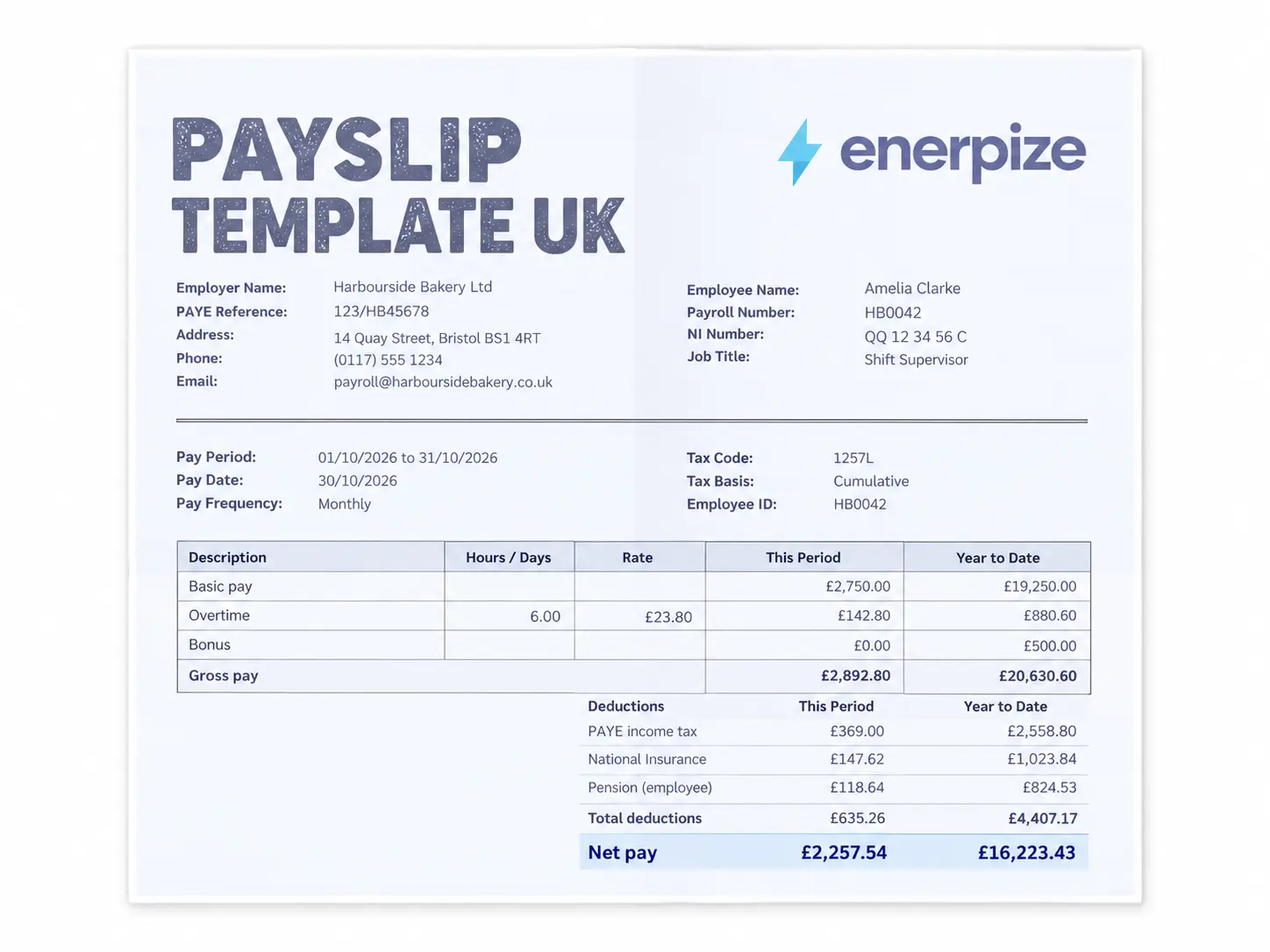
Amelia earns £33,000 a year at a Bristol bakery, paid monthly on tax code 1257L, NI letter A, with a Plan 2 student loan. In October she works 6 hours of overtime at £23.80.
- Gross pay: £2,750.00 salary + £142.80 overtime = £2,892.80
- PAYE: £369.00 (from payroll software)
- NI: 8% of pay above the £1,048 monthly threshold = £147.58
- Pension at 5% of qualifying earnings: £118.64
- Plan 2 student loan: 9% above £2,448.75 a month, rounded down = £39.00
- Fixed deductions: £90.00
- Net pay: £2,128.58
Her payslip shows "6.00 variable hours" and nothing about her contracted hours. Her salary does not vary with time; her overtime does. This is the UK payslip example filled in on the Excel and Word downloads.
The Hourly Retail Assistant With Rolled-Up Holiday Pay
Jordan, 24, works irregular shifts, paid monthly at the £12.71 National Living Wage that applies from 1 April 2026. In October he works 64 hours.
- Basic pay: 64 × £12.71 = £813.44
- Rolled-up holiday pay at 12.07%: £98.18, on its own line
- Gross pay: £911.62
- NI and PAYE: £0, because his pay sits below the monthly thresholds
- The payslip must show all 64 hours
One detail catches employers out: the rolled-up holiday element does not count towards minimum wage pay. The basic rate alone has to clear £12.71.
The Scottish Taxpayer With a Plan 4 Loan
Ewan earns £38,000 in Glasgow on tax code S1257L with a Plan 4 student loan. Across Scotland's six bands, his income tax comes to about £5,131 a year, roughly £45 more than the same salary in England.
- Gross pay: £3,166.67 a month
- Scottish income tax: about £427.59
- NI: £169.49, because NI is UK-wide
- Plan 4 student loan: 9% above £2,816.25 a month, rounded down = £31.00
- Net pay before pension: about £2,538.59
Same layout, different prefix. On this example payslip UK employers in Scotland would recognize, the template's nation check confirms the S is there.
Tax Codes and NI Letters, Decoded
Your employees will ask what the code on their payslip means. Here is your cheat sheet.
| Code | What it means |
|---|---|
| 1257L | Standard code: £12,570 tax-free personal allowance |
| BR | All pay taxed at the basic rate, often a second job |
| 0T | No personal allowance used on this pay |
| D0 / D1 | All pay taxed at the higher or additional rate |
| K codes | Benefits or untaxed income exceed the allowance |
| W1, M1 or X | Emergency, non-cumulative basis |
| S prefix | Scottish taxpayer, Scottish bands apply |
| C prefix | Welsh taxpayer, Welsh rates apply |
| NI letter A | Most employees aged 21 to State Pension age |
| NI letter C | Over State Pension age, no employee NI |
| NI letter M / H | Under 21 / apprentice under 25, employer relief applies |
For the bigger picture of how codes, deductions and filing fit together, the Enerpize payroll cheat sheet puts the whole cycle on one page.
Payslip Rules in Scotland, Wales and Northern Ireland
One payslip template UK wide. Three places where the payslip quietly changes.
Scotland
A Scottish payslip can be perfectly laid out and still wrong by hundreds of pounds a year if the tax code lacks one letter.
Scotland sets its own income tax on earnings. For 2026/27, Scottish Income Tax runs across six bands, from a 19% starter rate on £12,571 to £16,537 up to a 48% top rate above £125,140. The Scottish Government estimates around 55% of Scottish taxpayers will pay less income tax than they would elsewhere in the UK, with those earning under about £33,500 paying less.
What to add for Scottish payslips:
- A tax code starting with S, such as S1257L
- Plan 4 for most Scottish student loans, with a 2026/27 threshold of £33,795
- NI exactly as the rest of the UK, because NI is not devolved
Practical note for Scottish employers: HMRC decides who is a Scottish taxpayer by where they live, not where your office is. A Carlisle business with a Dumfries employee runs a Scottish payslip.
Wales
Wales looks identical on paper. For now.
Since April 2019, Welsh taxpayers have carried a C prefix, and the Senedd sets its own Welsh Rates of Income Tax. For 2026/27, those rates stay at 10p in each band, so the combined rates match England at 20%, 40% and 45%. Per gov.uk's Welsh Income Tax page, someone pays the Welsh rates if they live in Wales for longer than anywhere else in the UK during the tax year, and the change is backdated to the start of that year.
What to add for Welsh payslips:
- A tax code starting with C, such as C1257L
- The same deduction figures as an English payslip on the same pay
- A step in your starter process to confirm the home address with HMRC
Practical note for Welsh employers: the C does not change take-home pay today, but it decides which government receives the tax. Leave it off and HMRC will correct the code, and your payslips, later.
Northern Ireland
Northern Ireland is the big surprise.
Payslip law there comes from Article 40 of the Employment Rights (Northern Ireland) Order 1996, not the GB Act, and the 2019 changes that brought in workers and the hours rule were made for Great Britain. According to nidirect's guidance on pay and payslips, the statutory right covers employees, while contractors, freelancers and workers have no right to a payslip. The same guidance lists the pay rate, annual or hourly, among the details a pay statement contains. A Northern Ireland government impact assessment cites figures showing 88% of employers already put hours on payslips anyway.
What to add for Northern Ireland payslips:
- The pay rate on every payslip, as nidirect lists it
- Hours for hourly staff, even where not strictly required, to match GB practice
- A standing statement for fixed deductions, which applies in Northern Ireland too
Practical note for Northern Ireland employers: the Labour Relations Agency, not Acas, handles employment advice here. Its pay rates at a glance page confirms the April 2026 minimum wage and statutory pay rates, including sick pay from the first full day of sickness.
Sending Payslips by Email and Keeping Records
A payslip does not need paper. It needs to reach the person, on time, in a form they can keep.
Electronic Payslips
Gov.uk lets employers choose printed or electronic payslips. Acas adds a condition: if an employee cannot access payslips online, provide another format, such as paper.
Two habits help. Password-protect emailed PDFs, and let leavers download their payslip history before you switch off their access. Their next mortgage application will thank you.
How Long to Keep Payroll Records
The honest answer is "longer than you think."
| Record | Minimum period | Source |
|---|---|---|
| PAYE payroll records | 3 years after the end of the tax year | HMRC |
| Hours and pay for minimum wage | 6 years | Acas |
| Sick leave and payment records | Keep with payroll | HMRC |
Six years covers both rules. The template's register works out each keep-until date for you.
Can Self-Employed People Make Their Own Payslip?
Short answer: no, and they should not try.
A payslip is something an employer gives a worker. A sole trader has no employer, no PAYE deducted at source and no payroll. A self employed payslip showing tax and NI that were never deducted describes a pay run that never happened, and lenders know it.
Self-employed income is proven by the SA302 tax calculation and the Tax Year Overview from HMRC, backed by accounts and bank statements. When a sole trader needs to get paid by a client, the right document is an invoice, and our sole trader invoice template handles that.
The one real exception: a director paid a salary through their own limited company's payroll is that company's employee and gets a genuine payslip. So an honest self-employed payslip exists, but only when the company runs real PAYE.
How Enerpize Handles Payslips and Payroll
What happens when the spreadsheet that worked for three employees meets your fifteenth?
The template gets you compliant today. Enerpize takes the copying and pasting out of tomorrow. Inside the Enerpize HR and payroll module, payslips are not a separate document you rebuild every month. They are the output of the pay run itself.
Pay Runs Built From Salary Components
You define salary components once: basic pay, allowances, overtime, deductions. Each employee contract links to the components that apply, and every pay run pulls from that structure instead of a blank page.
Payslips Generated Inside Each Pay Run
Run payroll for the period and Enerpize produces a payslip for each employee in the run. Employee loans, like the season ticket loan in our example, sit in the loans area and come off pay until they are repaid.
Attendance and Leave Feeding the Numbers
Attendance logs, shifts and leave records live in the same system as payroll, so hours worked and leave taken reach the pay run without anyone retyping a timesheet.
Keep using HMRC-recognized payroll software or Basic PAYE Tools for your RTI submissions. Enerpize keeps the people, the pay structure and the payslips organized in one place, alongside your accounting.
Payslip Checks for Different Industries
Every industry has one payslip line that causes more questions than the rest. Here is yours.
Hospitality and Restaurants
Tips. Since 1 October 2024, the Employment (Allocation of Tips) Act 2023 requires employers to pass all qualifying tips to workers in full. Show tips paid through payroll on their own line so staff can see every pound arrived. Enerpize for restaurants connects your sales side to the people who serve it.
Retail
Variable hours. Retail rotas change weekly, so most retail payslips must show every hour, and irregular-hours staff may need a rolled-up holiday line. Enerpize retail management keeps stock, sales and staff in one system.
Construction
Status. Your PAYE site staff get payslips. Your CIS subcontractors do not; they get monthly payment and deduction statements, with deductions usually at 20% or 30% of labor. Mixing the two up invites an HMRC investigation. Enerpize for construction companies tracks projects and costs alongside the team.
Clinics and Care
Travel time. For care workers visiting clients, time traveling between appointments counts as working time for minimum wage purposes. If it is paid by the hour, it belongs on the payslip. Enerpize for clinics brings appointments, staff and billing together.
Key Takeaways
- Payslips are a legal requirement. In Great Britain, every employee and worker must get one on or before payday under section 8 of the Employment Rights Act 1996.
- Four things are non-negotiable. Gross pay, each variable deduction, net pay, and hours or days where pay varies by time worked.
- Fixed deductions need a plan. Itemize them or issue a standing statement, and reissue it every 12 months.
- Northern Ireland is different. The statutory right covers employees, and nidirect lists the pay rate among the required details.
- The tax code prefix matters. S for Scottish taxpayers, C for Welsh taxpayers, based on where the employee lives.
- Keep records for 6 years. That covers HMRC's 3-year rule and the 6-year minimum wage rule in one go.
Frequently Asked Questions
Are payslips a legal requirement in the UK?
Yes. In England, Scotland and Wales, employers must give every employee and worker a payslip on or before each payday under section 8 of the Employment Rights Act 1996. In Northern Ireland, the right comes from Article 40 of the Employment Rights (Northern Ireland) Order 1996 and covers employees.
When should I receive my payslip?
On or before payday, every time you are paid. Acas recommends issuing payslips before payday so errors can be fixed before the money arrives. If yours is late, raise it with payroll first, then through a formal grievance.
What must a UK payslip include by law?
Gross pay, each variable deduction as its own amount, fixed deductions or a standing statement covering them, net pay, and the split if pay goes more than one way. Hours or days must also appear when pay varies by time worked.
Do payslips have to show hours worked?
In Great Britain, only when pay varies by time worked. Hourly and day-rate workers need their time shown. Salaried staff with paid overtime need only the overtime hours. Fixed-salary staff with no variable pay need none.
Can payslips be sent by email?
Yes. Employers can choose printed or electronic payslips, including email and online portals. If an employee cannot access them electronically, Acas says provide another format. Password-protect emailed payslips, because they carry personal data under UK GDPR.
How long should employers keep payroll records?
HMRC requires PAYE records for 3 years after the end of the tax year they relate to, and can charge up to £3,000 for incomplete records. Minimum wage records need 6 years, so keeping everything for 6 years is the safe approach.
Can self-employed people make their own payslip?
No. A payslip comes from an employer, and a sole trader has no employer or PAYE deductions. Self-employed income is evidenced by HMRC's SA302 and Tax Year Overview. A director paid through their own company's payroll is an employee and gets a genuine payslip.
Does a payslip need to show the tax code and NI number?
Neither is a legal requirement, though gov.uk lists both as details a payslip can include. Showing them is good practice: employees use the tax code to check their tax, and lenders often expect both.
What is a standing statement of fixed deductions?
A written statement listing each fixed deduction, its amount and how often it is taken. With one in place, fixed deductions can appear as a single total on the payslip. It lasts 12 months and must be reissued, or updated sooner if a deduction changes.
Is there a UK payslip template in Excel?
Yes. The Enerpize payslip template UK download includes an Excel version that calculates gross pay, NI, pension, student loan and net pay. Every UK payslip template free download here is an editable payslip template with no sign-up, and each payslip template free download includes the worked example.
About the Author
Omar El Bahr is a Senior Digital Growth Specialist at Enerpize, where he leads SEO, content strategy, and organic growth across international markets. He is a Forbes Communications Council contributor and has written for Entrepreneur on business communication and digital strategy.
Disclaimer: This template and guide are for general information only and do not constitute legal, tax or payroll advice. Rates and rules change, so verify figures with HMRC, gov.uk or a qualified adviser before relying on them.