Templates
/
Business Loan Documents Australia: Free Checklist and Template Pack
Posted on 20 September 2026
Business Loan Documents Australia: Free Checklist and Template Pack
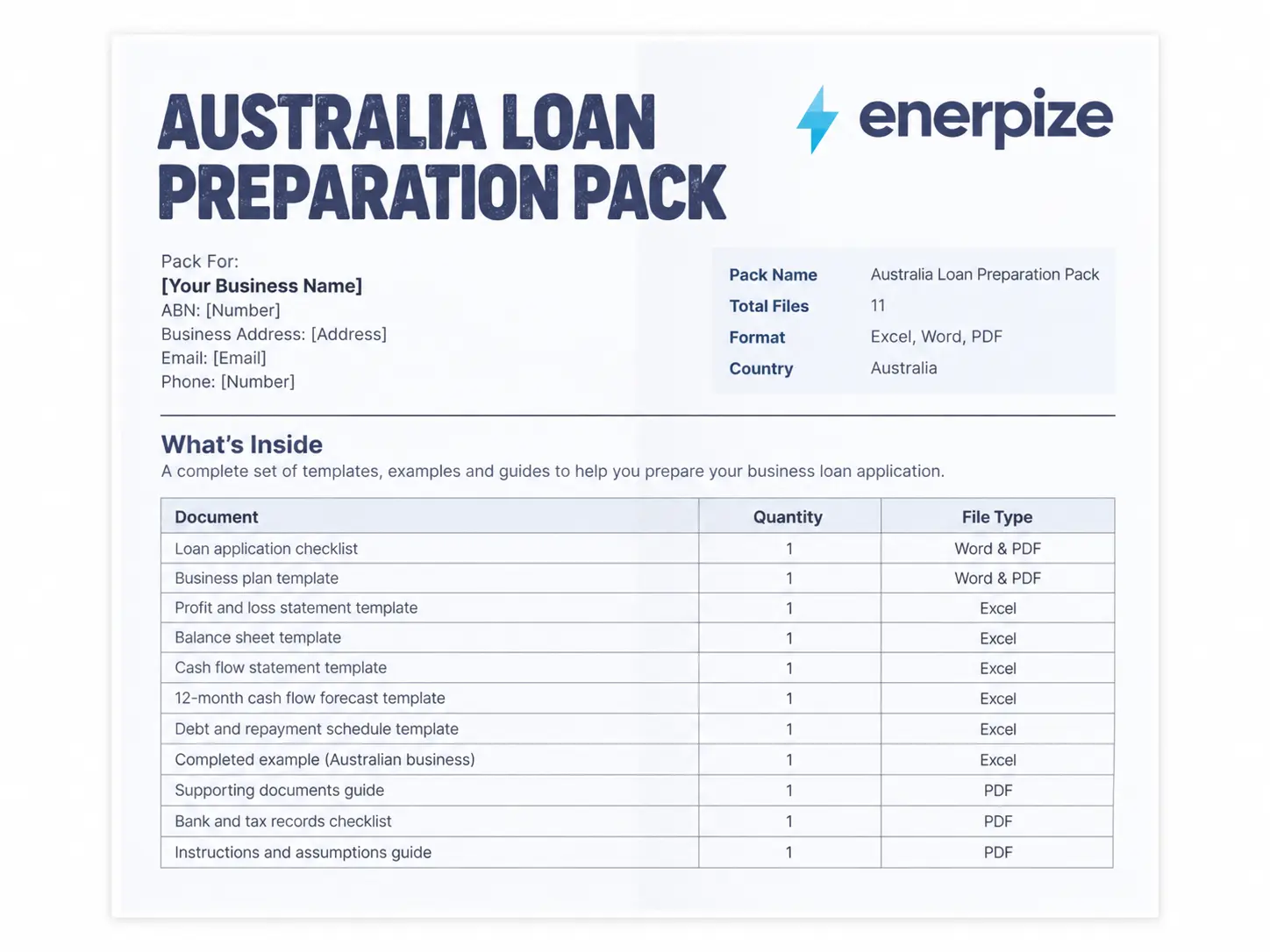
Download one ZIP containing 11 files, including an Australian application checklist, an editable business plan, financial statement templates, debt and repayment schedules, a completed example, a bank-rate reference, and practical guides.
Organise historical results and future projections separately, with a 12-month cash-flow forecast and space to explain your assumptions.
Follow a worked Australian business example that connects the amount requested, planned spending, customer collections, and loan repayments.
Compare published bank rates and identify the bank statements, tax records, and supporting documents you need to collect before applying.
Business loan documents are the financial records, business details, forecasts, and supporting evidence a lender uses to assess a funding request. This Australian loan preparation pack brings together 11 practical files to help you organise your information, explain your borrowing needs, and identify anything missing before you apply.
Business loan documents help a lender understand three things: how your business is performing, why you need the money, and how you expect to repay it.
A sales figure on its own cannot answer all three. You also need to explain the expenses behind that revenue, the cash tied up in unpaid invoices, and the commitments already coming out of your bank account.
That is where preparation matters. Your profit and loss statement might show a profitable business, but your bank account could still be under pressure because customers pay late or you buy stock months before selling it. Your application needs to explain both.
This pack gives you a structure for preparing that information. It is not a bank application form, a loan agreement, or a substitute for bank-issued statements. Your lender decides which documents it needs and whether accountant-prepared financials are required.
CommBank’s application guide identifies financial statements, bank statements, personal income evidence, and identification among the records applicants may need. Additional requirements depend on the business and loan.
Lender, outstanding balance, facility limit, repayments, security, maturity, and any balloon payment
Loan contracts and current statements
Business bank statements
Original statements covering the period requested
Your bank
BAS and tax records
Lodged statements, returns, and ATO account information requested by the lender
Your ATO records or tax agent
Accounts receivable and payable
Customer and supplier balances, due dates, and overdue amounts
Your customer and supplier ledgers
Supporting evidence
Relevant contracts, leases, quotes, licences, ownership documents, or guarantees
Original issuers and your business records
For context, ANZ’s lending checklist lists two years of finalised profit and loss statements and balance sheets among common supporting records. It also distinguishes the non-ANZ statement history requested from new and existing customers. These are ANZ’s checklist examples, not a universal Australian requirement.
One field belongs on every financial worksheet: the reporting period or “as at” date. A full financial year, a recent quarter, and a forecast describe different things. Label them clearly so the lender can understand what it is comparing.
What the Enerpize Loan Preparation Pack Includes
The ZIP contains 11 files organised into templates, a completed example, and supporting guides. Together, they help you document the request, prepare the financial information, test repayments, and identify the official records you still need to obtain.
An application checklist in Word and PDF
The application checklist helps you record each document requested by the lender, the required reporting period, who is responsible for preparing it, its status, and the final file reference.
The Word version can be edited digitally. The PDF version can be printed or used as a fixed reference. The financial workbook also contains a checklist sheet for tracking the same process alongside your financial preparation.
A business plan in Word and PDF
The business plan template covers:
Business identity and ownership
Funding request and proposed terms
Business model and trading history
Customers, competition, and pricing
Sales and marketing plans
Operations, suppliers, premises, and staffing
Management responsibilities
Use of funds
Forecast and repayment assumptions
Risks and proposed responses
Supporting evidence
Use the Word version to write and revise the plan. The PDF version provides a printable copy of the same structure.
The Excel workbook brings the main financial schedules into one file:
Summary
Assumptions
Profit and loss
Balance sheet
Historical cash flow
12-month cash forecast
Existing debt
Proposed loan repayments
Receivables and payables
Application checklist
Review and reconciliation checks
Amber cells with blue text identify the areas you can edit. Formula cells calculate totals, loan repayments, forecast cash balances, and differences between connected schedules.
The historical statements remain manual input templates because they need to come from your reconciled accounting records. The forecast, repayments, debt schedules, and summary are linked through formulas.
Base and downside cash-flow cases
The workbook includes one case selector for switching between a base forecast and a downside forecast.
You can enter separate customer-collection assumptions for each case while keeping the same payment schedule. This helps you see what happens to cash if customers pay less or later than expected.
The forecast also keeps project purchases, operating payments, debt repayments, owner contributions, and loan proceeds separate so you can understand what causes each cash change.
Existing debt and proposed repayments in one workbook
The existing-debt schedule records current balances, facility limits, monthly payments, rates, security, maturity dates, and any balloon amounts.
The proposed-loan schedule calculates monthly principal and interest from the amount, annual rate, term, fees, and balloon entered. The resulting payment feeds into the 12-month cash forecast.
Confirm the calculation against the lender’s written repayment schedule before making a borrowing decision.
A receivables and payables schedule
The workbook includes a register for outstanding customer and supplier invoices.
Record the counterparty, invoice reference, invoice date, due date, outstanding amount, and supporting evidence. The schedule calculates overdue days and compares the totals with the corresponding balance-sheet figures.
This helps you check whether the balances in your application agree with the invoices behind them.
A completed Australian business example
The completed example includes:
A completed business plan in Word and PDF
A completed financial workbook
A base cash-flow forecast
A 10% lower-collections case
A proposed A$80,000 loan
An A$20,000 owner contribution
A detailed A$100,000 use-of-funds plan
Historical financial statements
Existing debt and outstanding-invoice schedules
Loan repayment calculations
Financial reconciliation checks
The example follows Harbour Trade Supplies, a fictional Melbourne wholesaler. Every business detail and financial figure is invented for teaching purposes and must not be submitted as real information.
A dated Australian bank-rate reference
The pack includes a PDF comparing published business-loan information from CommBank, NAB, ANZ, and Westpac.
It distinguishes secured starting rates, unsecured rates, fixed rates, variable rates, personalised pricing, and selected fees. The figures were checked on 19 September 2026.
The reference is a research starting point. Rates, fees, eligibility, and lending terms can change, so confirm the current information directly with the lender before applying.
A user guide and starting instructions
The User Guide explains the recommended completion order, workbook structure, model assumptions, repayment method, GST treatment, and limitations.
The START_HERE.txt file provides a quick inventory of the pack and explains which files are blank templates and which contain fictional example information.
Review checks connecting the documents
The workbook’s Review sheet compares:
Assets with liabilities and equity
Historical closing cash with balance-sheet cash
Existing debt with the balance-sheet debt total
The receivables register with balance-sheet receivables
The payables register with balance-sheet payables
The project budget with the loan and owner contribution
Historical reporting dates across the statements
A zero difference confirms that the entered figures agree mathematically. It does not verify whether the source documents are accurate or complete.
The pack does not include bank-issued statements, lodged BAS, tax returns, identity documents, signed contracts, or other official evidence. Obtain those documents from their original issuers according to the lender’s requirements.
Loan Preparation Pack vs Business Plan vs Bank Application Form
Document
Main purpose
Who prepares it?
What it does not replace
Loan preparation pack
Organise financial information and supporting evidence
Business owner, with accountant input where needed
The lender’s application process
Business plan
Explain the business, strategy, funding purpose, and assumptions
Business owner or adviser
Historical financial statements and bank records
Bank application form
Capture information in the lender’s required format
Applicant using the lender’s form
Supporting documents the lender requests
Loan agreement
Set out the agreed lending terms and obligations
Issued by the lender for review and acceptance
A preparation worksheet or forecast
Use the pack to prepare, the business plan to explain, and the lender’s application process to submit.
Australian Bank Business Loan Interest Rates
The following figures were checked against official bank sources on 19 September 2026.
These are published product rates, not personalised offers or a cheapest-bank ranking. A “from” rate is a starting point. Your rate can depend on the product, security, term, and the bank’s assessment.
A lower headline rate does not automatically mean a lower total cost.
Compare offers for the same borrowing amount and term. Include establishment charges, ongoing fees, early repayment costs, and any final balloon payment. Check what security or guarantees each offer requires.
Also distinguish a product rate from a reference rate. NAB’s business rates page, for example, lists indicator rates and explains that a customer margin may apply. An indicator alone is not a complete customer quote.
Put the repayment into your forecast
Consider an illustrative loan of A$80,000 at an assumed 12% annual nominal interest rate over 60 months.
With monthly compounding, payments at month-end, no fees, and no balloon, the estimated monthly principal-and-interest repayment is A$1,779.56.
The 12% rate is a calculation assumption, not a bank offer. Replace it with your quoted rate and the lender’s repayment schedule.
Then ask the more useful question: after suppliers, wages, tax, existing debt, and other commitments are paid, does the business have enough cash left for that repayment?
How to Use the Pack Before Applying
1. Confirm the product and eligibility
Check the lender’s business loan requirements before completing every worksheet. Trading history, turnover, business structure, security, and borrowing purpose can affect eligibility.
For example, NAB QuickBiz lists GST registration, annual turnover of at least A$75,000, and more than 12 months under the current ABN or ACN among its criteria.
A well-prepared application still needs to meet the product’s eligibility rules.
2. Ask for the lender’s document list
Confirm which reporting periods, file formats, and level of accountant involvement the lender needs.
Record those requirements in your business loan application checklist. This prevents you from spending time preparing a document that covers the wrong period or leaves out information the lender specifically requested.
3. Bring your books up to date
Record outstanding sales invoices, supplier bills, receipts, refunds, bank fees, and owner transactions. Investigate unexplained differences before using the figures in your application.
The bank reconciliation template can help document how your accounting cash balance relates to your bank statement.
4. Prepare the historical financial statements
Use reconciled records and keep the legal entity, reporting dates, and accounting basis consistent.
Label interim accounts separately from finalised annual accounts. Explain material one-off transactions so the lender can distinguish normal trading from an unusual event.
5. Forecast when money will move
An invoice issued in October may not be paid in October.
Forecast when customers are expected to pay and when suppliers, employees, tax authorities, and lenders must be paid. Use the pro forma cash-flow statement template to organise those movements.
6. Write the business plan from the numbers
Your business plan for a loan application should explain the amount needed, what it will fund, and the evidence supporting future collections.
Connect each major assumption to something concrete, such as historical sales, a supplier quote, an existing contract, or available operating capacity. Keep unsigned opportunities separate from confirmed orders.
7. Test a downside case
Model slower customer payments, lower sales, or higher costs. Start with a clearly stated change so you can see what causes the shortfall.
Then explain the response. Could you stage a purchase, reduce discretionary spending, or change collection practices? Our financial forecasting guide explains how to review assumptions against actual results.
8. Review and submit
Check that your business loan documents use consistent figures and dates. Obtain any accountant review the lender requests and remove fictional examples from your submission.
Send the required information through the bank’s nominated channel. Keep a dated copy so you know exactly what was submitted.
Business Plan for Bank Loan Example: An Australian Wholesaler
This fictional example shows how a business can connect its funding request to its operations and expected cash flow.
All figures are in Australian dollars. The example is a condensed plan, not a lender-approved model or a substitute for a complete forecast.
Business and customers
Harbour Trade Supplies is an established Melbourne wholesaler supplying packaging and cleaning consumables to local hospitality businesses.
It earns revenue from repeat trade orders. Its expansion plan is to hold more fast-selling stock and improve picking capacity within its existing premises.
The business expects customers to value reliable availability and predictable delivery. A real application should support that expectation with order history, customer retention information, competitor research, and supplier lead times.
Funding request and planned spending
The business requests A$80,000 and contributes A$20,000 of owner funds, creating a total project budget of A$100,000.
Use of funds
Amount
Additional inventory
A$50,000
Storage and picking equipment
A$20,000
Setup and delivery changes
A$10,000
Working-capital reserve
A$20,000
Total
A$100,000
These figures represent planned cash allocations. The full forecast must identify GST treatment, payment dates, and any recoverable tax separately.
The working-capital reserve remains cash until used. It is not automatically an expense.
Operations and sales plan
The owner manages supplier negotiations and customer accounts. The warehouse lead oversees stock and dispatch.
The expansion initially focuses on increasing orders from existing customers before adding delivery areas. This keeps the first stage manageable within the existing operation.
Supporting records should include supplier quotes and evidence behind expected demand. Delivery costs, staffing, marketing activity, and stock losses also belong in the forecast assumptions.
Repayment case
Using the illustrative monthly loan repayment of A$1,779.56, a normal trading month might look like this:
Monthly cash movement
Amount
Customer collections
A$55,000.00
Operating payments, tax settlements, and planned owner withdrawals
(A$48,000.00)
Existing debt repayments
(A$1,000.00)
Proposed loan repayment
(A$1,779.56)
Net cash movement after these payments
A$4,220.44
This table shows cash movements, not profit.
It excludes the initial project spending and financing inflows, which must appear separately in the full forecast. Closing cash also depends on opening cash and any other movements.
Downside case
If customer collections fall by 10% to A$49,500, while the listed payments remain unchanged, the month produces a cash shortfall of A$1,279.56.
The application should explain how the business would manage that gap and how long its available reserve would last.
Possible responses include staging inventory purchases, following up overdue accounts earlier, or postponing discretionary spending. Each response needs realistic timing. A supplier payment due tomorrow cannot be covered by an improvement expected three months from now.
Australian Records: GST, BAS, and Reporting Periods
Keep GST treatment consistent
Australia’s standard GST rate is 10% on most taxable supplies. Businesses generally must register when GST turnover reaches A$75,000, with different thresholds or rules for certain entities and activities. Australian Government GST guidance
State whether worksheet amounts include GST. Your accounting treatment of revenue and expenses may differ from the cash actually received and paid, so the forecast also needs the timing of GST settlements or refunds.
Use the Australian GST invoice template where appropriate for your registration and transactions. It helps organise source records but does not replace lodged BAS or ATO statements.
Explain differences between your reports
Your BAS, profit and loss statement, and bank deposits may show different totals because they measure different things or use different timing.
Loan proceeds and owner contributions, for example, increase cash without being sales revenue.
Document the reasons for differences instead of changing figures to make them match. Ask your accountant to review material discrepancies and confirm the accounting and GST bases used.
Match the lender’s reporting periods
Do not assume every bank needs the same history.
Westpac’s borrowing-power guidance asks applicants to have their latest annual financial statements or business tax return and 12 months of BAS available. Other products and circumstances can require different records.
Record the requested periods in your checklist before preparing the final files.
Keep original supporting evidence
Collect original bank statements, lodged tax documents, contracts, and supplier evidence alongside your worksheets.
A forecast can explain an expected amount. A worksheet can organise a historical figure. Neither replaces an official document where the lender asks for one.
How Enerpize Helps You Prepare Your Records
What happens when your business plan says one thing, your invoices show another, and your receipts are scattered across inboxes?
You spend time explaining differences before you can explain the borrowing.
Enerpize helps organise the everyday transactions behind your business loan documents, giving you a clearer starting point for preparation.
Use your recorded transactions to review revenue, costs, and balances. Then work with your accountant on adjustments and any presentation requirements set by the lender.
Keeping the books current also makes it easier to investigate a figure while the underlying transaction is still familiar.
Invoicing: separate sales from customer collections
With invoicing and billing software, manage invoices and related payments so you can examine what customers owe and what they have paid.
That distinction matters when building a forecast. A sale contributes to your business performance, but the repayment still needs cash available on its due date.
Review the extracted information before approving it. Keeping the supporting evidence with the transaction makes it easier to check an expense later or answer a question from your accountant.
Confirm how the lender accepts your information
Check the bank’s submission options before assuming it can connect directly to your accounting platform.
ANZ GoBiz names Xero, MYOB, and QuickBooks for its accounting-software route. If you use Enerpize, confirm an alternative submission method with the bank. A direct Enerpize lending integration is not claimed here.
Adapt the Pack to Your Industry
Retail and wholesale
Explain stock turnover, slow-moving inventory, supplier terms, and seasonal purchasing.
Show when additional stock is expected to turn into customer receipts. Buying inventory uses cash before the business necessarily receives any return from it.
Construction and trades
Build the forecast around deposits, progress payments, retentions, and subcontractor costs.
A signed project may support the sales assumption while leaving a gap between paying for materials and receiving the next progress payment.
Hospitality
Separate normal trading from seasonal peaks. Include food and beverage costs, wages, rent, equipment purchases, and any opening or refurbishment downtime.
Test whether repayments remain manageable during a quieter month, especially if the borrowing funds additional fixed costs.
Professional services
Show contracted work, billing dates, collection history, and reliance on major customers.
Keep unsigned pipeline separate from committed revenue. Allow for the time between completing work, issuing the invoice, and receiving payment.
Key Takeaways
Prepare records that explain performance, funding purpose, and expected repayments.
Confirm the lender’s business loan requirements before assembling the final submission.
Keep actual results separate from forecasts and label every reporting period.
Compare interest rates alongside fees, security, and repayment conditions.
Explain how sales turn into cash and test lower or slower collections.
Collect genuine bank and tax records alongside your editable worksheets.
Check that the business plan, statements, and debt schedule agree.
Maintain your records after applying so future reviews start with current information.
Frequently Asked Questions
What documents do I need for a business loan in Australia?
You may need financial statements, bank statements, identification, tax records, existing borrowing details, and a business plan or forecast. Requirements depend on the lender and product. Ask for the lender’s current checklist before preparing the final submission. Australian Government application guidance
Do I need a business plan for a loan application?
Some applications require a detailed plan, particularly where the lender needs to understand a startup, acquisition, or expansion. Other processes rely more heavily on existing financial data. ANZ’s checklist includes a recent plan and 12-month forecast for startup or business-purchase situations. ANZ lending checklist
How many months of bank statements will I need?
Ask the lender. There is no single period that applies to every Australian business loan. Requirements can change with the product, your trading history, and whether the lender already holds your business accounts.
Can a startup use this pack?
Yes, for preparation. Label forecasts clearly and explain the evidence behind them. Do not invent historical results. Check startup eligibility separately because some lending products require an established trading history.
Can I use templates instead of bank statements or tax returns?
No. Templates help organise and present information. Obtain bank statements from your bank and lodged tax documents from your records, tax agent, or ATO services. A reconstructed worksheet is not an official statement.
Which Australian bank has the lowest business loan rate?
The rate table cannot establish the cheapest bank for your business. Products differ in security, eligibility, fees, and terms, and some rates are personalised. Compare written offers for the same amount, repayment structure, and term.
Does an unsecured loan mean I have no personal liability?
Not necessarily. An unsecured product may still require a personal guarantee. ANZ notes that director guarantees may be required. Read the offer and guarantee terms before accepting. ANZ unsecured lending
Will using Enerpize guarantee loan approval?
No. Enerpize helps organise financial records, but the lender assesses eligibility, credit history, repayment capacity, and other factors. Accurate records support preparation; they do not guarantee approval or a particular interest rate.
Omar El Bahr is a Senior Digital Growth Specialist at Enerpize, where he leads SEO, content strategy, and organic growth across international markets. He is a Forbes Communications Council contributor and has written for Entrepreneur on business communication and digital strategy.
Disclaimer: General information only, not financial, credit, tax, or legal advice. Rates and requirements can change. Confirm terms with the lender and seek qualified advice for your circumstances.