

Posted on 16 August 2026
Free Delivery Invoice Template: Word, Excel, PDF & Google Sheets
- Available in Word, Excel, PDF, Google Docs, and Google Sheets, free to download with no sign up required
- Covers pickup and delivery addresses, distance and zone charges, fuel surcharges, rush fees, and proof of delivery references in one structured document
- Built with country specific tax fields for sales tax (US), GST/HST (Canada), VAT (UK), and GST (Australia) in one template
- Calculates line item amounts, subtotal, tax, and balance due automatically in Excel and Google Sheets
A delivery invoice template is a pre formatted billing document that itemizes delivery, courier, or freight charges and requests payment for a shipment that has already left your hands.


What Is a Delivery Invoice?
Picture a courier driver dropping a signed proof of delivery through the mail slot, hopping back in the van, and speeding off to the next stop. The package arrived. The job feels done. Nobody has been paid yet, because a signature at the door is proof something happened, not proof you got compensated for making it happen.
That is what a delivery invoice actually is. It is the formal bill you send after a shipment, a courier run, or a freight job is complete, listing what was delivered, how you calculated the charge, and when you expect to be paid. If you have ever pulled up a delivery invoice sample online just to see what a finished one looks like, you have probably noticed most of them skip a dedicated tax field entirely, a problem the moment you bill across a border. A delivery note travels with the goods and proves what physically arrived. A delivery invoice arrives afterward and asks to be paid for arranging that arrival. One is evidence. The other is a bill. You need both, but only one of them gets you paid.
Depending on your industry, you might search for this exact document under a handful of different names. A courier invoice template, a shipping invoice template, a freight invoice template, a dispatch invoice template, or simply a delivery bill. They are all the same core document wearing a different label: itemize what you delivered, show how the price was calculated, and give the client a due date. Businesses running scheduled routes search for a delivery service invoice template because their billing repeats weekly. Freight brokers search for a freight invoice template because their line items are mileage and weight, not units sold. The document underneath is nearly identical every time.
Tired of rebuilding this invoice by hand every time a delivery goes out? Generate delivery invoices automatically with Enerpize. Start free with Enerpize
Delivery Invoice vs Delivery Note vs Packing Slip vs Bill of Lading
Four documents move alongside every shipment. Here is the difference in one table.
| Document | Purpose | Includes Prices? | Requires Signature? | Triggers Payment? |
|---|---|---|---|---|
| Delivery Invoice | Bills the client for a completed delivery, courier run, or freight job | Yes | No | Yes |
| Delivery Note | Confirms what was physically delivered | No | Yes, recipient signs | No |
| Packing Slip | Internal picking and packing reference | Sometimes | No | No |
| Bill of Lading | Carrier contract and goods title document | No | Carrier signs | No |
The rule that keeps these straight: delivery notes and packing slips travel with the goods. A delivery invoice follows after the fact and asks for money. A bill of lading sits on top of it all as the carrier's legal contract for freight and cross border shipments.
What to Include in a Delivery Invoice Template
Most free templates give you a name field, a total, and a due date. That covers a one off job, not a business shipping regularly across a border where tax treatment changes depending on what is inside the box. Getting the delivery invoice format right the first time also saves you from rebuilding the document every time a client asks why a charge is missing, whether you call your document a delivery bill, a courier bill, or a proper invoice.
| Field | Why It Matters |
|---|---|
| Invoice Number | Sequential reference for tracking and matching to the delivery job |
| Invoice Date and Due Date | Establishes when payment is owed |
| PO Reference | Accounts payable teams will not release payment without one |
| Pickup and Delivery Address | Kept separate from the billing address |
| Delivery Date | The date the job was physically completed |
| Service Type | Standard, express, same day, or scheduled route |
| Tracking or Reference Number | Ties the invoice back to the shipment for disputes |
| Distance or Zone | Supports mileage or zone based pricing |
| Base Fee, Fuel Surcharge, Rush Fee | Named separately so the client sees what each cost |
| Handling Fee | For fragile, oversized, or special care items |
| Tax Type and Rate | Sales tax, VAT, GST, or HST, depending on where you operate |
| Proof of Delivery Reference | Links back to the signed delivery note or POD number |
| Payment Terms | Due upon receipt, Net 15, or Net 30 |
The two fields most generic templates skip entirely are the PO reference and the proof of delivery reference. Without the first, a corporate client's accounts payable team has nothing to match your invoice against. Without the second, you cannot easily prove the delivery happened if a client disputes the charge months later.
What the Enerpize Delivery Invoice Template Includes
I have looked at a lot of these documents while building this one, whether they call themselves a courier invoice template, a delivery service invoice template, or just a plain delivery invoice sample, and most of them are a generic invoice with the word delivery swapped into the header. A line item table, a total, done. That works for a single job. It falls apart the moment you are running twenty deliveries a week across three service types with two different tax rates depending on the client's location.
A Dedicated Shipment Details Block
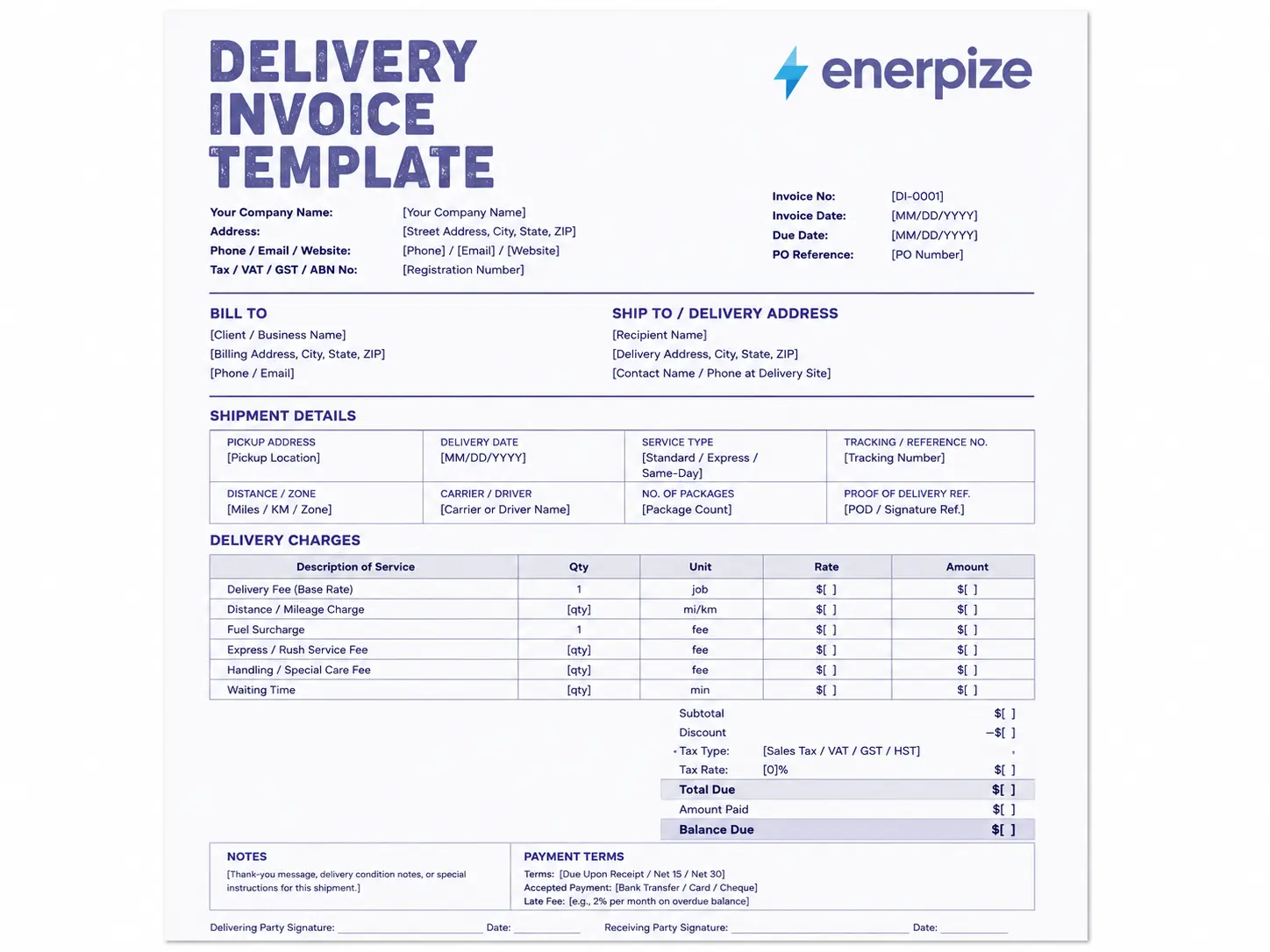
The Enerpize template was built differently. It has a dedicated shipment details block that sits apart from the standard billing address, covering pickup address, delivery date, service type, tracking number, distance or zone, carrier or driver name, package count, and a proof of delivery reference. None of that gets buried inside a notes field or left out entirely, which is where most competing templates fall short.
PO Reference and an Adaptable Tax Field
It also has a PO reference field positioned exactly where a corporate accounts payable team expects to find it, and a tax field labeled Tax Type rather than a fixed Tax Percent, so the same template can say Sales Tax for a US client, VAT for a UK client, or GST for an Australian one without a rebuild every time you cross a border.
Automatic Calculations
Every amount recalculates automatically in the Excel and Google Sheets versions. Enter the rate and quantity for base delivery fee, mileage, fuel surcharge, and any rush charges, and the subtotal, tax, and balance due update on their own.
How to Fill Out a Delivery Invoice Template
Step 1: Add Your Business Details
Fill in your company name, address, phone, email, and tax or VAT registration number. If you invoice regularly, save this as your master file.
Step 2: Enter Client and Shipment Details
Add the client's billing information, then fill in the pickup address, delivery address, delivery date, and service type separately, since the finance office and the receiving warehouse are often in two different places.
Step 3: Assign an Invoice Number and PO Reference
Give the invoice a unique sequential number, add the invoice date and due date, and enter the client's PO reference. This one field is what gets an invoice approved for payment without a follow up email.
Step 4: List Your Delivery Charges
Enter the base delivery fee, then add distance or mileage, fuel surcharge, rush fees, and handling charges as separate line items. Keeping every charge on its own line is what makes an invoice dispute proof.
Step 5: Apply the Correct Tax
Select your tax type, sales tax, VAT, GST, or HST, and enter the rate. The tax amount and total calculate automatically once the rate is entered.
Step 6: Reference Proof of Delivery
Add the delivery note number or proof of delivery reference so the invoice ties back to the signed confirmation of what was delivered.
Step 7: Set Payment Terms and Send
Choose your terms, due on receipt for individual clients or Net 15 to Net 30 for standing accounts, then send the invoice the same day the delivery is completed.
Seven steps is fine for one invoice. It gets old fast at fifty a week. Let the fields fill themselves in from your dispatch data. Start free with Enerpize
Delivery Invoice Template for the United States
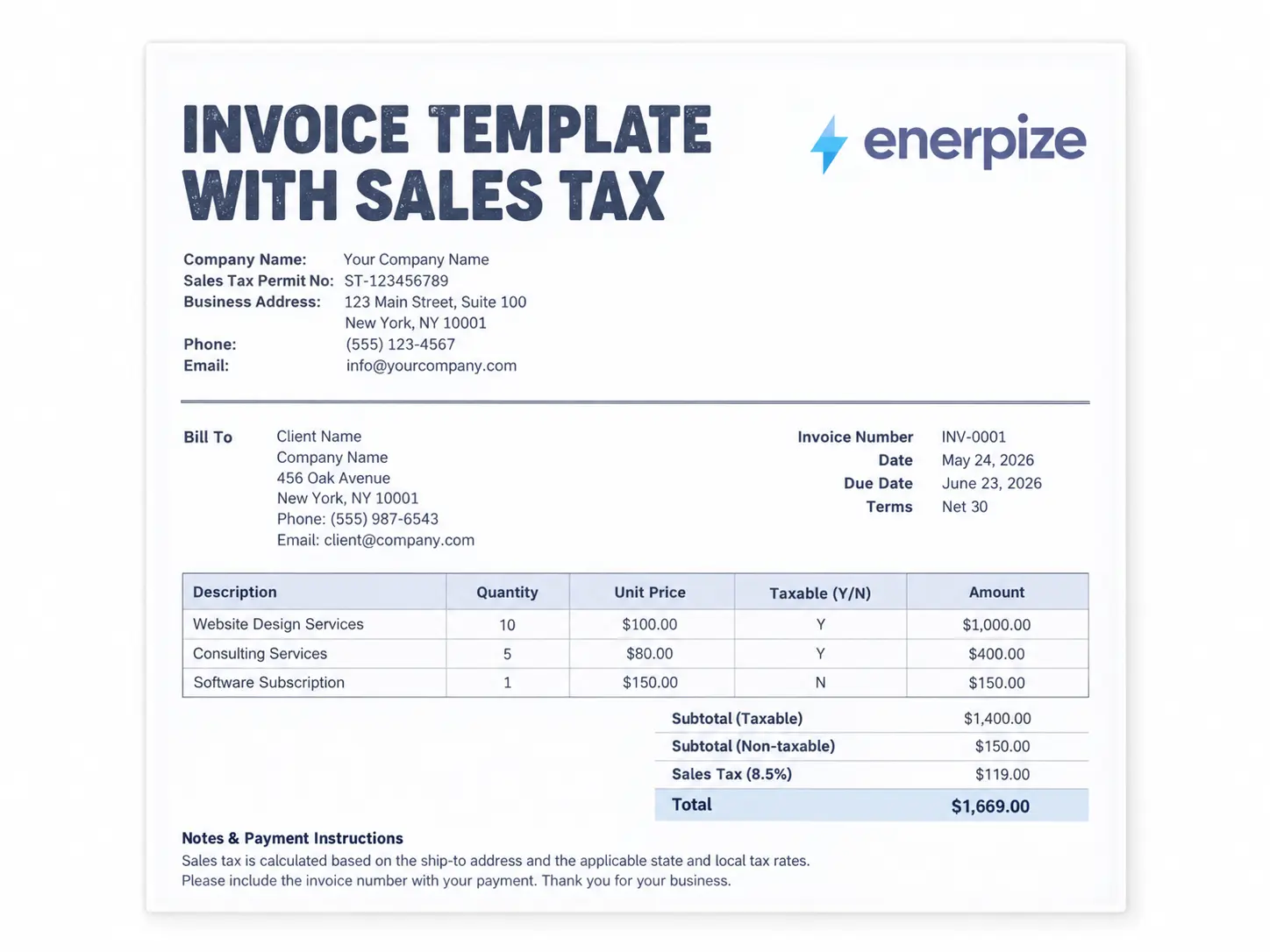
There is no federal sales tax in the US, so what belongs on a delivery invoice comes down to your state's rules, and states are not consistent about it. Some tax the delivery charge whenever the goods being shipped are taxable. Others exempt delivery entirely if it is listed as a separate line item and the customer had the option to arrange their own pickup. A few states tax delivery charges outright regardless of how they are itemized.
What US businesses should have on a delivery invoice: your Tax ID or EIN, a clearly labeled delivery charge line, a PO reference field, and your state's tax treatment noted in your terms.
For corporate accounts, Net 15 or Net 30 is standard. For one off deliveries, due on receipt is typical. The IRS Small Business and Self-Employed Tax Center is a reasonable starting point for how delivery revenue should be recorded, though sales tax on delivery is set at the state level, so check your state revenue department for the exact rule that applies to you.
Delivery Invoice Template for Canada
Canadian delivery invoices need to show the GST or HST registration number, and the rate depends entirely on the province the supply is made in. Ontario charges 13% HST. British Columbia charges 5% GST plus 7% PST as separate lines. Quebec charges 5% GST plus 9.975% QST. Delivery and freight charges are almost always taxed at the same rate as the goods being shipped, since the CRA treats delivery as part of a single taxable supply rather than a separate exempt service.
What to include: your GST/HST number, the provincial tax breakdown if you charge PST or QST separately, a delivery date distinct from the invoice date, and sequential invoice numbering.
Interac e-Transfer is widely used alongside credit card and bank transfer for settling delivery invoices in Canada, and Net 15 to Net 30 is typical for standing courier accounts. The Canada Revenue Agency's guidance on GST/HST for businesses covers how tax applies to freight, delivery, and courier services specifically.
Delivery Invoice Template for the United Kingdom
UK VAT treatment of delivery charges depends on what is being delivered, not on the delivery service itself. If the goods are standard rated, the delivery charge is standard rated at 20%, even if you list it separately. If the goods are zero rated, like most food, the delivery charge attached to that supply is generally zero rated too. This trips up delivery and courier operators who assume delivery is always taxed the same way regardless of the cargo.
VAT registered businesses issuing invoices over 250 pounds need a full VAT invoice, not a simplified one. That means your VAT registration number, the date of supply shown separately from the invoice date if they differ, the VAT rate applied to each line, and the VAT amount broken out as its own figure.
HMRC requires VAT invoices to be issued within 30 days of the date of supply. HMRC's guidance on keeping VAT records sets out exactly what your VAT account and invoices need to show, and it is worth checking directly if you deliver a mix of taxable and zero rated goods regularly, since that is the scenario most templates get wrong.
Delivery Invoice Template for Australia
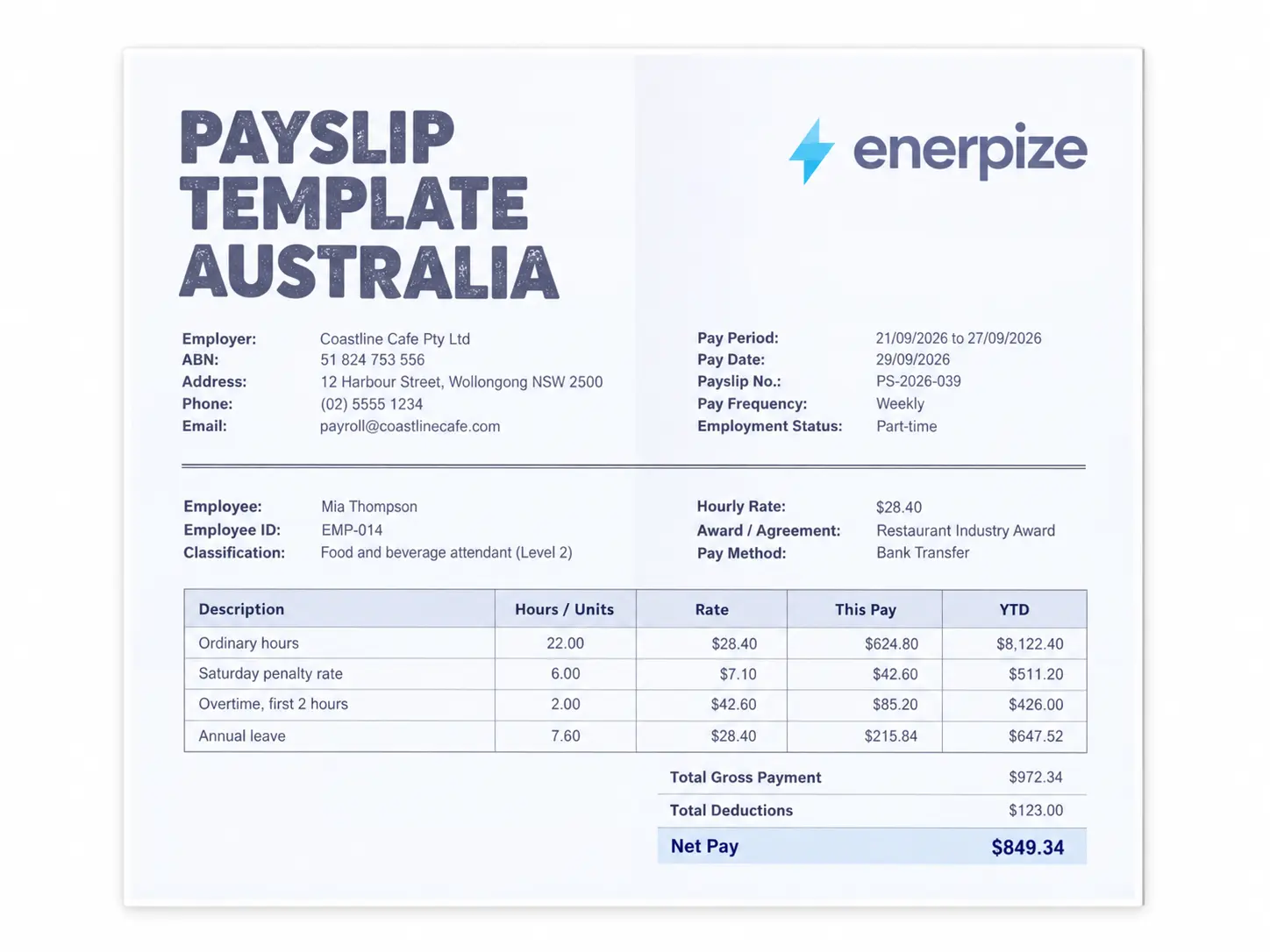
Australian delivery invoices need your ABN displayed for every business transaction, and if you are GST registered, the document has to say Tax Invoice, not just Invoice, once GST is included. Delivery and freight charges attached to a taxable supply are taxed at the standard 10% GST rate. If you are delivering GST free goods, most commonly certain food categories, the delivery charge tied to that supply is typically GST free as well, following the same logic as the UK's zero rating rule.
What to include: Tax Invoice in the heading once GST applies, your ABN near your business name and address, the GST amount shown as a separate figure from the GST exclusive subtotal, and for transactions of 1,000 dollars or more, the buyer's identity or ABN.
The Australian Taxation Office's guidance on tax invoices covers what a compliant tax invoice needs to include, including how GST applies when delivery is bundled with a mix of taxable and GST free goods on the same order.
How Enerpize Handles Delivery Invoicing
A downloaded template gets you through the first invoice. What most delivery and courier businesses actually run into is invoice fifty, when the same fields need filling in again and a missed follow up starts costing real cash flow.
Billing and Invoicing Built for Delivery Fields
Enerpize's billing and invoicing software builds the delivery invoice fields straight into the platform, including shipping options, deposits, and custom fields, so a tracking number or PO reference has a permanent home. Recurring invoicing handles standing courier accounts automatically, while the client portal lets a corporate account view statements and pay online without a phone call to your office.
Sales Management for Routes and Walk In Jobs
For businesses running both routes and walk in jobs, the sales management software connects cloud POS to invoicing directly, so a delivery collected in person and one billed to a standing account flow into the same records. It supports PayPal, Stripe, Authorize.net, eWay, and Paymate, along with cash, checks, and bank deposit.
Purchase and Inventory Management on the Supplier Side
On the supplier side, the purchase management software uses AI to extract supplier name, invoice number, items, quantities, prices, and taxes from uploaded purchase invoices. And because a delivery invoice is only half the picture for anyone running a warehouse, the inventory management system tracks stock by serial, lot, or expiry date in real time and updates warehouse quantities the moment a delivery is confirmed.
None of that replaces the template above. It just means the fields you filled in by hand today are the same fields Enerpize fills in automatically once you are ready to stop rebuilding the same invoice every week.
This template will get you paid. Enerpize will get you paid without opening it. Start free with Enerpize
Key Takeaways
A delivery invoice bills for a completed job. A delivery note proves what physically arrived. Confusing the two is how deliveries go unbilled.
Most free templates skip the two fields corporate clients need to pay fast: a PO reference and a proof of delivery reference.
Keep every charge, base fee, mileage, fuel surcharge, and rush fee, on its own line to keep an invoice dispute proof.
Delivery tax treatment often follows the goods being shipped, not the delivery service itself, in both the UK and Australia.
Corporate accounts run on Net 15 or Net 30 terms. One off deliveries are typically due on receipt.
Invoice the same day the delivery is completed. That gap is the single biggest lever you have over how fast you get paid.
Frequently Asked Questions
What is a delivery invoice?
A delivery invoice is a billing document sent after a delivery, courier run, or freight job is complete, listing charges and payment terms. It differs from a delivery note, which confirms what physically arrived and does not request payment.
Is a delivery note the same as an invoice?
No. A delivery note travels with the shipment and gets signed as proof of what arrived. A delivery invoice is sent separately, usually after the job is done, and it is the document that actually asks to be paid.
Can you invoice before delivery?
Yes, for prepaid or deposit based arrangements, though most delivery invoices go out after the job is complete once mileage, fuel surcharge, and any rush fees are known. For payment upfront, use a separate deposit or proforma invoice instead.
What fields belong on a delivery invoice format?
At minimum, an invoice number, invoice date, PO reference, pickup and delivery addresses, delivery date, itemized charges including base fee, mileage, and fuel surcharge, the applicable tax type and rate, a proof of delivery reference, and clear payment terms.
Is a delivery invoice template free to download?
Yes, the Enerpize template is free to download in Word, Excel, PDF, Google Docs, and Google Sheets, with no sign up required.
What is the difference between a delivery invoice and a shipping invoice?
In practice, none. A shipping invoice template, a freight invoice template, a courier invoice template, and a dispatch invoice template describe the same core document under different industry labels. The fields you need stay the same regardless of which term your industry uses.
How do I calculate delivery charges on an invoice?
Most delivery businesses use one of four pricing methods: a flat fee per job, a per mile or per kilometer rate, an hourly rate for multi stop routes, or zone based pricing. Show it as its own line item so the client can see how the total was calculated.
About the Author
Omar El Bahr is a Senior Digital Growth Specialist at Enerpize, where he leads SEO, content strategy, and organic growth across international markets. He is a Forbes Communications Council contributor and has written for Entrepreneur on business communication and digital strategy.
Disclaimer: This template and the information on this page are provided for general guidance only. Tax rates and invoicing requirements vary by country, state, and province, and change over time. Always confirm current requirements with a qualified accountant or your local tax authority before relying on this template for compliance.