

Posted on 17 September 2026
Digital Nomad Invoice Template Free Download: Word, Excel & PDF
- Available in Word, Excel, PDF, Google Docs, and Google Sheets, free to download with no sign up required
- Includes a correspondence address field for freelancers who do not have a fixed office, plus a currency line that states exactly what a client owes, whether they are paying from Tokyo or Toronto
- Built with tax residency fields for Spain's Beckham Law, Portugal's 183 day threshold, and Japan's foreign source income exemption, all in one template
- Calculates the subtotal, the tax amount, and the balance due automatically in Excel and Google Sheets
A digital nomad invoice template is a pre-formatted billing document for people who work while traveling. It records the services delivered, the currency charged, and the freelancer's tax residency status, giving both sides a clear record of the transaction no matter which country either party is in when the invoice is issued.


What Is a Digital Nomad Invoice Template?
It is Tuesday afternoon in a co-working space in Chiang Mai, and you just wrapped a logo project for a client sitting in Copenhagen. You open your laptop to send the invoice, and the first field asks for your business address.
You do not have one. Not really. You have a bag, a laptop, and a visa that expires in four months.
That gap is exactly what a digital nomad invoice template is built to close. It is also a bigger gap than it used to be. MBO Partners' 2025 State of Independence study counts more than 18 million American digital nomads alone, a number that has grown 153 percent since 2019. A lot of them are issuing invoices with no idea what to put in the address field.
A digital nomad invoice template is a normal invoice with one important difference. It assumes the person filling it out does not have a permanent office, does not bill in only one currency, and might owe tax in a country they landed in six weeks ago. It goes by other names too. Location-independent invoice. Remote worker invoice. Freelance travel invoice. Whatever you call it, the job is the same: prove what you delivered, state what you are owed, and hold up if a tax office in Madrid or Lisbon ever asks you to explain where your income actually came from.
Here is what it is not. It is not the same document as a standard freelance invoice, and the difference matters more than it looks. A standard freelance invoice assumes you already know which country's rules apply to you. A digital nomad invoice template assumes you might not know yet, because you have been in three countries this year and your accountant is still working out which one gets first claim on your return. For the country by country VAT and GST field requirements that apply once you do know where you are registered, our Freelance Invoice Template covers that ground in full.
Want your invoices generated automatically the moment a project wraps, in whatever currency your client pays in? Start Free with Enerpize
What to Include in a Digital Nomad Invoice Template
Most free templates you find online hand you a blank text box and a signature line. That works fine if you have one client in one country. It falls apart the moment you are billing a client in euros this month and a client in yen next month, from a laptop that has moved twice in between.
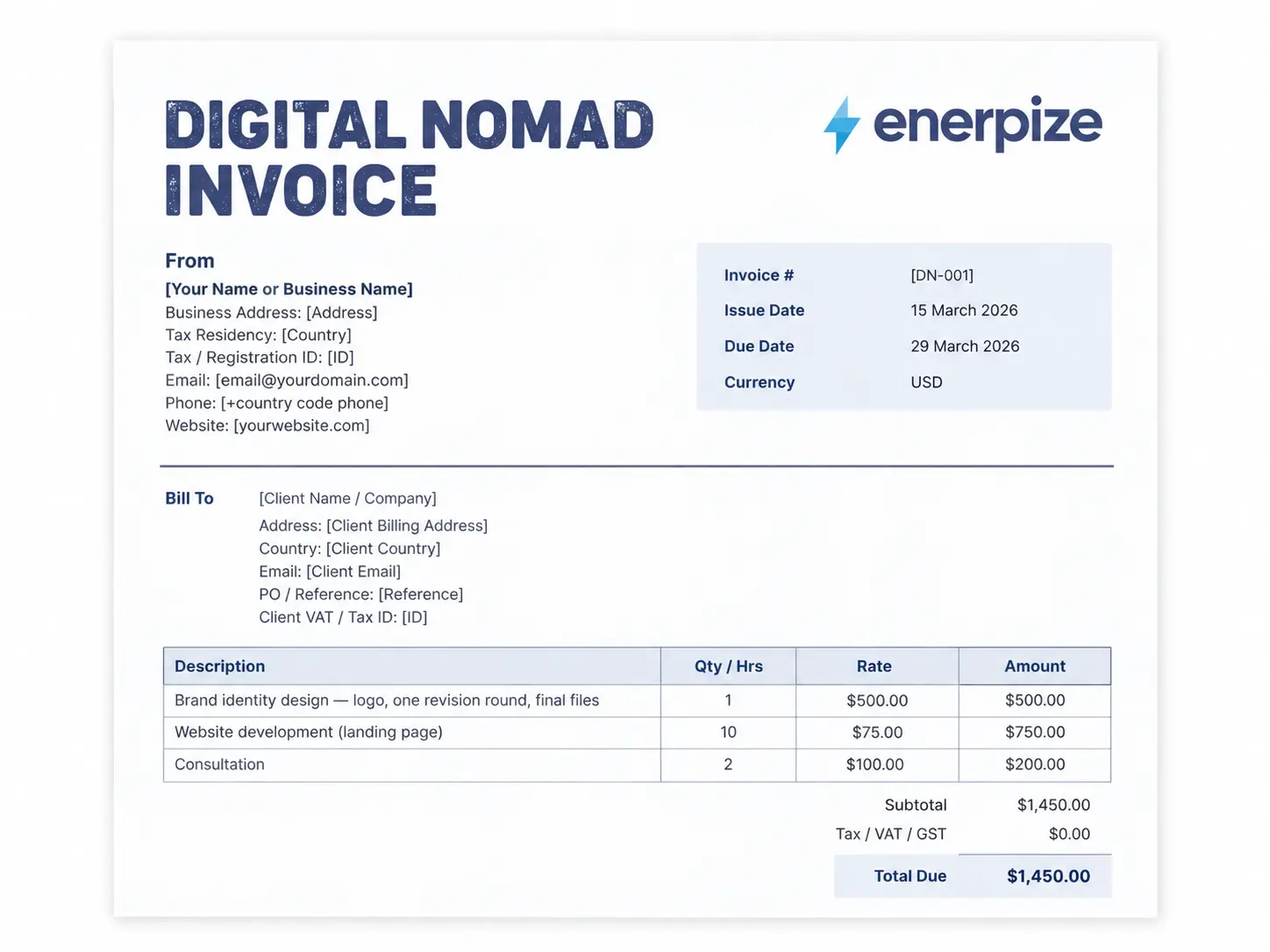
Here is every field a complete digital nomad invoice needs.
| Field | Why It Matters |
|---|---|
| Invoice Number | Sequential reference for your own records and for tax authorities that expect an unbroken numbering series |
| Issue Date and Due Date | Written in full, not numerals only, since date formats flip between countries and a misread due date delays payment |
| Correspondence Address | A virtual mailbox, registered agent, or stable mailing address, since wherever you happen to be sleeping this week is not something a client or a tax office can file |
| Client Name and Country | Determines which country's invoicing rules apply on the client's end |
| Currency | Stated in full on every line, not assumed, because 450 means something different in dollars than it does in euros |
| Line Items | Description, quantity or hours, rate, and amount for each service delivered |
| Tax Residency Note | The country where you are currently liable for tax, and the regime you are filing under if a special one applies |
| Payment Method | A payment link, SWIFT and IBAN details, or local multi-currency account details |
| Late Fee Clause | A specific rate, trigger date, and calculation method, not a vague line that says fees may apply |
The field that trips people up is the tax residency note. It sounds like paperwork for its own sake until the day a tax authority asks why you have not filed anywhere. A dated, numbered invoice stating your residency status at the time of the transaction is the easiest evidence you can hand over, and it costs you nothing to add now. Browse the rest of our business templates if you need a companion document, such as a receipt or a quotation, alongside this one.
What the Enerpize Digital Nomad Invoice Template Includes
I built this template after going through the tax guidance for the three countries digital nomads actually search for the most: Spain, Portugal, and Japan. Here is what made it into the final version and why.
A Correspondence Address Field That Does Not Pretend You Have an Office
Most invoice templates assume a fixed business address. This one has a labeled field for a virtual mailbox or registered agent instead, because that is what most digital nomads actually use, and leaving it blank looks worse to a client than filling it in properly.
Currency Stated on Every Single Line, Not Just the Total
A number without a currency symbol is a guess. This template writes the currency next to the rate, the subtotal, and the total, so a client never has to ask what 1,200 is supposed to mean.
A Tax Residency Line Built Around Three Real Regimes, Not a Generic Note
The template has a dedicated field for your residency status, worded so it can hold "non-resident under Spain's Beckham Law," "Portuguese tax resident as of [date]," or "non-resident, foreign-source income, Japan digital nomad visa" without you redesigning the document every time you cross a border.
Payment Fields That Assume More Than One Bank
Beyond SWIFT and IBAN, there is a labeled field for local account details from a multi-currency provider, since that is usually the faster and cheaper way to get paid once you are set up in a new country.
Live Formulas That Do Not Care What Currency You Are In
In the Excel and Google Sheets versions, the subtotal, tax, and total calculate automatically off whatever rate you enter, so switching from euros to yen mid trip does not mean rebuilding your math.
Start Free with Enerpize and generate invoices like this one automatically instead of rebuilding them from scratch every time you land somewhere new.
Digital Nomad Invoice vs. Freelance Invoice vs. Pro Forma Invoice
People use these three terms interchangeably, and that causes real problems when a client's finance team is trying to file the right document. Here is the difference in one table.
| Document | Assumes a Fixed Address? | Multi-Currency by Default? | Tax Residency Field? | Sent Before or After Work? |
|---|---|---|---|---|
| Digital Nomad Invoice | No | Yes | Yes | After |
| Standard Freelance Invoice | Yes | Sometimes | No | After |
| Pro Forma Invoice | Yes | Sometimes | No | Before |
The rule to remember: a digital nomad invoice is a freelance invoice with two extra jobs to do, proving where you can be reached and proving which country's tax rules currently apply to you.
How to Use the Digital Nomad Invoice Template
Step 1: Fill In Your Correspondence Details
Add your name or business name and your correspondence address, not the address of wherever you are staying this week. A virtual mailbox or registered agent works fine here, and it should stay the same even as your physical location changes.
Step 2: Set the Invoice Number, Dates, and Currency
Assign the next number in your sequence, write both the issue date and due date in full, and state the currency you are billing in at the top of the document. Do this before you touch the line items, so nothing downstream is ambiguous.
Step 3: Add Your Client's Details
Client name, billing address, and country. If a PO or client reference number was issued, add it here too, since corporate finance teams often cannot process an invoice without one.
Step 4: List What You Delivered
One line per service. Description, quantity or hours, rate, and amount. Vague line items are the single most common reason invoices get questioned, so be specific about what the client is paying for.
Step 5: State Your Tax Residency
Fill in the tax residency field with your current status. If you are relying on a special regime such as Spain's Beckham Law, name it here. This single line is what turns a stack of invoices into a usable record if you are ever asked to explain your tax position.
Step 6: Add Payment Details
SWIFT and IBAN for a bank transfer, plus local account details if you are using a multi-currency provider. Include a payment link if you have one, since a client who can pay with one click pays faster than a client who has to copy account numbers into a banking app.
Step 7: Calculate and Review the Total
In the Excel or Google Sheets version, the subtotal, tax, and total calculate automatically. Check that the currency on the total matches the currency you stated at the top before you send anything.
Step 8: Send It the Same Day You Finish the Work
Do not let it sit in a drafts folder. The moment a client receives finished work is the moment they are most inclined to approve payment without questions, and that window closes faster than most freelancers expect.
Skip rebuilding this every time. Start Free with Enerpize and generate a digital nomad invoice with your correspondence details, currency, and payment methods already saved.
Digital Nomad Invoicing and Tax Residency in Spain
Spain is the single most searched destination for digital nomads, and its tax treatment is a big part of why.
Spain's digital nomad visa lets remote workers apply for a special tax regime known as the Beckham Law, named after the footballer who first used it. Under this regime, you are treated as a non-resident for tax purposes even though you are physically living in Spain, which means a flat 24 percent rate on the first 600,000 euros of income instead of the standard progressive scale that climbs toward 47 percent. To qualify, you cannot have been a Spanish tax resident in the five years before you arrive, and you have to apply within six months of registering with Spanish Social Security.
Here is the detail that catches freelancers off guard. The Beckham Law was originally built for employees, not freelancers. A 2023 reform opened it to the self-employed too, but only if at least 80 percent of your income comes from clients outside Spain. This is exactly where your invoices stop being paperwork and start being proof. A folder of dated invoices billed to non-Spanish clients is what demonstrates that 80 percent threshold if the Agencia Tributaria, Spain's tax agency, ever asks you to show it. If you are structuring your invoicing as a registered sole trader while you sort this out, our Sole Trader Invoice Template covers the base format.
What to add to your invoice for Spanish clients or Spanish tax purposes: your tax residency status written out in full, for example "non-resident under Article 93, Beckham Law regime," the client's country clearly stated since that is what your 80 percent test is measured against, and the currency spelled out since Spanish invoices commonly mix euros with a client's home currency.
Practical note for freelancers in Spain. Keep every invoice from the date you arrive, not just the ones after you apply for the Beckham Law. Your six-month application window is measured from your Social Security registration date, and a clean invoice trail from day one makes that filing far less stressful than reconstructing it after the fact.
Digital Nomad Invoicing and Tax Residency in Portugal
Portugal built its reputation as a digital nomad destination on the back of the Non-Habitual Resident program, which used to exempt most foreign income for ten years. That program closed to new applicants on January 1, 2024, and the transitional window closed entirely on March 31, 2025.
What replaced it is narrower than most people expect. Portugal now offers IFICI, sometimes called NHR 2.0, a flat 20 percent rate aimed specifically at scientific research, technology, and other qualifying professional categories tied to eligible employers. A freelancer invoicing foreign clients from a laptop in Lisbon usually does not fit that description, which means most digital nomads on Portugal's D8 visa are taxed under the standard progressive system once they become residents, at rates that run roughly from 14 percent up to 48 percent depending on income.
The trigger for that residency is the same 183 day rule you will see across most of Europe. Spend more than 183 days in Portugal in a calendar year and you are generally treated as a Portuguese tax resident on your worldwide income, not only what you earned while physically there.
What to add to your invoice for Portugal: the delivery date of the service, since that date is what determines which side of the 183 day line a piece of income falls on, your client's country, and a clear currency line, since Portugal's Tax and Customs Authority, the Autoridade Tributária e Aduaneira, expects income declarations to reconcile against the actual invoices behind them. If your D8 application needs a document showing agreed scope and rate before the work starts, our Quotation Template pairs well with this one.
Practical note for freelancers on the D8 visa. Do not assume the old NHR benefits still apply just because you read about them before you applied. Confirm your actual regime with a Portuguese accountant before you commit to a stay longer than 183 days, and keep your invoice numbering unbroken from your first day of income in the country.
Start Free with Enerpize and keep every invoice organized automatically as you move between tax years and countries.
Digital Nomad Invoicing and Tax Residency in Japan
Japan is one of the newest countries to formalize a digital nomad visa, and its structure is unusually tight for a reason worth understanding.
Launched in 2024 as a Designated Activities status, Japan's digital nomad visa allows a maximum stay of six months, and it cannot be renewed. You have to leave and wait before reapplying. That six-month cap is not arbitrary. It sits deliberately on the safe side of the 183 day threshold that would otherwise trigger Japanese tax residency, so most holders owe no Japanese income tax on their remote earnings as long as that income comes entirely from clients or employers outside Japan.
To qualify, you need proof of annual income of at least 10 million yen, which runs somewhere around 67,000 to 70,000 US dollars depending on the exchange rate, and you need to hold a passport from one of the roughly 49 countries that both have a tax treaty with Japan and qualify for visa-free entry. If you are self-employed, Japan's Immigration Services Agency asks for signed client contracts and recent invoices alongside your tax filing as part of that income proof. This is the most direct link between this template and an actual visa application you are likely to find. Your invoices are not just for your own records here. They are part of the paperwork Japan wants to see.
What to add to your invoice for Japan: your client's country and a note confirming the client is based outside Japan, since income with any Japanese nexus can change your tax treatment entirely, the currency, since most Japan-bound nomads bill in dollars or euros rather than yen, and a clean sequential invoice number, since a gap in your numbering is exactly the kind of thing that draws a second look during a visa review, a point Japan's National Tax Agency also cares about once you are filing locally.
Practical note for freelancers heading to Japan. If you are settling in long enough to register locally under the country's qualified invoice system for consumption tax, our Japan Qualified Invoice Template covers that separate, more formal invoicing format in full.
Digital Nomad Invoicing and Tax Residency in the United States
The United States is not a destination on this list. It is the starting point for a large share of the digital nomads counted in that MBO Partners study earlier, and it plays by a different rule than almost anywhere else.
Most countries tax you based on where you live. The United States taxes you based on citizenship, full stop. If you are a US citizen or green card holder, you owe US tax on your worldwide income no matter which country your invoices are addressed to, and no matter how many years you have been away. Only the US and Eritrea run their tax systems this way.
The relief valve is the Foreign Earned Income Exclusion, claimed on IRS Form 2555. For the 2026 tax year, it lets you exclude up to 132,900 US dollars of foreign earned income from federal income tax, provided you pass either the Physical Presence Test, which means at least 330 full days outside the US in any 12 month period, or the Bona Fide Residence Test, which fits people who have genuinely settled in one country rather than moving every few weeks.
Here is the part that surprises freelancers specifically. The FEIE reduces your federal income tax. It does nothing for self-employment tax, the 15.3 percent that covers Social Security and Medicare on your net self-employment earnings. A US freelancer excluding their entire income under the FEIE can still owe a five figure self-employment tax bill, and plenty of digital nomads find this out only once the return is already filed.
What to add to your invoice for US tax purposes: a clean, dated record of where you were physically located when the work was performed, since both qualifying tests are decided day by day, and the client's country, since that supports the foreign earned half of the exclusion.
Practical note for US digital nomads. Keep a day-by-day travel log alongside your invoices from the day you leave, not from the day you start thinking about Form 2555. The Physical Presence Test is purely mathematical, and a gap in your travel record is far harder to reconstruct after the fact than it is to keep in the first place. For the paperwork a US client will likely ask you for, our W-9 Form Template covers exactly that.
Source: IRS, Foreign Earned Income Exclusion and IRS, About Form 2555.
Digital Nomad Invoicing and Tax Residency in the United Kingdom
The United Kingdom does not use a simple day count either, and the number most people quote, 183 days, is only one part of a longer test.
HM Revenue and Customs decides your residence status each tax year using the Statutory Residence Test. There are three layers. First, the automatic overseas tests. Broadly, fewer than 16 days in the UK if you were UK resident in any of the previous three years, or fewer than 46 days if you were not, or working full time abroad with fewer than 91 days in the UK and fewer than 31 working days there. Second, the automatic UK tests, the simplest of which is spending 183 or more days in the UK in the tax year. Third, if neither set of automatic tests settles it, a sufficient ties test weighs your day count against five connections to the UK: family, accommodation, work, a 90 day tie, and, for people leaving the UK, a country tie.
If you come out of that test as UK resident, you pay UK tax on your worldwide income through Self Assessment. If you come out as non-resident, you generally pay UK tax only on UK-source income.
This is why a UK freelancer cannot simply count days outside the country the way a US citizen tracks the Physical Presence Test. Keeping a UK rental property, a UK-based partner, or even a stretch of UK work in a tax year can pull you back into UK residence at a much lower day count than 183.
What to add to your invoice for UK tax purposes: the exact dates of the work, since both the day count and the work tie are measured in days, and your client's country, since UK-source income can remain taxable even after you become non-resident.
Practical note for UK freelancers abroad. Register for Self Assessment before you need it, not after HMRC asks why you have not filed. If you are billing UK clients while traveling, our Statement of Account Template helps you show a client a running balance across several invoices rather than chasing one payment at a time.
Source: GOV.UK, Tax on Foreign Income, Residence.
Digital Nomad Invoicing by Profession
Not every digital nomad bills the same way, and the fields that matter most shift depending on what you actually do for a living.
Consultants and advisors tend to bill by the hour or by retainer, which means the invoice needs to show the engagement period clearly, not just a lump total. Our Consulting Invoice Template breaks down exactly how to structure that. If you are running a consulting practice with clients across several countries at once, Enerpize's consulting service management software tracks the budget, expenses, and profit on each engagement in one place rather than in a separate spreadsheet per client.
Translators and language professionals usually bill per word or per project, often for several clients in several languages in the same week. That volume is exactly where Enerpize's translation agency management software earns its keep, since it tracks which project belongs to which client and which currency without you keeping a separate ledger by hand.
Marketing and creative freelancers, along with web developers who build and host sites for clients abroad, tend to mix one-off project fees with recurring retainers in the same client relationship. That mix is precisely what a rigid, single-purpose invoice format struggles to handle, and precisely why the flexible line item structure in this template, with its explicit currency and tax residency fields, holds up better across a varied client roster than a template built for one type of work.
How Enerpize Handles Digital Nomad Invoicing
A template solves the invoice you are sending today. It does not solve the fortieth invoice you will send this year, from your fourth country, to a client who wants to know why last month's numbers do not match this month's currency. That is a different problem, and it needs a system underneath the template, not another version of the template.
Multi-Currency Invoicing That Does Not Require You to Remember Exchange Rates
Enerpize lets you invoice in a client's own currency, or your own, and keeps a clean record of what was actually billed in what currency. That matters enormously once you are filing taxes in a country like Portugal, where an auditor will want your declared income to match your invoices line for line, not a rough conversion you did in your head somewhere over the Atlantic.
Recurring Invoices for Retainer Clients
If a client pays you monthly regardless of which country you are in that month, Enerpize sends the invoice on schedule automatically, so a missed billing date because you were mid-flight or dealing with a visa appointment never happens. You set the amount, the currency, and the schedule once, and it runs without you touching it again.
Expense Tracking That Matches Your Invoicing Currency
Co-working memberships, local SIM cards, short-term accommodation, and the flight that got you to your next visa deadline all show up in whatever currency you paid them in. Enerpize logs expenses the same way it logs invoices, by currency and by date, so when it is time to work out what you can actually deduct, you are not reconstructing three months of receipts from memory.
Client Follow-Up That Works Across Time Zones
Automated reminders chase a late payment while you are asleep on the other side of the planet, so a client in a different time zone is not effectively getting extra grace on their due date just because you cannot email them at 3 a.m. local time. The follow-up runs on the client's clock, not yours.
Cloud Access From Whatever Device You Have With You
Your invoicing setup should not live on one laptop. Enerpize is cloud based, so if a device gets lost, stolen, or simply left charging in a hostel two cities behind you, your invoice history, your client list, and your numbering sequence are all still there the moment you log in from whatever you have on hand.
One Client Record That Survives Your Move to the Next Country
A client you started billing while you were in Spain should not turn into a fresh, disconnected record once you have relocated to Portugal. Enerpize keeps one history per client, invoices, payments, and correspondence together, so your own change of country never fragments the relationship on the client's end.
A Record That Holds Up if a Tax Authority Asks
Every invoice generated through Enerpize is timestamped, sequentially numbered, and stored in one place, exactly the kind of clean trail Spain's Agencia Tributaria, Portugal's Autoridade Tributária e Aduaneira, or Japan's Immigration Services Agency would want to see if your residency status is ever questioned.
Start Free with Enerpize and stop rebuilding your invoicing setup every time you land somewhere new.
Key Takeaways
- A digital nomad invoice needs a correspondence address in place of a fixed office, plus the currency spelled out in full on every line, not assumed from context.
- Spain's Beckham Law can bring your effective tax rate down to a flat 24 percent, and since 2023 freelancers can qualify too, provided at least 80 percent of their income comes from clients outside Spain.
- Portugal's old Non-Habitual Resident program closed to new applicants in 2024, so most digital nomads on the D8 visa now pay standard progressive tax once they cross 183 days in the country.
- Japan's digital nomad visa caps at six months specifically to keep holders under the 183 day residency threshold, and signed invoices are literally part of the paperwork the Immigration Services Agency asks self-employed applicants to provide.
- Keep every invoice you issue while traveling, from day one, not only from the day you formally apply for a special tax regime. It is the simplest evidence you have of where your income actually came from.
- Different professions need different invoice structures. A consultant billing retainers and a translator billing per word both need currency and tax residency fields, but the line item structure underneath should match how each of them actually works.
Frequently Asked Questions
What should I put on an invoice if I do not have a permanent business address?
Use a correspondence address instead, such as a virtual mailbox or a registered agent in your country of tax residence. What matters to a client or a tax office is that the address is stable and real, not that it is a physical office you own.
What currency should I invoice clients in as a digital nomad?
There is no single right answer. Invoicing in the client's currency is easiest for them, invoicing in your own currency protects you from exchange rate swings, and many digital nomads settle on a neutral currency like US dollars or euros for international work. Whichever you choose, state it clearly next to every figure on the invoice.
Do I owe tax in Spain, Portugal, or Japan if I am only there on a digital nomad visa?
It depends on how long you stay and which regime you qualify for. In Spain, the Beckham Law can keep you taxed as a non-resident even past 183 days if you qualify and apply in time. In Portugal, crossing 183 days generally triggers standard tax residency now that the old NHR exemption has closed to new applicants. In Japan, the visa itself caps your stay at six months specifically to keep you under that threshold. None of this replaces advice from a local accountant who knows your specific situation.
Is a digital nomad invoice different from a regular freelance invoice?
Yes, in two specific ways. A digital nomad invoice needs a correspondence address instead of a fixed one, and it needs a tax residency field that a standard freelance invoice usually does not include, since a typical freelance invoice assumes you already know which country's rules apply to you.
Does Japan's digital nomad visa require me to show my invoices?
If you are applying as a self-employed freelancer rather than an employee, yes. Japan's Immigration Services Agency asks for signed client contracts and recent invoices alongside your tax filing to demonstrate that you meet the 10 million yen annual income requirement from sources outside Japan.
Can I use the Beckham Law in Spain if I am a freelancer, not an employee?
Yes, since a 2023 reform, but only if at least 80 percent of your income comes from clients located outside Spain. You will also need to confirm you have not been a Spanish tax resident in the five years before you arrive, and apply within six months of registering with Spanish Social Security.
How long can I invoice from Portugal before I become a tax resident there?
The general trigger is 183 days in a calendar year. Cross that threshold and Portugal generally treats you as a tax resident on your worldwide income, not only the income you earned while physically in the country.
What is the best way to get paid across borders as a digital nomad?
Most digital nomads combine a payment link for fast card payments with a multi-currency account for larger transfers, since a multi-currency provider typically offers a rate much closer to the real exchange rate than a traditional bank wire. State clearly on the invoice which method you prefer and who covers any transfer fees.
About the Author
Omar El Bahr is a Senior Digital Growth Specialist at Enerpize, where he leads SEO, content strategy, and organic growth across international markets. He is a Forbes Communications Council contributor and has written for Entrepreneur on business communication and digital strategy.
Related Templates
Disclaimer: This page is for informational purposes only and is not tax or legal advice. Tax rules for Spain, Portugal, and Japan change often and depend on your personal situation, so confirm your position with a licensed accountant before you rely on anything above.