

Posted on 4 October 2026
Free Superbill Template Download: Word, Excel & PDF with a Filled Example
- Available in Word, Excel, PDF, Google Docs, and Google Sheets, free to download with no sign-up required
- Carries every field insurers check, from the individual NPI and tax ID to CPT, ICD-10-CM, place of service, and modifier codes
- Works for therapists, physical therapists, chiropractors, dietitians, acupuncturists, and medical clinics, with a code library for each
- Totals charges, flags any balance that isn't $0, checks each service line, and tracks filing deadlines automatically in Excel and Google Sheets
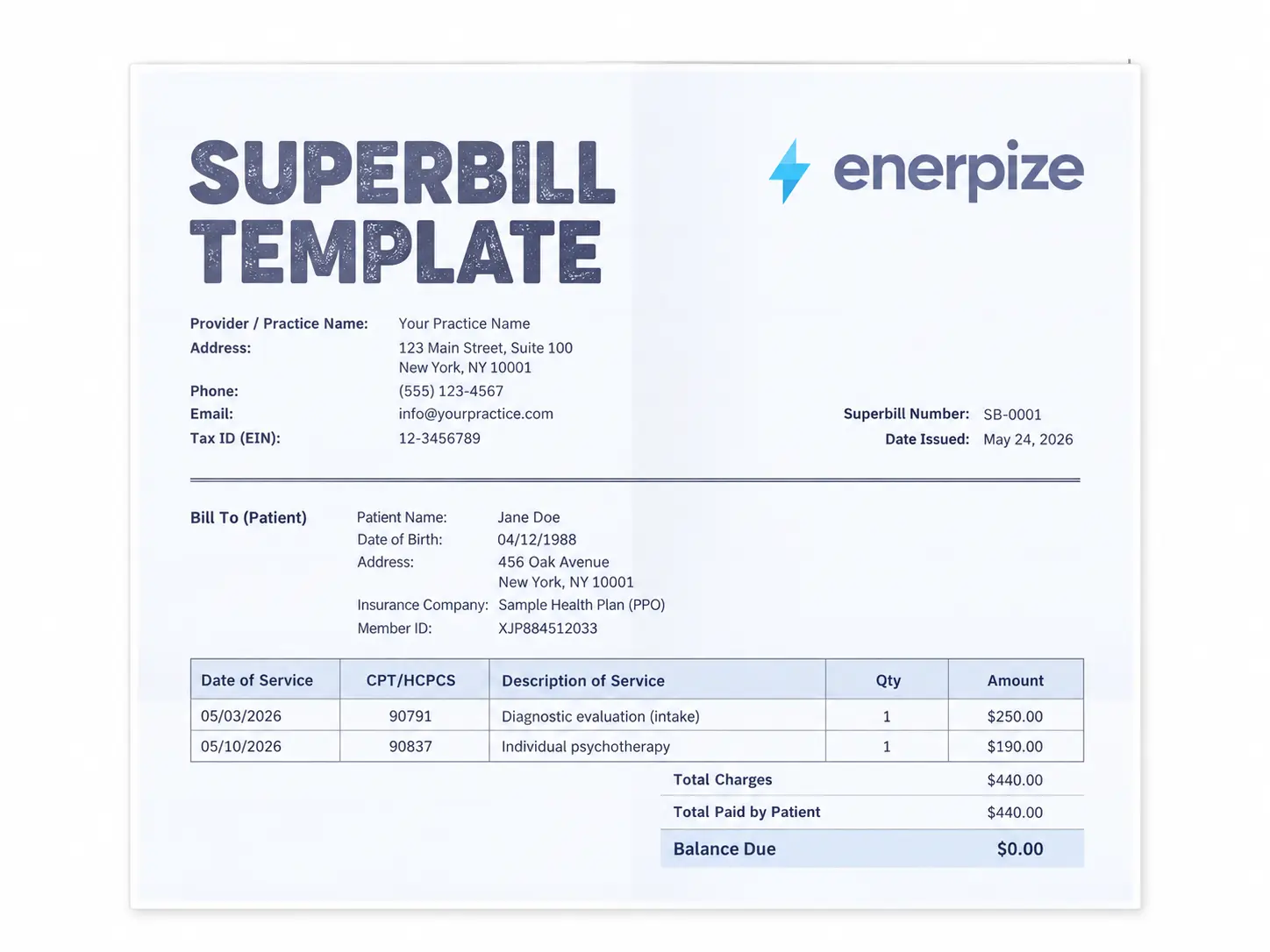
A superbill template is a prebuilt form that turns a patient visit into an itemized, coded receipt, listing the provider's NPI and tax ID, the patient's insurance details, each date of service with its CPT and ICD-10-CM codes, and the amount paid, so the patient can claim out of network reimbursement from their insurer.


What Is a Superbill Template?
A receipt says your client paid you. A superbill says why.
That one difference decides whether an insurer sends money back. A plain receipt shows a date and a dollar amount. A superbill adds the language insurers actually read: who delivered the care, what the care was, and the medical reason it was needed, all written in codes.
The client pays you in full, you hand over the superbill, and the client files it. You never deal with the insurer. Your paperwork does.
A template means you set that structure up once and stop rebuilding it from last month's file.
Other Names for a Superbill
You will hear it called an encounter form, a charge slip, a fee ticket, or a statement for insurance reimbursement. Same document. Whatever the name, people mean a superbill form with all the right boxes.
What a Superbill Is Not
It is not a bill. Nobody owes anything on a finished superbill, because the client has already paid.
It is not a claim either. A claim goes from your practice to the payer. A superbill goes from your practice to the client, and the client does the filing.
What to Include on a Superbill
Think of a superbill like a passport at a border crossing. Every field gets checked, and one smudged digit sends you back to the end of the line.
| Field | Why It Matters |
|---|---|
| Practice name, address, and phone | Tells the payer where care happened; a P.O. box can get the superbill rejected |
| Tax ID (EIN or SSN) | The number the reimbursement is reported against |
| Rendering provider name and credentials | Shows a licensed professional delivered the care |
| Individual NPI (Type 1) | The 10-digit ID the payer uses to look up the clinician who saw the patient |
| Group NPI (Type 2) | Identifies the practice, and it goes in its own field |
| License number and state | Some plans verify it before releasing payment |
| Supervising provider details | Needed when an associate or intern delivered the session |
| Patient legal name, date of birth, member ID | Must match the insurance card exactly, prefix included |
| ICD-10-CM diagnosis codes | The medical reason for the visit |
| Date of service, one line per session | Payers price every visit separately |
| Place of service code and modifier | Tells the payer whether the visit was in the office or by telehealth |
| CPT or HCPCS code, units, minutes | What you did and for how long |
| Diagnosis pointer | Links each line to the diagnosis that justifies it |
| Fee, amount paid, balance due | Shows the client already paid in full |
| Signature and date | An unsigned superbill reads like a draft |
If I had to pick the field that causes the most quiet damage, it is the NPI.
Practices put the group NPI where the individual one belongs all the time. The form looks complete. The payer can't match it to a clinician. You can check any NPI in seconds in the free NPPES NPI Registry run by CMS.
What the Enerpize Superbill Template Includes
We built this template around the moments where superbills actually fail: the wrong NPI, a balance left open, a 45 minute session coded as an hour, a telehealth line marked as an office visit, and a filing deadline nobody wrote down.
In short, the Enerpize template is a superbill that checks itself and then follows the claim, not a blank form you fill and forget.
One Form, Every Specialty
The same layout works for a psychotherapy practice, a physical therapy clinic, or a primary care office. A built in code library covers mental health, PT, OT, speech therapy, chiropractic, dietitians, acupuncture, massage, and office visits, and you can edit it to match what you actually bill. A therapy superbill template and a clinic form share the same bones here.
A Line Check That Reads Like a Billing Coach
Every service line in the Excel version gets a verdict. Forget the diagnosis pointer and it tells you. Put POS 11 next to modifier 95 and it flags the conflict. Enter 90837 with 45 documented minutes and it reminds you that code starts at 53.
A $0 Balance Alarm
If the balance due isn't zero, a warning appears on the form. Out of network plans reimburse what the patient paid, so a superbill with money still owed invites trouble.
A Log That Remembers Deadlines
The Superbill Log tab works out each filing deadline from the last date of service and the payer's window, then counts down the days. Under 30 days and still unpaid, the number turns red.
A Payback Preview
The Reimbursement Estimator takes your fee, the plan's allowed amount, the remaining deductible, and the coinsurance, then shows what the client can realistically expect back. Fewer surprised clients. Fewer awkward emails.
It is also an editable superbill template from top to bottom, so your logo, fields, and codes stay yours.
Superbill Example: What a Filled Form Looks Like
Here is a sample superbill for psychotherapy from our file. The practice, patient, and fees are invented, and the codes are illustrative.
| Date of service | POS | CPT | Modifier | Dx | Minutes | Fee |
|---|---|---|---|---|---|---|
| 09/03/2026 | 11 | 90791 | A | 60 | $250.00 | |
| 09/10/2026 | 11 | 90837 | A | 55 | $190.00 | |
| 09/17/2026 | 11 | 90834 | A | 45 | $145.00 | |
| 09/24/2026 | 10 | 90834 | 95 | A | 48 | $145.00 |
Diagnosis A is F41.1, generalized anxiety disorder. Total charged: $730. Total paid: $730. Balance due: $0.
Notice the details that make this one work. The 55 minute session carries 90837, while the 45 and 48 minute sessions carry 90834. The video session on September 24 uses POS 10 and modifier 95. Every line points back to the same diagnosis. Page two of the Word file shows this same sample superbill with the key fields numbered.
CPT and ICD-10 Codes by Specialty
Codes are where a superbill earns its name. Here are the ones each specialty reaches for most.
Mental Health and Psychotherapy
Psychotherapy codes run on documented time. 90832 covers 16 to 37 minutes, 90834 covers 38 to 52, and 90837 starts at 53. Intakes usually use 90791, family sessions use 90846 or 90847, and groups use 90853.
This is the busiest corner of the superbill world. A 2019 Milliman study of employer health plans found that in 2017, 17.2% of behavioral health office visits were out of network, compared with 3.2% of primary care visits. That gap is why a superbill for therapy matters so much.
A therapy superbill template should also leave room for a supervising clinician, because associates and interns need their supervisor named. If you run a counseling practice, our superbill template for mental health covers that out of the box and doubles as a psychotherapy superbill template, and you can pair it with our therapy invoice template for clients who never plan to file.
Physical, Occupational, and Speech Therapy
Evaluations use 97161 to 97163 for PT and 97165 to 97167 for OT, with 97164 for a PT re-evaluation. Treatment codes like 97110, 97112, 97140, and 97530 bill in 15 minute units, so the units column matters on a physical therapy superbill. Medicare counts a timed unit once at least 8 minutes are delivered, and many commercial plans follow similar math.
Speech therapy usually uses 92523 for evaluation and 92507 for treatment. For everyday billing outside insurance, our physiotherapy invoice template handles the same clients.
Chiropractic
A chiropractic superbill leans on three codes: 98940 for one or two spinal regions, 98941 for three or four, and 98942 for five. The region count has to match the notes.
Dietitians, Acupuncture, and Massage Therapy
Dietitians bill medical nutrition therapy with 97802 for the first assessment and 97803 for follow ups, both in 15 minute units. An acupuncture superbill uses 97810 and 97811 without electrical stimulation, or 97813 and 97814 with it. A superbill for massage therapy usually lists 97124 in 15 minute units, and plans vary a lot on whether they cover it.
Primary Care and Medical Clinics
A medical superbill template for a clinic centers on office visits: 99202 to 99205 for new patients and 99212 to 99215 for established ones, chosen by documented medical decision making or time. Our medical invoice template covers the same visits when a patient just needs a bill.
Keep Your Codes Current
ICD-10-CM codes update every October 1, which includes this week. CPT updates every January 1.
Old forms keep circulating with codes that no longer exist. 99201 was deleted in 2021. M54.5 for low back pain stopped being valid on October 1, 2021, replaced by M54.50, M54.51, and M54.59. R05 for cough was split into R05.1 to R05.9 the same day. A superbill with a deleted code gets rejected automatically, no matter how clean the rest of it is.
Superbill vs. Invoice vs. Receipt vs. CMS-1500 vs. Good Faith Estimate
Five documents that get confused constantly:
| Document | Who sends it, to whom | Codes? | What it is for |
|---|---|---|---|
| Superbill | Provider to patient, patient to insurer | CPT and ICD-10-CM | Out of network reimbursement to the patient |
| Invoice | Provider to patient | No | Asks for payment |
| Receipt | Provider to patient | No | Proves payment |
| CMS-1500 | Provider to payer | CPT and ICD-10-CM | In network billing paid to the provider |
| Good Faith Estimate | Provider to self-pay patient, before care | Expected services | Shows expected charges in advance |
Our guide on what an invoice is covers the invoice side in depth. The quick rule: if it asks for money, it's an invoice, and if it asks an insurer for money on the patient's behalf, it's a superbill.
How to Use the Superbill Template
Step 1: Set Up the Provider Block Once
Fill in your practice name, address, EIN, NPI, license, and taxonomy code, then save the file as your master copy. Every future superbill starts from there.
Step 2: Verify Your NPI
Look yourself up in the NPPES registry and copy the number exactly. Use your individual NPI in the rendering field, and keep the group NPI in its own box.
Step 3: Copy Patient Details From the Card
Use the legal name, member ID, and group number exactly as printed on the insurance card. "Jordan" and "Jordan A." can be two different people to a payer.
Step 4: List the Diagnoses
Enter each ICD-10-CM code once in the diagnosis block, lettered A to D. Each service line will point back to these letters.
Step 5: Add One Line per Session
Date, place of service, CPT code, modifier, diagnosis pointer, units, minutes, and fee. Never bundle several sessions into one date range.
Step 6: Match the Code to the Minutes
Open the note before you pick the code. If the note says 45 minutes, the line says 90834, even if the appointment was booked for an hour.
Step 7: Collect Payment in Full
Record what the client paid. The balance should read $0 before the superbill leaves your hands.
Step 8: Sign, Export, and Log It
Sign and date the form, then save it as a PDF so nobody can edit it before submission. Fill in the superbill template Word file and export it as a superbill template PDF in one step. Then add it to the Superbill Log with the payer's filing window.
How Patients Get Reimbursed
Whether it is a superbill for therapy or a chiropractic visit, the client's side looks the same, and it is worth explaining before the first session, not after the first rejection.
The Submission Steps
The client logs into their insurer's member portal, finds the claims section, and uploads the superbill along with the plan's own claim form if it asks for one. Some plans still want it mailed or faxed. Then the client waits for an Explanation of Benefits.
The Reimbursement Math
Insurers don't pay back your fee. They pay a share of their own "allowed amount," and only after the out of network deductible is met.
Take ten sessions at $175. Say the plan allows $120 a session, the client has $500 of deductible left, and their coinsurance is 40%. The plan allows $1,200 in total, the first $500 goes to the deductible, and the plan pays 60% of the remaining $700. That is $420 back on $1,750 paid.
Not thrilling. Still $420 that would have stayed in the insurer's pocket.
Deadlines and Denials
Filing windows commonly run from 90 days to a year, depending on the plan. When a superbill for insurance reimbursement gets denied, the EOB says why, and the fix usually lives in one field:
| Denial reason | Field to fix |
|---|---|
| Provider not found | Individual NPI |
| Member not found | Legal name or member ID |
| Invalid code | CPT or ICD-10-CM, check the current year |
| No out of network benefits | Nothing on the form, the plan doesn't cover it |
| Late submission | Filing deadline |
Superbill Rules by Payer
A superbill only works if the patient's plan pays people back. Some plans don't, and knowing which saves everyone a wasted month.
Commercial Plans: PPO and POS vs. HMO and EPO
PPO and POS plans often include out of network benefits, which is where an out of network superbill does its best work. HMO and EPO plans usually cover out of network care only in emergencies.
What to add for commercial plan clients: the member ID with its prefix, the group number, and the policyholder's name when the client is a dependent.
Practical note: ask clients to call the number on their card and ask three questions before you start: do I have out of network benefits, how much deductible is left, and what percentage do you reimburse.
Medicare
Medicare works differently. Under the mandatory claim submission rule in the Medicare Benefit Policy Manual, providers who haven't opted out must submit claims for covered services to Medicare themselves. Providers who opt out sign private contracts with each Medicare patient, and Medicare reimburses neither the provider nor the patient for those services.
What to add: nothing. A superbill isn't the tool here.
Practical note: if a Medicare patient asks for a superbill, check your enrollment status first.
Medicaid
Medicaid generally pays only providers enrolled with the state program, and members usually can't get reimbursed by filing a superbill themselves. Check your state's rules before promising anything.
TRICARE
TRICARE beneficiaries who see a provider who won't file for them can submit the claim themselves using DD Form 2642, the patient's request for medical payment, attached to an itemized bill. The TRICARE medical claims page lists where to send it by region.
What to add: every field on the superbill, plus the dates and codes the DD Form 2642 asks for. Your superbill becomes the itemized bill TRICARE wants attached.
Before the Superbill: Good Faith Estimates
Since January 1, 2022, the No Surprises Act has required providers to give uninsured or self-pay patients a Good Faith Estimate when they schedule care or ask for one. If the final bill comes in at least $400 above the estimate, the patient can dispute it, as CMS explains here.
Practical note: the rule clearly covers clients who don't plan to use insurance. Clients who plan to file superbills sit in a grayer area, so many practices give every client who pays out of pocket an estimate anyway.
Using a Superbill for HSA or FSA Reimbursement
Clients with a health savings account or flexible spending account can often use the same superbill as their itemized proof. IRS Publication 502 lists qualifying medical expenses, including care from psychologists, chiropractors, and acupuncturists. The plan administrator decides what paperwork it accepts.
How Enerpize Handles Superbills and Patient Billing
What happens when you see 60 clients a month and half of them want superbills?
A spreadsheet superbill template is perfect for a solo practice. At volume, retyping the same provider block and chasing payments eats the time you meant for clients. Enerpize, used by more than 40,000 businesses across 50+ industries, takes the repetitive part off your desk.
Store Your Details Once
Enerpize invoicing lets you define additional fields and customize your printable templates, so your NPI, license number, and EIN print on every document without retyping. Client records hold each patient's details for the next visit.
Insurance and Co-Payments
The sales management module includes insurance management that activates insurance on client invoices, manages co-payments, and links client profiles to insurance classes. Useful when part of your caseload is in network and part pays you directly.
Payments, Portals, and Statements
Clients can pay online through the client portal and pull their own statements. Every payment you record brings the balance down, so you know exactly when a superbill is ready to issue. For one-off bills, our free invoice maker works in your browser.
One honest note. Enerpize doesn't choose codes for you, and it isn't a medical claims clearinghouse. You pick the codes. Enerpize keeps everything around them organized.
Superbills by Practice Type
Enerpize supports clinics of every shape, and each one uses superbills a little differently.
Medical Clinics
Primary care and specialist clinics bill office visits, procedures, and labs on the same superbill. Enerpize clinic management software issues invoices for healthcare services, keeps patient records, and lets you register insurance providers and apply rates.
Dental Clinics
A dental superbill is its own animal. Dental procedures use CDT codes from the American Dental Association, not CPT, so a dental form needs a code column built for D codes. Our dental clinic software handles invoicing, appointments, and insurance management in one place.
Pediatric Clinics
The same Milliman study found a child's behavioral health office visit was 10.1 times more likely to be out of network than a primary care visit. For children, the policyholder is usually a parent, so the relationship field reads "Child," not "Self." Pediatric clinic software in Enerpize handles check-up invoices and parent alerts by email or SMS.
Medical Labs
Labs often run several tests per visit, and each test needs its own line and its own diagnosis pointer. Enerpize medical lab software invoices tests and shares results by email or SMS.
Key Takeaways
- A superbill is a coded, itemized receipt that the patient, not the practice, files with their insurer.
- The individual NPI, exact patient name, and current codes decide whether it gets paid.
- Psychotherapy codes follow documented minutes, and timed therapy codes bill in 15 minute units.
- Medicare and most Medicaid programs don't reimburse patients through superbills, while PPO and POS plans often do.
- A superbill should show a $0 balance, one line per session, and a signature.
- The Enerpize template checks each line, flags open balances, and tracks filing deadlines, and Enerpize takes over as your caseload grows.
Frequently Asked Questions
What is a superbill?
A superbill is an itemized receipt with medical codes that a provider gives a patient after paid visits. The patient sends it to their insurer to request out of network reimbursement.
Do insurance companies pay superbills?
Yes, when the patient's plan has out of network benefits and the superbill is complete. The insurer pays the patient, based on its allowed amount, after the out of network deductible is met.
Is a superbill the same as an invoice?
No. An invoice asks for payment. A superbill comes after payment and adds the CPT and ICD-10-CM codes an insurer needs. A free superbill template already has both the receipt fields and the code fields laid out.
What does a superbill look like?
It looks like a detailed receipt: provider and patient blocks at the top, a diagnosis block, a table with one line per session, and a payment summary with a signature. A good superbill template shows all of this on one page.
How do I submit a superbill to insurance?
Log into your insurer's member portal, open the claims section, and upload the superbill with any claim form the plan requires. Some plans accept mail or fax. Keep a copy until the EOB arrives.
Do superbills count toward my deductible?
Often, yes. Depending on the plan, allowed amounts from submitted superbills can count toward the out of network deductible, even when the plan pays nothing back yet.
How long do I have to submit a superbill?
It depends on the plan. Filing windows commonly range from 90 days to a year from the date of service, so submit monthly instead of saving them up.
Can Medicare or Medicaid patients use a superbill?
Generally, no. Medicare requires providers who haven't opted out to file claims themselves, and opted out providers bill under private contracts Medicare won't reimburse. Medicaid usually pays only enrolled providers.
About the Author
Omar El Bahr is a Senior Digital Growth Specialist at Enerpize, where he leads SEO, content strategy, and organic growth across international markets. He is a Forbes Communications Council contributor and has written for Entrepreneur on business communication and digital strategy.
Disclaimer: This template and article are for general information only and are not billing, coding, or legal advice. Codes and payer rules change, and reimbursement is never guaranteed.