

Posted on 6 July 2026
Physiotherapy Invoice Template Download: Excel, Word, PDF & Google Sheets and Docs
- Available in Word, Excel, PDF, Google Docs, and Google Sheets, free to download with no sign-up required
- Covers assessment sessions, treatment sessions, exercise programs, and progress or insurance reports in one structured document
- Built with country-specific tax fields so you can add GST (Australia), VAT (UK), HST (Canada), or leave the field blank where the service is exempt
- Calculates the subtotal, tax, and total amount due automatically in Excel and Google Sheets


What Is a Physiotherapy Invoice Template?
A physiotherapy invoice template is a ready-made billing document built specifically for how physiotherapy clinics work, rather than a generic invoice with the word "physiotherapy" added to the title. It gives you a structured place to record the patient's details, the therapist who treated them, each session or assessment delivered, the item codes tied to those services, and the totals owed, so nothing gets left off when the bill actually needs to go out.
The reason this matters more in physiotherapy than in most service businesses comes down to how the billing actually works. A single visit can include an assessment, a treatment session, and a home exercise plan, each billed separately. Add insurance into the mix, and now the invoice also has to carry a diagnosis code, a referring physician, and a health fund item number the insurer will check against. A generic invoice template was never built to hold all of that. A physiotherapy invoice template was.
Start issuing physiotherapy invoices built for how your clinic actually bills. Start for free.
What Enerpize's Physiotherapy Invoice Template Includes
Most free templates online give you a name field, a date field, and a single line for "services rendered." That gets you through one invoice. It does not get you through a full patient caseload, an insurance audit, or a clinic with three therapists on staff.
Practice Details and Registration Number
Your clinic name, address, phone, email, and practice registration number, so the invoice reads as an official document, not a note scribbled on letterhead.
Tax or VAT Identification Field
Left blank where physiotherapy is exempt, filled in where it is not. More on that below.
Invoice Number, Issue Date, and Payment Due Date
Most generic templates only show an issue date. Without a due date, patients have no reason to pay on time, and you have no basis for a late fee.
Treating Therapist Name
If your clinic has more than one physiotherapist, this single field saves you from a dozen "who actually saw me" emails.
Patient Details and Patient ID
Name, address, date of birth, and a unique ID so records do not get mixed up between two patients with the same name.
Insurance and Claim Details
Insurer name, policy or member number, referring physician, diagnosis code, and health fund item number, all in one block instead of scattered across the page.
Session Package Tracking
If a patient bought a 10-session rehab package, the invoice shows sessions used, sessions remaining, and the package expiry date. Almost none of the templates we reviewed from other providers do this, and it is one of the most common physiotherapy billing scenarios there is.
Itemized Line Items With Item Codes
Each treatment, assessment, or report gets its own code, quantity, unit price, and tax line, not a single lump sum.
Subtotal, Discount, Tax, and Co-Payment Breakdown
So the patient can see exactly how the number at the bottom was built.
Payment Method Field
Cash, card, or insurer direct billing, recorded on the invoice itself.
Signature Lines for Patient and Practitioner
A small addition that matters if a bill is ever disputed.
Terms and Cancellation Policy
Written out, not buried in a footnote.
This is the physiotherapy invoice template most download sites are not giving you, because most of them are built for a generic service business and relabeled for healthcare. Ours was built specifically around how physiotherapy clinics actually bill.
Issue your first physiotherapy invoice today. No credit card required. Start for free.
How to Fill Out a Physiotherapy Invoice
Step 1: Add Your Practice Information
Start with your practice name, address, phone number, and email. Add your registration number and tax or VAT ID if you have one. This is the section patients and insurers use to verify the invoice is legitimate.
Step 2: Add the Patient's Details
Name, address, date of birth, and patient ID. If the patient carries insurance, this is also where the insurer name and policy number go.
Step 3: Assign the Invoice Number and Dates
Give the invoice a unique number, even if you are only issuing a handful a week. Add the issue date and a payment due date. Without a due date, "please pay soon" is not a policy, it is a suggestion.
Step 4: List Each Service Separately
Do not lump five treatment sessions into one line that just says "physiotherapy." Break it out: assessment sessions, treatment sessions, exercise program setup, and any progress reports, each with its own quantity and rate. This is what makes an invoice usable for an insurance claim instead of just a receipt.
Step 5: Add the Health Fund Item Number and Diagnosis Code
If the patient is claiming through insurance, the item number tied to each service and a diagnosis code are often what stands between a smooth claim and a rejected one.
Step 6: Calculate the Subtotal, Tax, and Total
Add up the line items, apply tax only where it actually applies, and show the total amount due. If you are using Enerpize, this step happens automatically.
Step 7: Note the Payment Method and Terms
Record how the patient paid, or how they intend to, and include your cancellation and late payment policy so nobody is caught off guard.
What to Include in a Physiotherapy Invoice
Practice and Therapist Information
Your clinic name, address, contact details, registration number, and the name of the treating therapist. In a multi-therapist clinic, that last detail is not optional.
Patient and Insurance Information
Patient name, address, date of birth, patient ID, insurer name, policy number, referring physician, and diagnosis code. This is the block that turns an invoice into something an insurer can actually process.
Itemized Services
Every assessment, treatment session, exercise program, and report, listed separately with a quantity, a unit price, and an item code where relevant.
Financial Summary
Subtotal, discount if applicable, tax where it applies, insurance co-payment covered, and the total amount due.
Payment and Policy Terms
Payment method, due date, cancellation policy, and any late payment terms.
Sample Physiotherapy Invoice Breakdown
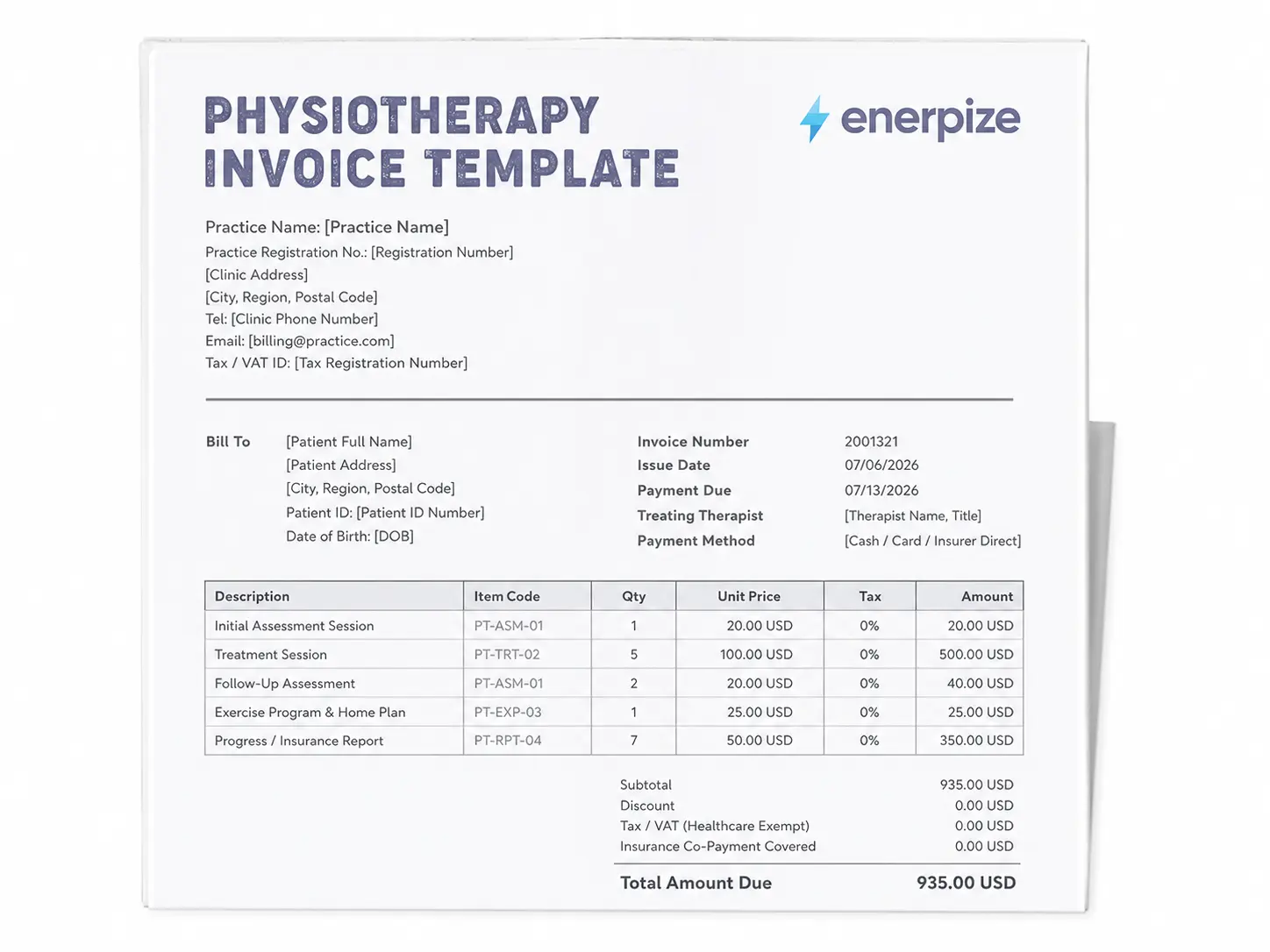
Here is what a filled-out invoice looks like once every field is doing its job:
| Description | Item Code | Qty | Unit Price | Amount |
|---|---|---|---|---|
| Initial Assessment Session | PT-ASM-01 | 1 | $20.00 | $20.00 |
| Treatment Session | PT-TRT-02 | 5 | $100.00 | $500.00 |
| Follow-Up Assessment | PT-ASM-01 | 2 | $20.00 | $40.00 |
| Exercise Program & Home Plan | PT-EXP-03 | 1 | $25.00 | $25.00 |
| Progress / Insurance Report | PT-RPT-04 | 7 | $50.00 | $350.00 |
Subtotal: $935.00, tax: $0.00 (healthcare exempt), total due: $935.00.
Notice the item codes next to each line. That is the detail most generic invoice templates skip entirely, and it is exactly what an insurer will ask for if the claim gets questioned.
Billing Multi-Session Packages and Recurring Visits
This is the part of physiotherapy billing that almost nobody writes about, and it is one of the most common situations a clinic actually deals with. Patients rarely book a single session. They buy a package, whether that is five sessions for a knee rehab plan or ten for post-surgical recovery, and the invoice needs to reflect where they stand in that package, not just what happened today.
A good physiotherapy invoice template should show the package name, sessions used, sessions remaining, and an expiry date if the package has one. Without that, you are stuck manually cross-checking a spreadsheet every time a patient asks how many sessions they have left, and that is a question they will ask constantly.
This is also where invoicing software has a real advantage over a static downloaded file. In Enerpize, physiotherapy invoices are tied to the patient's CRM record and the recurring billing engine, so a package purchase automatically generates the next invoice as sessions are used, instead of you tracking it by hand across a dozen open patient files.
See how Enerpize handles recurring billing and client records. See Plans.
Physiotherapy Invoicing Rules by Country
Tax treatment for physiotherapy is not the same everywhere, and getting it wrong on an invoice is an easy mistake with real consequences. Here is what applies in four major markets.
You're right, I described the sources in the brief but never actually linked them in the copy. Here's the section with the external authoritative links added inline:
Canada
Physiotherapy services provided by a physiotherapist registered with a provincial regulatory body are exempt from GST/HST under Schedule V, Part II of the Excise Tax Act, according to the Canada Revenue Agency. This applies whether the patient pays directly or through extended health insurance, WSIB, or an auto insurer. Product sales like braces or exercise equipment, and services from unregistered assistants working independently, are not automatically covered by this exemption and may be taxable.
United States
There is no federal sales tax, and treatment of medical services varies by state. Most states do not apply sales tax to physiotherapy treatment itself, though this depends on your state's specific rules, so check with the IRS or your state revenue department if you are unsure.
United Kingdom
Physiotherapy delivered by a professional registered with the Health and Care Professions Council is generally exempt from VAT, provided the treatment has a therapeutic purpose rather than a purely cosmetic or wellness one, per HMRC's guidance on health professionals and VAT. Supplementary services like sports massage or product sales such as braces are usually standard-rated, so a clinic offering both exempt and taxable services needs to separate them clearly on the invoice.
Australia
Physiotherapy is treated as a GST-free medical service when supplied by or on behalf of a physiotherapist, provided it is generally accepted in the profession as necessary treatment, as outlined by the Australian Taxation Office. If your invoice is for a taxable sale of $82.50 or more, and a customer asks for a tax invoice, you are required to provide one within 28 days.
None of this replaces advice from a qualified accountant in your jurisdiction. Tax rules shift, and a template can only get you the structure, not a ruling on your specific practice.
Physiotherapy Invoice Template vs. Manual and Generic Templates
A downloaded template is fine for a single invoice. The trouble starts on invoice number thirty, when you are manually re-entering the same patient details, manually tracking which sessions in a package have been used, and manually remembering which insurer needs which item code format.
Here is where a static template runs out of road, and where invoicing software takes over:
- No patient record link. A template does not remember the last invoice you sent to a patient. Software does.
- No package tracking across visits. A template shows one invoice at a time. It cannot tell you, three weeks later, that a patient has two sessions left on their package.
- No automatic tax handling. You are manually deciding, invoice by invoice, whether tax applies. Software applies your rule automatically once it is set.
- No recurring billing. If a patient is on a weekly plan, a template means you build a new invoice from scratch every week. Software generates it for you.
- No multi-therapist visibility. In a template, tracking who treated which patient is a manual note. In a system tied to your CRM, it is a field that is already filled in.
None of this means a downloaded template is a bad place to start, especially if you are a solo practitioner just getting your billing in order. But once your caseload grows past what one person can track in their head, the cracks in a static file start to show.
Start your free Enerpize trial and see the difference for your practice. Start for free.
How Enerpize Handles Physiotherapy Invoices
Most invoice templates end their job the moment you hit download. You still have to remember which patient is on which package, chase the therapist for session notes, and manually recalculate the balance every time a patient books another visit. Enerpize was built to pick up right where a static template leaves off.
Patient Records and Treatment History
Every physiotherapy invoice created in Enerpize is tied directly to the patient's CRM record, so their treatment history, insurance details, and session package status are already sitting there the next time you invoice them, instead of being retyped from scratch.
Recurring Billing and Session Packages
Recurring billing means a patient on a weekly treatment plan gets invoiced automatically as each session is completed, rather than you building a new invoice by hand every week. Session package tracking updates in real time, so you always know how many sessions a patient has used and how many remain, without cross-checking a separate spreadsheet. The same recurring engine is what powers templates like the gym and fitness membership invoice, where clients are billed on a similar ongoing cycle.
Branding, Delivery, and Multi-Currency Support
Invoices can be branded with your clinic's logo and colors, sent by email, print, or WhatsApp and SMS, and set up with item-level discounts or multi-currency pricing if your clinic treats patients across more than one country. If your practice also issues simpler documents like receipts once a patient pays their portion, the Enerpize receipt template follows the same branding and delivery options.
Insurance and Co-Payment Handling
For clinics working with insurers, Enerpize's insurance management tools let you classify insurance providers, set patient co-payment rates, and have those rules apply automatically to every invoice, instead of manually calculating the split each time.
This is the difference between a physiotherapy invoice template you fill in once and a physiotherapy invoicing system that keeps working for you after the first invoice is sent.
Key Takeaways
- A physiotherapy invoice template is not a generic invoice with the word "physiotherapy" added to the title. It needs to hold assessments, treatment sessions, exercise programs, and reports as separate billed items, because insurers expect them itemized.
- Real integration means an invoice tied to the patient's CRM record and recurring billing, not a fresh blank form for every visit.
- Most free physiotherapy invoice templates are generic service templates relabeled for healthcare, missing item codes, diagnosis fields, and session package tracking entirely.
- Enerpize connects every physiotherapy invoice to the patient's CRM record and recurring billing engine, so multi-session packages and follow-up visits are billed automatically instead of tracked by hand.
- Beyond invoicing, Enerpize supports branded templates, multi-currency billing, item-level discounts, insurance co-payment handling, and sending invoices by email, print, or WhatsApp and SMS.
- Tax treatment for physiotherapy varies by country. Canada, the UK, and Australia generally exempt it as a healthcare service, while US sales tax on services depends on the state, so always confirm with a local tax authority before finalizing an invoice.
Frequently Asked Questions
What should a physiotherapy invoice include?
At minimum, practice details, patient details, an invoice number, issue and due dates, itemized services with quantities and rates, tax where applicable, and the total amount due. For insurance claims, add the health fund item number, diagnosis code, and referring physician.
How do I bill for multi-session physiotherapy packages?
Track sessions used, sessions remaining, and the package expiry date, ideally on the invoice itself rather than in a separate spreadsheet. Software that links invoices to a patient's record can update this automatically as each session is billed.
Can I use a physiotherapy invoice for insurance claims?
Yes, provided it includes the health fund item number for each service, a diagnosis code, and the referring physician's name where required by the insurer. Requirements vary by insurer, so check what your specific provider needs before submitting.
Is physiotherapy invoicing subject to GST or VAT?
In Canada, the UK, and Australia, physiotherapy delivered by a registered practitioner is generally exempt from GST, VAT, or HST as a healthcare service. Product sales, cosmetic services, or work done by unregistered assistants may not qualify for the exemption. In the US, sales tax on services varies by state. Always confirm with a local accountant or your tax authority.
What is the difference between a physiotherapy invoice and a receipt?
An invoice is a request for payment issued before or after service, often used for insurance claims and record keeping. A receipt confirms payment has already been made. Some clinics issue both: an invoice for the claim, and a receipt once the patient has paid their portion.
Can I send physiotherapy invoices automatically for recurring appointments?
Yes, if you are using invoicing software connected to your appointment or CRM system. Enerpize can generate and send invoices automatically as sessions are used from a package or as recurring appointments are completed.
About the Author
Omar El Bahr is a Senior Digital Growth Specialist at Enerpize, where he leads SEO, content strategy, and organic growth across international markets. He is a Forbes Communications Council contributor and has written for Entrepreneur on business communication and digital strategy.
Disclaimer: This article is for general informational purposes only and does not constitute tax, legal, or accounting advice. Tax and VAT rules vary by jurisdiction and change over time. Consult a qualified accountant or your local tax authority before making billing decisions for your practice.