

Posted on 6 October 2026
Progress Claim Template: Free Excel and Word Download for Australian Builders and Subcontractors
- Available in Excel, Word, PDF, Google Sheets and Google Docs, free to download with no sign-up required
- Covers contract items or stages, approved variations, prime cost and provisional sum adjustments, retention and GST in one claim
- Built with the payment claim wording for NSW, Victoria and Western Australia, plus the Queensland request for payment, chosen from one dropdown
- Calculates claim to date, previous claims, retention held, GST, the payment schedule due date and the payment due date automatically in Excel and Google Sheets
A progress claim template is a pre-formatted payment document that a builder, subcontractor or supplier fills in to claim payment for work completed so far on a construction contract, showing the contract value, work done to date, previous claims, retention and GST. The Enerpize progress claim template also adds your state's Security of Payment Act wording.


What Is a Progress Claim in Construction?
You finished the frame on Tuesday.
The trades who built it want paying on Friday. The client pays when the claim clears approval. Your cash flow lives in that gap.
A progress claim is a written request for payment for the work you have completed up to a point in the job, made under the payment terms of the contract, instead of one invoice at the very end. Residential jobs claim by stage. Commercial jobs claim monthly, as a percentage of each contract item.
Every progress claim answers four questions. What was the deal? What has been done? What has already been claimed? What is owed now? Get those four right and the claim reads itself. A good progress claim template asks all four for you.
Progress Claim vs Payment Claim
Here is where most people blur two different things.
A progress claim is the commercial document. A payment claim is that document once it meets your state's Security of Payment Act. In practice, the payment claim form and the progress claim are often the same page. The upgrade matters because a valid payment claim starts a legal clock: miss the payment schedule deadline and the respondent can owe the full amount.
So what is a payment claim, exactly? It is a progress claim that identifies the work, states the amount claimed, is served correctly and, in NSW, Victoria and Western Australia, says in words that it is made under the Act. In Brodyn v Davenport (2004), the NSW Court of Appeal called those requirements basic and essential.
Progress Claim vs Tax Invoice vs Lender Drawdown Claim
These documents travel together, which is why they get confused.
| Progress claim (payment claim) | Tax invoice | Lender drawdown claim | QBCC domestic Form 2 | |
|---|---|---|---|---|
| Who issues it | Builder, subcontractor or supplier | Any GST-registered seller | Builder, through the owner's lender | Contractor on a QBCC Level 1 domestic contract |
| What it does | Claims payment for work done to date | Records a taxable sale for GST | Releases a stage of a construction loan | Claims a stage under that contract |
| Legal clock | Security of Payment Act deadlines | None for payment | The loan agreement | Owner pays or disputes within 5 business days |
The quotable rule: a tax invoice satisfies the ATO, a progress claim satisfies the contract, and a payment claim satisfies the Act. One document can do all three, but only if it is built to. If you only need to bill a finished job with no stages, a construction invoice template is the simpler tool.
What to Include in a Progress Claim Template
A progress claim with a project name, a total and a signature looks finished.
It is not. An adjudicator will ask how you got to that total. Every progress claim template should carry these fields.
| Field | Why It Matters |
|---|---|
| Claimant and respondent legal names, ABN and ACN | A claim against the wrong legal entity cannot be enforced, even if the work was done |
| Contract reference and date | Ties the claim to the agreement that sets its value and timing |
| Claim number and reference date | Most states allow one claim per reference date or named month |
| Description of each item or stage | The work must be identified clearly enough to be valued |
| Contract value per item | The ceiling every percentage is measured against |
| Previous % and % complete to date | Shows how this claim was calculated, not just the result |
| Approved variations with dates | Unapproved extras invite a dispute that holds up the whole claim |
| PC and provisional sum adjustments | Allowances get reconciled to actual cost, with invoices attached |
| Gross to date, less previously claimed | The core claim-to-date maths |
| Retention withheld and the cap | Money owed to you later, so it needs its own line |
| GST and the total including GST | Write $11,000 including GST, not "$10,000 plus GST" |
| The payment claim statement for your state | Required in NSW, Victoria and Western Australia |
Here is the field that quietly decides most fights: the respondent's legal name. Adjudicate Today, an authorized nominating authority in NSW, points out that courts will not enforce a determination when the name and ABN on the claim do not match the contracting entity. Fred Smith trading as ABC Building is Fred Smith, not ABC Building.
The Payment Claim Wording Each State Requires
Three states want the claim to say, in plain words, that it is made under their Act. Queensland stopped requiring that on 17 December 2018, when the BIF Act took over.
| State | What the claim should say |
|---|---|
| NSW | This is a payment claim made under the Building and Construction Industry Security of Payment Act 1999 (NSW). |
| Victoria | This is a payment claim under the Building and Construction Industry Security of Payment Act 2002. |
| Western Australia | This is a payment claim made under the Building and Construction Industry (Security of Payment) Act 2021. |
| Queensland | No statement required. The claim must identify the work, state the amount and request payment. |
Copy it word for word. In Leighton Contractors v Campbelltown Catholic Club, the NSW Supreme Court said there is no room for ambiguity in the endorsement. A missing word or a wrong year is not a typo. It is a gift to the other side.
Getting the Respondent's Name and ABN Right
Copy the respondent's legal name and ABN from the contract. Never type them from memory, an email signature or a bank statement.
The Enerpize template checks this for you. Enter the name and ABN as written in the contract, and the claim flags any difference before you serve it.
What the Enerpize Progress Claim Template Includes
We built this one backwards. We started with the four Security of Payment Acts, the regulator guidance in each state, and the reasons claims fail at adjudication. Then every tab had to answer one of them.
The progress claim template Excel version has ten tabs. You type into two of them, and the claim builds itself.
The Claim That Does Its Own Maths
Enter the percentage complete for each contract item and the Claim Schedule works out value to date, previous claims and this claim. Variations and PC or PS adjustments flow straight into the total.
The Right Words for Your State
Pick your state from one dropdown and the claim inserts the exact statement, or the Queensland request for payment. The words that make it a payment claim are never forgotten.
A Calendar That Counts Business Days
Enter the date the claim was served and the template works out when the payment schedule is due and when payment is due, for your state, your position and your contract terms. It skips weekends and your state's public holidays, and in NSW it shows the last day to serve a section 17(2) notice.
Retention With a Memory
The Retention Ledger tracks what has been held, the cap, and the two release events: practical completion and the end of the defects liability period. When a release date passes without the money, it tells you.
Both Sides of the Argument
Received a claim instead? The Payment Schedule tab lists each item claimed, what you will pay and why you are withholding the rest, then checks your items add up to the claim.
A Paper Trail for Every Claim
The Claim Register logs each claim, its service, the response and the payment, and flags a missing schedule, a dispute or an overdue payment.
A Supporting Statement Page for NSW Head Contractors
NSW head contractors claiming from a principal must attach a supporting statement. The template includes the page, with a reminder to check it against the current approved form.
The Word version gives you a progress claim form with all four state statements as tick boxes, plus a fully worked example. It is the progress claim template free of formulas, for anyone who prefers to fill in a document by hand.
How to Calculate a Progress Claim
The maths is not hard. It is just easy to do in the wrong order, which is why the progress claim template locks the order in.
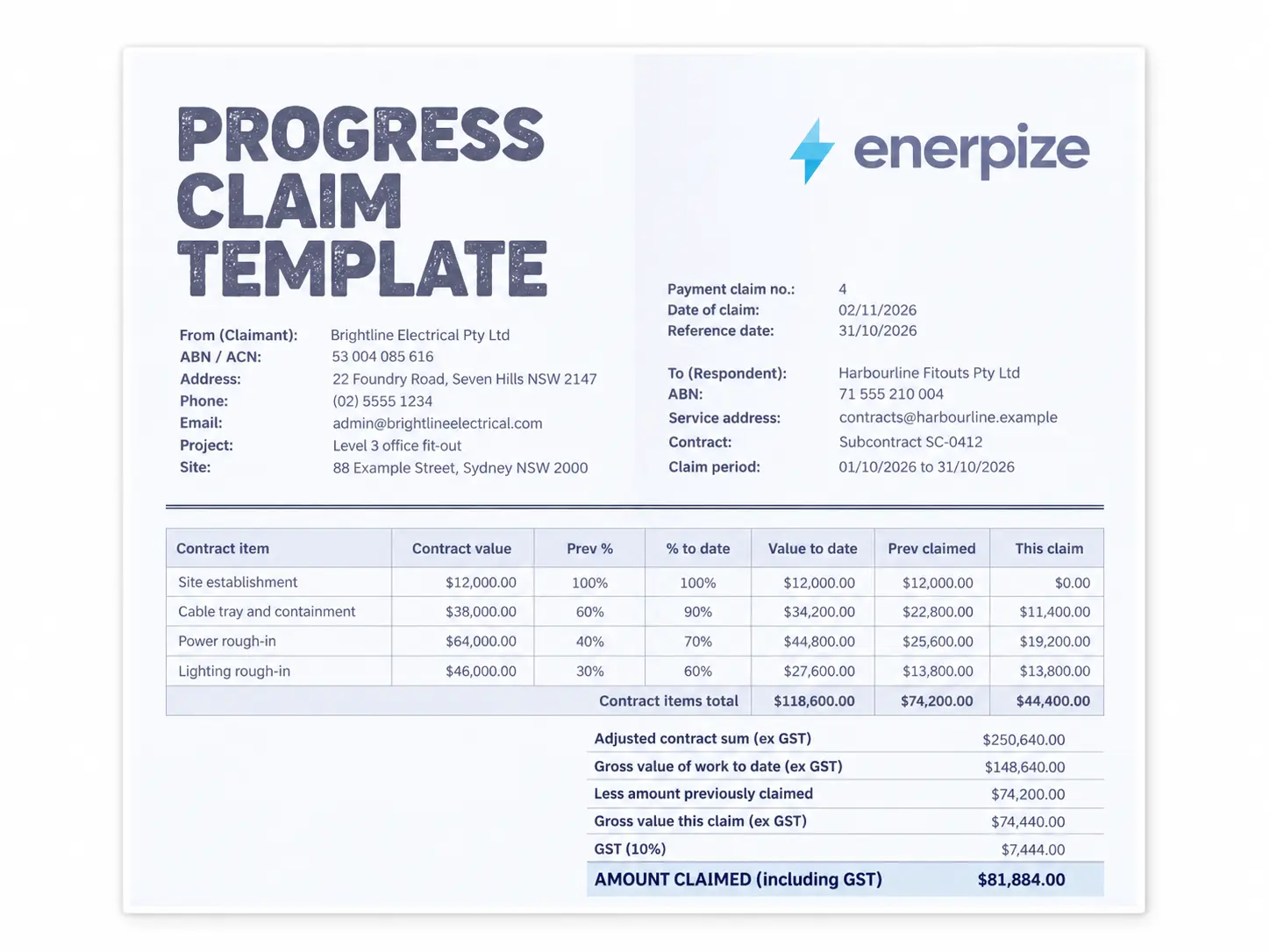
Our worked example is an electrical subcontractor on a commercial office fit-out in Sydney, with a $240,000 subcontract. This is claim number 4.
Percentage-Complete Claims
Multiply each item's value by its percentage complete, then subtract what you claimed last time.
Power rough-in is worth $64,000. Last month it was 40% complete, so $25,600 was claimed. This month it is 70% complete, so the value to date is $44,800 and this claim is $19,200. Add every line, $8,400 of completed variations and a $640 provisional sum adjustment, and the gross value to date is $148,640. Previous claims total $74,200, so the gross value of this claim is $74,440.
Stage-Based Claims
Residential contracts mostly claim by stage, and each stage is either complete or it is not. In our construction progress claim template, a stage is simply a line at 0% or 100%. The contract decides what "complete" means, so read the stage definition before you claim it, not after the client queries it.
Retention and GST on Each Claim
Our subcontract holds 5% retention, capped at 5% of the adjusted contract sum of $250,640. Retention held to date is $7,432, of which $3,710 was held on earlier claims, so $3,722 comes off this claim.
That leaves $70,718. Add GST of $7,071.80 and the amount claimed is $77,789.80 including GST. That number, and only that number, goes in the payment claim total.
How to Fill In the Progress Claim Template: 8 Steps
The first claim takes about twenty minutes. After that, five.
Step 1: Enter both parties exactly as named in the contract
Copy legal names, ABN and ACN from the contract. If a match check says CHECK, fix it now.
Step 2: Choose your state and your position in the contract chain
Your state and your position decide the wording, the payment schedule deadline and the due date for payment.
Step 3: Set the reference date
In NSW, you can serve one payment claim for each named month, on and from the last day of that month, unless the contract gives an earlier date. Queensland allows one claim for each reference date. Claim too early and it may not support an adjudication.
Step 4: Update every contract line
Enter the percentage complete to date for each item or stage. The progress claim template Excel file carries the previous percentage forward, so you only touch what moved.
Step 5: Add approved variations and PC or PS adjustments
Only variations approved in writing. Attach supplier invoices for any prime cost or provisional sum adjustment, because the respondent is entitled to see the actual cost.
Step 6: Check retention and GST
Confirm the retention rate and cap match the contract. GST is added if you are registered.
Step 7: Attach your evidence
Dated photos, dockets, certificates and signed variation approvals. Evidence turns approval into a formality.
Step 8: Serve the claim and record how
Serve it by a method the contract and the Act allow, and log it. Proof of service is worth as much as the claim itself.
Payment Schedules: Responding to a Progress Claim
Now flip the chair around. Someone has served a claim on you.
A payment schedule is your written answer. It must identify the claim, state the amount you propose to pay (which can be nil), and give every reason for paying less than the amount claimed. If you intend to pay the full amount by the due date, you do not need one at all. The progress claim template includes a Payment Schedule tab for this moment.
The deadlines are short and they are not suggestions:
- NSW: 10 business days after receiving the claim, or earlier if the contract says so
- Victoria: 10 business days, or earlier under the contract
- Queensland: 15 business days, or the shorter contract period
- Western Australia: 15 business days, or earlier under the contract
In our worked example, the head contractor assesses lighting rough-in at 50% instead of 60%. It schedules $72,982.80, withholds $4,807 including GST, and attaches dated photos showing the east zone of Level 3 not yet installed. A number, a reason, the evidence.
Our guide to accounts receivable explains how unpaid claims sit on your books while you wait.
What Happens If No Payment Schedule Arrives
Silence is expensive.
If a respondent serves no payment schedule in time and does not pay, the full amount claimed generally becomes payable. In NSW, the claimant can go to court, or serve a section 17(2) notice within 20 business days of the due date, giving the respondent one last 5 business day window before adjudication. The claimant can also suspend work after 2 business days' warning.
Queensland removed that second chance in 2018. Miss the 15 business day deadline under the BIF Act and no reminder is coming.
Serving a Payment Claim and Keeping Proof
A perfect claim that was never validly served is a draft. A payment claim form sitting in your outbox has started nothing.
Serve it the way the contract says. If the contract is silent, the Acts generally allow personal delivery, delivery or post to the respondent's place of business, or an address the respondent nominated. Adjudicate Today prefers signed courier or email with read receipts over ordinary post, because respondents have denied receiving posted claims.
Service cuts both ways. In BCFK Holdings v Rork Projects (2022), a claim handed to an unauthorized superintendent was still validly served once the principal read it. Because only one claim is allowed after termination in NSW, the builder's second claim, and its $685,915 adjudication win, fell over.
Record the date, the time and the method in the progress claim template's Claim Register. Every deadline counts from the day the claim is received.
Progress Claim Rules by State
The idea is the same everywhere. The details change at every border. Here is how the four largest construction markets handle progress claims, and the progress claim template switches between them from one dropdown.
New South Wales
NSW runs the strictest timetable and the most paperwork. If you want a payment claim template NSW adjudicators will respect, start with the exact statement.
The NSW Government's guide to making a payment claim lets you claim for work done within the last 12 months, or longer if the contract allows. Payment is due within 15 business days for a principal paying a head contractor and 20 business days for anyone paying a subcontractor or supplier, unless the contract sets a shorter time. Since 1 March 2021, residential builders can also use the Act against owner-occupiers, with payment due within 10 business days if the contract is silent.
What to add for NSW claims:
- The exact NSW statement, word for word
- A supporting statement if you are a head contractor claiming from a principal
- One claim per named month, served on or after the last day of that month
- A trust account for subcontractors' retention if you are a head contractor on a project worth $20 million or more
Practical note for NSW businesses: NSW business days exclude 27 to 31 December, so a pre-Christmas claim has a later deadline than you think.
Queensland
Queensland made claiming easier and responding harder.
The QBCC payment claim template reads like a tax invoice and asks the respondent to pay or serve a payment schedule within 15 business days. Under the Building Industry Fairness (Security of Payment) Act 2017, payment is due on the date in the contract or 10 business days after the claim if the contract is silent. The QBCC Act caps contract payment terms at 15 business days for commercial building contracts and 25 business days for subcontracts. Anything longer is void and the 10 business day default applies.
What to add for Queensland claims:
- A clear request for payment, such as a due date or the word invoice
- The QBCC wording inviting a payment schedule within 15 business days
- One claim per reference date
- Payment terms checked against the 15 and 25 business day caps
Practical note for Queensland businesses: on a QBCC Level 1 domestic renovation contract, the owner must pay or dispute your Form 2 claim within 5 business days. That is the contract's timetable, not the BIF Act's.
Victoria
Victoria protects commercial work and leaves most home owners outside the Act.
According to the Building and Plumbing Commission, the Building and Construction Industry Security of Payment Act 2002 does not apply to domestic building work for a building owner, unless that owner is in the business of building residences. A claim can be served on and from the last day of the month in which work was first carried out, then monthly. Work done between 1 and 21 December can be claimed from 22 December, and work done between 22 and 31 December from 31 January. The latest time to serve is the later of the contract time or 6 months after practical completion.
What to add for Victorian claims:
- The exact Victorian statement, word for word
- Your claim date set against the December cut-offs
- A note of the practical completion date, so the 6 month window does not close on you
Practical note for Victorian businesses: the respondent has 10 business days to serve a payment schedule, and Victoria has no Christmas blackout, so holiday claims run on a tighter clock than in NSW.
Western Australia
Western Australia rebuilt its regime from scratch in 2022.
The WA Government's payment claim template contains the minimum statutory information for a claim under the Building and Construction Industry (Security of Payment) Act 2021, which applies to contracts entered into on or after 1 August 2022. The respondent has 15 business days to serve a payment schedule. HIA's summary of the payment timeframes is 10 business days for dwelling work when the contract is silent, 20 business days for principals paying head contractors, and 25 business days for subcontractors, unless the contract specifies an earlier date.
What to add for Western Australian claims:
- The exact WA statement, word for word
- A check that the contract was signed on or after 1 August 2022
- Your claim served within 6 months of completing the work, unless the contract allows longer
Practical note for Western Australian businesses: miss the payment schedule deadline and, according to HIA, you lose the right to respond at adjudication and to seek a review.
How Enerpize Handles Progress Claims and Job Costing
What happens when you are running six jobs, each with its own claim schedule, variations and retention in limbo?
The spreadsheet starts to sweat. That is where Enerpize, used by more than 40,000 businesses, picks up.
Claims That Become Invoices
Enerpize invoices carry item-level detail, tax and cost centers, and record deposits and partial payments. Once a claim built in the progress claim template is approved, it becomes an invoice without anyone retyping the numbers. If you need a quick standalone invoice before you set up the full system, try the free invoice maker.
Retention That Does Not Disappear
Enerpize supports retention on construction invoices, applied after tax, so the amount withheld is recorded against the client from the first claim.
Job Costing That Tells the Truth
A claim tells you what you can bill, not whether the job makes money. Enerpize's construction management software ties costs, purchases and claims to each project and cost center, so a stage that blew its budget shows up while there is still time to act.
From Quote to Final Claim
Most claim schedules start as a quote. Price the job with our construction quote template, and the items you priced become the lines in your construction progress claim template. For jobs using the AIA format, there is an AIA-style payment application built on the same logic.
Enerpize does not serve claims or lodge anything with a regulator. It keeps the numbers right, so the claim you serve is one you can defend.
Progress Claims by Construction Type
Every corner of construction breaks progress claims in its own favorite way, so a construction progress claim template has to flex.
Residential Builders
Stage claims rule here, and the contract's stage definitions decide every argument. Claim the day a stage is complete and attach the inspection record. Several states also cap deposits on domestic building contracts.
Commercial Subcontractors
Monthly percentage claims and retention on every claim. Your biggest risks are the reference date and the respondent's legal name, which is why the construction progress claim template puts both on the front page.
Civil Contractors
Measured quantities and schedules of rates replace percentages. Keep the survey or docket that proves each quantity. A progress payment schedule template with quantity columns does the job better than percentages here.
Trades
Trades often work under short subcontracts with one payment at the end. The Acts still give you a right to progress payments in most cases, even when the contract is silent. For small jobs billed on completion, an electrical invoice template or a contractor invoice template is usually all you need.
Key Takeaways
- A progress claim template should show contract value, work to date, previous claims, retention and GST, not just a total.
- A progress claim becomes a payment claim when it meets your state's Security of Payment Act, which starts a strict response clock.
- NSW, Victoria and Western Australia require a statement that the claim is made under the Act; Queensland does not, but the claim must request payment.
- Payment schedules are due within 10 business days in NSW and Victoria, and 15 in Queensland and Western Australia, unless the contract sets less.
- Name the respondent and its ABN exactly as in the contract, and keep proof of service for every claim.
- Track retention as money owed to you later, with release dates for practical completion and the end of the defects liability period.
Frequently Asked Questions
What is a progress claim in construction?
It is a written claim for payment for work completed to date, made during the job rather than at the end.
What is the difference between a progress claim and a payment claim?
A payment claim is a progress claim that meets the requirements of your state's Security of Payment Act. That status gives the respondent a strict deadline to respond with a payment schedule.
What must a payment claim include under the Security of Payment Act?
It must identify the work, state the amount claimed and be served correctly. In NSW, Victoria and Western Australia, it must also state that it is made under the Act. In Queensland, it must request payment.
How often can I submit a progress claim?
Usually monthly. NSW allows one payment claim per named month, and Queensland one per reference date.
How is retention calculated on a progress claim?
Multiply the gross value of work to date by the retention rate, stop at the cap set in the contract, then subtract the retention already held on earlier claims. The difference comes off this claim.
What is a payment schedule in response to a payment claim?
It is the respondent's written answer. It identifies the claim, states the amount the respondent will pay, and gives every reason for paying less than the amount claimed.
What happens if a payment claim is not paid?
If no payment schedule is served in time, the full amount can become payable and the claimant can apply for adjudication or recover it as a debt. If a schedule is served but the amount is disputed or unpaid, the claimant can apply for adjudication.
Do head contractors need a supporting statement in NSW?
Yes. A head contractor serving a payment claim on a principal in NSW must attach a supporting statement declaring that subcontractors have been paid all amounts due and payable.
Is there a progress claim template in Excel?
Yes. The Enerpize progress claim template comes as an Excel workbook that calculates claim to date, retention, GST and every response deadline, with a Word progress claim form and a worked example included. It doubles as a construction progress claim template Excel users can copy for every job, with the whole progress claim template free to download.
About the Author
Omar El Bahr is a Senior Digital Growth Specialist at Enerpize, where he leads SEO, content strategy, and organic growth across international markets. He is a Forbes Communications Council contributor and has written for Entrepreneur on business communication and digital strategy.
Disclaimer: This template and its examples are general information, not legal advice. Figures are illustrative, Security of Payment rules differ by state and change over time, and Enerpize is not affiliated with any state building regulator. Check the current Act or speak with a construction lawyer before serving or responding to a claim.