

Posted on 12 July 2026
Free Construction Quote Template Download: Excel, Word, PDF & Google Sheets
- Available in Word, Excel, PDF, Google Docs, and Google Sheets, free to download with no sign up required
- Covers materials, labor, equipment rentals, permits, retention, and deposit terms in one structured document
- Built with country specific compliance fields for the US, Australia, the UK, and South Africa in one template
- Calculates materials subtotal, labor subtotal, contingency, tax, and total quote amount automatically in Excel and Google Sheets
A construction quote template is a pre formatted document that lets a contractor propose a fixed price for labor, materials, and equipment on a specific job.


A Job Site on Monday, a Blank Quote on Sunday Night
You walked the site on Friday. You know the wall coming down, the wiring that needs rerouting, the flooring the client picked out after changing her mind twice. Now it is Sunday night and you are staring at a blank page trying to remember whether you priced the dumpster rental into last month's bathroom job or ate that cost yourself.
This is the part of contracting nobody puts on the brochure. The build is the fun part. Getting the number right before you touch a single stud is the part that decides whether you eat this quarter.
A construction quote is not a guess dressed up in a nice font. It is a fixed price for defined work, and once your client signs it, that price can turn into a contract whether you meant it to or not. Get the structure wrong and you are either underpricing your own labor or handing a client a document a lawyer could pick apart in ten minutes. Get it right and you look like the contractor who has done this a thousand times, even if this is only your fortieth.
We built the template below so you are not rebuilding that structure from scratch every Sunday night. Then we will walk through what actually belongs on a construction quote, how the rules shift depending on which country you are quoting in, and how the smart contractors turn a signed quote into a moving job without retyping a single line.
What Is a Construction Quote?
A construction quote is a fixed price offer a contractor sends a client for a defined scope of work, covering materials, labor, and any equipment or permit costs, before the job begins. Unlike a rough number scribbled on the back of a business card, a proper quote locks in the price for a set period and spells out exactly what is and is not included.
The word doing the heavy lifting here is fixed. An estimate is a best guess based on rough measurements and a phone call. A construction quote is a commitment. Once the client accepts it, most jurisdictions treat that acceptance as the start of a binding agreement, which is exactly why a vague quote is a liability wearing a nice logo.
A construction quote does three things at once. It tells the client what they are paying for, down to the materials and labor hours. It protects your margin with a clear expiry date, because lumber and copper do not sit still for long. And it makes your business look like the one that has its act together before anyone has swung a hammer.
Skip the spreadsheet gymnastics. Build construction quotes in Enerpize, calculate materials, labor, and tax automatically. Start for free.
Construction Quote vs. Construction Estimate vs. Construction Invoice
Contractors use these three words like they mean the same thing. They do not, and mixing them up is how a friendly ballpark number turns into an argument on a job site three weeks later.
| Document | Purpose | When Issued | Price | Binding |
|---|---|---|---|---|
| Estimate | Rough cost projection based on limited information | Early conversation, before a full site visit | Approximate, expected to move | No |
| Construction Quote | Fixed price offer for a defined scope of work | After a site visit and full takeoff | Fixed for the validity period | Yes, once accepted |
| Invoice | Request for payment for completed or in progress work | After work is done or at agreed milestones | Final | Yes, payment is due |
Here is the short version. An estimate is a conversation starter. A quote is a promise. An invoice is the bill for keeping it.
Send an estimate when a homeowner calls asking what a kitchen remodel "usually costs." Send a quote once you have walked the site, measured the space, and know exactly what materials the job needs. Send the invoice only once work is underway or complete, tied to the milestones you already laid out in the quote.
What to Include in a Construction Quote Template
A construction quote template with missing fields is how scope creep happens. The client assumes something was included because you never wrote down that it was not, and now you are eating the cost of a decision you never made. Here is what actually belongs on the document, split into the header, the scope of work, and the pricing.
Header and Contact Fields
| Field | What It Does |
|---|---|
| Company name, logo, and license number | Identifies your business and, in many regions, proves you are legally allowed to do the work |
| Client name and billing address | Names who you are quoting and where the invoice will eventually go |
| Project or work site address | The physical job location, which is often different from the client's billing address |
| Quote number | A sequential reference so you can find this exact document a year from now |
| Issue date and valid until date | Sets the clock on how long this price holds |
| Prepared by | The named person the client can actually call with questions |
Scope, Line Item, and Financial Fields
| Field | What It Does |
|---|---|
| Project overview | A short summary of the work, the property type, and the location |
| Scope of work | The specific tasks included, broken down by trade or phase |
| Exclusions | What is explicitly not covered, so nobody assumes it is |
| Materials | Itemized materials with quantity, unit, and unit price |
| Labor | Labor hours, crew or trade, and hourly rate |
| Equipment, permits, and miscellaneous | Rentals, permit fees, and anything outside materials or labor |
| Discount and contingency | Any price reduction, and a buffer for unforeseen costs |
| Tax rate and type | Sales tax, GST, or VAT depending on where you operate |
| Payment schedule | Deposit, progress payments, retention, and final payment |
| Terms and conditions | Warranty, change order process, cancellation policy, and insurance |
| Signature block | Space for both the client and the contractor to sign and date |
Two of these get skipped more than any others, and they are the two that protect you the most. The valid until date keeps you from being locked into a price after your supplier raises theirs. And the deposit and retention terms in the payment schedule are what keep a slow paying client from turning into a client who never pays at all.
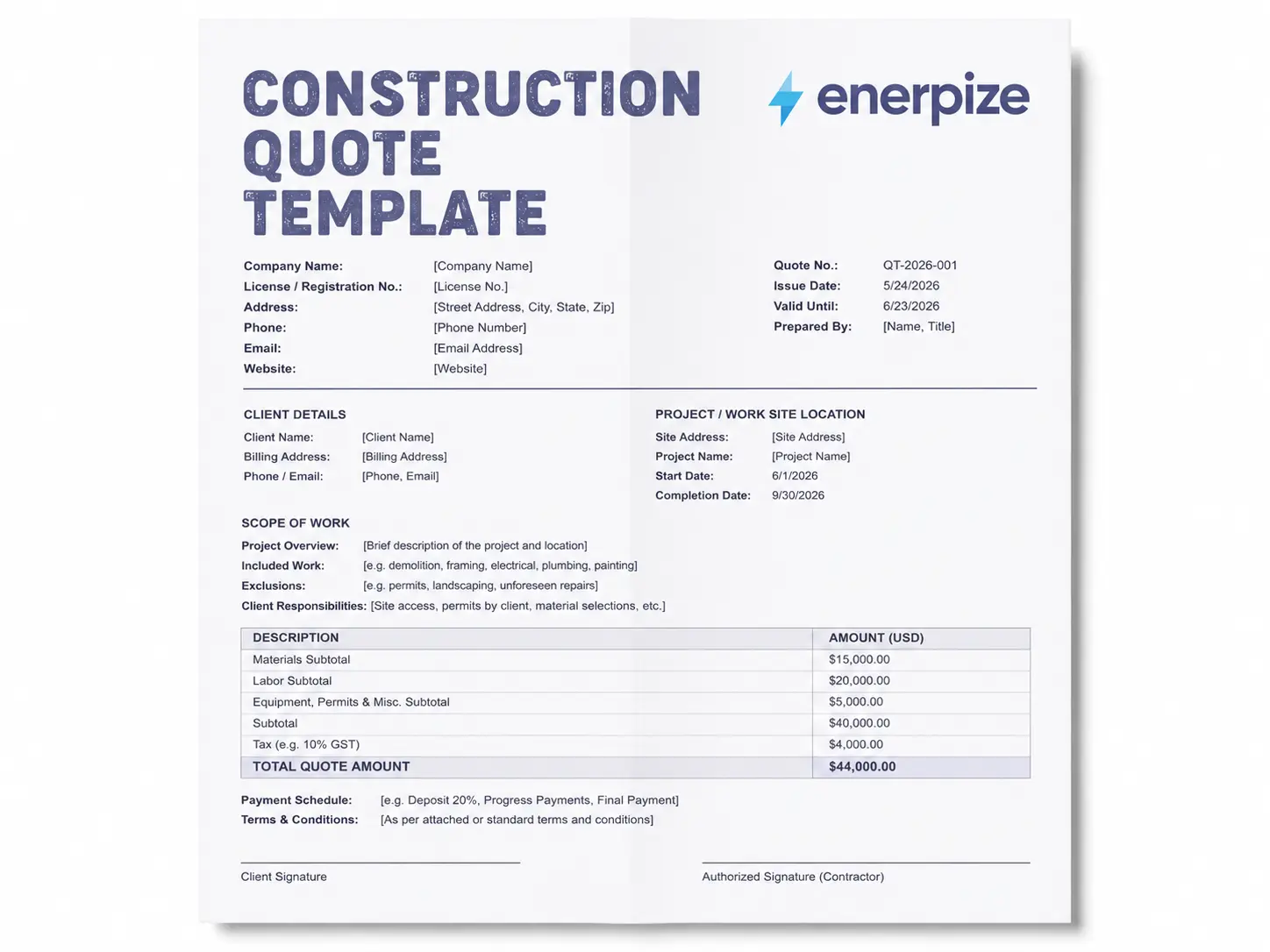
What the Enerpize Construction Quote Template Includes
A Generic Quote With the Word "Construction" Pasted Onto It
Most construction quote templates you find online are a generic quote form with the word "construction" swapped into the title. One line item table, one flat total, done. That works fine for a freelance graphic designer. It does not work for a contractor who needs to show a client exactly where the money is going, because materials, labor, and equipment behave completely differently once the job starts moving.
Three Tables Instead of One
The Enerpize construction quote template splits the pricing into three separate tables instead of one, materials, labor, and equipment or permits, each with its own subtotal. That is not a cosmetic choice. It means when a client asks why the price went up after a material shortage, you can point to the materials subtotal instead of re-explaining the whole quote. It also means when you are comparing this job to the last one, you are comparing apples to apples instead of one big undifferentiated number.
The Fields Generic Templates Leave Out
We also built in fields most generic templates leave out entirely. A project or work site address that sits separate from the client's billing address, because on a lot of jobs those are two different places. A scope of work section with a dedicated exclusions line, so what is not included is written down instead of assumed. A payment schedule table with a specific retention line, because retention is standard practice in construction and almost no generic quote template accounts for it. And a tax field built to hold sales tax, GST, or VAT depending on which country you are quoting in, instead of a flat percentage box that assumes you only ever sell in one country.
Why None of This Is Filler
None of this is filler. Every field on this template exists because leaving it off is exactly the gap that turns a quote into a dispute six weeks into the job.
Build this once and stop rebuilding it every Sunday night. Create construction quotes in Enerpize with materials, labor, and tax calculated automatically. Start for free.
Construction Quote Requirements by Country
Compliance rules for a construction quote are not the same everywhere, and this is the part most templates skip entirely because it is genuinely different depending on where your business operates.
United States
There is no federal law dictating the format of a construction quote, but most states require a licensed contractor to display their license number on any quote or contract over a certain dollar threshold, and the threshold and rules vary by state. California, for example, requires contractors to include their license number on all contracts and bids.
For larger commercial jobs, especially anything tied to progress billing, many contractors and architects rely on the AIA G702 and G703 forms, the industry standard for certifying payment applications. If you are quoting a job that will eventually need this level of documentation, it is worth structuring your payment schedule with that end point in mind from day one. You can check your state's specific contractor licensing requirements through the National Association of State Contractors Licensing Agencies.
Australia
Australian states regulate construction contracts through their own Home Building Acts, and the rules tighten once a job crosses a certain dollar value. In New South Wales, for instance, any residential building work over $20,000 requires a written contract with specific mandatory content, and the client has a statutory cooling off period on larger contracts. GST at 10 percent applies to most construction work, and if your quote crosses into what the Australian Taxation Office considers a tax invoice, it needs to meet those specific disclosure requirements. The NSW Fair Trading website lays out the contract thresholds and mandatory terms for residential building work in that state, and other states publish similar guidance through their own fair trading bodies.
United Kingdom
VAT registered contractors in the UK need to show VAT clearly on any quote that will convert into a VAT invoice, and the standard rate is 20 percent, though certain residential renovation work can qualify for a reduced rate. If you work as a subcontractor, the Construction Industry Scheme changes how payments are handled, since contractors are required to deduct money from a subcontractor's payments and pass it to HMRC as an advance payment toward the subcontractor's tax and National Insurance. Consumers in the UK also have cooling off rights under the Consumer Contracts Regulations for work agreed away from your business premises. Full detail on CIS deductions and how they affect invoicing is available directly through HMRC's Construction Industry Scheme guidance.
South Africa
VAT in South Africa sits at 15 percent, and any VAT registered contractor issuing a quote that will become a tax invoice needs to meet SARS disclosure requirements once the sale crosses the relevant threshold. Home builders also need to be aware of the National Home Builders Registration Council, since NHBRC registration is a legal requirement for anyone building new homes in South Africa, and your registration number is worth including directly on the quote for larger residential jobs. Contractors bidding on public sector work should also be familiar with B-BBEE status disclosure and CIDB grading, since both affect eligibility for tendered work. You can confirm registration requirements directly through the NHBRC's official site.
How to Create a Construction Quote
Six steps, whether you are filling in the downloadable template or building the quote straight into software.
Step 1: Walk the Site and Confirm the Scope
Do not price a job you have only heard described over the phone. A site visit is what turns a guess into a quote you can actually stand behind.
Step 2: Add Your Business and Client Details
Company information, license number, the client's contact, the project address, and the prepared by field.
Step 3: Break Down Materials and Labor Separately
List materials with quantity and unit price, then labor with hours and rate, so the client can see exactly where the number comes from.
Step 4: Add Equipment, Permits, and Miscellaneous Costs
Anything outside materials or labor belongs in its own line so nothing gets buried.
Step 5: Apply Tax, Contingency, and Calculate the Total
Add your local tax rate, build in a contingency buffer for the unexpected, and let the totals calculate before the quote goes anywhere.
Step 6: Set Your Payment Schedule and Send It
Spell out the deposit, progress payments, retention, and valid until date, then follow up within a day or two. A quote that sits in an inbox is a quote your competitor is about to beat.
How Enerpize Handles Construction Quotes
A downloadable template gets you through the occasional job. Send quotes every week, try to track which ones turned into work, and try to convert a signed quote into an invoice without retyping the whole thing, and the cracks show fast. This is where a dedicated construction companies management system earns its keep.
Retention Discounts and Installment Invoicing
Retention is standard practice in construction, and most generic invoicing tools were never built with it in mind. Enerpize calculates retention discounts on invoice items after tax, and lets you invoice a contracting job in installments or as a lump sum, with the retention clearly reflected on every invoice tied to the project.
Project Based and Volume Based Price Lists
Materials in construction rarely have one fixed price. A supplier charges differently depending on the volume you order, and a client agreement might lock in a rate that differs from your standard list. Enerpize lets you maintain multiple price options for the same material depending on project size or client agreement, so your quote reflects the real cost structure instead of a single flat number that never quite matches what you actually pay. This same pricing logic carries through to the sales management platform once the job moves from quote to invoice.
Quote to Invoice to Purchase Order in One Click
When a client accepts a quote in Enerpize, it becomes an invoice in one click, every material line, labor hour, and tax calculation carried across without retyping a single number. If completing the job means ordering more lumber or fixtures, the same quote converts into a purchase order to your supplier just as fast. Quote, invoice, and purchase order stay linked under one reference, so you can trace a job from the first proposal to the final delivery on a single thread.
Client Portal Acceptance and Project Tracking
Clients can review and accept a quote directly through a self-service portal, without a phone call or a signed PDF bouncing back and forth by email. Once accepted, the project itself can carry a site address, engineering plan, map, and photo, with budget and profitability tracked against the same record the quote originated from. Automated statements through the invoicing and billing platform keep the client updated without you having to chase the paperwork by hand.
Real Construction Quoting Scenarios
The structure of a construction quote does not change much from job to job. What changes is what happens the moment the client says yes.
The renovation contractor. A kitchen remodel is quoted at eighteen thousand dollars, with materials and labor broken out separately so the client can see exactly where the number comes from. The client signs, and instead of an afternoon spent rebuilding the numbers as a deposit invoice and starting a separate project file by hand, the accepted quote becomes both in the same motion. The contractor is ordering cabinets while a competitor down the street is still retyping last week's numbers into a new document.
The electrical subcontractor. A quote goes out with a fifteen percent deposit, a thirty day validity window, and retention held until final inspection, because copper prices do not sit still and an open ended quote is a slow leak on margin. The client accepts on day twelve. The deposit invoice goes to the client and the purchase order for conduit and fittings goes to the supplier off the same accepted quote, no materials list retyped a second time.
The general contractor managing subtrades. A larger residential build is quoted with materials and labor broken out by phase, foundation, framing, electrical, plumbing. When the client signs, the project record carries the site address and engineering plan straight from the quote, and profitability against budget is visible from week one instead of something reconstructed at the end of the job from a stack of separate invoices.
Common Construction Quoting Mistakes
A pricing mistake on a construction quote rarely costs you one job. It compounds across every similar job you price the same way after it.
Underpricing labor to win the bid. Shaving your labor rate to land one job feels harmless in the moment. Do it on every bid for a year and you have quietly worked a year for less than you are worth.
No contingency buffer. Construction has unknowns baked into it, old wiring behind a wall you could not see, subfloor damage under old tile. A quote with no contingency line is a quote that assumes nothing will go wrong, and something always does.
Vague scope of work. "Renovate bathroom, five thousand dollars" invites a fight the moment the client expected a new vanity that was never actually priced in. "Demo existing tile, install new vanity and fixtures per attached spec, five thousand dollars" ends that argument before it starts.
No retention or payment milestones. A single lump sum due on completion leaves you fronting the entire cost of materials and labor with no cash flow along the way. Milestone payments tied to actual progress protect you if a job runs long.
Skipping the site visit. A quote built entirely off a phone description is a quote built on guesses. The site visit is what turns those guesses into a number you can defend if the client pushes back.
Key Takeaways
- A construction quote is a fixed price offer that can become a binding agreement once the client accepts it, which is why vague scope and missing fields are a real liability, not just a formatting issue.
- A construction quote differs from an estimate, which is approximate and non-binding, and from an invoice, which requests payment after work is done or underway.
- Materials, labor, and equipment should be broken into separate line item tables with their own subtotals, not combined into one flat total.
- Compliance requirements shift by country, from state contractor licensing in the US to NHBRC registration in South Africa, and a quote should reflect the rules of wherever the work is happening.
- A payment schedule with a deposit, progress payments, and a retention line protects your cash flow across the life of the job, not just at the end of it.
- Enerpize converts an accepted construction quote into an invoice and a purchase order in one click, with retention discounts and project based pricing built in from the start.
Frequently Asked Questions
What Is a Construction Quote?
A construction quote is a fixed price offer a contractor sends a client for a defined scope of work, covering materials, labor, and any equipment or permit costs, issued after a site visit and valid for a set period.
What Is the Difference Between a Construction Quote and a Construction Estimate?
A construction quote is a fixed price you commit to for the validity period stated on the document. A construction estimate is an approximate figure based on limited information, given before a full site visit, and it is not binding.
What Should a Construction Quote Include?
A construction quote should include your business and license details, the client and project site address, a quote number, issue and valid until dates, a defined scope of work with exclusions, itemized materials and labor, tax, a payment schedule, terms and conditions, and a signature block.
Is a Construction Quote Legally Binding?
A construction quote is an offer, not a contract, until the client accepts it. Once accepted on its stated terms within the validity period, it can become a binding agreement, so the scope and terms should be written clearly from the start.
How Long Should a Construction Quote Stay Valid?
Most construction quotes stay valid for thirty to sixty days, though volatile material prices can justify a shorter window. State the expiry date clearly so you are never locked into a price after your own costs have moved.
Do I Need to Include a Deposit on a Construction Quote?
Yes, a deposit is standard practice in construction. Ten to twenty five percent upfront is common for residential work, and it protects your cash flow and confirms the client is committed before materials are ordered.
What Is Retention in a Construction Quote?
Retention is a percentage of the total payment held back by the client until the job is complete and passes final inspection, protecting the client against unfinished or defective work. It should be stated as its own line in the payment schedule, not buried in the total.
Can I Convert a Construction Quote Into an Invoice?
Yes. In Enerpize, an accepted construction quote converts into an invoice in one click, with materials, labor, and tax carried across automatically. The same quote can also convert into a purchase order if the job requires ordering more materials.
Stop rebuilding the same construction quote from scratch every week. Create, send, and convert quotes to invoices and purchase orders inside Enerpize. Start for free.
About the Author
Omar El Bahr is a Senior Digital Growth Specialist at Enerpize, where he leads SEO, content strategy, and organic growth across international markets. He is a Forbes Communications Council contributor and has written for Entrepreneur on business communication and digital strategy.
Disclaimer: This article is for informational purposes only and does not constitute legal or tax advice. Construction contract and licensing requirements vary by state, province, and country. Consult a qualified professional for advice specific to your business and location.