

Posted on 11 June 2026
Free Plumbing Invoice Template Download: Excel, Word, PDF & Google Sheets and Docs
- Available in Word, Excel, PDF, Google Docs, and Google Sheets, free to download with no sign-up required
- Covers labor hours, parts and materials, call-out fees, emergency surcharges, permit fees, and disposal charges in one structured document
- Built with country-specific tax fields for GST (Australia), VAT (UK), HST (Canada), and sales tax (US) in one template
Calculates labor subtotal, materials subtotal, and balance due automatically in Excel and Google Sheets
A plumbing invoice template is a pre-formatted billing document that records services delivered, rates charged, and parts used, giving both the business and client a clear record of every job.


What Is a Plumbing Invoice?
You finish the job. The leak is fixed, the parts are in, the water is running. The client is happy. And then you hand them a scrap of paper with a number on it.
That is the moment that determines whether you get paid in 24 hours or 24 days.
A plumbing invoice is the billing document you send a client after completing work. It records what you did, what you charged for labor, what parts you used, and when payment is due. It is not a quote, which comes before work starts. It is not a receipt, which you issue after payment clears. The invoice is the request. It sits between those two documents and it is the one that actually moves money.
Most disputes in plumbing billing come down to one thing: the client could not see the breakdown. They saw a total and questioned it. A proper plumbing invoice template eliminates that problem before it starts.
Generate and send plumbing invoices automatically inside Enerpize. Track labor, parts, and job costs in one place. Start for free.
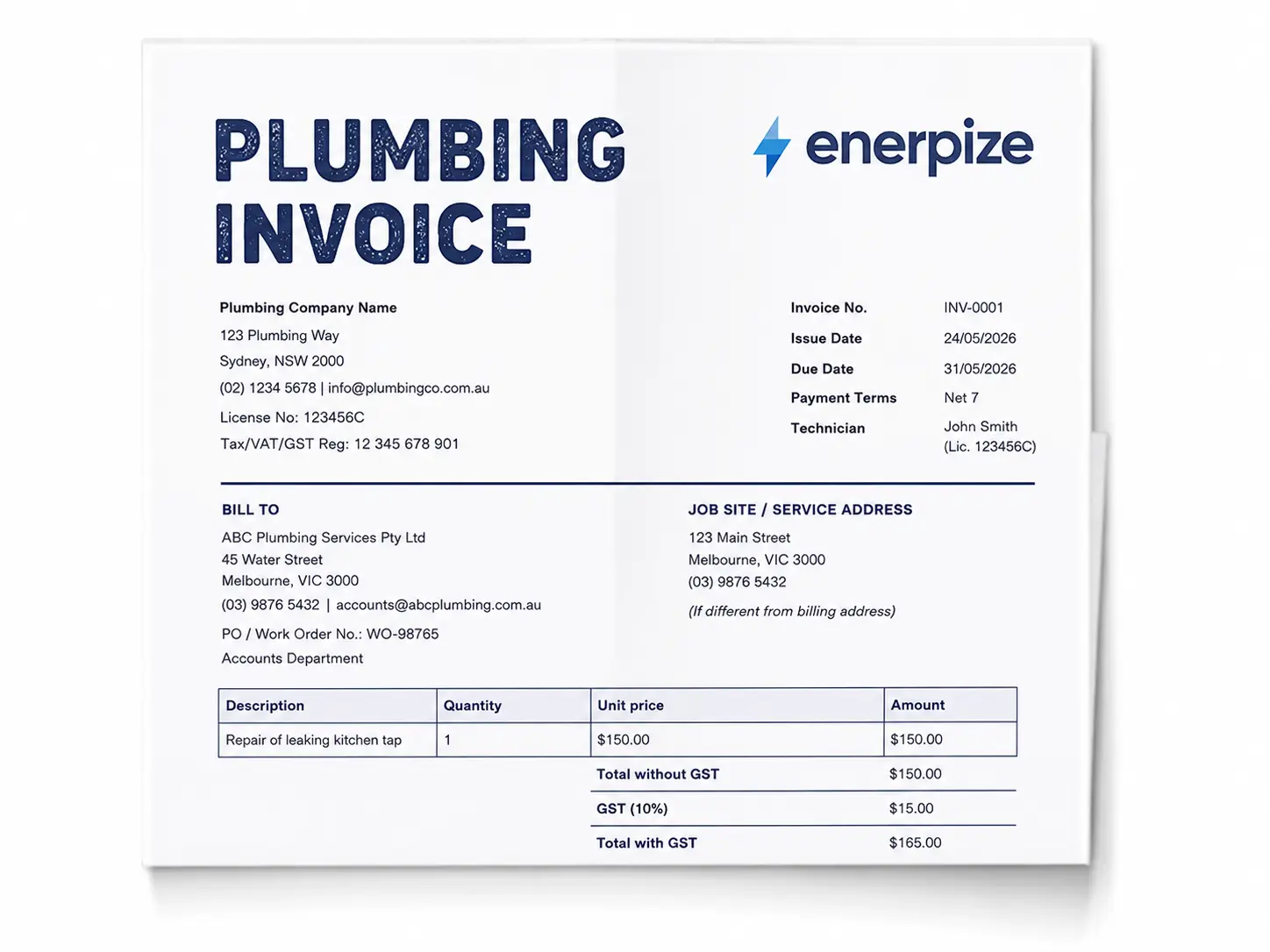
What Enerpize Plumbing Invoice Template Includes
Most free templates online give you a blank table and five rows. That covers the basics. It does not cover the diagnostic fee you charged before touching anything, the emergency surcharge for the Sunday call-out, the permit you pulled, or the deposit the client paid upfront. The Enerpize plumbing invoice template is built around how plumbing jobs actually work, not how a generic billing form assumes they do.
Header Block
Your business name, physical address, phone, email, and trade license number. The license number field matters. In most US states and Australian states, it is legally required on any document you issue to a client. If you are VAT or GST registered, there is a dedicated tax registration number field in the header too.
Invoice Metadata
Invoice number, issue date, due date, payment terms, and the name of the technician who did the work. That last field is one competitors skip. For plumbing businesses with more than one field worker, it matters for your records, for warranty callbacks, and for client trust.
Bill To and Job Site Address
Two separate address blocks. This is deliberate. On commercial jobs, the person paying the invoice and the person at the job site are often different. A property manager pays the bill but the tenant is at the address. If you send one address block and it goes to the wrong person, you are starting a payment chase before the ink is dry.
Labor Section
A dedicated section with a description of work column, hours column, unit column, rate per hour column, and line total. The diagnostic fee and emergency surcharge each have their own pre-labeled rows so you never forget to charge for them. Blank rows below for standard labor lines.
This is separate from materials. Always. Bundling labor and parts into one line is the single biggest reason clients push back on invoices.
Materials and Parts Section
Part description, SKU or reference number, quantity, unit, unit price, and line total. Five blank rows. If you installed a 50-gallon water heater, you list the brand, model, and serial number here. When the client calls six months later about a warranty issue, that information is on the invoice and you are not searching through supplier emails.
Additional Charges Section
Three pre-labeled rows: call-out or trip fee, permit fee with a permit number field, and disposal or haul-away fee. These are the charges that get missed most often on generic templates. On a job where you pulled a permit and hauled away an old unit, those are real costs and they deserve their own lines.
Totals Block
Labor subtotal, materials subtotal, additional charges subtotal, overall subtotal, discount line, subtotal less discount, tax line with rate and registration number fields, deposit received line, and balance due. The deposit line is one of the most important fields on the page. If you collected a deposit before starting work, it shows here as a deduction. The client sees exactly what was owed, what was already paid, and what is left.
Warranty and Payment Terms
Two-column section at the bottom. Left side: accepted payment methods, late fee policy, and notes. Right side: labor warranty period, parts warranty terms, and callback policy. Documenting your warranty in writing on the invoice protects you. If a client demands a free return visit eight months later and your invoice says "90-day labor warranty," the conversation is short.
Enerpize handles invoicing, dispatch, job costing, and client management for plumbing businesses in one system. Start for free.
What to Include in a Plumbing Invoice
Business Name and Trade License Number
Your license number goes on every invoice you issue. In California, Texas, Florida, and most other US states, contractor licensing law requires it on all client-facing documents. The National Association of State Contractors Licensing Agencies (NASCLA) publishes a state-by-state summary for US plumbers. In Australian states, the equivalent plumbing license or drainer license number applies. In the UK, Gas Safe registration details appear on invoices for any gas-related work.
Client Details and Job Site Address
The client's full name or company name, billing address, and the physical job site address if they differ. For commercial accounts, add a contact person's name and a purchase order number if the client provided one. Many commercial accounts payable departments will not process an invoice without a matching PO number.
Labor and Materials on Separate Lines
One combined line that says "plumbing services, $850" tells the client nothing. Separate lines that say "replace copper supply line, 2 hrs at $125/hr, $250" and "copper fittings, 6 units at $12 each, $72" tell the client everything. When a client can see the breakdown, they almost never question it.
Fees and Permits on Their Own Lines
Call-out fee, emergency surcharge, permit fee with the permit number, and disposal charges each get a separate line. These charges were disclosed before you started work. They need to be visible on the invoice, not buried in a remarks field. A permit fee labeled "City permit, pass-through at cost, Permit No. 2026-0451" reads completely differently to a client than a mystery line item at the bottom of the page.
Payment Terms and Late Fee Policy
State the due date directly. "Net 30" is fine for commercial clients. "Due on receipt" is standard for residential work. If you charge a late fee, state it in plain language: "A 2% monthly fee applies to balances unpaid after 30 days." Clients do not pay faster because you hope they will. They pay faster because the invoice tells them exactly when it is due and what happens if they miss it.
What to Leave Off a Plumbing Invoice
No vague line items. "Miscellaneous parts" on an invoice is an invitation for a dispute. Itemize everything.
No new charges that were not in the original quote or scope agreement. If the scope changed during the job, the change order should have been documented and signed before the work happened. Billing surprises after the fact erodes trust and slows payment.
No recycled invoice numbers. Every invoice gets a unique sequential ID. It sounds obvious until you are trying to reconcile three invoices from the same client in the same month.
Plumbing Invoice Line Item Wording Guide
Nobody covers this. Others list field names. They do not tell you what to actually type in those fields. Here is a reference table of ready-to-use wording for the most common plumbing charges.
| Service Type | Line Item Wording |
|---|---|
| Emergency call-out | "Emergency call-out, after-hours response, [date], [time window]" |
| Drain clearing | "Drain snaking, [location, e.g. main line], [X] hrs at $[rate]/hr" |
| Leak repair | "Leak repair, [pipe type] at [location], [X] hrs at $[rate]/hr" |
| Water heater install | "Supply and install [brand] [model] [capacity] water heater" |
| Part supply | "[Part description], Qty [X] at $[unit price] each" |
| Permit | "City permit, reimbursed at cost, Permit No. [number]" |
| Diagnostic fee | "Diagnostic fee, [issue investigated], flat rate $[amount]" |
| Warranty callback | "Warranty callback, [issue], no charge" |
| Disposal | "Haul-away and disposal, [item removed, e.g. 50-gal water heater]" |
| Camera inspection | "Sewer camera inspection, [location], flat rate $[amount]" |
| After-hours surcharge | "After-hours surcharge, work outside standard hours, [date]" |
Copy these, adjust the brackets, and your invoice wording looks like it came from a business that has been doing this for 20 years.
Plumbing Invoice Template by Country
The compliance requirements are different in each. Your invoice should reflect that.
United States
No federal format governs a plumbing invoice in the US, but state contractor licensing laws create requirements that matter in practice. In California, contractors must put their CSLB license number on all written documents issued to clients. Texas, Florida, and most other states have equivalent rules through their respective licensing boards. The NASCLA provides a state-by-state reference.
Sales tax on plumbing work varies by state. In most states, labor on repair jobs is not taxable but parts and materials are. In New York and Texas, both labor and materials on certain repair classifications can be taxable. Verify with your state's Department of Revenue before applying or omitting tax.
For plumbing work that is part of a larger construction project, progress billing tied to milestones is standard. The construction invoice template covers that billing structure in detail.
United Kingdom
VAT-registered plumbers must include their VAT registration number on every invoice, show the VAT rate applied (20% standard rate), and break out the VAT amount as a separate line. If your annual turnover is below the VAT registration threshold, state "No VAT charged" on the invoice to avoid confusion.
One point most UK plumbing invoices get wrong: certain energy-saving installations including ground source heat pumps, solar water heating systems, air source heat pumps, and battery storage systems qualify for a 0% VAT rate until 31 March 2027, after which the rate reverts to 5%. This is set out in HMRC's guidance on VAT energy-saving materials relief. Charging 20% when 5% applies is a compliance error, not just a pricing one.
Gas Safe registration details typically appear on invoices for gas-related plumbing work alongside any relevant trade body membership such as CIPHE or WIAPS.
Australia
If you are registered for GST, you must issue a tax invoice for any plumbing job above AUD $82.50 including GST. The invoice must carry the words "Tax Invoice" in the header, your ABN, the GST amount shown either per line item or as a single total, and the date of issue. The Australian Taxation Office publishes the full requirements.
If your business turnover sits below the $75,000 GST registration threshold, you use a standard invoice without a GST breakdown. The Australian GST invoice template covers the registered version and the Australian invoice without GST covers the non-registered version.
NDIS-funded home modification plumbing work requires additional fields including the participant's NDIS number and the relevant support item number. The NDIS invoice template is built specifically for that.
Canada
GST or HST registration numbers must appear on Canadian plumbing invoices if you are registered. The rate depends on the province: Ontario charges 13% HST, Nova Scotia 15% HST, and Alberta 5% GST only. British Columbia uses 5% GST plus a separate provincial sales tax. The CRA's rate guide by province is the reference for current rates.
Quebec requires 5% GST and 9.975% QST shown as two separate line items on the same invoice, totaling 14.975%. This is the most common invoicing error Canadian plumbers make when billing Quebec clients for the first time. The combined total must appear, but the two taxes must not be merged into one line.
How Enerpize Supports Plumbing Businesses Beyond the Invoice
Most template pages stop at the invoice. The invoice is actually the last step in a workflow that started with a job request, ran through dispatch, field time, parts pulled from stock, and back-office accounting. When those steps are disconnected, invoices get written from memory. Labor hours get estimated. Parts get missed. The total is wrong before you even send it.
Enerpize's plumbing and heating management software connects every step of that workflow so your invoice reflects what actually happened on the job, not what you think happened.
Work Orders and Dispatch in One Place
Before an invoice exists, there is a job. Someone called, a technician was assigned, a service window was set. In most plumbing businesses, that information lives in a WhatsApp thread or a whiteboard.
In Enerpize, you create and manage work orders, assign customers and technicians, schedule service appointments, and track job progress all from the same dashboard. When the job closes, the invoice is generated from the work order data directly. No re-entry. No guessing. The description, the technician, the date, all of it carries through.
Invoice Your Customers in the Field
Your technician finishes the job. The client is standing right there. That is the best moment to close the invoice, because the client can see the work, remember the scope, and approve the total without a conversation three days later when the memory has faded.
With Enerpize, your field team can create and send quotations and invoices from the job site. The client gets a professional invoice immediately. You get paid faster. The gap between "job done" and "invoice sent" closes to minutes.
Technician Timesheets and Payroll
You cannot run a plumbing business with multiple field workers if you are tracking hours on spreadsheets. Someone always forgets to log. Someone always rounds up. The number on the invoice and the number in your payroll records never quite match.
Enerpize lets you delegate tasks and permissions, track plumber timesheets, monitor expenses, and run payroll from the same system. Hours logged by the technician in the field feed into the job cost report. The job cost report feeds into the invoice. And when payroll runs, the hours are already there.
Equipment and Parts Inventory
Parts are where plumbing margins disappear. A fitting that cost $12 gets absorbed into the job because nobody logged it. A water heater ordered for one site gets used on another. Two weeks later, you are wondering where it went.
Enerpize tracks your equipment stock and inventory transactions in real time. Issue purchase orders to suppliers, receive stock, and track what was used on which job. When a part is pulled for a job, it appears as a line item on the invoice automatically. Nothing gets forgotten. Nothing gets absorbed.
Client Management and Service History
Commercial clients and property managers often deal with multiple sites, multiple technicians, and multiple jobs running at the same time. Keeping that straight without a CRM is a customer service problem waiting to happen.
Enerpize stores full client profiles with attached maintenance reports, recurring service schedules, and follow-up reminders. When a commercial client calls about a previous job, the history is right there. When a recurring maintenance visit is due, Enerpize flags it. Consistent pricing per client is saved in the system so your team is never quoting from memory on a return visit.
Accounting and Cash Flow in Real Time
Every invoice a plumbing business sends is also an accounting event. It needs to hit the right account, carry the right tax, and show up in the right period. When invoicing and accounting are in separate systems, that reconciliation happens manually at month end and takes longer than it should.
In Enerpize, every invoice flows directly into your accounts receivable. Tax is calculated at the correct rate for your country and province or state. Cash flow, outstanding balances, and profit per job are visible without running a separate report. You can track and manage your cash flow, equipment purchases, services invoices, and profit and loss all from the same place.
Retention and Installment Billing for Larger Contracts
Not every plumbing job is a flat invoice. Larger contracts, commercial fit-outs, and long-term service agreements often involve deposits, progress payments, or retention clauses where a percentage is withheld until the project is signed off.
Enerpize handles retention billing and installment agreements natively. On larger plumbing contracts, retainage withheld per invoice is tracked and released at project close. This is the same retention logic used in the AIA G702/G703 template for construction payment applications, applied directly to any trade contract with a retention clause.
The template gets you started. The software is what makes the whole operation run.
How to Fill Out a Plumbing Invoice
Ten steps. None of them complicated. The plumbers who get paid fastest are not the ones doing the best work. They are the ones who send a clean, complete invoice the same day the job closes.
Step 1: Enter Your Business Details in the Header
Start with your business name, physical address, phone number, and email. Then add two fields that most plumbers skip: your trade license number and your tax registration number. In most US states and Australian states, the license number is legally required on any document you hand to a client. The tax registration number, whether that is a GST number, VAT number, or HST number, is required in the header if you are registered. Get these right once in your template and you never have to think about them again.
Step 2: Add the Client Details and Job Site Address as Two Separate Blocks
This is where most generic templates fail. They give you one address block. Plumbing jobs regularly involve a client who pays from a different address to where the work happened: a property manager, a landlord, a facilities team. Put the billing address on the left and the job site address on the right. If they are the same, leave the job site block blank. If they are different, both need to be there. Commercial clients also expect to see a purchase order number or work order reference on the invoice before they will process payment.
Step 3: Assign a Unique Invoice Number and Set Your Dates
Every invoice needs a sequential, unique number. Not "Invoice 1" forever. A proper system: INV-0001, INV-0002, INV-0003. This matters for your accounting records, for any disputes, and for matching invoices to receipts and quotes. Set the issue date as the day the invoice is created, which should be the same day the job is complete. Set the due date explicitly: due on receipt, Net 7, or Net 30 depending on the client. Do not leave the due date blank. A blank due date is an open invitation to pay whenever.
Step 4: Fill In the Labor Lines with Hours and Rate
This section has its own dedicated block in the Enerpize plumbing invoice template, separate from materials. For each labor line, describe what was done specifically, not "plumbing work" but "replace ball valve on cold water supply line, under kitchen sink." Enter the number of hours and the hourly rate. The total calculates automatically in the Excel and Google Sheets versions. Pre-labeled rows for the diagnostic fee and the emergency surcharge are already in the template so you never forget to charge for them.
Step 5: Add Each Materials Line with Part Description and Unit Cost
Materials go in their own section, never bundled with labor. For each part, write the description and the SKU or reference number if you have it. Enter the quantity and the unit cost. For major items like a water heater, include the brand, model, and serial number. That information lives on the invoice permanently, which matters when a manufacturer warranty claim comes up six months later and the client cannot find their paperwork. You will have it.
Step 6: Add the Additional Charges
Three rows are pre-labeled in the Enerpize plumbing invoice template for the charges that most invoices forget: the call-out or trip fee, the permit fee with a permit number field, and the disposal or haul-away fee. Each gets its own line with its own amount. These charges were disclosed before the job started. They need to be visible on the invoice, labeled clearly, not buried in a notes field at the bottom where a client can reasonably claim they did not see them.
Step 7: Apply the Correct Tax Rate for Your Country and Province or State
The tax field in the Enerpize plumbing invoice template is labeled for all four markets: GST for Australia, VAT for the UK, HST or GST by province for Canada, and sales tax by state for the US. Enter the rate once and the tax amount calculates from the subtotal automatically. If you are in Quebec, you need two separate tax lines: 5% GST and 9.975% QST shown independently. If you are in the UK billing for a qualifying energy-saving installation, the rate is 0% until March 2027, not the standard 20%. Get the rate right before you send.
Step 8: Subtract Any Deposit Already Received
If you collected a deposit before starting the job, it goes here as a deduction. The client sees the full subtotal, the tax, the deposit received as a negative, and then the balance due at the bottom. This is the only format that prevents the "I already paid you" conversation. Everything is visible on one document. What was owed, what was paid, and what is left.
Step 9: Set Your Payment Instructions, Accepted Methods, and Late Fee Policy
Payment methods go here: bank transfer, card, cash, cheque, or whatever you accept. Write out your late fee policy in plain language: "A 2% monthly fee applies to balances unpaid after 30 days." Do not hide it in your terms and conditions. Put it directly on the invoice where the client will see it before they decide how quickly to pay. Clients respond to clarity. An invoice that tells them exactly how to pay and exactly what happens if they do not tends to get paid faster than one that leaves both questions open.
Step 10: Add Your Warranty Terms Before You Send
The notes and warranty section at the bottom of the Enerpize plumbing invoice template has three fields: labor warranty period, parts warranty terms, and callback policy. Fill them in before every invoice goes out. "90-day warranty on all labor" and "Manufacturer warranty applies to all parts supplied" takes 30 seconds to write and protects you from an uncomfortable conversation months down the line. A documented warranty is your proof that you stood behind the work. An invoice without one is a gap a client can drive a dispute through.
Stop filling out invoices from scratch after every job. Generate your plumbing invoice directly inside Enerpize. Start for free.
When to Send a Plumbing Invoice
Small and One-Off Jobs
Send it the same day the job is complete. Every day you wait on a small job is a day the client deprioritizes it. Same-day invoicing on residential work is standard practice.
Emergency Call-Outs
Send before you leave the site if you can. If not, within 24 hours. Emergency jobs invoiced days later create disputes because the urgency the client felt at 11pm on a Sunday evaporates quickly in the morning.
Large Projects
Use progress invoices at agreed milestones. Rough-in complete, fixture installation, final inspection passed. Never wait until the end of a multi-week job to bill. If something goes wrong mid-project, you want a documented billing trail, not an invoice for the entire contract that the client is seeing for the first time.
Recurring Maintenance Contracts
Invoice at the frequency agreed in the service agreement: monthly, quarterly, or annually. Set it on a schedule and automate it.
Warranty Callbacks
Always issue a zero-charge invoice documenting the visit, what was inspected, and what was found. You did not charge for the visit. But the record that you showed up, looked at the issue, and confirmed the fix still holds matters if the client comes back later claiming the problem was never resolved.
Plumbing Invoice vs. Plumbing Quote vs. Plumbing Receipt
Three documents. Three different moments in the job lifecycle. They are not interchangeable.
The plumbing quote comes first. It defines the scope and estimated cost before any work starts. Use the quotation template to build one that converts cleanly into an invoice once the job is approved.
The plumbing invoice comes after the work is done. It is the formal request for payment based on what actually happened, not the estimate.
The plumbing receipt comes after the client pays. It confirms the transaction is closed. Use the receipt template to issue one that matches your invoice number for a clean paper trail.
Assign a consistent reference number across all three documents. If Quote No. Q-0042 becomes Invoice No. INV-0042 and then Receipt No. REC-0042, your accounting records are clean and any dispute is easy to trace.
Key Takeaways
- A plumbing invoice is not a quote and not a receipt. It is the formal payment request that sits between them, and how it is written determines whether you get paid in 24 hours or 24 days.
- Separating labor and materials into dedicated sections is the single most effective way to prevent client disputes before they start. Bundling them into one line gives clients a number to question instead of a breakdown to read.
- Most free plumbing invoice templates online are generic billing forms with "plumbing" in the title. The Enerpize plumbing invoice template is built around how plumbing jobs actually work: diagnostic fee, emergency surcharge, permit pass-through, disposal fee, and deposit deduction all have their own labeled fields.
- Tax compliance on a plumbing invoice varies by country and region. Australian plumbers registered for GST must include "Tax Invoice" and their ABN on any job above AUD $82.50. UK plumbers billing qualifying energy-saving installations apply 0% VAT until March 2027, not the standard 20%. Canadian plumbers in Quebec show GST and QST as two separate line items.
- The Enerpize plumbing and heating management software connects the invoice to every step that came before it: work orders, technician timesheets, parts inventory, client history, and accounting. When those steps are linked, the invoice reflects what actually happened on the job, not what someone remembered afterward.
Documenting warranty terms directly on the invoice, labor warranty period, parts warranty, and callback policy, protects the business from disputes months after the job closes and takes less than a minute to fill in before sending.
Frequently Asked Questions
What should a plumbing invoice include?
A plumbing invoice should include your business name, trade license number, and tax registration number; the client's name and job site address; a unique invoice number and issue date; separate itemized lines for labor and materials; additional charges such as call-out fees, permits, and disposal; the applicable tax rate and amount broken out; a deposit deduction if one was collected; the balance due; your payment terms and due date; and your warranty terms.
What is a plumbing invoice?
A plumbing invoice is a billing document a plumber or plumbing company sends to a client after completing work. It records what was done, what it cost, and when payment is due. It sits between the quote, which comes before work starts, and the receipt, which confirms payment was received.
What is the difference between a plumbing invoice and a plumbing receipt?
An invoice is a payment request. You send it when the work is done and payment has not yet been received. A receipt confirms payment was received. Issuing a receipt before payment creates an accounting error and removes your formal record of what is still owed.
How do I write plumbing invoice wording for line items?
Be specific. Instead of "repair work," write "Leak repair, copper supply line under kitchen sink, 1.5 hrs at $125/hr." For parts: "3/4 inch ball valve, Qty 2 at $28 each." Specific wording reduces client questions and speeds up payment.
Do I need a license number on a plumbing invoice?
In most US states and Australian states, yes. Your trade license number is legally required on all client-facing documents. In the UK and Canada it is not universally mandated by law, but most insurers require it and commercial clients expect to see it.
Can I charge a diagnostic fee on a plumbing invoice?
Yes. List it as a separate line item: "Diagnostic fee, [issue investigated], flat rate $[amount]." If you credit it toward the repair when the client proceeds, state that explicitly on both the invoice and the original quote.
How do I invoice for emergency plumbing work?
Add a dedicated "Emergency call-out fee" or "After-hours surcharge" line item. Include the rate, the date, and the time window covered. This fee should have been disclosed in your service terms before the work started. If it was, the invoice is simply confirming what was agreed.
Do Australian plumbers need a tax invoice for every job?
If you are registered for GST, you must issue a tax invoice for any transaction above AUD $82.50 including GST. It must show the words "Tax Invoice," your ABN, the GST amount, and the issue date.
What is the correct tax rate for Canadian plumbing invoices?
It depends on the province. Ontario is 13% HST, Nova Scotia is 15% HST, and Alberta is 5% GST only. Quebec requires 5% GST plus 9.975% QST shown as two separate line items. Always confirm current rates with the CRA before billing clients in a new province.
What is plumbing invoice wording?
Plumbing invoice wording refers to the descriptions written in the line items on a plumber's bill format. Good wording is specific: it names the service, the location, the duration, and the rate. Vague wording like "labour" or "parts" triggers client questions and slows payment.
About the Author
Omar El Bahr is a Senior Digital Growth Specialist at Enerpize, where he leads SEO, content strategy, and organic growth across international markets. He is a Forbes Communications Council contributor and has written for Entrepreneur on mobile apps, business communication, and digital strategy.
Disclaimer: Tax rates, licensing requirements, and invoicing regulations vary by country, state, and province and change over time. Always verify current requirements with your relevant tax authority: IRS.gov for the US, HMRC for the UK, ATO for Australia, and Canada.ca for Canada.