

Posted on 5 July 2026
Free Electrical Invoice Template Download: Excel, Word, PDF & Google Sheets and Docs
- Available in Word, Excel, PDF, Google Docs, and Google Sheets, free to download with no sign-up required
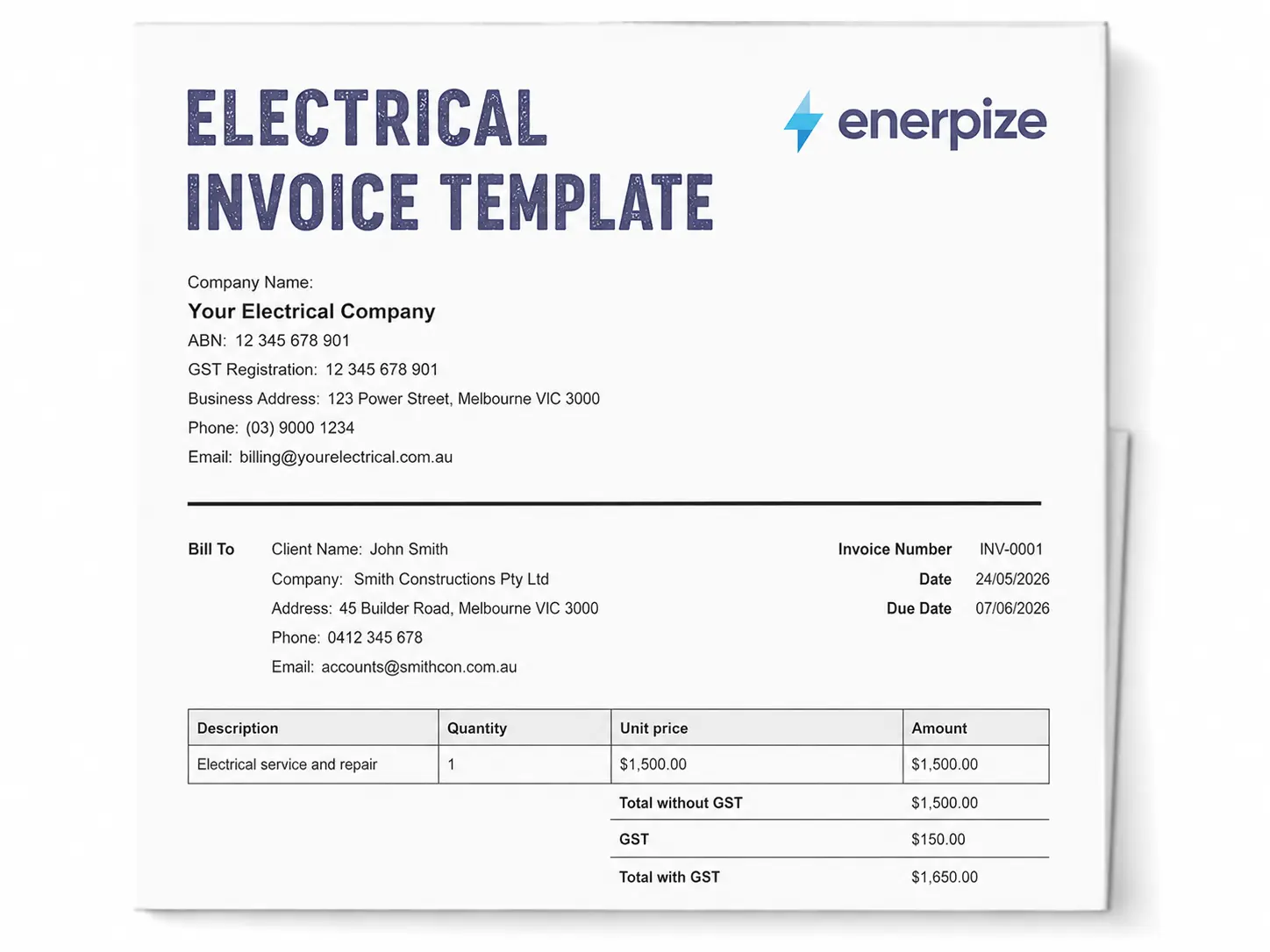
- Covers labor hours, parts and materials, call-out fees, permit and inspection fees, and warranty terms in one structured document
- Built with country-specific tax and compliance fields for the US, Australia, UK, and South Africa in one template
- Calculates labor subtotal, materials subtotal, permit fees, and balance due automatically in Excel and Google Sheets
An electrical invoice template is a pre-formatted billing document that separates labor from materials, records permit and inspection references, and gives both the electrician and the client a clear paper trail for every job.


What Is an Electrical Invoice?
Picture this. A breaker trips for the third time in a week, the client finally calls someone, and by six that evening the panel is fixed, the smell of ozone is gone, and everyone is relieved. Then two days later the client opens an invoice that says, in full, "Electrical work, $740," and suddenly the relief turns into a phone call asking what exactly they paid for.
That single line is the whole problem. An electrical invoice is the document that answers the question before it gets asked. It is a formal billing record that itemizes the labor performed, the parts and materials used, any permits or inspections tied to the job, and the total the client owes, with enough detail that nobody has to guess where the number came from.
It is not the same as a quote, which is the number you give before you touch a single wire. And it is not the same as a work order, which is the internal record of what needs doing. The invoice is what happens after the work is done, when the only thing left standing between a completed job and money in your account is a piece of paper that either builds trust or invites a dispute.
Get this part right and clients pay faster, ask fewer questions, and come back the next time something sparks. Get it wrong and you spend more time defending a number than you spent fixing the panel.
Start invoicing electrical jobs the moment you finish them. Start for free.
What the Enerpize Electrical Invoice Template Includes
We did not want to build another invoice that just lists "electrical work" and a total, because that is exactly the invoice that gets disputed. So every field on this one earns its place.
Labor and Materials, Split on Purpose
The Enerpize Electrical Invoice Template separates labor from materials on two different tables, because a client should be able to see what they paid for your time versus what they paid for the breaker itself. One lump number invites a phone call asking what it was for. Two clear tables answer that question before anyone has to ask.
The Service Call Fee, Written Down Properly
It has a dedicated line for the service call or diagnostic fee, with a note that it gets credited toward the repair if the client approves the work, because that is standard practice and it should be written down, not explained after the fact. A fee the client discovers for the first time on the invoice feels like a surprise. The same fee stated up front, in writing, feels like a policy.
Built for More Than One Country's Tax System
It has fields for your license number, your insurance or workers' comp policy number, and your VAT, GST, or tax registration number, side by side, because a template built only for one country's tax system stops being useful the moment you take a job across a border.
Permits and Inspections as Their Own Field
It has a permit and inspection number as its own field, not buried in a paragraph at the bottom. If an inspector or an auditor ever needs that number, they should not have to read your remarks section to find it.
Enough Detail for the Next Electrician
It has a voltage and amperage field and a panel or circuit location field, because "fixed the wiring" means nothing to the next electrician who opens that panel five years from now, but "replaced breaker, garage subpanel, circuit 14, 240V" tells them exactly where to look.
Deposit and Balance, Kept Separate
It separates deposit paid from balance due, so a panel upgrade with a deposit up front does not read as one confusing lump sum. The client should see what they already paid and what is left, not do the subtraction themselves.
Retainage, on Its Own Line
And it has a retainage line, because commercial electrical contracts withhold a percentage until the job passes final inspection, and that number needs to live on the invoice, not in someone's head.
Most templates online are one invoice trying to serve every trade. This one was built specifically around how electrical work gets billed, and it shows in the fields that other templates leave out.
Field-by-Field Guide to an Electrical Invoice
Every field on the template exists because someone, somewhere, got into a payment dispute without it. Here is what each one is doing and why it matters.
| Field | What It Means |
|---|---|
| Business name, license number, insurance policy no. | Identifies who did the work and confirms they were legally allowed to. Many US states and South African regulations require the license number on the invoice itself, not just on file somewhere. |
| Invoice number and invoice date | A unique, sequential number so you and the client can reference this exact job later, plus the date the bill was actually sent. |
| Job or service date(s) | The date(s) work was performed, which is not always the same as the invoice date, especially on jobs that ran over more than one visit. |
| Payment due date and terms | Due on receipt, Net 15, or Net 30, whatever you have agreed. State it plainly so nobody has to ask. |
| Permit or inspection number | The reference number tied to any permit pulled or inspection scheduled for this job. |
| Client and service address | Who is being billed and where the actual work happened, since those are sometimes two different addresses. |
| Panel or circuit location | Which panel, which circuit, so the invoice becomes a useful record for the next person who works on that system. |
| Voltage and amperage | The technical spec of the circuit or panel involved, useful for insurance, resale, and any future electrician who touches the job. |
| Labor table | Hours worked multiplied by the rate, broken out by technician level, journeyman versus master electrician, since those rates differ. |
| Materials table | Every part used, with quantity, unit price, and whether it is taxable, so the client sees exactly what they are paying for. |
| Permits, inspections, and other fees | Pass-through charges at cost, plus travel and after-hours premiums, kept separate from labor so nothing gets lost in a single number. |
| Retainage | The percentage withheld on commercial jobs until the work is certified complete, shown as its own line rather than folded into the total. |
| Warranty and compliance | Your workmanship warranty terms and a note on whether a safety certificate or certificate of compliance is included. |
Electrical Invoicing by Country
This is where most invoice templates give up and just say "check local rules." I would rather actually tell you what those rules are, because a US-only template does nothing for the electrician working a job in Nairobi or Johannesburg.
United States
American electricians itemize labor and materials, and most states require the electrical or contractor license number to appear on the invoice, not just on a wall certificate somewhere back at the shop. Sales tax typically applies to materials, and whether it applies to labor depends on the state, so it is worth confirming with your accountant rather than guessing.
Commercial jobs, especially anything running through a general contractor, tend to use retainage, usually 5 to 10 percent withheld from each progress payment until the project reaches substantial completion. If you are doing formal payment applications on a larger construction job, our AIA G702/G703 template is built specifically for that certified draw process, and it pairs well with this invoice for anyone working under a general contractor.
Australia
If your business is registered for GST, the invoice needs to be labeled a tax invoice, show your ABN, and display the GST amount separately from the subtotal, in line with the Australian Taxation Office's requirements for tax invoices. Beyond the tax side, several states layer their own licensing rules on top.
An electrical contractor in Queensland, for example, may need to display their electrical contractor license number on every invoice, which is a state requirement sitting on top of the national GST framework rather than a replacement for it. If you regularly invoice Australian clients, our Australian GST invoice template is built around that exact compliance structure.
United Kingdom
If you are VAT registered, the standard rate of 20 percent applies to most electrical labor and materials, and HMRC requires the VAT amount to be shown clearly, separate from the net total. What UK-specific competitors tend to skip is Part P. Since 2005, certain electrical work in dwellings across England and Wales, new circuits, consumer unit replacements, and work in kitchens or bathrooms, is classified as notifiable, meaning it either has to be carried out by an electrician registered with a competent person scheme like NICEIC or NAPIT, or reported to local building control before work starts. If the job you are invoicing was notifiable, that certification belongs in the paperwork you hand over, not as an afterthought.
South Africa
Registered VAT vendors in South Africa need to show the VAT amount separately, in line with SARS invoicing rules. What almost nobody outside South Africa knows about, and what none of the competitor pages I checked even mention, is the Electrical Certificate of Compliance, or CoC. Under the Occupational Health and Safety Act and the Electrical Installation Regulations, no electrical installation may be sold, let, or supplied unless it is safe, and a CoC is the legal document that proves it.
It has to be issued by a person registered with South Africa's Department of Employment and Labour, and it becomes essential the moment a property changes hands or a landlord needs proof the wiring is safe. If your invoice covers work that requires a CoC, note it on the invoice the same way you would note a permit number anywhere else, because it carries the same legal weight.
Invoicing across more than one of these markets? Set up your invoice templates once in Enerpize and let the tax fields adjust per client. Start for free.
Electrician vs. Electrical Contractor Invoices
People use these two terms like they mean the same thing, and mostly they do, until the job gets bigger than one person with a van.
An electrician invoice usually covers a single tradesperson doing residential service work, a service call, a repair, a fixture install, billed at an hourly rate with materials added on. An electrical contractor invoice covers a business, sometimes with multiple electricians and apprentices on payroll, handling commercial installations, new builds, or larger renovation projects, and it often needs to speak the language of general contractors and project managers rather than a homeowner. That means labor broken down by role, since a journeyman and an apprentice bill differently, retainage tracked properly, and sometimes a reference back to a signed contract or purchase order.
If you are billing as a contractor working under a GC or managing subcontractors of your own, our contractor invoice template is worth a look alongside this one, since it is built around exactly that layered billing structure.
Common Billing Scenarios
Every electrician has a version of this story. A simple job turns complicated, and the invoice has to catch up.
The Service Call That Becomes a Repair
A client calls about a dead outlet. You show up, diagnose it in twenty minutes, find a bad connection, fix it in another forty. The invoice shows a diagnostic fee credited against the repair labor, not stacked on top of it, because charging for diagnosis and then charging again for the same time spent fixing it is how good electricians earn bad reviews.
The Emergency Call-Out at Eleven at Night
Nobody minds paying a premium for someone showing up after hours when the power is out and the fridge is dying. What they mind is finding that premium buried inside a flat number with no explanation. State it as its own line, at whatever multiplier you charge, one and a half or two times your standard rate, so the client understands exactly why the number is higher than the daytime job would have been.
The Panel Upgrade With a Deposit
Materials for a 200A panel upgrade are real money committed before you pull a single wire. Collect a deposit up front, show it clearly against the total, and bill the balance once the work passes inspection. The invoice should show deposit paid and balance due as two separate numbers, not one confusing subtraction the client has to do in their head.
The EV Charger Install
These jobs live and die on panel capacity. Bill the load calculation as part of the labor, list the charger and breaker as materials, and if you require a deposit before ordering equipment, note that clearly, since EV charger hardware is not something most electricians keep sitting on a shelf.
How Enerpize Handles Electrical Invoicing
A template gets you through one invoice cleanly. It starts to strain the moment you are running several jobs a week, tracking retainage on a commercial contract, or trying to remember which client still owes a deposit.
From Work Order to Invoice, No Retyping
Enerpize turns a completed job into an invoice without you retyping a single line. Create the work order, assign the technician, log the parts and labor as the job happens, and convert it straight into an invoice when the work is done. No copying numbers from a paper form into a spreadsheet at the end of the day.
Retainage on Commercial Contracts, Tracked Automatically
On the commercial side, Enerpize generates contractor invoices in installments or as a lump sum, with retention amounts calculated and shown as their own line, exactly the way commercial electrical contracts expect. When retainage releases at project close, the system tracks it instead of you hunting through old invoices to remember what was withheld.
Pricing That Actually Reflects the Job
Material pricing on electrical jobs is never flat. A spool of 12/2 Romex costs different money depending on the job size and the supplier relationship you have. Enerpize lets you keep multiple price lists for the same product, so your panel unit costs on a big commercial job do not have to match what you charge a homeowner for a single breaker swap.
Labor Costs That Flow Into the Job, Not a Spreadsheet
Labor costs flow the same way. Log each electrician's hours against the job they worked, journeyman and master electrician rates included, and those hours roll straight into project cost reports instead of living in a separate spreadsheet nobody updates.
Purchase Records Already There When You Need Them
And when a stored materials claim needs backup, or a supplier invoice needs to be matched against a purchase order for a panel you ordered three weeks before installing it, the full purchase cycle lives in the same system, from requisition through supplier invoice, so the paperwork already exists when you need to point to it.
See how a job becomes an invoice without the retyping. Start for free.
Common Mistakes to Avoid
The Single-Line Invoice
"Electrical repair, $740" tells a client nothing and invites every question they could possibly ask. The same $740 broken into labor hours, parts with quantities, and a permit fee reads as a bill instead of a guess.
Hiding the Service Call Fee
A diagnostic fee disclosed on the phone before you show up is a professional norm. The same fee discovered for the first time on the invoice is how a five-star client turns into a one-star review.
Starting a Big Job With No Deposit
A panel upgrade commits real material cost before you touch a single wire. Collecting nothing up front means you are financing the client's project on your own supplier account, and that is how a good month quietly turns into a bad one.
Forgetting the License Number
Several jurisdictions require it on the invoice itself, not just on a certificate on your office wall. Leaving it off costs you credibility at best and a compliance headache at worst.
Sending the Invoice a Week Later
Send it the same day the work wraps, while the job is fresh in the client's mind and the value of what you just did is still obvious to them.
Key Takeaways
- Separate labor from materials on every invoice, since a client who can see the split trusts the total more than one who just sees a lump sum
- Credit the diagnostic or service call fee against repair labor instead of stacking both, since double-charging for the same visit is how good electricians earn bad reviews
- Show deposits, retainage, and after-hours premiums as their own lines, never folded quietly into one total the client has to untangle themselves
- Put your license, insurance, and tax registration numbers directly on the invoice, since several jurisdictions require it and clients increasingly check
- Country-specific compliance documents like the South African Certificate of Compliance or a UK Part P certificate belong on the invoice the same way a permit number does
- Send the invoice the same day the job wraps, since a fast invoice gets paid faster than a delayed one
Frequently Asked Questions
What should an electrical invoice include?
At minimum, your business name and license number, the client's details and service address, an invoice number and date, itemized labor hours and rates, materials with quantities and unit prices, any permit or inspection fees, applicable tax, and clear payment terms.
Do electricians need to add their license number to an invoice?
In many US states and under South African regulation, yes, and even where it is not strictly required, showing it builds trust with commercial clients and general contractors who expect to see it.
Should I charge a diagnostic fee separately from the repair?
Yes, but credit it toward the repair if the client approves the work. Charging the diagnostic fee and then charging full labor again for the same time spent fixing the problem is exactly the kind of thing that turns a five-star client into a one-star review.
How do I bill for materials versus labor?
Keep them on separate lines or separate tables entirely. Labor is hours multiplied by your rate, materials are quantity multiplied by unit price, and mixing the two into one number is the single most common reason electrical invoices get disputed.
How should I handle a deposit on a bigger job like a panel upgrade?
Show the deposit collected and the balance due as two separate numbers, never one confusing subtraction the client has to work out themselves. Bill the balance once the work passes inspection.
What is a South African Electrical Certificate of Compliance and does it belong on the invoice?
It is the legal document, required under the Occupational Health and Safety Act, that proves an electrical installation is safe, issued by an electrician registered with the Department of Employment and Labour. If the job required one, reference it on the invoice the same way you would a permit number.
How is retainage handled on commercial electrical contracts?
The client typically withholds a percentage, often 5 to 10 percent, from each progress payment until the project reaches substantial completion. Show that withheld amount as its own line on the invoice rather than subtracting it silently from the total.
Is electrical labor taxable?
It depends on where you operate. In the US it varies by state, in Australia GST applies if you are registered, in the UK VAT applies at the standard rate for VAT-registered businesses, and in South Africa VAT applies for registered vendors. Confirm with your accountant for your specific jurisdiction rather than assuming one rule covers every job.
About the Author
Omar El Bahr is a Senior Digital Growth Specialist at Enerpize, where he leads SEO, content strategy, and organic growth across international markets. He is a Forbes Communications Council contributor and has written for Entrepreneur on business communication and digital strategy.
Disclaimer: This template and article are for general informational purposes only and do not constitute legal, tax, or professional advice. Always confirm licensing, tax, and compliance requirements with a qualified professional or your local authority before relying on them for your business.