

Posted on 4 June 2026
Free Construction Invoice Template Download — Excel, Word, PDF & Google Sheets
- Tracks labor, materials, and permit fees across every billing period.
- Separates your draw schedule from your final invoice so nothing gets lost in the back-and-forth.
- Available in Excel, Word, PDF, Google Sheets, and Google Docs.
A construction invoice is a formal billing document issued by a contractor to a client, itemizing labor costs, material costs, equipment fees, permit fees, and retainage withheld for each billing period or project milestone.


What Is a Construction Invoice?
Most industries have a simple rule: finish the job, send a bill. Construction doesn't work that way.
You're billing across weeks or months. Materials arrive before labor starts. Subcontractors invoice you before you invoice the owner. The owner withholds retainage until final inspection. And somewhere in the middle, a client approves a change order that rewrites 15% of the original scope.
A construction invoice is the document that makes all of that legible. It is not just a bill. It is a project record. It tells the owner what was done, in what period, for how much, and what still needs to happen before the final dollar is released.
Get it wrong and you chase payments for weeks. Get it right and the money moves with the work.
Create your first construction invoice free. No credit card required. Start for free.
What Should Be on a Construction Invoice?
There is no single universal format required by law in the US. But there is a set of fields that every owner, architect, lender, and bonding company expects to see. Missing any of them slows your payment down.
Here is the full list, in order of how it should appear on the document:
Contractor information Your business name, office address, phone number, email, and contractor license number. In states like California, Texas, and Florida, in most cases, displaying your license number is legally required on invoices and contracts. Check your state licensing board if you are unsure.
Client and project information Client name, billing address, project name, and the physical site address. These should match the contract exactly. Mismatched names between the invoice and the contract are one of the top reasons payment applications get kicked back.
Invoice number and dates A unique invoice number for tracking. The invoice issue date. The billing period covered (start date to end date). The payment due date.
Contract and permit references Your project or contract ID number. The permit number if permits are open. For larger commercial projects, include the architect's project number so the invoice can be matched to the payment chain.
Itemized line items This is where most small contractors cut corners, and it costs them. Every line item needs a description, quantity, unit, unit price, and total. Group them clearly:
- Materials (each item, quantity, unit price, markup percentage)
- Labor (worker name or role, hours, hourly rate)
- Equipment rental (item, days/hours, rate)
- Subcontractor costs (trade, subcontractor name, invoice reference, markup)
- Permit fees and inspection fees (pass-through, with receipt reference)
Change order reference If any work on this invoice was added after the original scope was signed, it must reference the approved change order number and amount on a separate line. Bundling change order work into the base contract is how disputes start.
Subtotal, tax, and total Subtotal before tax. Tax rate and amount (more on US sales tax for construction below). Total amount due.
Retainage A separate line showing the retainage percentage and the dollar amount withheld this period. And a running total of all retainage withheld to date. This is not optional on any progress billing job. It is the number the owner, lender, and bonding company will check first.
Prior payments and balance to finish What has been certified and paid in previous billing periods. What the current payment due is after deducting prior payments. What remains on the contract after this application.
Payment terms Due date. Accepted methods (ACH, wire, check, card). Late payment fee if applicable. And in many US states, a lien notice or lien rights statement is required on contractor invoices.
Authorized signature Your name, title, and signature certifying that the work has been completed as described. On AIA contract projects, there will also be a space for the architect or construction manager to certify the amount before payment is released.
Why Enerpize Goes Further Than Any Template
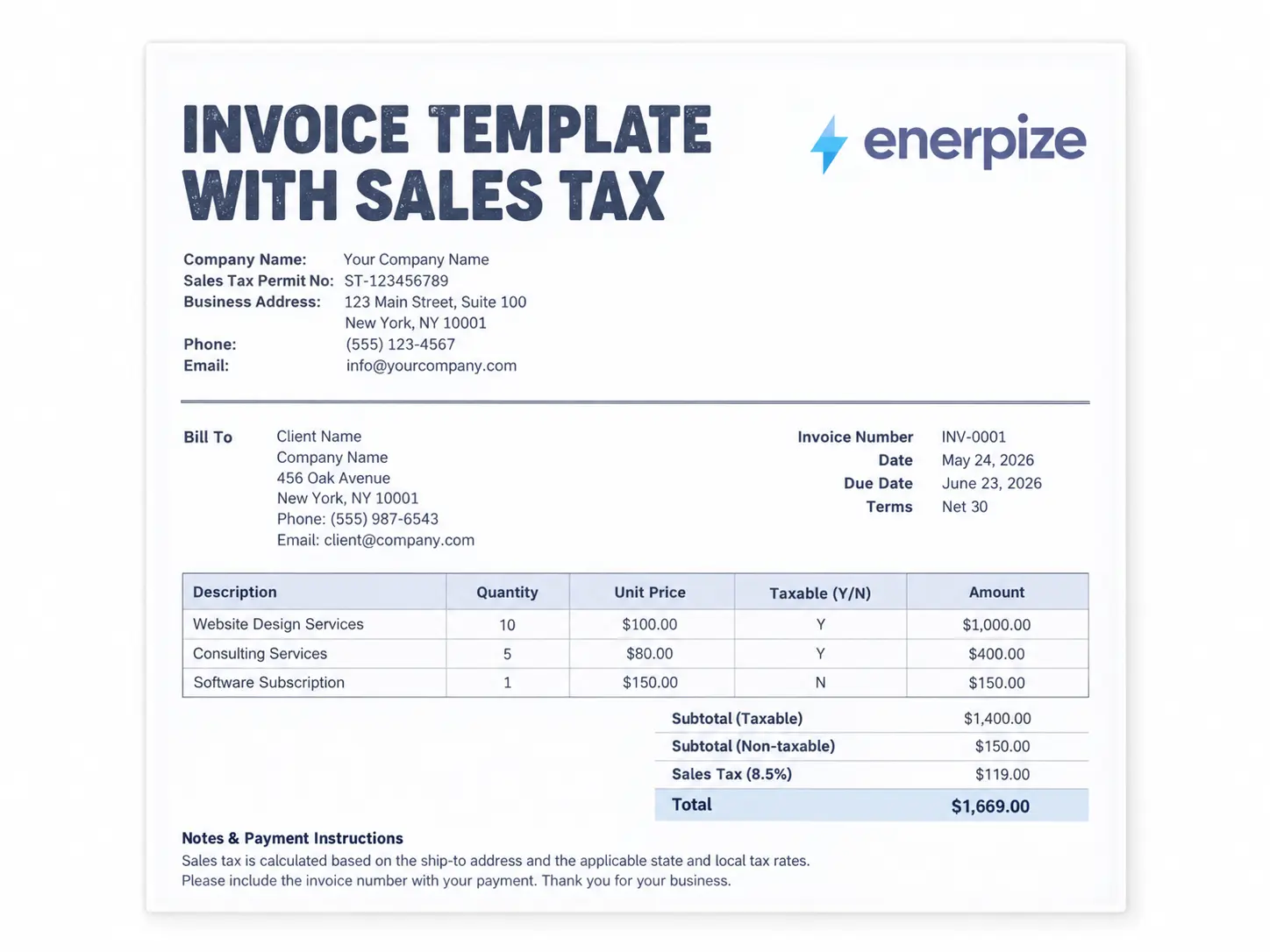
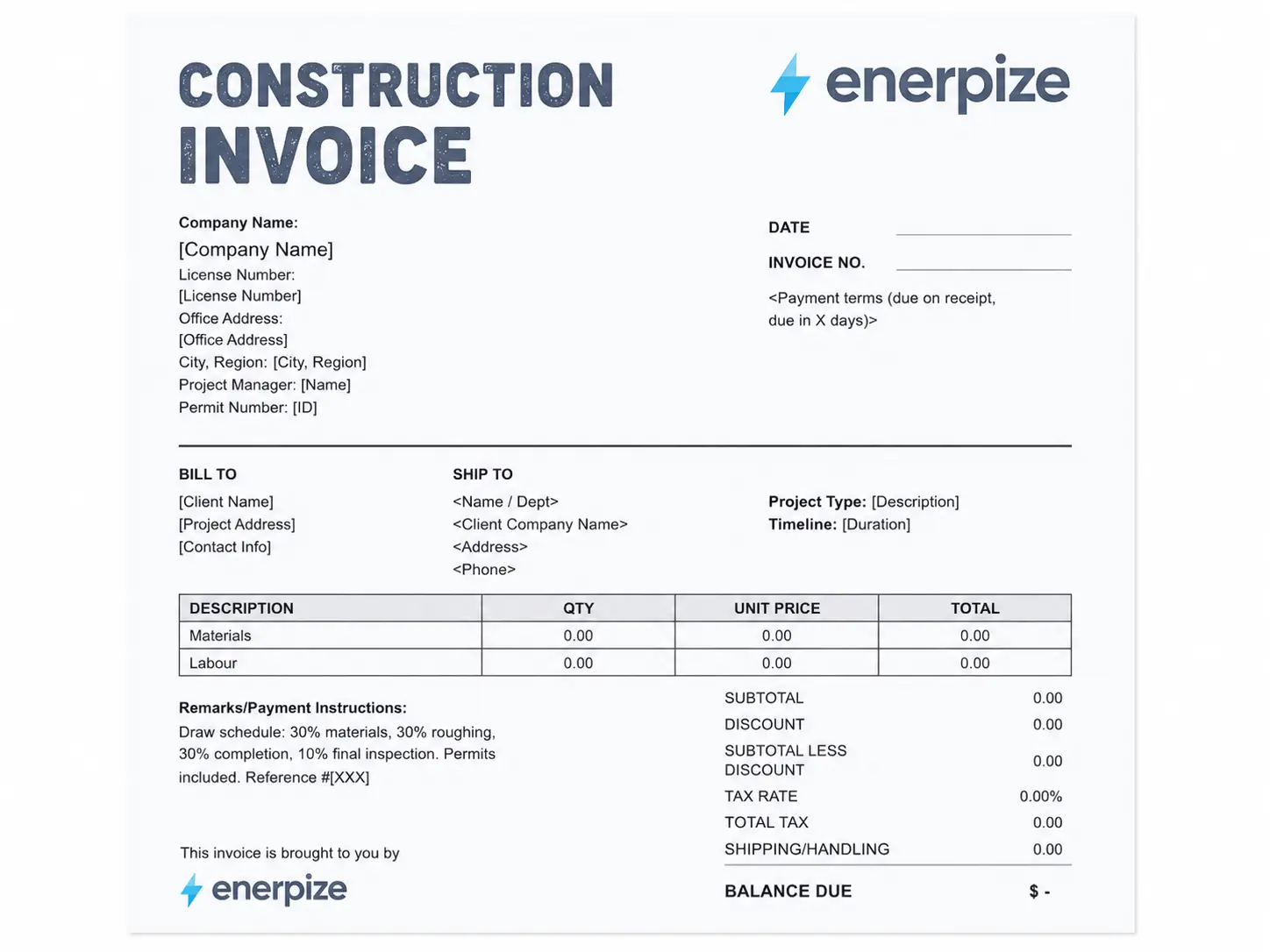
The template above covers the core fields every construction invoice needs: company information, client details, permit number, project manager, and separate sections for materials, labor, and other costs.
Retainage calculations, change order tracking, progress billing across multiple periods, and subcontractor cost management are handled directly inside Enerpize's invoicing module. If those are part of your workflow, the template is the starting point. Enerpize is where you manage the full billing cycle without building your own spreadsheet formulas or tracking retainage release dates manually.
Handle retainage, change orders, and progress billing automatically. Start for free.
Which Construction Invoice Type Fits Your Project?
Not every job gets the same invoice. Use the wrong format and you create confusion about what's owed, when it's owed, and whether the work qualifies for payment.
| Invoice Type | When to Use | What It Looks Like |
|---|---|---|
| Lump Sum | Fixed-price residential or commercial build with agreed scope | One total, broken into milestone payments |
| Time and Materials | Renovations, repairs, and emergency service calls | Hourly labor + itemized materials per period |
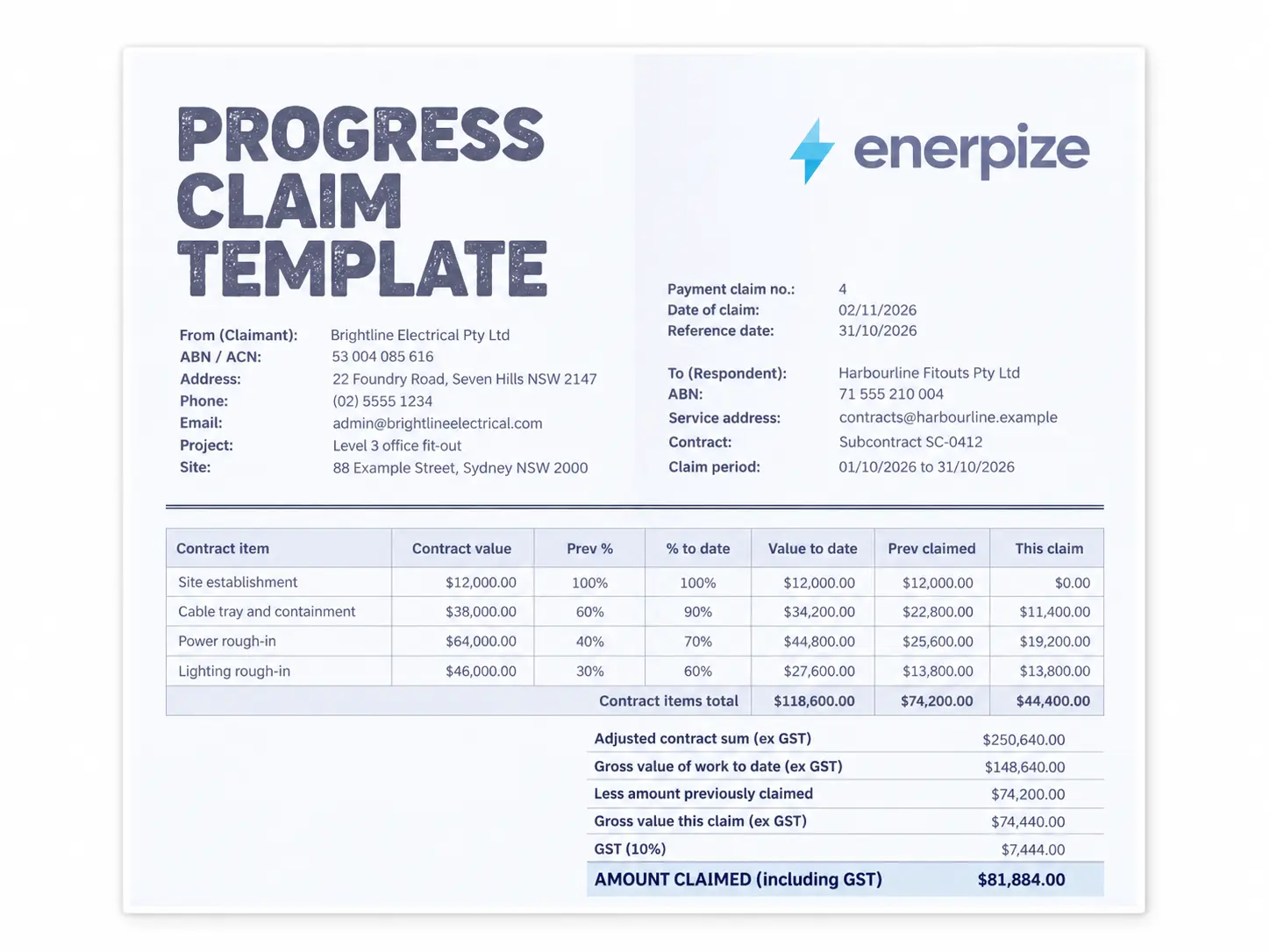
| Progress (Draw) Billing | Multi-month construction projects | Percentage complete, prior paid, retainage withheld |
| Unit Price | Civil infrastructure, earthworks, paving | Quantity x unit rate (cubic metres, linear feet) |
| Cost Plus | Custom builds where final cost isn't known at contract signing | Actual costs plus an agreed fee or percentage |
Most residential general contractors use progress billing. Most subcontractors use time and materials. Most civil contractors use unit price. If your contract doesn't specify, look at how your owner is funding the project. A construction lender will almost always require progress billing with a draw schedule tied to inspection milestones.
How Retainage Works on a Construction Invoice
Retainage is the percentage of each certified payment that the owner holds back until the project reaches substantial completion. The standard rate is 10%, though contracts in some states and project types run at 5%.
It exists to protect the owner. If the contractor walks off the job or the punch list stretches to 200 items, the owner has a financial cushion. For the contractor, it means a chunk of every invoice sits in someone else's account until final sign-off.
Here is what it looks like on a real project:
Contract value: $80,000 Retainage rate: 10% Four billing periods:
| Period | Billed | Retainage Withheld (10%) | Net Payment Due |
|---|---|---|---|
| Period 1 | $20,000 | $2,000 | $18,000 |
| Period 2 | $20,000 | $2,000 | $18,000 |
| Period 3 | $20,000 | $2,000 | $18,000 |
| Period 4 (Completion) | $20,000 + $8,000 retainage release | $0 | $28,000 |
| Total | $80,000 | $8,000 released at close | $80,000 |
On each invoice, retainage appears as its own line item. Not buried in the subtotal. Not hidden in the notes. Its own line, clearly labeled, with the cumulative retainage withheld to date shown beneath it.
Retainage is released when the architect or construction manager issues a final certificate of substantial completion and any punch list items have been resolved. The release is typically a separate final invoice or a line item on your last progress application.
In the US, many states have prompt payment laws that govern how quickly retainage must be released after substantial completion. California requires release within 45 days. Texas within 30 days of accepting the work. Know your state's rules before you close out a project.
For US contractors working under AIA contracts, retainage tracking is built directly into the AIA G702/G703 payment application format. The G702 cover sheet and G703 schedule of values handle retainage calculation by line item and cumulative across the full project. See how it works in our AIA G702/G703 template.
How to Fill Out a Construction Invoice in 7 Steps
Step 1: Set your invoice number and dates Assign a unique sequential number. Every invoice for every project gets its own number. Set the issue date, the billing period (start date to end date), and the payment due date. If you are on a draw schedule, note which draw number this is.
Step 2: Add contractor and client details Your business name, license number, address, and contact information at the top. Client name, billing address, and site address below. These must match the contract exactly.
Step 3: List materials Every material line needs a description, quantity, unit, unit price, and total. If you apply a markup on materials (most contractors run between 10% and 20%), show it as a separate column or a separate markup line below the materials subtotal. Transparency here prevents disputes.
Step 4: Log labor Worker name or role, hours worked in this billing period, hourly rate, and line total. If you have multiple crew members at different rates, each gets their own line. Do not average rates across workers and present a single blended number. Owners and architects will push back on it.
Step 5: Add permit fees, equipment rental, and subcontractor costs Each category gets its own section. Permit fees are typically passed through at cost with a receipt reference. Equipment rental is billed at your rate for the period used. Subcontractor costs are shown with the sub's invoice reference and your markup applied on a separate line.
Step 6: Calculate retainage Apply the agreed percentage to the current period's work completed. Show it as a deduction below the subtotal. Then show the cumulative retainage withheld to date so the owner can see the running total across all billing periods.
Step 7: State payment terms and send Due date, accepted payment methods, and any late fee language from your contract. In states where a preliminary lien notice is required, include it or attach it. Send the invoice with supporting documentation: timesheets, material receipts, subcontractor invoices, and for stored materials, delivery receipts.
Construction Invoicing in the United States: What Changes by State
Construction invoicing in the US is federal in concept but state in execution. The core document looks the same everywhere. The compliance requirements vary significantly.
License number on the invoice California, Texas, Florida, Arizona, and most other states require licensed contractors to display their license number on any contract or billing document. Invoicing without it can jeopardize your license and create grounds for non-payment. Check your state's contractor licensing board website for the exact format required, as some states mandate specific prefix codes alongside the number.
Sales tax on construction Construction is one of the most complicated categories in US sales tax. The general principle: labor is not taxable, materials are. But the actual rules vary by state, project type, and whether you are the prime contractor or a subcontractor.
In Texas, a general contractor working on a new residential build is responsible for paying sales tax on materials at purchase. In New York, a contractor performing capital improvements issues Form ST-124 and does not charge sales tax on labor or materials to the owner. In California, tax applies to materials but not labor, and the taxable amount depends on whether you are billing lump sum or time and materials.
If you bill across multiple states, or your business crosses nexus thresholds in a state where you work regularly, consult a construction accountant before assuming your invoice tax treatment is correct. IRS Publication 334 covers the basics for self-employed contractors and is a useful starting point for understanding what goes on your return versus what goes on your invoice.
Prompt payment laws Most states have prompt payment laws that set deadlines for owners to pay contractors after receiving a certified invoice. At the federal level, the Prompt Payment Act applies to government construction contracts. Know your state's rules because late payment penalties and interest clauses are not automatic. They have to be documented correctly in your contract and on your invoice.
Mechanic's lien rights A mechanic's lien is a contractor's legal claim against a property for unpaid work. In most states, you must serve preliminary notices at the start of the project and include lien rights language on your invoices to preserve your right to file. Missing this step early in a project can leave you with no legal recourse if payment stops. For contractors working under AIA contracts, AIA's standard billing and contract documentation includes guidance on lien waivers and the certification process that ties directly to your payment application workflow.
Construction Invoice Tips That Get You Paid Faster
Invoice at milestone completion, not at month end. The moment the inspection passes or the phase closes, the clock starts. Waiting until the 30th of the month adds 30 days to your payment cycle for no reason.
Separate labor from materials on the face of the invoice, always. Even if your contract is lump sum. Owners want to see the breakdown. Architects need it to certify. Lenders will require it for draw approval.
Reference the contract section for every line item. Not "concrete work." Instead: "Concrete slab, Section 3.2 of contract, 120 sq meters at $85/sqm." That one change removes the most common grounds for a payment dispute.
Never bundle a change order into the base contract line items. Approved change orders get their own line with the change order number. Unapproved scope additions do not get invoiced until they are signed. Full stop.
Attach your backup documentation with every invoice submission. Timesheets. Material receipts. Subcontractor invoices. Delivery tickets for stored materials. Every document that supports a line item should travel with the invoice, not arrive two weeks later when the owner calls.
For Australian contractors: include your ABN and contractor license number on every invoice. If your business is registered for GST (turnover above $75,000 AUD), issue a valid tax invoice showing GST as a separate amount. For residential building work in New South Wales, Victoria, and Queensland, your license number is legally required on contracts and invoices. The Australian Business Register covers ABN registration and GST obligations for contractors across all states.
For UK contractors: include your UTR or company registration number. If VAT-registered, show VAT separately with your VAT registration number. The Construction Industry Scheme (CIS) applies to subcontractors in the UK. Under CIS, contractors deduct tax at source from subcontractor payments, which affects how you present the gross and net amounts on your invoice. See HMRC's guidance on VAT in the construction industry.
How Enerpize Handles Construction Invoicing
A template works for a single project on a calm Tuesday. It starts to fall apart when you are running six projects simultaneously, tracking retainage across all of them, reconciling stored materials claims, managing subcontractor payments, and trying to close your books without re-entering data from three different spreadsheets.
Enerpize is built for that second scenario. With a dedicated customization for construction companies.
Invoicing with retention. Generate contractor invoices in installments or lump sum, with retention amounts calculated and clearly shown on each invoice item. Retention is calculated based on total items after tax, which matches standard AIA and commercial contract behavior. Create quotations, send them to clients for price negotiation, and convert them to invoices once accepted. When retainage is released at project close, the ledger updates without a manual journal entry.
Multiple price lists per project. Add multiple price options for the same product or material unit, depending on project size and client agreement. Some materials in contracting vary in price based on volume or area. Maintain those variable price lists without overwriting your standard rates across other clients.
Project management built into the billing cycle. Add each contracting project with its site address, engineering plan, map, and photos. Set project budgets, attach construction or maintenance details, and specify property activity, units, and area. Every invoice ties to a project. Profitability and cost reports are available at any point in the billing cycle, not just at project close.
Labor time and cost allocation. Calculate each engineer and worker's hours and hourly rate. Allocate labor costs directly to the project they worked on. Review reports on employee working hours and labor costs per project so your line items reflect actual job cost data, not estimates updated manually at the end of the period.
Complete purchasing cycle. Run a full purchasing cycle from requisition to supplier order to purchase invoice, or use a simplified version that only requires issuing purchase invoices. Subcontractor and material supplier invoices are logged against the project budget. When a stored materials claim needs documentation, the purchase record is already in the system.
Inventory and warehouse management. Track inventory quantities across warehouses, control issuance and additions through approved vouchers, and receive notifications when stock falls below threshold. Reconcile actual quantities against records to manage shortages before they hit a billing period.
Accounting customized for contracting. Modify your chart of accounts for contracting needs, assign cost centers to projects, track assets with depreciation, and manage expenses and revenues per project. Financial statements reflect the actual structure of construction billing, not a generic small business template.
Cross-reference: for US contractors working under AIA contracts, the AIA G702/G703 payment application template handles the schedule of values, retainage tracking, and architect certification workflow.
Generate retainage-ready construction invoices from any device. Start for free.
Frequently Asked Questions
What is a construction invoice?
A construction invoice is a formal billing document issued by a contractor or subcontractor to a project owner, detailing labor costs, material costs, equipment fees, permit fees, retainage withheld, and payment terms for a specific billing period or project milestone. It serves as both a payment request and a project record.
What should be included in a construction invoice?
Every construction invoice should include: contractor name, license number, and contact details; client name and site address; invoice number, issue date, billing period, and due date; itemized labor and materials with quantities and unit prices; permit fees; retainage withheld this period and cumulative; change order references; subtotal, tax, and total due; and payment terms with accepted payment methods.
What is retainage in construction invoicing?
Retainage is a percentage of each certified payment (typically 5-10%) that the project owner withholds until substantial completion. It protects the owner against incomplete work. For the contractor, it is money earned but not yet paid. It is released after final inspection, punch list completion, and architect certification.
What is the difference between a progress invoice and a final invoice?
A progress invoice covers work completed during a specific billing period. It shows the current draw amount, retainage withheld, and prior payments. The final invoice is issued after substantial completion and typically includes the retainage release in addition to any remaining balance on the contract.
How do I invoice for change orders in construction?
Reference the signed change order number on a separate line item in your invoice. Include the scope description, agreed amount, and the CO number. Do not bundle change order work into base contract line items. If a change order is not yet signed, do not invoice for it. Bill it in the next period once it is formally approved.
What is the difference between a construction invoice template in Excel vs. PDF?
Excel gives you editable fields and auto-calculations. It is better for projects where you update the same template each billing period. PDF is a fixed format, better for printing and submitting to owners who require a locked document. Enerpize generates both formats from the same invoice record.
What is a civil construction work bill format?
A civil construction invoice uses the same structure as a standard construction invoice but typically applies unit pricing rather than lump sum or hourly rates. Work items are billed per cubic metre of excavation, per linear metre of pipe, or per square metre of paving, referenced against engineering drawings or a Bill of Quantities.
How do I create a free construction invoice template in Word?
Download the Word template from this page. Add your contractor name, license number, address, and contact details. Fill in the client and project information. Add your labor and materials as separate line items. Save a master copy with your company details pre-filled so you only need to update the project-specific fields each time.
Does my construction invoice need to show sales tax?
In the US, it depends on your state and contract type. Labor is generally not taxable. Materials are taxable in most states, though the rules differ by project type, contract structure, and whether the contractor is the tax remitter. Consult your state tax authority or a construction accountant if you are unsure.
How does Australian GST apply to construction invoices?
If your construction business is registered for GST (turnover above $75,000 AUD), you must issue a valid tax invoice for any taxable supply. The invoice must show your ABN, the GST amount as a separate figure, and the words "Tax Invoice" in a prominent position. Most construction services in Australia are taxable under GST. Residential building work is taxable. Some government construction contracts have specific GST treatment, be sure to check current requirements.
About the Author
Omar El Bahr is Senior Digital Growth Specialist at Enerpize, a cloud ERP platform serving 40,000+ SMBs across Australia, Kenya, and global markets. He covers organic growth strategy, construction invoicing systems, and SMB finance workflows. Forbes Communications Council contributor.
Disclaimer
This page is for informational purposes only and does not constitute legal, tax, or financial advice. Invoicing requirements, tax rules, and lien laws vary by country, state, and contract type. Information was accurate at time of publication but may change. Consult a qualified professional before making compliance decisions for your business.