

Posted on 19 January 2026
Procurement Template Excel & Word
- The procurement policy template is available in Excel, Word, Google Sheets, and Google Docs.
- It establishes a structured, transparent framework for managing procurement requests, approvals, and supplier selection.
- Helps businesses control spending, reduce risk, and maintain accurate procurement records from request to delivery.
- Ideal for small and medium-sized enterprises seeking consistency, accountability, and compliance in purchasing.


What is a Procurement Template?
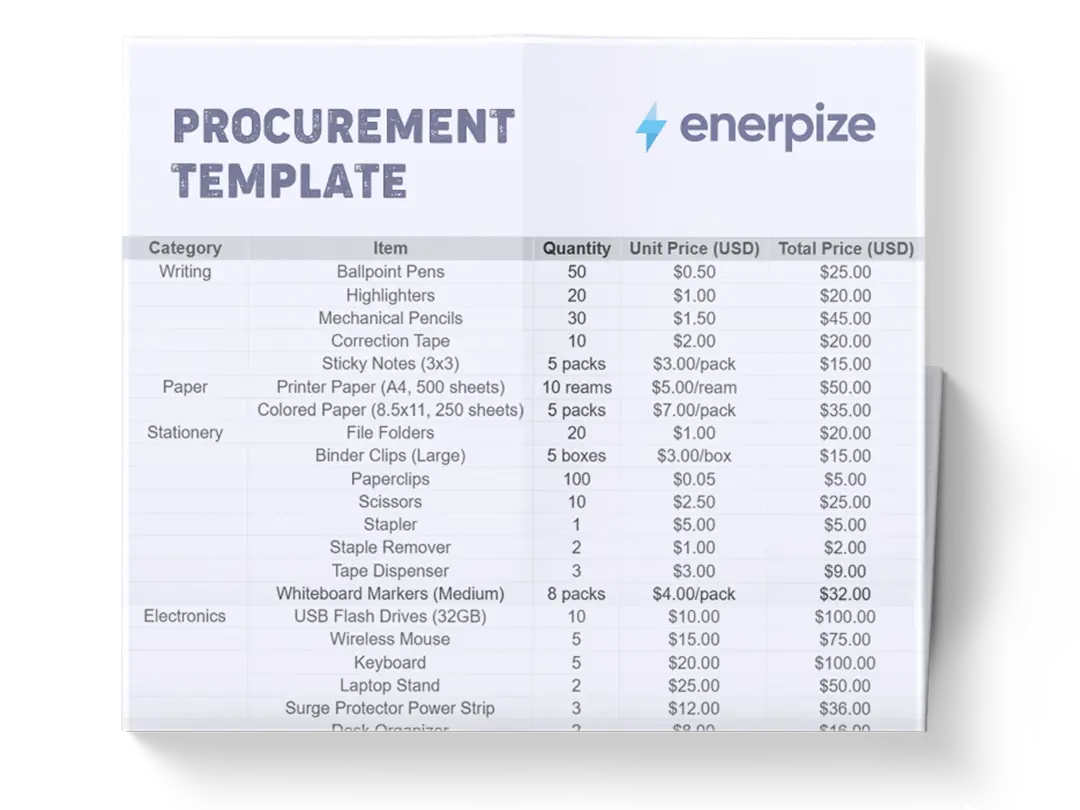
A procurement policy template is a structured document that defines how an organization requests, approves, purchases, and records goods and services in a consistent and controlled manner. It translates procurement principles into clear rules, thresholds, and documented steps that teams can follow without ambiguity.
Rather than relying on informal purchasing decisions, this template establishes a standardized framework that governs who can request purchases, how suppliers are selected, when approvals are required, and how records are retained.
The procurement template serves as both a decision-making reference and an operational control tool, ensuring that every procurement activity aligns with budget authority, ethical standards, and internal controls, regardless of department or purchase size.
What Does the Procurement Policy Template Contain?
Business Details
Includes the organization’s name, address, phone number, and email. This section clearly identifies the entity governed by the policy and links all procurement activity to a specific business.
Purpose
States the intent of the policy: establishing a transparent, consistent, and accountable framework for acquiring goods and services while ensuring value for money, compliance, and strategic alignment.
Scope
Defines where and to whom the policy applies. It explicitly covers all purchases of goods, services, or works made by or on behalf of the company, regardless of department or funding source.
Definitions
Clarifies key procurement terms used throughout the template, including Procurement, Purchase Requisition (PR), Purchase Order (PO), Supplier, Total Cost of Ownership (TCO), and Lowest Evaluated Responsive Bidder (LERB). This section removes ambiguity and ensures consistent interpretation.
Guiding Principles
Outlines the core principles governing procurement decisions, such as value for money, fairness and competition, transparency, integrity, and compliance. These principles act as decision filters across all purchasing activities.
Roles & Responsibilities
Specifies accountability by assigning procurement-related duties to defined roles, including Requester, Budget Owner, Procurement Officer, and Finance. Each role has a clearly stated function in the process.
Procurement Thresholds & Approval Matrix
Defines approval requirements based on purchase value ranges. This section links dollar thresholds to required actions, approvers, and sourcing rigor (e.g., number of quotes or formal RFQ/RFP).
Score
Lists scoring dimensions—price, quality, delivery, and performance—indicating that supplier evaluation is multi-dimensional rather than price-only.
Supplier Selection Criteria
Provides a weighted scoring model with explicit weight percentages for price, quality, delivery time, and past performance, culminating in a total score used for supplier evaluation.
Ethical Standards
Sets behavioral boundaries for procurement activities, including limits on gifts, disclosure of conflicts of interest, and objective bid evaluation.
Recordkeeping
Defines retention requirements for procurement documents, including PRs, POs, quotes, delivery notes, and invoices, along with a standardized digital naming convention and retention period.
Policy Review
Specifies that the policy is reviewed annually and includes a field for the next review date, reinforcing governance and continuous oversight.
How to Use the Procurement Policy Template
1- Start by Completing the Business Details Section
Enter the company name, address, phone number, and email. This establishes ownership of the policy and ensures the document clearly applies to a defined legal and operational entity.
2- Review and Confirm the Purpose and Scope
Read these sections to ensure they accurately reflect how procurement is intended to function within the organization. Replace placeholders such as [Company Name] where applicable.
3- Align Internal Understanding Using the Definitions Section
Ensure all stakeholders involved in procurement—requesters, approvers, finance, and procurement officers—use the defined terms consistently, especially PR, PO, TCO, and LERB.
4- Apply the Guiding Principles as Decision Criteria
When evaluating purchases or suppliers, refer back to the guiding principles to ensure decisions prioritize value for money, fairness, transparency, and compliance—not convenience or personal preference.
5- Assign and Communicate Roles & Responsibilities
Confirm who acts as Requester, Budget Owner, Procurement Officer, and Finance. Each purchase should clearly move through these roles in the order implied by the template.
5- Use the Procurement Thresholds & Approval Matrix to Determine Required Actions
For every purchase, identify the total value and follow the corresponding approval and sourcing requirements—whether a direct purchase, single approval, multiple approvals, or formal RFQ/RFP.
6- Evaluate Suppliers Using the Score and Supplier Selection Criteria Sections
When competitive sourcing is required, assess suppliers against the listed criteria and weights. Record scores objectively to support selection decisions.
7- Enforce Ethical Standards During Sourcing and Evaluation
Ensure no prohibited gifts are accepted, conflicts are disclosed, and all bids are evaluated using the stated criteria.
8- Maintain Documentation According to The Recordkeeping Section
Store all procurement documents digitally, using the specified naming convention, and retain them for the required period to support audits and reviews.
9- Schedule and Track Policy Reviews
Record the next review date and ensure the policy is reviewed annually to remain aligned with operational and regulatory changes.
Importance of a Procurement Policy Template
Controls spending and Budget Discipline
A procurement policy template for small businesses creates clear rules around how money is committed before it is spent. By defining approval thresholds and required actions based on purchase value, the policy prevents unauthorized or impulsive purchases. This ensures that spending decisions are reviewed at the right level and aligned with available budgets, reducing the risk of overspending and cash flow issues.
Boosts Transparency and Audit Readiness
Every procurement decision made under a documented policy leaves a clear trail. Purchase requisitions, approvals, supplier evaluations, and purchase orders are all tied to predefined rules. This transparency makes it easy to justify decisions internally and externally, especially during audits, financial reviews, or compliance checks.
Reduces Risk
The inclusion of ethical standards and objective supplier evaluation criteria protects the business from conflicts of interest, favoritism, and unethical supplier relationships. By requiring disclosure, competitive evaluation, and documented scoring, the template reduces legal, financial, and reputational risks.
Ensures Consistency Across Departments
Without a policy, each department tends to procure differently. A procurement policy template standardizes how purchases are requested, approved, and recorded across the organization. This consistency minimizes confusion, reduces delays, and ensures equal treatment of suppliers and internal stakeholders.
Enhances Supplier Selection Process
The weighted scoring model included in the policy shifts supplier selection away from price-only decisions. By evaluating price, quality, delivery, and past performance together, businesses make more balanced procurement choices that support long-term value rather than short-term savings.
Promotes Stronger Financial and Operational Governance
Defined roles and responsibilities ensure accountability at every stage of procurement. Requesters, budget owners, procurement officers, and finance each have a clearly defined role, reducing errors, duplicated effort, and decision bottlenecks.
Who Can Use the Procurement Policy Template?
Small and Medium-Sized Enterprises (SMEs)
SMEs that are growing beyond informal purchasing benefit most from this template. It provides structure without complexity, helping businesses introduce control and governance before procurement risks escalate.
Finance Teams
Finance teams use the policy to validate spending authority, ensure budget alignment, and maintain control over financial commitments. The approval matrix and recordkeeping rules support accurate forecasting and audit preparation.
Procurement Officers and Purchasing Teams
Procurement professionals rely on the policy as an operational reference. It clarifies when competitive sourcing is required, how suppliers should be evaluated, and how purchase orders are issued and documented.
Department Heads and Budget Owners
Managers approving purchases use the policy to understand their authority limits and responsibilities. This ensures approvals are informed, consistent, and aligned with company-wide procurement standards.
Operations and Administrative Teams
Teams responsible for day-to-day purchasing benefit from a clear, documented process. Instead of relying on informal approvals, they can follow a structured workflow that reduces delays and rework.
Auditors, Compliance Teams, and Leadership
The policy serves as evidence of internal controls and governance. Leadership and auditors can quickly assess whether procurement activities follow approved rules, ethical standards, and documentation requirements.
Looking for Beyond Just Managing Procurement with a Template?
While this procurement policy template helps you standardize purchasing rules and controls, growing businesses often need more advanced tools. That’s where Enerpize, our powerful ERP system, comes in.
With Enerpize Purchase Management Software, you can:
- Centralize purchase requests, approvals, and supplier records.
- Automate procurement workflows and approval routing.
- Link procurement directly with finance, inventory, and reporting.
- Maintain real-time visibility into spending across departments.
If you’re ready to go beyond a static template, Enerpize makes procurement management simple, connected, and scalable.