

Posted on 9 April 2025
Free Daily Cash Report Template for Excel & Google Sheets
- The daily cash report template is available in Excel and Google Sheets.
- It is the backbone of your cash flow management, detailing every receipt, payment, and balance with perfect accuracy.
- Designed to simplify financial tracking, ensure real-time precision, and support strategic cash flow decisions with ease.
- Offers a transparent view of your daily cash flow, enabling you to optimize resources.
- Download it free, available in Excel and Google Sheets, no setup required.


What is The Daily Cash Report?
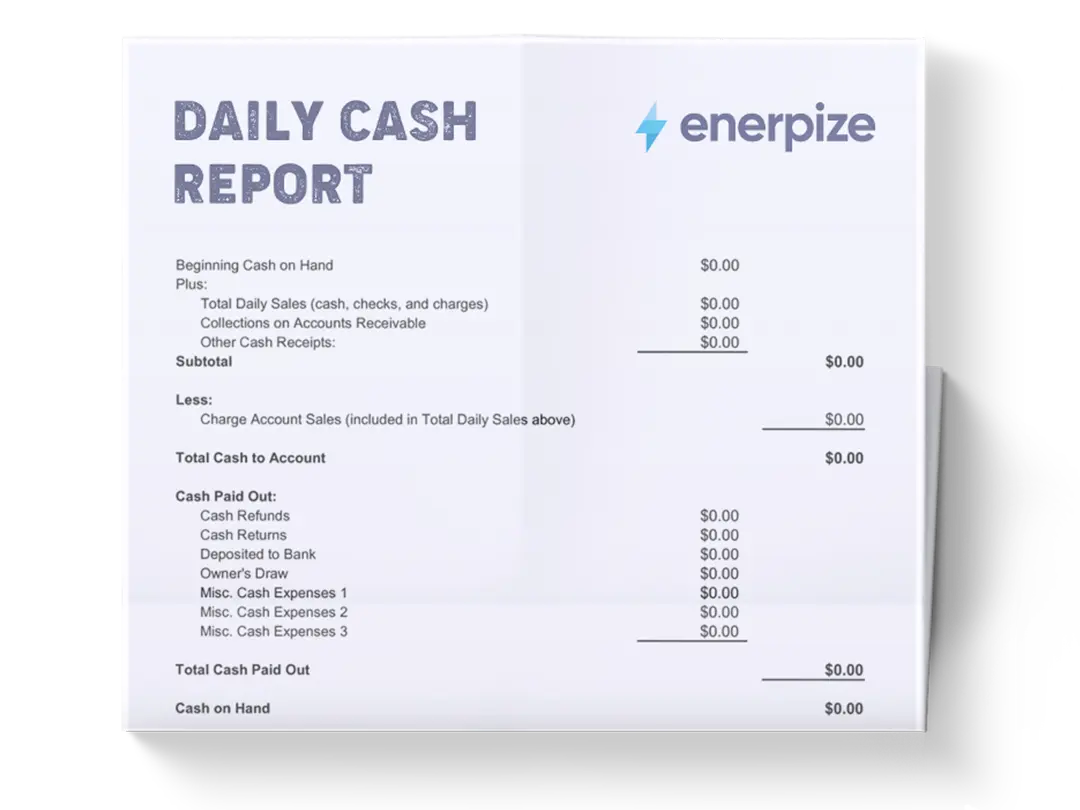
A daily cash report is a record of every cash movement in your business on a given day — inflows, outflows, opening balance, and closing balance. It tells you, at a glance, whether your cash position is where it should be or whether something needs attention before it becomes a problem.
This free daily cash report template is available in Excel and Google Sheets. Download it, enter your transactions, and your closing balance calculates automatically — no formula building required.
Your closing balance shouldn't be a mystery at end of day. Enerpize calculates it automatically — every transaction, every day, in real time. Try Enerpize Free.
Importance of the Daily Cash Report Template
Delivers holistic financial insight
The daily cash template consolidates all cash-related activities—from bank accounts to digital payment platforms and credit cards—into a unified view. This ensures you’re not missing critical pieces of your daily cash flow puzzle, giving you confidence that every dollar is accounted for and traceable across your operations.
Granular Transaction Details
Every transaction is broken down with precision, identifying the exact payee or payer and categorizing expenditures or earnings (e.g., utilities, sales revenue). This level of detail eliminates ambiguity, allowing you to quickly pinpoint where your money is going and why, which is crucial for budgeting and financial planning.
Offers Real-Time Precision
Forget waiting for month-end reconciliations or relying on rough estimates—this report delivers immediate, accurate data as transactions occur. By reflecting cash movements in real time, it equips you with the most current financial standing, enabling swift responses to emerging trends or issues.
Enables Effortless Accessibility
Modern automation means your daily cash report template is available at the click of a button, no manual calculations required. This instant access saves time and ensures you’re always working with up-to-date information, streamlining your financial oversight.
Allows Customizable Timeframes
Whether you need a daily snapshot, a weekly overview, or an annual summary, the report adapts to your needs. This flexibility lets you analyze cash flow patterns over any period, making it a versatile tool for both short-term tactics and long-term strategy.
Who Uses the Daily Cash Report?
A daily cash report isn't exclusive to large finance teams. Anyone responsible for tracking money in and out of a business on a daily basis has a use for it.
Retail and Shop Owners
Use it to reconcile end-of-day POS sales against physical cash in the till. If the numbers don't match, the report tells them exactly where to look — before the discrepancy compounds overnight.
Restaurant and Hospitality Managers
Rely on it to track cash across multiple revenue streams — dine-in, takeaway, delivery, and bar tabs — in a single consolidated view. High transaction volumes and shift-based staff make daily reconciliation non-negotiable.
Small Business Owners and Sole Traders
Use it to maintain a real-time picture of cash on hand. When you're managing payroll, supplier payments, and customer receipts without a dedicated finance team, the daily cash report is the fastest sanity check available.
Accountants and Bookkeepers
Use daily cash reports as source documents for month-end close. Instead of reconstructing cash movements from receipts at the end of the month, they have a day-by-day audit trail already built. Daily cash reports are a foundational input in financial accounting — they feed the cash flow statement and support month-end close. For a broader view of financial performance across a full period, pair it with an income and expense statement.
Operations and Finance Managers
In multi-branch or high-volume businesses, use it to monitor cash across locations and flag irregularities before they become audit findings.
Updating your cash report every day? Enerpize generates your daily cash report automatically from every transaction logged in the system — no spreadsheet, no manual entry. Start for free.
What Does The Daily Cash Report Template Contain?
1- Business Details:
Input your business name, address, phone, and email. Recording these identifiers ensures the report is unequivocally tied to your entity, facilitating organization, retrieval, and compliance during audits or internal reviews.
2- Beginning Balance:
To capture the total cash available at the start of the day. It serves as the starting point for all subsequent calculations and is typically the ending balance from the previous day’s report.
3- Cash Receipts:
This section records all cash inflows, including:
- Sales Revenue: Cash from direct customer sales.
- Customer Payments: Funds received from clients for invoiced goods or services.
- Wholesale Orders: Income from bulk sales to distributors or retailers.
- Interest Income: Earnings from interest-bearing accounts or investments.
- Tax Refund: Cash returned from tax authorities.
- Other Cash Receipts: Miscellaneous inflows like rebates or grants.
- Other: Additional inflows not covered by the above.
4- Cash Payments:
This section itemizes all cash outflows, categorized to reflect the diverse expenditures of your business:
- Cost of Goods Sold: Direct costs tied to production or inventory.
- Supplier Payments: Disbursements to vendors for goods or services.
- Employee Salaries: Wages paid to staff.
- Rent for Retail Space: Lease payments for business premises.
- Utilities: Costs for essential services like electricity or water.
- Marketing and Advertising: Expenditures on promotional efforts.
- Shipping and Logistics: Costs for transporting goods.
- Employee Benefits: Additional staff perks or contributions.
- Returns and Refunds: Cash returned to customers.
- Others: Miscellaneous outflows not otherwise specified.
5- Net Cash Flow:
Calculated by subtracting Total Cash Payments from Total Cash Receipts. The net cash flow indicates the net change in cash for the day. A positive value reflects a cash surplus, while a negative value signals a deficit—both critical insights for financial planning.
6- Ending Balance:
This represents the cash position at the day’s close. It serves as the starting point for the next day’s report and must be verified against actual cash holdings to ensure continuity.
Daily Cash Report vs. Cash Flow Statement
These two documents track cash — but they serve completely different purposes, and confusing them is one of the most common mistakes in small business financial management.
A daily cash report is an operational document. It records every cash movement on a specific day: opening balance, inflows, outflows, and closing balance. It's a working tool — updated daily, used by operations staff and managers, and designed for speed and visibility. You don't need an accountant to fill one in.
A cash flow statement is a formal financial statement. It summarizes cash movements across an entire period — monthly, quarterly, or annually — and categorizes them into operating, investing, and financing activities. It follows accounting standards, is prepared by accountants, and is used by investors, lenders, and boards to assess financial health.
The relationship between the two: your daily cash reports are the raw data that feeds your cash flow statement. If your daily records are accurate and consistent, your cash flow statement is straightforward to produce. If they're not, month-end becomes a reconstruction exercise.
| Daily Cash Report | Cash Flow Statement | |
| Frequency | Daily | Monthly / Quarterly / Annual |
| Prepared by | Operations / owner | Accountant |
| Purpose | Real-time visibility | Financial reporting |
| Audience | Internal management | Investors, lenders, boards |
| Standards | None required | Accounting standards (GAAP/IFRS) |
If you need a structured view of cash across a full period, pair this template with our cash flow statement template for a complete picture from day-level to period-level.
What Is a Daily Cash Position Report?
A daily cash position report is a snapshot of the net cash available to your business at the end of each working day. Where a standard daily cash report records every individual transaction, a cash position report summarizes the outcome — opening balance, total inflows, total outflows, and the closing cash position — giving management a single number that answers the question: how much cash does the business actually have right now?
The terms are often used interchangeably in small business settings. In practice, the distinction is one of audience: operations teams use the full transaction-level daily cash report for reconciliation and audit purposes, while managers and business owners refer to the cash position report for daily decision-making. This template serves both functions — the transaction detail is there for your accountant, and the closing balance is there for you.
Daily Cash Report Best Practices
Filling in the template is the easy part. Getting value from it requires consistency.
Update it at the same time every day
The end of the business day is the natural close point — all transactions have cleared, all receipts are in. Updating it in the morning from memory introduces errors. Make it a closing routine, not a catch-up task.
Reconcile against your bank and POS daily, not weekly
A discrepancy spotted on the day it happens takes five minutes to trace. The same discrepancy spotted seven days later can take hours — and may never be fully resolved. Pair your daily report with a cash reconciliation template to verify your totals against your bank balance at the end of each day.
Log every category separately
Grouping all outflows as "expenses" defeats the purpose. Break them down — supplier payments, staff wages, petty cash, refunds — so patterns become visible over time. If your supplier costs spike in a particular week, you want to see that in the data, not buried under a single total.
Archive reports, don't delete them
Each daily report is a legal-grade record. Over time, they become your most reliable audit trail. Store them in a shared folder organized by month and year. If a dispute arises — with a supplier, a tax authority, or a customer — your daily cash records are the primary source of evidence.
Flag discrepancies before closing the report
If your closing balance doesn't match your expected position, note it in the report before you save it. Don't adjust numbers to make them balance — document the variance, investigate the cause, and update once you've confirmed the explanation. Unexplained adjustments are how small errors become accounting errors that compound across reporting periods.
Use it to inform weekly planning
A daily cash report tells you where you are. Five of them together tell you where you're going. Review the week's reports on Friday and carry those insights into next week's payment scheduling, purchase decisions, and cash reserve planning.
How to Use The Daily Cash Report Template
1- Prepare Your Financial Data:
- Gather Source Documents: Collect all records of cash transactions, including sales receipts, invoices, bank statements, and expense logs. These documents are the foundation of your report.
- Organize by Date: Sort these materials chronologically to match the report’s date. This organization reduces errors and speeds up the entry process.
2- Record the Beginning Balance:
Enter the cash balance from the end of the prior day. For a new report cycle, use your verified cash on hand. This figure anchors the day’s calculations, so confirm its accuracy against your records.
3- Enter Cash Receipts:
- For every cash inflow:
- Specify the Category: Choose the appropriate category (e.g., Sales Revenue, Interest Income) or use “Other” for unique receipts.
- Input the Amount: Record the exact amount received.
- Include Descriptions (Optional): Add brief notes (e.g., “Payment from Client A”) to provide context for future reviews or audits.
4- Enter Cash Payments:
- For every cash outflow:
- Specify the Category: Select from the listed categories (e.g., Supplier Payments, Utilities) or use “Others” for various expenses.
- Input the Amount: Enter the precise amount paid.
- Include Descriptions (Optional): Note details like “Invoice #5678” to aid in tracking and reconciliation.
5- Verify and Cross-Reference:
- Check Totals: Confirm that Total Cash Receipts, Total Cash Payments, Net Cash Flow, and Ending Balance are accurate.
- Use Source Documents: Match entries to receipts, invoices, or statements using descriptions or amounts. This step ensures your report withstands scrutiny during audits.
6- Analyze and Cross-Reference:
- Review Regularly: Examine your reports daily or weekly to spot trends, like high supplier costs or fluctuating sales, that inform budgeting and strategy.
- Track Patterns: Use category totals to identify cash flow drivers, such as seasonal sales spikes or recurring expenses, enhancing your financial foresight.
7- Update and Maintain the Template:
- Keep It Current: Update the template daily to reflect real-time cash positions. Delays risk inaccuracies or forgotten transactions.
- Back-Up Your Data: Store digital copies on secure drives and keep physical backups. This protects your records from loss and ensures accessibility.
8- Integrate With Other Accounting Tools:
- Link with Software: Import data into accounting platforms to streamline reconciliation and reduce manual work. Many tools support such integration.
- Periodic Reconciliation: Use the daily cash template for monthly or quarterly checks against bank statements, ensuring your cash records align with external records.
FAQs
What is a daily cash report used for?
A daily cash report is used to record and verify every cash transaction in a business on a given day. It captures the opening balance, cash inflows, outflows, and closing balance — giving managers and accountants a real-time view of cash position without waiting for a bank statement.
What should a daily cash report include?
A daily cash report should include the date, opening cash balance, itemized cash receipts, itemized cash payments, net cash flow for the day, and the closing cash balance. Some versions also include the payment source for each transaction — bank account, POS, petty cash, or digital platform — to make reconciliation faster.
Is a daily cash report the same as a cash flow statement?
No. A daily cash report is an operational document tracking same-day transactions — it's a working tool updated by operations staff. A cash flow statement is a formal financial statement prepared by accountants for a full period (monthly, quarterly, or annually) and follows accounting standards. The daily report feeds into the cash flow statement.
Can I use this template for multiple bank accounts or payment channels?
Yes. The template supports logging transactions across different accounts and payment sources. Add rows for each channel — business checking, POS receipts, digital payments — and the totals consolidate into a single closing balance, giving you a unified view of your daily cash position.
How often should I update my daily cash report?
Daily — at the end of each business day. Delays create gaps in the audit trail and increase the risk of misallocated transactions or forgotten receipts. The report is only accurate if it reflects the day it was recorded, not a reconstruction from memory the following morning.
What's the difference between a daily cash report and a petty cash log?
A daily cash report captures all cash movements across the entire business — sales, supplier payments, wages, transfers, and more. A petty cash log tracks only small, ad-hoc office expenses drawn from a physical cash fund. The petty cash log is typically one input into the daily cash report, not a replacement for it.
Join 40,000+ businesses that monitor cash inflows, outflows, and closing balances in real time — without filling in a single row. Start for free.