

Posted on 8 June 2026
Free Consulting Invoice Template Download: Excel, Word & PDF
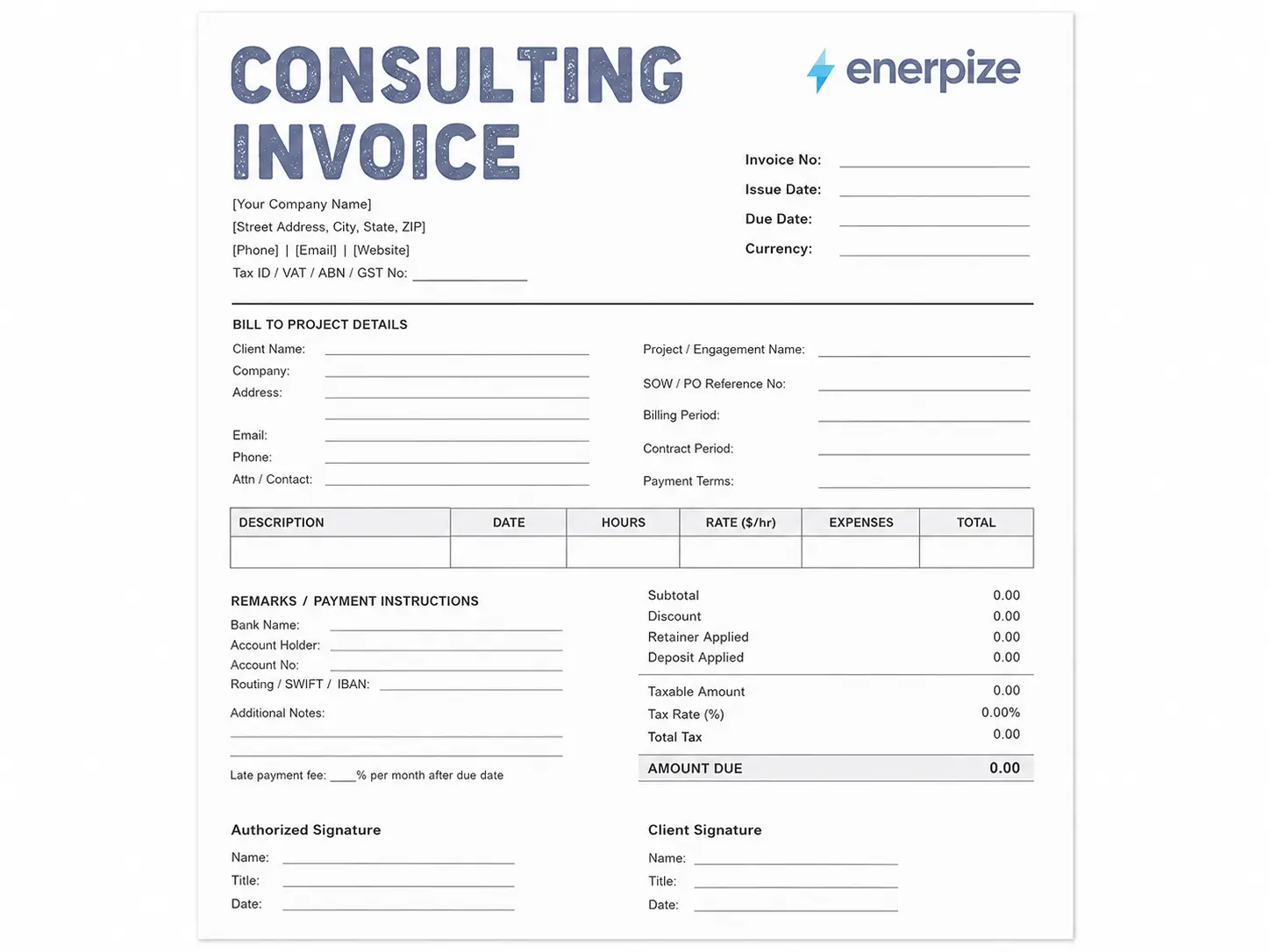
- Covers every billing model: hourly, flat fee, retainer, milestone, and expense reimbursement in a single flexible layout.
- Built with every field corporate AP departments require: SOW reference, PO number, billing period, Tax ID, and currency.
- Calculates subtotal, retainer applied, deposit applied, taxable amount, total tax, and final Amount Due automatically.
- Downloads instantly in Excel, Word, PDF, Google Sheets, and Google Docs.
A consulting invoice template is a ready-to-use billing document that independent consultants, advisory firms, and professional services businesses use to request payment from clients, document the scope of work delivered, and maintain a clear financial record of every engagement.


You just wrapped a strategy session that took three weeks to prepare. The client is thrilled. The work was good. Now comes the part nobody warned you about when you started consulting.
Getting paid for it.
Not because clients are dishonest. Most aren't. But because a vague invoice, a missing due date, or a line item that reads "consulting services" is enough to land your invoice in someone's AP queue for 60 days while their finance team tries to figure out what exactly they're approving.
The fix is simpler than you think. A clean, complete consulting invoice that leaves no questions unanswered.
Start invoicing free in Enerpize. No spreadsheet required. Start for free.
What Is a Consulting Invoice?
A consulting invoice is a formal payment request from a consultant to a client. It documents the services delivered, the agreed rates, and the total amount owed.
That is the textbook answer.
Here is the practical one: your invoice is a legal record and a scope-of-work confirmation rolled into one document. If a client ever disputes what they were billed for, your invoice is the first thing both sides look at. If a payment gets delayed inside a large company, it is the document their AP team uses to route, approve, and release funds.
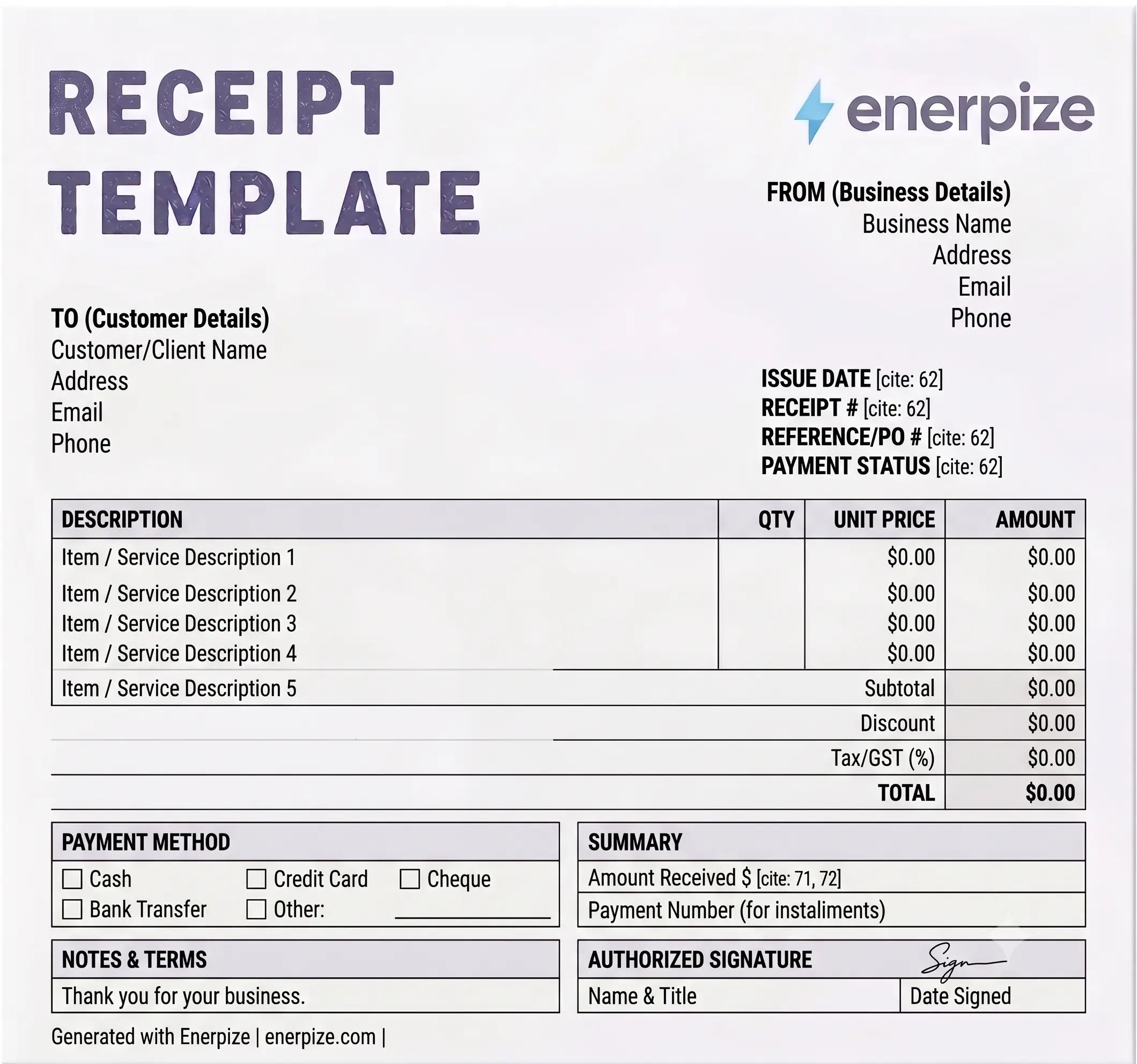
A consulting invoice is not a receipt. A receipt confirms payment already made. An invoice requests payment for work already done. The distinction matters when you are chasing an overdue balance and need to establish exactly what was owed and when.
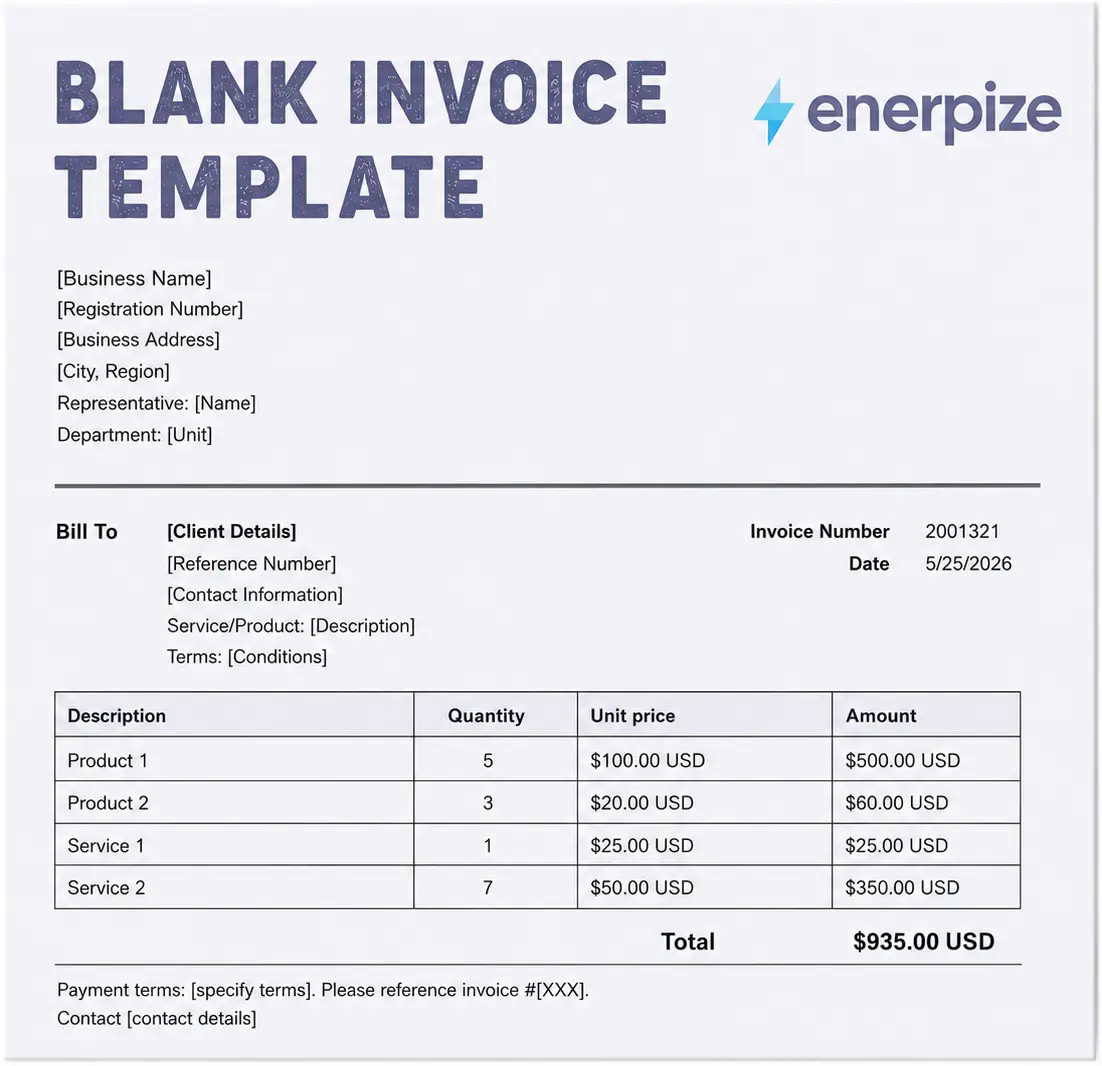
What to Include on a Consulting Invoice
Your Business Information
Name, address, phone, email, and website. Add your Tax ID, VAT number, ABN, or GST registration number depending on where you operate. Leaving this off is not just unprofessional. In Australia, Canada, and the UK it is a compliance problem.
Client Information
Client name, company, billing address, email, and phone. Add an "Attention to" or contact name if you are billing a large organization. Without it, the invoice goes to a general inbox and waits.
Invoice Number
Sequential and consistent. INV-001, INV-002. Or client code plus sequence: SMITH-003. Whatever system you use, stick with it. Your invoice number is how both sides track the document across emails, accounting systems, and payment confirmations.
Issue Date and Due Date
Two separate fields. Two separate dates. The issue date is when you sent it. The due date is when payment is expected. Net 30 means the due date is 30 days after the issue date, not 30 days after the client gets around to reading it.
Currency
Essential for any client outside your home country. USD, AUD, CAD, GBP, NZD. Specify it. A number without a currency attached is an invitation for a dispute.
SOW and PO Reference Number
For corporate clients this is non-negotiable. Their AP department needs a purchase order number to authorize payment. Without it, your invoice sits in a holding pattern while someone tracks down the right approval. Add a field for it. Fill it in every time.
Line Items
A description of each service delivered, the date or date range, hours worked, your rate, any expenses, and the line total. Separate columns. Not merged. Not combined into one vague description field.
Retainer and Deposit Applied
If the client paid a retainer upfront or left a deposit, show it as a deduction before the final total. Transparency here builds trust and eliminates the most common invoice disputes.
Tax Fields
Tax rate, tax amount, and taxable amount as separate lines. Clients want to see the calculation, not just the result.
Amount Due
Bold. Clear. At the bottom. The single most important number on the page should be impossible to miss.
Payment Instructions
Bank name, account holder, account number, routing number or SWIFT/IBAN for international transfers. Add any late payment fee terms here. Something like "a 1.5% monthly fee applies to balances unpaid after the due date" is enough to create urgency without damaging the relationship.
Choose the Right Invoice Type for Your Consulting Work
Not all consulting engagements are the same. The invoice format that works for a one-day workshop is not the right format for a six-month retainer. Here is how to match the invoice to the engagement.
Hourly Invoice
You tracked your time. The client agreed to an hourly rate. The invoice reflects hours worked multiplied by rate.
Use it for: advisory sessions, short-term projects, any work where scope is hard to define upfront.
Line item example: "Brand Strategy Session | June 3 | 2.5 hrs | $200/hr | $500"
Project-Based (Flat Fee) Invoice
One deliverable. One price. Agreed before the work started.
Use it for: reports, audits, training workshops, defined research projects.
Line item example: "Q2 Marketing Audit | May 2026 | $3,500"
Retainer Invoice
The client pays a fixed monthly amount for ongoing access to your expertise. The invoice goes out at the start of each billing period.
Use it for: ongoing advisory relationships, embedded consulting arrangements, monthly strategy work.
Add a line showing the retainer amount and, if applicable, any overage hours billed above the retainer cap.
Milestone Invoice
A large project broken into payment stages tied to deliverables, not time periods.
Use it for: long engagements, transformation projects, anything where a single invoice at the end creates cash flow risk for you or approval risk for the client.
Line item example: "Phase 1 Delivery: Discovery Report | 25% of Contract | $6,250"
Expense Reimbursement
Travel, software licenses, materials, and other out-of-pocket costs the client agreed to cover. Always keep these as separate line items from your service fees. Bundling them together is how disputes start.
How to Fill Out Your Consulting Invoice
Step 1: Enter Your Business Details
Your name or company name, address, contact information, and Tax ID. This is the header. It is also your brand. Make it look like someone who charges professional rates sent it.
Step 2: Fill in Client Information
Client name, company, address, and the specific contact or department the invoice is billed to. For large corporate clients, add the PO or SOW reference number at this stage.
Step 3: Assign an Invoice Number and Dates
Invoice number, issue date, due date, and currency. Set the due date based on your agreed payment terms. Net 30 from today means you write today's date as the issue date and add 30 days for the due date. Do not leave either field blank.
Step 4: Add Your Line Items
One row per service or deliverable. Date, description, hours, rate, expenses, total. If a row is project-based with no hourly component, enter the flat fee in the total column and leave hours and rate blank. The template handles both.
Step 5: Apply Any Deductions
If the client paid a deposit or if you are drawing down against a retainer, enter those amounts in the Discount, Retainer Applied, or Deposit Applied rows. The template calculates the taxable amount after deductions automatically.
Step 6: Enter the Tax Rate
Add your applicable tax rate as a percentage. The template calculates the tax amount and adds it to reach the final Amount Due.
Step 7: Complete the Payment Instructions
Bank details, accepted payment methods, and your late payment terms. If you use PayPal, Stripe, or a payment link, add it here. Make it as easy as possible for the client to pay you the moment they open the invoice.
Step 8: Sign and Send
Both signature fields are included. Use them. A signed invoice carries more weight than an unsigned one, particularly with corporate clients who may need documented approval before releasing funds.
Consulting Invoice Requirements by Country
A consulting invoice that works perfectly in Texas will have compliance problems in Sydney. The same invoice sent from Toronto to London raises completely different tax questions than one sent from Auckland to a US client.
The five countries driving the most traffic to this page are the United States, Australia, Canada, New Zealand, and the United Kingdom. Each one has its own tax registration thresholds, required fields, and invoicing rules. Here is what applies to each.
United States
No federal VAT or sales tax on services at the federal level. That is the good news. The less straightforward news is that sales tax on professional services varies significantly by state. Most states exempt consulting and advisory services, but some tax specific categories like IT consulting, staffing, or services tied to the sale of goods. Always verify your state's position with the IRS before assuming you are exempt.
Required fields on a US consulting invoice: your business name, address, and Employer Identification Number (EIN). If you operate as a sole proprietor without an EIN, your Social Security Number may be required for tax reporting purposes, though most consultants use an EIN to keep personal and business finances separate.
Payment terms in the US market tend to run Net 30 for corporate clients and Net 15 or due on receipt for smaller engagements. If you are using a freelance invoice template for US-based project work, the same field requirements apply.
For reference: IRS Self-Employment Tax Center
Australia
Australia has some of the most specific tax invoice requirements of any English-speaking market, and getting them wrong creates real compliance exposure.
If your consulting business turnover reaches AUD 75,000 or more in any 12-month period, you must register for GST with the Australian Taxation Office and include a 10% GST line on every invoice you issue. Your Australian Business Number (ABN) must appear on all invoices, and for invoices of AUD 1,000 or more, the invoice must also show the buyer's identity or ABN.
If you are not GST-registered, you issue a standard invoice without a GST line. Including a GST line when you are not registered is a compliance violation. The format differs enough between the two that we have built separate templates for each case. The Australian GST invoice template covers the registered format. The Australian invoice with no GST covers the non-registered format.
Australian consulting firms billing for disability support work should also refer to the NDIS invoice template, which has additional required fields specific to NDIS payment requests.
Payment terms in Australia commonly run Net 14 or Net 30. Some state government contracts require invoices to be paid within 20 business days by law.
Canada
Canada runs a layered tax system that catches a lot of consultants off guard the first time they bill across provincial lines.
GST applies at 5% federally across the country. Once your business revenue passes CAD 30,000 over four consecutive calendar quarters, or in a single quarter, you are no longer a small supplier and must register for GST/HST and include your registration number on all invoices.
Five provinces use HST, which combines the federal GST with a provincial component into a single rate: Ontario (13%), Nova Scotia (14%), New Brunswick (15%), Newfoundland and Labrador (15%), and Prince Edward Island (15%). Note that Nova Scotia reduced its rate from 15% to 14% on April 1, 2025. If any saved documents show Nova Scotia at 15%, update them. Quebec operates its own Quebec Sales Tax (QST) at 9.975% on top of the 5% GST, meaning Quebec-based consultants are managing two separate tax lines on the same invoice.
For consultants issuing recurring monthly invoices to Canadian clients, the receipt template is useful for confirming payments received once the invoice has been settled.
New Zealand
New Zealand keeps things relatively simple compared to the multi-rate systems in Canada and the UK.
GST applies at a flat 15% once your annual turnover exceeds NZD 60,000 in a 12-month period, at which point registration with Inland Revenue becomes mandatory. Your GST number must appear on all tax invoices, and buyer details are required for supplies over NZD 1,000.
If you are invoicing a New Zealand client for consulting work delivered remotely from another country, you may be supplying zero-rated services, meaning GST does not apply. The rules depend on where the services are consumed, not just where you are based. Verify with Inland Revenue before invoicing cross-border engagements.
New Zealand consulting firms frequently operate across both project-based and retainer billing models. If you need a starting point for scoping work before the invoice stage, the quotation template covers the pre-invoice approval step.
For reference: Inland Revenue New Zealand: Registering for GST
United Kingdom
The UK VAT registration threshold for 2026 is £90,000 of taxable turnover in any rolling 12-month period, confirmed as unchanged since April 2024. Once you cross it, VAT registration is mandatory. Below it, registration is optional but some consultants register voluntarily to reclaim input VAT on business expenses.
A full UK VAT invoice must include your VAT registration number, a unique sequential invoice number, the tax point date, itemized line descriptions with prices, the VAT rate applied, the VAT amount, and the gross total. That is a longer required field list than most other markets, and missing any one element means the invoice does not meet HMRC's legal definition of a valid VAT invoice.
Post-Brexit cross-border invoicing adds another layer. If you are a UK-based consultant invoicing a business client in the EU for professional services, the reverse charge mechanism typically applies, which shifts the VAT reporting obligation to the client. You issue the invoice without UK VAT and note "Reverse charge: Customer to account for VAT to HMRC." If you are invoicing EU consumers rather than businesses, the rules differ by EU member state.
UK consultants who issue pay stubs or manage payroll alongside their invoicing can reference the free pay stub template for the employee-side documentation that sits alongside consulting billing records.
How Enerpize Handles Consulting Invoicing End to End
Most invoice templates stop at "download, fill in, send." That is fine for a one-off project. It starts to break down when you have eight active clients, three retainer arrangements, and a corporate account that requires a PO number on everything.
This is where Enerpize is different.
Invoice from Tracked Hours Directly
Enerpize Time Tracking lets you log hours against specific clients and projects as you work. When it is time to invoice, you convert those tracked hours into a line item with one click. No manual transfer from a timesheet to a spreadsheet. No risk of forgetting billable time.
Send Invoices and Collect Payment Online
Invoices go out via email directly from Enerpize. Clients pay online through PayPal and integrated payment gateways. Payment due date reminders go to the client automatically by email or SMS. You do not have to chase.
Full Client and Project History in One Place
Every client gets a file with their full engagement history: invoices, payments, project notes, and assigned consultants. When a client questions a charge three months later, the answer is three clicks away.
Accounting That Closes Itself
Every invoice generates a journal entry automatically. Your chart of accounts, profit and loss, and income reports update in real time. By the time your accountant asks for the numbers, they are already there.
The template is where you start. Enerpize consulting services management software is where you never have to start from scratch again.
See how Enerpize handles consulting invoicing. Start for free.
Common Consulting Invoice Mistakes That Delay Payment
Leaving Off a Due Date
No due date means no deadline. No deadline means the client pays when it is convenient for them, not when you need the cash. Always set a specific date, not a range.
Vague Line Item Descriptions
"Consulting services" is not a line item description. It is a question waiting to happen. "Brand positioning workshop, May 14, 3 hours" is a line item description. The more specific you are, the fewer follow-up questions slow down approval.
Missing the PO Number
Large companies cannot process an invoice without a purchase order number. If your client works for a company with more than 50 people, ask for the PO number before you start the work, not after you send the invoice.
Forgetting to Specify Currency
Obvious until it isn't. An invoice for $5,000 sent to an Australian client without a currency field is an invoice for $5,000 AUD, CAD, USD, or something else entirely depending on who is reading it.
Bundling Expenses Into Service Fees
Expenses and service fees are different things. They are taxed differently in some jurisdictions and need to be approved separately in most corporate procurement processes. Always separate them.
No Late Payment Terms
You cannot charge a late fee you never mentioned. Add a late payment clause to every invoice. It does not have to be aggressive. One to two percent per month on overdue balances is standard and enough to create urgency.
Sending to the Wrong Contact
At large organizations, invoices need to go to accounts payable, not to your day-to-day project contact. Confirm the billing contact and billing email before you send the first invoice. It saves weeks of chasing.
Consulting Invoice Best Practices
Invoice Immediately
The moment a project is complete or a milestone is reached, send the invoice. Every day you wait is a day added to the payment timeline. Cash flow problems in consulting are almost always a billing discipline problem first.
Invoice Before You Start (for Retainers)
Retainer clients should receive their invoice at the beginning of the billing period, not the end. You are billing for availability and ongoing access, not for work already done. Invoice accordingly.
Always Quote First
Before any engagement, send a quotation template that the client approves in writing. The invoice should never contain a number the client sees for the first time. Surprise invoices cause payment delays. Approved quotes prevent them.
Use Consistent Invoice Numbering
Your invoice number is your filing system. Make it sequential, make it logical, and never reuse a number. Most accounting disputes start with someone who cannot find the invoice in question.
Specify Payment Methods Clearly
The more ways a client can pay you, the faster they will. Bank transfer, PayPal, credit card. List the details directly on the invoice. Do not make them email you to ask how to send money.
Follow Up Without Apology
A polite payment reminder on day 31 is not rude. It is professional. Something like: "Hi [Name], just checking in on invoice INV-043 which was due on June 8. Please let me know if you need anything from my side to process this." Short, direct, no pressure language. Most late payments are oversight, not avoidance.
Keep a Copy of Everything
Every invoice sent, every payment received, every reminder sent. Consulting disputes are rare but they happen. Your paper trail is your protection.
Frequently Asked Questions
What is a consulting invoice?
A consulting invoice is a formal document a consultant sends to a client to request payment for professional services. It details the scope of work delivered, the hours or deliverables involved, applicable rates, any taxes, and the total amount due.
How do I write an invoice for consulting services?
Start with your business name, contact details, and Tax ID. Add the client's name, company, and billing address. Assign an invoice number, set an issue date and due date, and choose a currency. Add line items for each service delivered with the date, hours, rate, and total. Apply any deductions such as retainer or deposit, calculate tax, and show the final Amount Due clearly at the bottom. Include payment instructions so the client knows exactly how to pay.
What is the difference between a consulting invoice and a freelance invoice?
They cover similar ground but consulting invoices typically reflect longer-term engagements with retainer arrangements, milestone billing, and SOW reference numbers. A freelance invoice template is usually simpler, built for one-off projects or hourly work without ongoing contract structures.
How do consultants structure their fees on an invoice?
The four most common structures are hourly (hours times rate), project-based (flat fee per deliverable), retainer (fixed monthly fee with optional overage), and milestone (percentage of the total contract billed at each phase). The invoice format should match whichever structure was agreed with the client.
When should I send a consulting invoice?
Immediately after completing a project or reaching a milestone. For retainer clients, invoice at the start of each billing period. For long engagements, milestone invoicing at defined project phases keeps cash flow steady and aligns payment to tangible progress.
What payment terms are standard for consulting invoices?
Net 30 is the most common. Independent consultants increasingly use Net 15 or due on receipt, particularly for new clients or project-based work. Whatever terms you use, write them into your contract before the work starts and display them clearly on every invoice.
Do consulting invoices need to include tax?
It depends on your country and registration status. In Australia, GST-registered consultants add 10% GST. In Canada, GST or HST applies depending on the province. In the UK, VAT-registered businesses charge 20%. In the US, professional services are generally sales-tax exempt but this varies by state. Always verify based on where you operate and where your client is located.
What if a client disputes a consulting invoice?
Go back to the agreed scope of work. If you sent a quote or proposal that the client approved before work started, the invoice should mirror that document exactly. Disputes almost always come from a mismatch between what the client expected and what the invoice shows. Detailed line item descriptions and a pre-approved quote eliminate most disputes before they start.
From invoice creation to payment tracking, Enerpize handles the full billing cycle. Start for free.
About the Author
Omar El Bahr is a Senior Digital Growth Specialist at Enerpize and a contributor to Forbes Communications Council and Entrepreneur. He writes about invoicing, financial operations, and business growth for small and medium-sized businesses.