

Posted on 8 June 2026
Free Rental Invoice Template Download – Word, Excel, PDF & Google Sheets
- Covers base rent, utilities, security deposit, and late fees across all your active tenancies in one clean document.
- Calculates prorated rent automatically when a tenant moves in or out mid-month, so the math is never a question.
- Creates a clear paper trail for lease disputes, end-of-tenancy deductions, and tax reporting across every rental period.
- The rental invoice template is available in Word, Excel, PDF, Google Sheets, and Google Docs.
A rental invoice template is a structured billing document used by landlords and property managers to request rent payments, track additional charges, and document each rental period against an active lease agreement.


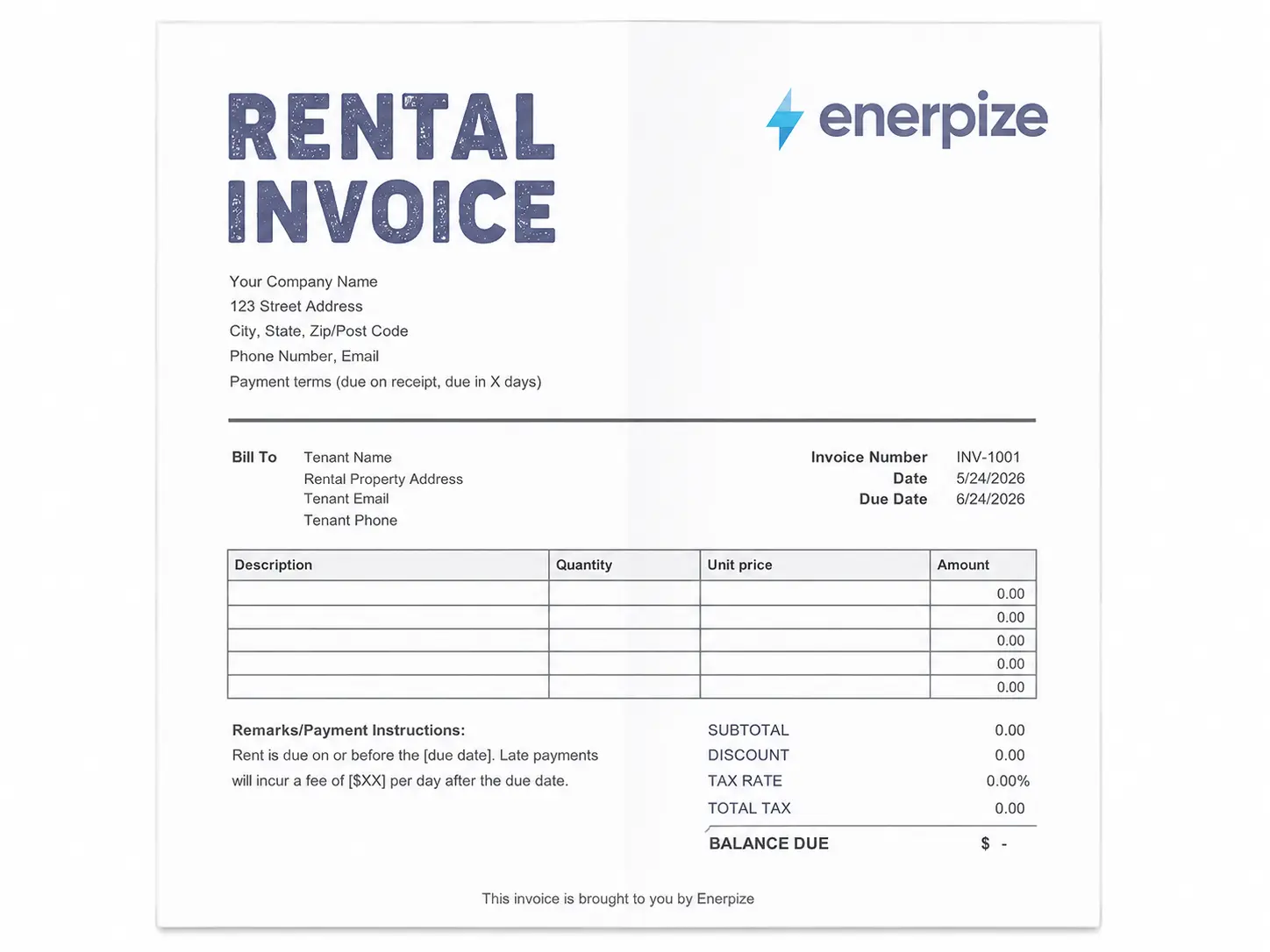
Most landlords do not lose tenants over bad properties. They lose them over bad communication. A missing invoice, a confusing payment request, or a disputed late fee can turn a good tenant relationship into a legal headache overnight. The rental invoice is the document standing between you and that conversation.
This page gives you a free rental invoice template in every format you need: Word, Excel, PDF, Google Sheets, and Google Docs. Download it, fill it in, send it. But stay for the rest of this guide, because there are things on a rental invoice that most landlords get wrong, and most template pages never mention.
Generate rental invoices automatically, calculate late fees, and track every payment in Enerpize. Start for free.
What Is a Rental Invoice Template?
A rental invoice template is a pre-formatted document that landlords and property managers use to bill tenants for rent, utilities, deposits, and any other charges tied to a rental agreement. It records what is owed, when it is due, and who owes it.
It is different from a generic invoice in one important way: it carries property-specific information that a standard invoice was never designed to hold. The unit number, the lease reference, the rental period dates, the late fee clause, the security deposit line. These are not optional extras. They are what make a rental invoice a legal record and not just a payment reminder.
When marked as paid, the same document doubles as a rent receipt. In some jurisdictions, that matters legally.
What to Include on a Rental Invoice
Here is where most template guides give you a list of twelve generic fields and call it done. That is not enough for a landlord.
Standard Invoice Fields
Every invoice, regardless of industry, needs these:
- Invoice number (unique, sequential, for your records)
- Issue date
- Payment due date
- Your name or property management company name
- Your address and contact information
- Tenant name and contact information
- Payment terms (due on receipt, net 7, net 30)
- Subtotal, tax rate if applicable, and total amount due
- Accepted payment methods
Rental-Specific Fields That Most Templates Skip
This is the section that separates a proper rental invoice from a generic one.
Property address and unit number. The billing address and the rental property address are often different. A tenant may have their bills sent to their employer or a P.O. box. List both separately. Include the unit or suite number.
Lease or rental agreement reference number. This ties the invoice to the contract. If a dispute ever reaches a tribunal or small claims court, this reference number is what connects your invoice to the signed agreement sitting in your files.
Rental period dates. Do not just put a due date. Write "Rental period: June 1, 2026 to June 30, 2026." This removes any ambiguity about what the payment covers, especially on prorated first months.
Prorated rent line. If a tenant moved in on the 18th of the month, they do not owe a full month. The formula is: (monthly rent divided by total days in the month) multiplied by days occupied. Show this calculation as its own line item, not buried in a lump sum.
Security deposit line. List it separately, labeled clearly as "Security Deposit (refundable)." Do not mix it into rent. It is not income. It is a liability you hold.
Utilities itemization. Water, electricity, internet, parking: if any of these are billed through you, each one gets its own line. Bundling them into rent creates disputes when a tenant questions the total.
Late fee clause. In the remarks section, state the grace period and the fee. "Rent is due on the 1st. A late fee of $[X] applies after the 5th." The amount and the trigger date both need to be visible, not just in the lease.
Landlord license or registration number. Required in several US states, parts of Canada, and Australia. If you operate in a jurisdiction that requires it, put it in your header next to your company name.
How to Calculate Late Fees on a Rental Invoice
Nobody likes charging late fees. But every landlord who has ever chased a payment on the 20th of the month wishes they had been clearer about them on the invoice.
There are two standard models.
The Flat Fee Model
You charge a fixed amount after a grace period. Example: $50 after a five-day grace period. This is simple to communicate, simple to calculate, and easy for a tenant to understand. Put it in plain language in your remarks section: "A flat late fee of $50 applies if payment is not received by the 5th of each month."
The Percentage Model
You charge a percentage of the monthly rent. The most common rate is five percent. On a $1,500 per month apartment, that is $75. On a $3,200 per month unit, that is $160.
The percentage model scales automatically with higher-value properties but can feel less predictable to tenants who are not good at mental math. If you use this model, show the calculation on the invoice itself: "Late fee: 5% of $1,500 = $75.00, applicable after the 5th."
Check your local laws before choosing either model. Several US states cap late fees at a specific dollar amount or percentage. Some require a minimum grace period of five to seven days.
Rental Invoice Requirements by Country
This is the section that almost no template page covers. The top four markets searching for rental invoice templates are the United States, Canada, the United Kingdom, and Australia. Each has different rules. Here is what you actually need to know in each one.
United States
There is no single federal law requiring landlords to issue a rental invoice. Requirements come from state law, and they vary significantly.
Several states require landlords to provide a written rent receipt whenever a tenant pays in cash. California, Washington, and New York have specific landlord-tenant regulations covering documentation. Some municipalities require landlords to hold a rental license, and that license number belongs on your invoice header.
Short-term rentals (think Airbnb-style) in many US cities are subject to occupancy or hotel taxes at the local level. If you operate short-term rentals, your invoice needs a tax line for those charges. Residential long-term rentals generally carry no sales tax.
For an overview of tenant rights that US landlords need to understand when documenting tenancies, the HUD FAQ on tenant and renter rights is the official federal reference.
Canada
Long-term residential rentals in Canada are generally exempt from GST and HST. If your annual rental revenue from a residential property stays under $30,000 CAD, you do not need to register for or charge GST.
The situation changes with short-term rentals. If you rent a property for periods of less than one month at a time, the CRA treats it as a taxable supply. That means GST applies, and if your revenue crosses the $30,000 threshold, you are required to register for a GST/HST account and charge it on your invoices.
Commercial rental properties are subject to GST regardless of revenue threshold.
The CRA's official memorandum on residential real property rentals is the authoritative reference for Canadian landlords working out whether their rental income is taxable, including the one-month threshold rule and exemption conditions.
United Kingdom
In the UK, residential rent is exempt from VAT. You do not charge VAT on a standard residential tenancy invoice.
Landlords in England are required to provide a rent receipt within 24 hours of a request from a tenant, and that requirement applies specifically when payment is made in cash. Under the Landlord and Tenant Act 1985, any tenant who requests a receipt must receive one.
Commercial property landlords have more complexity. VAT can be opted in on commercial properties, meaning some commercial landlords do charge VAT on rent. If you manage commercial properties and have opted to tax them, your invoice needs a VAT number and a VAT line.
HMRC's rental income guidance covers what counts as rental income, how to report it, and which expenses you can offset against it.
Australia
Residential rent in Australia is an input-taxed supply. That means GST does not apply to residential rental invoices. You do not add GST to a standard lease agreement for a house or apartment.
Commercial properties are different. GST does apply to commercial rent, which means your invoice needs an ABN, a GST line, and the total shown both pre-GST and post-GST. If your annual turnover exceeds $75,000 AUD, you are required to be registered for GST.
In New South Wales, landlords must provide a receipt for all rent paid in cash at the time of payment or within a reasonable time afterward. Other states have similar requirements.
The ATO's residential rental properties guide is the reference for Australian landlords on GST treatment, allowable deductions, and rental income reporting.
If you are billing a commercial or short-term rental in Australia, our Australian GST invoice template and Australian invoice without GST cover both scenarios.
Types of Rental Invoices
Not every rental situation is the same. A landlord with three apartments and a property management company running fifty commercial units have different invoicing needs. Here are the most common types and when to use each.
Monthly Rent Invoice
The most common type. Same amount, same tenant, same property, sent every month. The only fields that change are the invoice number and the rental period dates. This is the use case that benefits most from automation: set it once, send it automatically, never forget.
Prorated Rent Invoice
Used when a tenant moves in or out mid-month. The invoice shows the daily rate calculation clearly: monthly rent divided by days in the month, multiplied by days actually occupied. Showing the math prevents disputes before they start.
Commercial Lease Invoice
Used for office spaces, retail units, and industrial properties. These invoices typically include business billing details on both sides, a lease reference number, and applicable GST or VAT. They may also include service charges, building maintenance contributions, or business rates. For commercial property billing, our construction invoice template covers adjacent billing scenarios in the built environment.
Short-Term and Vacation Rental Invoice
Used for Airbnb-style or holiday rentals billed by the night or week. These invoices need a clear rental period (check-in to check-out dates), a daily rate, a cleaning fee line, a damage deposit line, and any applicable local occupancy taxes. The structure is closer to a service invoice than a monthly lease invoice.
Residential Apartment Invoice
The standard landlord invoice for long-term residential tenancies. It covers base rent, plus any utilities billed through the landlord, parking, pet deposits, and any one-off charges. This is the template on this page.
Equipment Rental Invoice
Technically outside the property category, but landlords who also rent equipment (furniture packages, appliances, storage units) sometimes need to invoice for those separately. Equipment invoices require rental duration, condition notes at checkout and return, and a damage waiver line.
How to Fill Out Your Rental Invoice Template
Six steps. Ten minutes. Done.
Step 1: Enter your landlord or property management details. Your full legal name or company name, address, phone number, email, and license or registration number if your jurisdiction requires one. This goes in the header on the left or top of the document.
Step 2: Enter the tenant details. Tenant's full name, the rental property address including unit number, and their contact information. If the billing address is different from the property address, list both.
Step 3: Set the invoice number and rental period. Invoice numbers should be sequential. If this is your third invoice to a tenant in unit 4B, a format like 4B-003 works cleanly. Then set the rental period start and end dates, not just the due date.
Step 4: List all line items. Base rent goes first. Then any separate items: utilities, parking, pet deposit, security deposit if it is the first invoice, any late fees from prior periods. Each item gets its own row, its own quantity, its own unit price, and its own total.
Step 5: Apply discounts if applicable. Long-term tenants, early payment discounts, promotional offers: list them as a separate line item with a negative value. Do not just quietly reduce the total. Show what the original charge was and what the discount amount is.
Step 6: Set payment terms and add the late fee clause. In the remarks or payment instructions section: state the due date, the grace period, the late fee amount, and your accepted payment methods. Bank transfer details, online payment link, check policy: whatever applies to your setup.
Managing multiple properties? Enerpize keeps every tenant's invoice history, security deposit record, and payment log in one place, and sends recurring invoices automatically on your schedule. Start for free.
Security Deposit: How to Invoice It Correctly
The security deposit is not rent. That one sentence saves landlords from a lot of accounting problems.
A security deposit is a liability you hold on behalf of the tenant. You are not earning it when you collect it. You are holding it until the tenancy ends and you determine how much, if any, to return.
Collecting the Deposit
On the first invoice, list the security deposit as its own line item. Label it clearly: "Security Deposit (refundable)." Keep it visually separate from the first month's rent. The total on the invoice will show both, but the line items must be distinct.
Returning or Deducting the Deposit
When the tenancy ends, you have two options depending on the condition of the property.
If you are returning the deposit in full, issue a credit note or a final invoice with the deposit shown as a credit against any outstanding balance.
If you are making deductions, the final invoice needs to itemize every deduction with a description and a dollar amount. "Carpet replacement: $320. Broken window repair: $150. Cleaning beyond normal wear: $90." Bundling deductions into a single line is what turns a straightforward end-of-tenancy into a dispute.
For proof of condition, attach your check-in and check-out inspection notes to the final invoice. This documentation, combined with a clearly itemized invoice, is what protects you if the tenant contests the deductions.
Rental Invoice vs. Rent Receipt
They are related. They are not the same thing.
A rental invoice is a request for payment. You send it before the money arrives. It tells the tenant what they owe and when they owe it.
A rent receipt is confirmation that payment was received. You issue it after the money arrives. It tells the tenant you got it.
In practice, many landlords use one document for both. They send the invoice at the start of the month and, when payment comes in, mark the same document as paid with a date stamp and send the updated version back to the tenant. This works in most cases, but some jurisdictions require a separate receipt document. Know what your local rules say.
If you need a standalone receipt, our rent receipt template is available in all the same formats as this one.
How Enerpize Handles Rental Invoicing
The template on this page works well if you have one or two properties and a straightforward billing setup. But at some point, the manual process starts costing you time you do not have.
Recurring Invoices on Autopilot
Set the invoice once. Configure the rental amount, the tenant, the billing date, and the rental period. Enerpize generates and sends the invoice automatically every month. You do not touch it unless something changes.
Multi-Property Management
Every tenant, every unit, every invoice, and every payment log sits in one place. Search by property, by tenant, by period. No spreadsheet archaeology when a tenant asks about a payment from four months ago.
Late Fee Automation
Configure your grace period and your late fee rate, flat or percentage. If payment does not arrive by the trigger date, Enerpize calculates and applies the late fee automatically. No awkward conversations, no manual calculations, no forgetting.
Payment Tracking and Receipts
When a payment arrives, Enerpize marks the invoice as paid, logs the payment method, and generates a receipt automatically. The tenant gets confirmation. You get a clean record. For full leasing and unit management, Enerpize's rental and unit management software gives you reservation tracking, flexible pricing, and occupancy reporting alongside your invoicing.
Your tenants get a professional invoice. You get paid on time. Enerpize handles the rest. Create your first rental invoice free.
FAQs
What should a rental invoice include?
A complete rental invoice includes your name and contact details, the tenant's name and property address, a unique invoice number, the rental period start and end dates, a line item for base rent, separate lines for any additional charges such as utilities or deposits, the payment due date, and a note on late fees and payment methods. The rental-specific fields that matter most are the lease reference number, the unit number, and the rental period dates.
Is a rental invoice the same as a rent receipt?
No. An invoice is a request for payment sent before money is received. A receipt is confirmation of payment sent after money is received. Some landlords combine them into one document by marking the invoice as paid after the fact, but they serve different purposes and some jurisdictions require a separate receipt, particularly for cash payments.
Do I need to charge GST or VAT on rent?
It depends on where you are and what type of property you are renting. Residential long-term rent is generally exempt from GST and VAT in Australia, Canada, and the UK. Short-term rentals and commercial properties are often taxable. Always confirm with a local tax advisor before adding or removing tax lines from your rental invoice.
How do I invoice a tenant for the first month when they move in mid-month?
Calculate the prorated amount using this formula: monthly rent divided by the total number of days in that month, multiplied by the number of days the tenant actually occupied the property. Show this calculation as a line item on the invoice so the tenant can verify the math. For example, on a $1,500 per month apartment with a tenant who moved in on the 18th of a 30-day month, the prorated rent is $1,500 divided by 30, multiplied by 13 days, which equals $650.
What is a grace period on a rental invoice?
A grace period is the number of days after the due date during which the tenant can pay without being charged a late fee. The most common grace period is five days. You should state the grace period explicitly in the remarks section of every invoice, such as: "Payment is due on the 1st. A late fee of $50 applies if payment is not received by the 5th."
Can I use the same template for commercial and residential rentals?
Yes, with modifications. A commercial rental invoice needs business billing details on both sides, a tax number, applicable GST or VAT lines, and a lease reference number. Residential invoices are simpler, generally without tax lines for long-term leases. The structure is the same; the fields differ.
How do I handle a partial payment from a tenant?
Record the partial payment against the invoice, note the remaining balance, and issue an updated statement showing what has been paid and what is still outstanding. Keep every record. If the shortfall becomes a pattern, that documentation is what you bring to a formal dispute or eviction proceeding.
About the Author
Omar El Bahr is a Senior Digital Growth Specialist at Enerpize, where he leads SEO strategy, content, and organic growth. He is a Forbes Communications Council contributor and a published author on Entrepreneur. His work focuses on helping small and medium businesses make better decisions through clearer financial tools and content.
Disclaimer: This page is for informational purposes only and does not constitute legal, tax, or financial advice. Rental invoice requirements, tax obligations, and landlord-tenant laws vary by country, state, and municipality. Always consult a licensed legal or tax professional for guidance specific to your situation.