

Posted on 6 July 2026
Free Dental Invoice Template Download: Excel, Word, PDF & Google Sheets and Docs
- Available in Word, Excel, PDF, Google Docs, and Google Sheets, free to download with no sign up required.
- Covers CDT procedure codes, tooth numbers, insurance adjustments, and patient co-payment math in one structured document.
- Built with country specific compliance notes for the US, UK, Australia, and South Africa in one template.
- Calculates billed amount, insurance adjustment, patient portion, and balance due automatically in Excel and Google Sheets.
A dental invoice template is a pre formatted billing document that records procedures performed, CDT codes used, insurance adjustments applied, and the final amount a patient owes, giving both the practice and the patient a clear paper trail for every visit.


What Is a Dental Invoice Template
Picture a Monday morning at a two chair dental practice. Four patients booked back to back. One cleaning, one filling, one root canal follow up, one insurance heavy crown case. By lunch, the front desk has four different balances to calculate, four different insurance breakdowns to explain, and four patients standing at the counter wanting a straight answer to one question. What do I actually owe today?
That question is the entire reason a dental invoice template exists.
A dental invoice template is the document that turns a clinical visit into a financial record. It lists what was done, using the CDT code that insurers actually recognize, what it cost, what insurance is expected to cover, and what's left for the patient to pay. Without it, a practice is left guessing, and a patient is left disputing.
Here's the part most templates online get wrong. They treat a dental invoice like a restaurant bill. Add up the line items, slap on a total, done. But dental billing rarely works that way. Insurance sits in the middle of almost every transaction, and that means the number a dentist bills is almost never the number a patient pays. A template that doesn't show that gap isn't really a dental invoice. It's a generic invoice wearing a dental costume.
If you're tired of rebuilding that math by hand for every patient at the counter, Enerpize applies insurance adjustments and co-payment rates automatically once a patient's plan is set up. Start for free.
What to Include in a Dental Invoice Template
A complete dental invoice needs more than a service description and a total. Here's the full field list.
| Field | Why It Matters |
|---|---|
| Invoice Number | Sequential tracking for the practice and for any insurance audit trail |
| Issue Date and Due Date | Establishes when payment is expected |
| Practice Name, License/NPI Number, Tax ID | Confirms who is billing and supports insurance claim submission |
| Patient Name, Date of Birth, Patient ID | Insurers verify eligibility using DOB, not just name |
| Insurance Provider, Policy Number, Group Number | Required for any claim tied to the visit |
| Treating Dentist | Attributes the procedure to a specific licensed provider |
| Date of Treatment | Anchors the invoice to a specific clinical visit |
| CDT Procedure Code | The actual billing code insurers use, not a plain text description |
| Tooth Number or Area | Required for anything beyond a routine exam or cleaning |
| Billed Amount per Line | What the practice charges before any adjustment |
| Insurance Adjustment | The portion insurance negotiates off the billed amount |
| Insurance Paid | What the insurer actually covers |
| Patient Portion Due | What's left after adjustment and insurance payment |
| Payment Terms | Due at time of service, net 15, or a payment plan |
Most templates stop at "list the services and add tax." That's fine for a car wash. It falls apart the moment insurance enters the picture, which in dental billing is almost always. If you're billing for services outside dentistry too, our medical invoice template follows the same insurance adjustment logic covered below.
Understanding Dental Insurance Billing on Your Invoice
This is the section every free dental invoice template online skips, and it's the one patients actually get confused about.
Here's the math nobody writes down. A dentist bills $180 for a filling. That's the billed amount. The insurer has a contracted rate with the practice, so they knock $50 off that number before anything else happens. That's the insurance adjustment, and the practice writes it off. Insurance then pays a portion of what's left, say $70. What's left after that is the patient's responsibility.
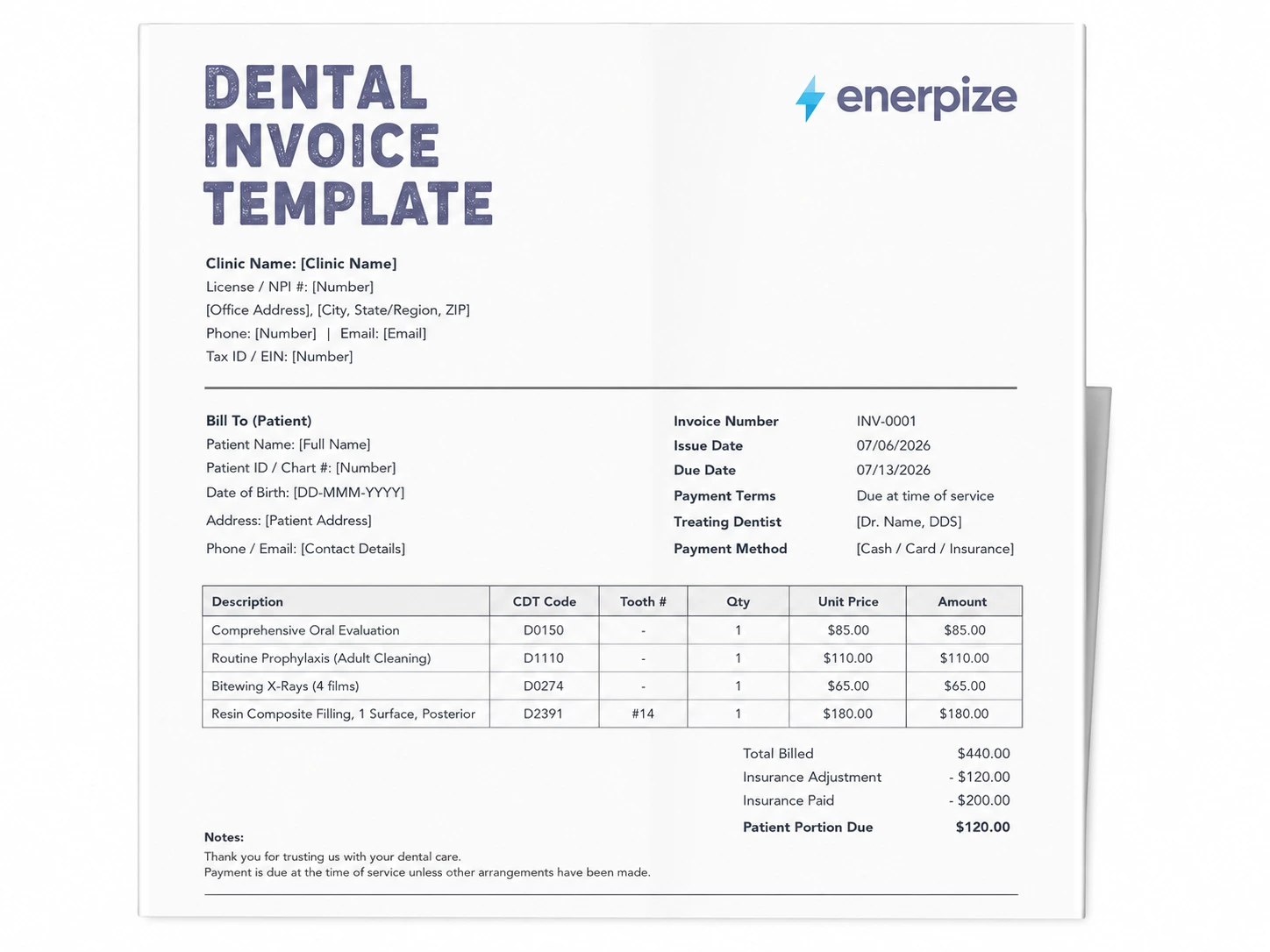
The Worked Example
Take a routine visit with four procedures.
| Procedure | CDT Code | Billed Amount | Insurance Adjustment |
|---|---|---|---|
| Comprehensive Oral Evaluation | D0150 | $85.00 | $25.00 |
| Adult Cleaning | D1110 | $110.00 | $30.00 |
| Bitewing X-Rays | D0274 | $65.00 | $15.00 |
| Composite Filling, Tooth #14 | D2391 | $180.00 | $50.00 |
| Subtotal | $440.00 | $120.00 |
Subtotal billed: $440.00
Less insurance adjustment: $120.00
Insurance paid: $200.00 (estimated)
Patient portion due: $120.00
That last number, the patient portion, is the number that actually matters to the person sitting in the waiting room. Every competitor page we reviewed shows a single total and calls it done. None of them show this breakdown. That's not a small omission. It's the difference between an invoice a patient trusts and one they call the front desk to argue about.
Why the Adjustment Line Can't Be Skipped
Leave out the adjustment line and a patient sees "$440 billed" next to "$120 due" with no explanation in between. That gap looks like an error. It isn't. It's the insurance contract doing its job. But if the invoice doesn't show the math, the practice ends up fielding a phone call that a properly built template would have prevented.
Enerpize applies insurance adjustment rules automatically once a patient's coverage is set up, so this math runs itself instead of getting rebuilt by hand on every invoice. Start for free.
CDT Codes and How They Affect Your Invoice
CDT stands for Current Dental Terminology, and it's maintained by the American Dental Association. It's not optional decoration. It's the only code set that HIPAA recognizes for dental billing, which means an invoice without the correct code isn't just incomplete, it's a claim rejection waiting to happen.
Why "Filling" Isn't Enough
Writing "filling" on an invoice tells a patient what happened. It tells an insurer nothing usable. D2391 tells the insurer exactly what happened: a one surface resin composite restoration on a posterior tooth. That specificity is what gets a claim processed instead of bounced back with a request for clarification.
Common CDT Code Categories
| Category | Example Code | Example Procedure |
|---|---|---|
| Diagnostic | D0150 | Comprehensive Oral Evaluation |
| Preventive | D1110 | Adult Prophylaxis (Cleaning) |
| Restorative | D2391 | Resin Composite Filling, 1 Surface |
| Radiographs | D0274 | Bitewing X-Rays (4 films) |
| Endodontics | D3310 | Root Canal, Anterior Tooth |
| Prosthodontics | D5110 | Complete Denture, Maxillary |
The ADA updates CDT codes every year, with changes taking effect January 1st. Using an outdated code on an invoice is one of the most common reasons a dental claim gets denied, which delays the practice getting paid and delays the patient getting a final answer on what they owe.
Dental Invoice vs Patient Statement vs Superbill vs EOB
People mix these four documents up constantly, and honestly, it's not their fault. Nobody explains the difference clearly. Here it is.
| Document | Who Issues It | What It Shows | Triggers Payment? |
|---|---|---|---|
| Dental Invoice | The practice | Procedures, codes, billed amount, insurance adjustment, patient portion | Yes |
| Patient Statement | The practice | A summary of all activity on a patient's account over a period, may span multiple visits | Yes, if a balance remains |
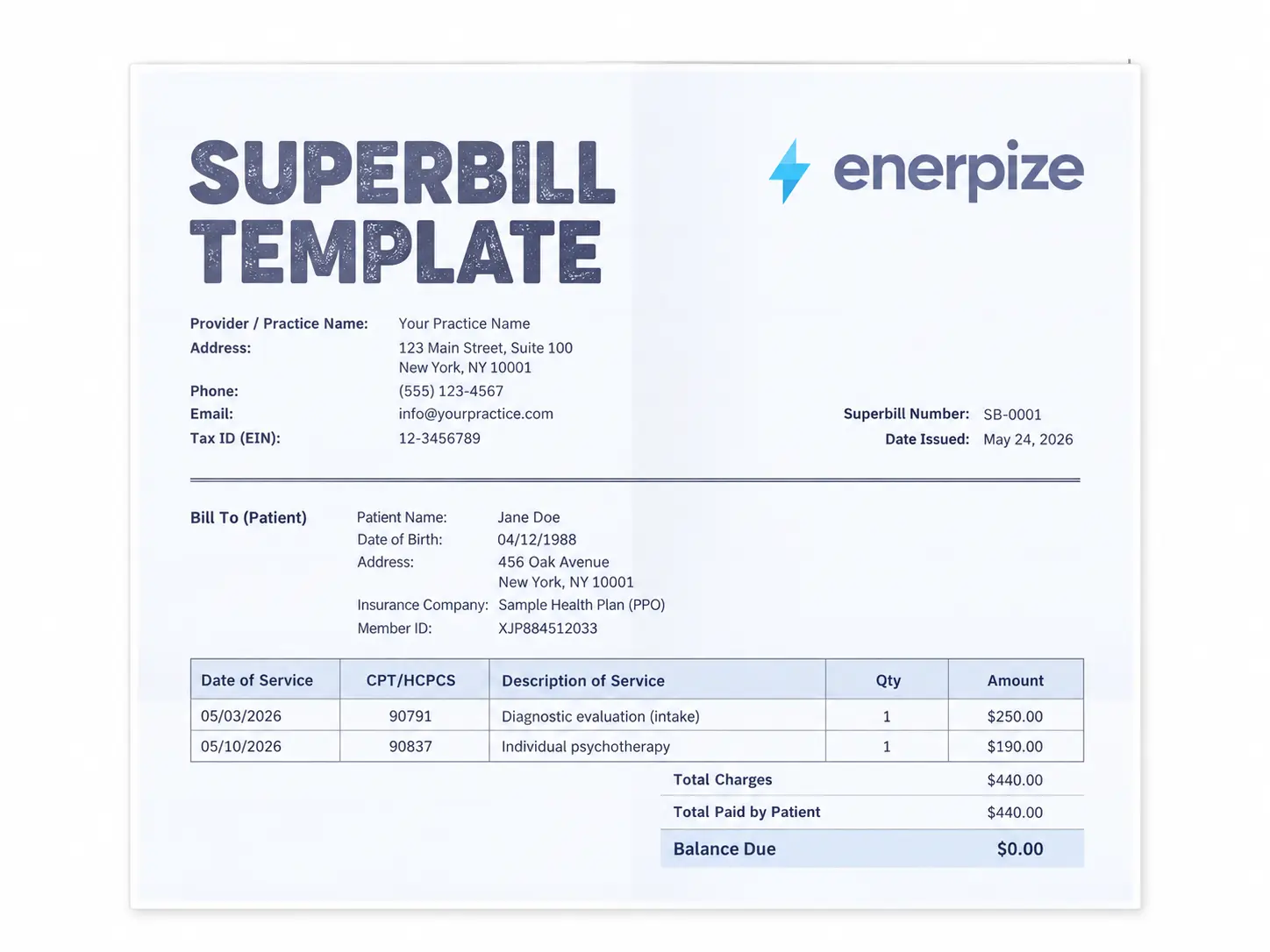
| Superbill | The practice | A detailed receipt with codes, used by the patient to self submit an out of network insurance claim | No |
| Explanation of Benefits (EOB) | The insurance company | What the insurer decided to pay, adjust, or deny for a specific claim | No |
The invoice is what the practice sends. The EOB is what the insurer sends back. A superbill is a hybrid, usually handed to a patient who's paying out of pocket at an out of network practice and needs a document detailed enough to submit their own claim. None of these four documents are interchangeable, and using one in place of another is exactly the kind of mix up that delays reimbursement. If a patient just needs proof of a completed, paid in full visit rather than a full insurance breakdown, a standard receipt template is the simpler document.
Treatment Plans and Multi Phase Invoicing
A single visit invoice is simple. A treatment plan spanning six months of orthodontic adjustments or a three phase implant case is not, and this is where most templates fall apart completely.
Estimate First, Invoice Later
Before any multi phase treatment starts, a practice should hand the patient an estimate, not an invoice. The estimate outlines the full treatment plan and the projected cost per phase. Once the patient accepts, each completed phase generates its own invoice, referencing back to the original treatment plan. That upfront estimate is really just a quotation with dental specific line items, and it should be treated with the same formality before any phase begins.
Keeping Phases Connected
Here's the failure mode. Phase one gets invoiced in January. Phase two happens in March. Phase three wraps in June. If each of those three invoices lives as a disconnected document, nobody, not the practice, not the patient, not the insurer, can look at one invoice and understand where the whole treatment plan stands. A treatment plan reference number tying all three invoices together solves this, and it's a field almost no free template includes.
Running Balance for Payment Plans
For higher cost procedures like implants or full mouth reconstruction, a payment plan with scheduled installments is common. The invoice needs a running balance that reflects the total treatment cost, what's been paid so far, and what remains, updated with every installment. A static invoice that only shows one visit's charges can't do that.
This running balance approach isn't unique to dentistry. Construction payment applications like the AIA G702/G703 track the exact same completed to date versus remaining balance math for phased projects.
What the Enerpize Dental Invoice Template Includes
We built this template after going through twelve of the most used dental invoice tools online, and one gap showed up in every single one of them. None of them show the insurance math. Not one. They all stop at a single total, which is exactly the point where a patient's confusion begins.
Here's what sets the Enerpize version apart.
CDT Code and Tooth Number Fields Built In
Every line item has a dedicated CDT code column and a tooth number column, not a plain text description box. That's the difference between a document a patient can read and a document an insurer can actually process.
The Insurance Math, Shown Line by Line
Billed amount, insurance adjustment, insurance paid, and patient portion due are each their own line in the summary. Nobody has to do mental math or call the front desk to understand their bill.
A Payment Plan Table for Multi Visit Cases
Two built in installment rows with amount, due date, and status, ready to expand for longer treatment plans. Most templates assume every visit is paid in full on the spot. Ours assumes real dental billing, where that's often not true.
Patient DOB and Full Insurance Block
Separate sections for patient details and insurance details, including policy number, group number, and pre authorization number, the fields an actual claim submission needs, not just a name and an address.
Signature Lines for Both Parties
A signed invoice carries more weight if a billing dispute ever comes up. Most free templates skip this entirely.
Built in Excel Formulas
The Excel and Google Sheets versions calculate the billed amount, subtotal, and balance due automatically. Change a quantity or a unit price and the totals update themselves. No manual recalculation, no formula errors.
The same principle applies across document types. A signed delivery note carries more weight in a shipping dispute for the same reason a signed dental invoice carries more weight in a billing dispute.
How to Use the Dental Invoice Template
Step 1: Fill in Practice and Invoice Details
Add the practice name, license or NPI number, tax ID, and contact information. Assign a sequential invoice number and set the issue date, due date, and payment terms.
Step 2: Enter Patient and Insurance Information
Add the patient's full name, date of birth, and patient ID. In the insurance block, add the provider name, policy number, group number, and pre authorization number if one was obtained.
Step 3: Record Treatment Details
Add the date of treatment and the name of the treating dentist. If the patient was referred by another provider, note that here too.
Step 4: List Each Procedure with Its CDT Code
For every procedure performed, add the CDT code, tooth number if applicable, a plain language description, quantity, and unit price. The Excel version calculates the billed amount for each line automatically.
Step 5: Complete the Insurance and Payment Summary
Enter the insurance adjustment and the amount insurance is expected to pay. The template calculates the patient portion due and the final balance due automatically in Excel and Google Sheets.
Step 6: Set Up a Payment Plan If Needed
If the balance is being paid in installments, use the payment plan table to log each installment amount, due date, and status.
Step 7: Get a Signature
Have the patient or guardian sign, along with an authorized member of the practice. This turns the invoice into a stronger record if a payment dispute comes up later.
Enerpize connects insurance adjustments, patient records, and recurring invoices in one system, so none of this has to be rebuilt by hand every visit. Start for free.
How Enerpize Runs Dental Invoicing Alongside Your Whole Clinic
A standalone invoice answers one question. What does this patient owe today. It doesn't answer what their insurance plan actually covers, whether the co-payment rate was applied correctly, or whether this invoice matches the treatment plan sitting in their file from three visits ago. That's where a template stops and clinic software starts.
Insurance and Co-Payment Rules Applied Automatically
Enerpize lets a practice classify insurance companies into categories and classes, and set patient co-payment rates per plan. Once that's set up, those rules apply automatically to every invoice. The insurance math worked example earlier in this article, billed amount, adjustment, patient portion, that same calculation runs itself instead of getting recalculated by hand for every patient.
Patient Records Tied to Every Invoice
Check-ups, prescriptions, surgeries, X-rays, and notes all attach to the same patient file the invoice is generated from. This is the direct answer to the treatment phasing problem covered earlier. An ortho case spanning eight months stays linked to one patient record, so every phase invoice reconciles against the same treatment history instead of living as six separate PDFs nobody can connect.
Case and Session Tracking Behind Every Line Item
Each dental operation gets documented with patient details, dates, and sessions. Invoices, payments, treatment costs, and patient balances get tracked per session, and session workflows can be reviewed through activity logs. This is what keeps a multi-visit treatment plan's running balance accurate instead of slowly drifting off.
Staff Assignment and Accountability
Specific dentists and receptionists get assigned to specific check-ups and cases, with activity logs and performance reporting behind them. For the invoice itself, this means a practice can show exactly which dentist performed which billed procedure, useful both for internal accountability and for backing up an insurance claim if one gets questioned.
Clinic Assets and Equipment Costs
Dental devices and equipment get registered as assets, with depreciation calculated and revaluation or sale tracked over time. Equipment costs generally aren't itemized per patient invoice, but they still belong in the same overall accounting system, since a clinic's real profitability depends on more than just what's billed to patients that day.
One Financial Picture, Not Six Spreadsheets
Every financial operation gets auto-journaled, and a full chart of accounts reflects the clinic's balances across the board. A signed PDF invoice is a record of one transaction. A chart of accounts is what actually tells a practice owner whether the clinic is profitable.
Dental Invoice Template for Practices in the United States
If you're running a dental practice in the US, three things sit underneath every invoice you send. CDT coding accuracy, HIPAA, and your NPI number.
CDT Codes Are Not Optional
The American Dental Association maintains CDT as the only HIPAA recognized code set for dental billing. CDT 2026 introduced 31 new codes, 14 revisions, and 6 deletions, effective January 1, 2026. Using a deleted or outdated code is one of the most common reasons a claim bounces back unpaid, which delays both the insurer's payment and the patient's final invoice.
HIPAA and Patient Data
Any dental invoice carrying patient health information falls under HIPAA. That means secure storage, limited access, and no casual emailing of invoices with treatment detail attached unless the transmission method is compliant.
What to Add for US Practices
Practice Tax ID or EIN, the treating dentist's NPI number, and CDT codes on every procedure line. If insurance is involved, the subscriber's policy number and group number need to be accurate, since a mismatch is a common reason claims get kicked back for review.
Dental Invoice Template for Practices in the United Kingdom
Dental practices in the UK sit at the intersection of NHS billing and private billing, and the two work completely differently on an invoice.
NHS vs Private Billing
NHS dental treatment uses a banded charge system, not itemized CDT style codes. Private treatment, by contrast, is itemized and priced per procedure, closer to what this template is built around. A practice offering both needs to make clear on the invoice which category a given treatment falls under, since patients are frequently confused about why one filling cost them a fixed NHS band fee and another cost considerably more.
Record Retention
HMRC requires VAT registered businesses to keep records, including invoices, for six years from the date of issue. If your practice is VAT registered for any part of its billing, that six year window applies to your dental invoices too.
What to Add for UK Practices
Your practice's registered legal name as it appears with Companies House, not just a trading name. Clear separation between NHS banded charges and private itemized charges. Sequential invoice numbering, which mirrors HMRC's expectation for consistent record keeping.
Dental Invoice Template for Practices in Australia
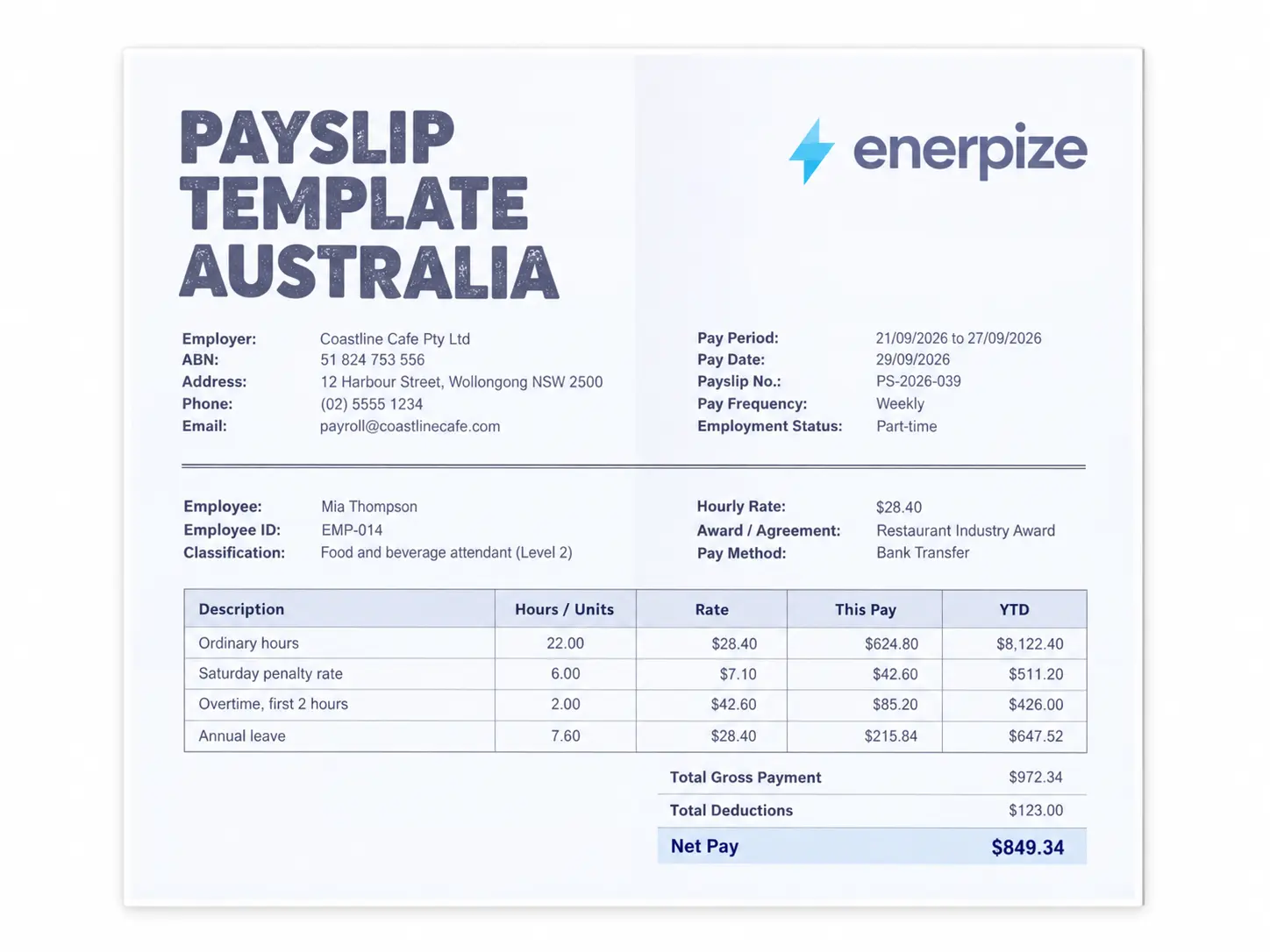
Australian dental invoicing runs on GST, and getting the invoice format right matters more than most practices realize.
GST and Tax Invoices
A GST registered practice must issue a tax invoice for supplies over a certain threshold, and the Australian Taxation Office has specific requirements for what that invoice must show, including the practice's ABN and a clear GST amount. Many dental procedures are actually GST free under specific health exemptions, so getting this classification wrong on an invoice can create real reporting headaches at BAS time.
Record Retention
The ATO requires most business records, including invoices, to be kept for five years from the date you lodge the relevant return.
What to Add for Australian Practices
Your practice's ABN, a clearly stated GST amount or GST free notation per line item, and the date of supply, which anchors when the five year retention clock actually starts.
Dental Invoice Template for Practices in South Africa
South African dental practices operate under a VAT system where the tax invoice, not a generic invoice, is what matters most for compliance.
Tax Invoice Requirements
SARS operates a tiered tax invoice system under the VAT Act. A full tax invoice is required for transactions over R5,000, while transactions between R50 and R5,000 may use an abridged tax invoice that leaves out the recipient's details. A dental invoice functioning as a tax invoice needs to meet that same threshold based standard.
Record Retention
Business records, including invoices, are generally expected to be retained for five years under South African tax law.
What to Add for South African Practices
Your practice's VAT registration number, a clear breakdown of VAT charged per line item, and the patient's full details if the invoice value crosses the full tax invoice threshold.
Key Takeaways
- A dental invoice needs to show the insurance math, billed amount, adjustment, insurance paid, and patient portion, not just a single total. Most free templates skip this entirely.
- CDT codes are not optional labels. They're the actual billing language insurers process, and using an outdated code is one of the most common reasons a claim gets rejected.
- A dental invoice, a patient statement, a superbill, and an EOB are four different documents. Confusing them delays payment and confuses patients.
- Multi phase treatment plans need a treatment plan reference number connecting every invoice, or nobody, patient or practice, can see the full picture.
- Enerpize applies insurance co-payment rules automatically and ties every invoice back to the same patient record, so the math doesn't have to be rebuilt by hand for every visit.
- Record retention rules vary by country. Six years in the UK. Five years in Australia and South Africa. The US ties retention to HIPAA and general tax record standards rather than one fixed number.
Frequently Asked Questions
What should a dental invoice include?
It should include the invoice number, practice and patient details, CDT procedure codes with tooth numbers where relevant, the billed amount per procedure, the insurance adjustment, insurance paid, and the final patient portion due.
What's the difference between a dental invoice and a patient statement?
A dental invoice covers one visit's charges in detail. A patient statement summarizes all activity on a patient's account, sometimes spanning several visits, and shows the running balance across all of them.
Do dental invoices need ADA CDT codes?
Yes, if the practice intends to submit the charge to an insurer. CDT is the only HIPAA recognized code set for dental procedures, and a claim without proper codes is far more likely to be delayed or denied.
How is insurance handled on a dental invoice?
The invoice should show the full billed amount, subtract the insurance adjustment the insurer negotiates off that amount, subtract what insurance actually pays, and land on the patient's portion due. Skipping any one of those steps leaves the patient looking at a number they can't explain.
What is a superbill and how does it differ from an invoice?
A superbill is a detailed receipt, usually given to a patient at an out of network practice, that they use to submit their own reimbursement claim to their insurer. An invoice is issued by the practice and typically expects direct payment, either from the patient or the insurer.
How long should dental practices keep invoice records?
It depends on the country. Six years in the UK under HMRC VAT rules. Five years in Australia under ATO rules. Five years in South Africa under general tax record requirements. In the US, retention ties to HIPAA documentation standards and general federal and state tax record rules rather than one single fixed number.
Can a dental invoice be used for insurance reimbursement?
Yes, provided it includes accurate CDT codes, the treating dentist's information, and the date of service. Some insurers may still request a superbill format specifically, so it's worth checking what the patient's insurer requires before assuming a standard invoice will work.
Should prices be shown before or after insurance adjustment?
Both. Show the full billed amount first, then the adjustment, then the patient portion. Showing only the adjusted number without the original billed amount hides the math a patient needs to trust the final figure.
About the Author
Omar El Bahr is a Senior Digital Growth Specialist at Enerpize, where he leads SEO, content strategy, and organic growth across international markets. He is a Forbes Communications Council contributor and has written for Entrepreneur on business communication and digital strategy.
Disclaimer: This article is for general informational purposes and doesn't constitute tax, legal, or accounting advice. Rules and thresholds vary by jurisdiction and change over time, so confirm current requirements with a licensed accountant or tax authority before relying on this content for compliance decisions.